



What is SecDevOps?
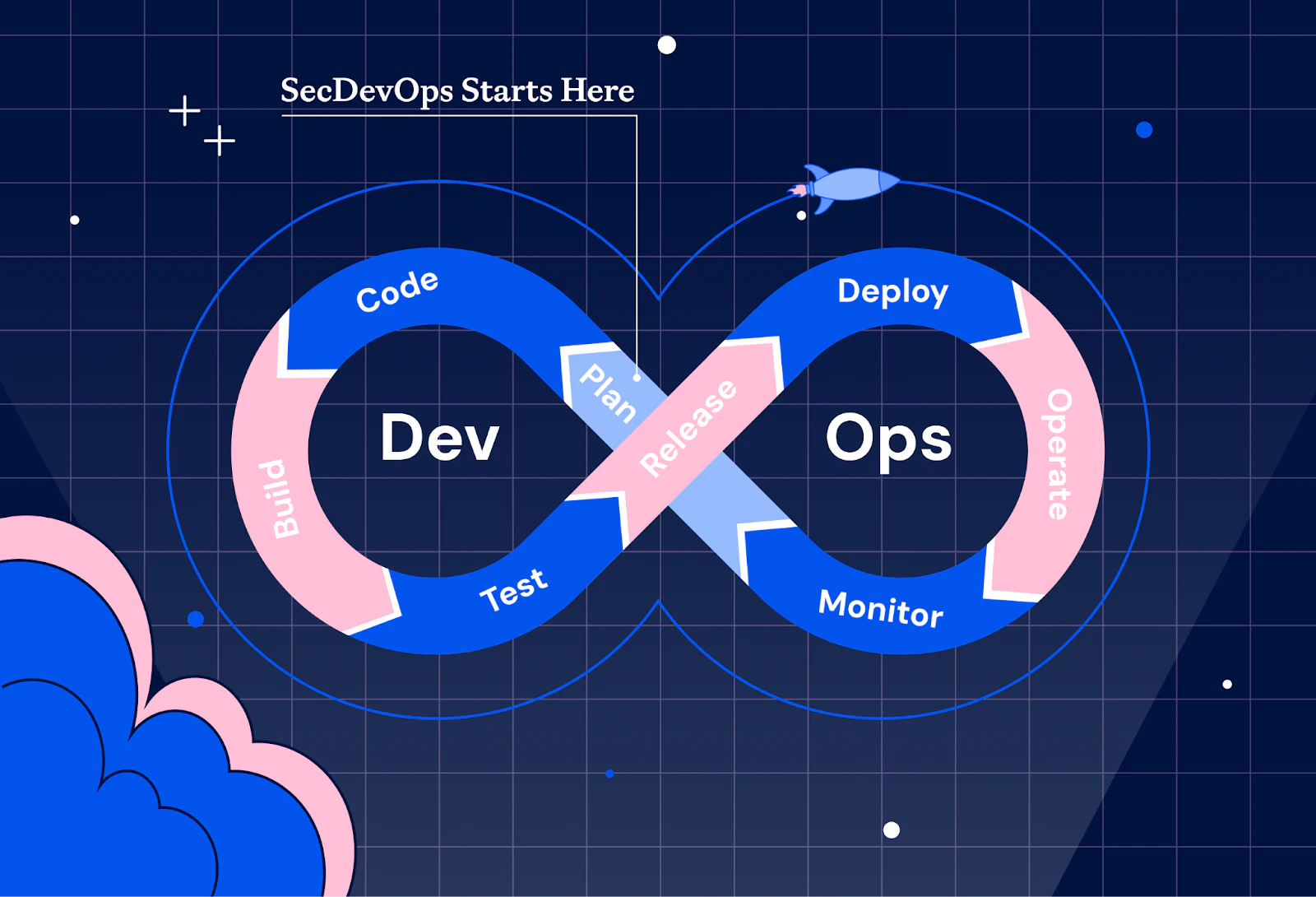
SecDevOps is a software development methodology that integrates security into every stage of the software development lifecycle (SDLC), ensuring vulnerabilities are identified and addressed as early as possible.
SecDevOps is an evolution of the DevOps approach, building on collaboration between development and operations by embedding security into every phase of the SDLC through a shift-left security approach. Rather than treating security as a final checkpoint before release, security becomes a continuous part of development, testing, deployment, and operations.
While security has always been a part of DevOps, the emergence of terms like SecDevOps and DevSecOps reflects the growing importance of making security a continuous responsibility throughout the software delivery lifecycle rather than an afterthought.
Detect active cloud threats
Learn how Wiz Defend detects active threats using runtime signals and cloud context—so you can respond faster and with precision.

Why the word order matters
The naming evolution from DevOps to DevSecOps to SecDevOps is not just semantics. It reflects a shift in how organizations think about security throughout the software development lifecycle.
In DevOps, security was an afterthought. DevSecOps brought security into the development process as a shared responsibility, while SecDevOps goes a step further by placing security at the start of every engineering decision.
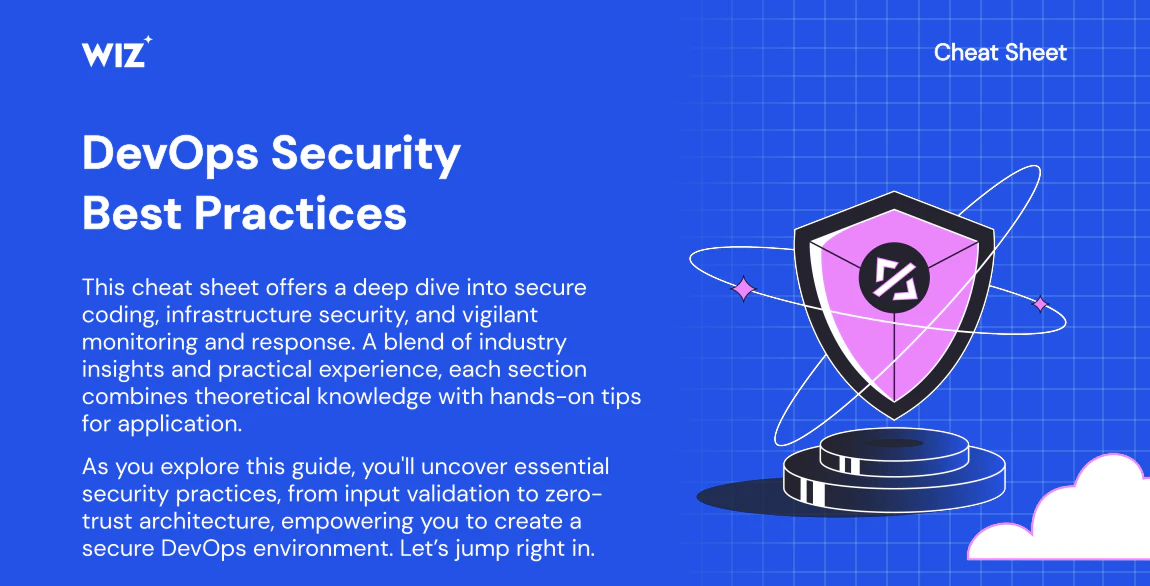
DevOps Security Best Practices [Cheat Sheet]
In this 12 page cheat sheet we'll cover best practices in the following areas of DevOps: secure coding practices, infrastructure security, monitoring and response.
Download Cheat Sheet
SecDevOps flips that order intentionally. Placing "Sec" first signals that security is a prerequisite, not an add-on. Development and operations then execute within those security guardrails, making security a foundational engineering requirement rather than something addressed later in the delivery process.
SecDevOps vs. DevSecOps
Both approaches integrate security into software delivery, but they differ in how security is positioned within the development process. While the two share many practices, SecDevOps places greater emphasis on security leading engineering decisions from the outset.
| Dimension | SecDevOps | DevSecOps |
|---|---|---|
| Security positioning | Security leads and shapes development | Security is integrated throughout DevOps workflows |
| Team structure | Security is embedded from planning through operations | Security is shared across development, security, and operations teams |
| When security applies | Built into requirements before coding begins | Integrated throughout the software development lifecycle |
| Cultural emphasis | Security-first with developer enablement | Developer-first with shared security responsibility |
| Tooling philosophy | Security guardrails, policy-as-code, and continuous validation | Automated security integrated into CI/CD pipelines |
| Risk approach | Prevent by design and validate continuously | Detect, prioritize, and remediate throughout development |
In practice, most mature organizations blend both philosophies. The key difference is whether security reacts to development plans or helps shape them from the start.
Why SecDevOps matters
Organizations adopting SecDevOps can improve security posture, compliance readiness, and delivery speed by embedding security throughout the software development lifecycle rather than treating it as a final checkpoint.
Catch vulnerabilities earlier and cheaper
SecDevOps embeds automated scanning and peer review at every stage, so security issues are identified during design, coding, and testing rather than after deployment. Finding vulnerabilities earlier reduces the effort, disruption, and cost of remediation because issues can be addressed before they require emergency fixes or changes to production systems.
Early detection also reduces risk exposure. IBM's Cost of a Data Breach report found that the global average cost of a data breach reached USD $4.4 million, highlighting the importance of preventing vulnerabilities from reaching production in the first place.
When vulnerabilities are identified before they can be exploited, organizations reduce the likelihood of costly security incidents and avoid the scramble of emergency patches and incident response escalations.
Continuous compliance without the scramble
Regulated industries often treat audits as fire drills. SecDevOps replaces that pattern with policy-as-code and automated governance checks that run on every deployment. Your compliance posture stays current because the pipeline enforces it.
This approach also creates an auditable trail automatically. Instead of scrambling to gather evidence before an audit, teams can point to pipeline logs that prove every release met the required controls.
Faster releases with fewer security blockers
When security reviews happen at the end of a sprint, they become bottlenecks. SecDevOps eliminates that friction by running security checks in parallel with development. Teams ship faster because security is already validated by the time the code reaches the release gate. Google's 2024 DORA Accelerate State of DevOps Report found that elite software delivery teams achieve 127× faster lead times, 182× more deployments per year, and 8× lower change failure rates than low-performing teams.
This also builds trust between security and engineering. Developers stop seeing security as the "team of no" and start seeing them as partners who help code reach production safely and quickly.
Achieving these outcomes depends on implementing SecDevOps effectively. The implementation practices below show how to put these principles into operation.
How to implement SecDevOps in your pipeline
Moving to a SecDevOps model does not require ripping out your existing pipeline. Start by embedding security into the areas that present the greatest risk, then expand your practices as your teams and processes mature.
Define security policies as code
Translate your organization's security requirements into machine-readable policies that run automatically. Security as code tools let you define rules for container configurations, network access, secret management, and infrastructure provisioning. When a deployment violates a policy, the pipeline blocks it before it reaches production.
Store these policies in version-controlled repositories alongside your application code so changes can be reviewed, tracked, and managed consistently.
Start with your highest-risk controls and expand from there. You do not need to codify every policy on day one.
Automate scanning in CI/CD
Integrate SAST, SCA, container image scanning, and infrastructure-as-code (IaC) scanning directly into your CI/CD pipeline. These tools analyze source code, third-party dependencies, container images, and infrastructure templates for known vulnerabilities and misconfigurations before they reach production.
Tools like OWASP ZAP can run automated security tests against staging environments as part of your deployment workflow.
Solutions such as Wiz Code extend these capabilities by identifying vulnerabilities in application code, open-source dependencies, containers, and infrastructure throughout the software development lifecycle. The goal is to make security scanning as routine as running unit tests.
Embed threat modeling early
Run lightweight threat-modeling sessions during design, not after implementation. When architects and security engineers review proposed features together, they identify attack surfaces before any code is written.
Keep these sessions lightweight by using a simple framework such as STRIDE-lite to identify likely attack paths before development begins.
Monitor, measure, and iterate
Security does not end at deployment. Use monitoring tools like Prometheus and Grafana to track runtime behavior, and feed those signals back into your security policies. Solutions such as Wiz Defend extend this visibility into cloud workloads by detecting runtime threats and suspicious activity in real time.
Track metrics such as mean time to detect (MTTD), mean time to remediate (MTTR), scan pass rates, and the percentage of vulnerabilities identified before production. These metrics help you measure whether your SecDevOps practices are improving security and delivery over time.
SecDevOps best practices
Successful SecDevOps is built on consistent habits rather than one-off security initiatives. These best practices help organizations strengthen security while maintaining the speed and collaboration that make DevOps effective.

Automate wherever possible: Integrate security testing, policy enforcement, and compliance checks into your CI/CD pipeline so vulnerabilities are identified consistently without slowing development.
Shift security left: Incorporate SAST, SCA, container image scanning, infrastructure-as-code (IaC) scanning, secrets detection, and lightweight threat modeling early in the software development lifecycle.
Treat security as code: Store security policies in version-controlled repositories and enforce them automatically through policy-as-code to ensure consistent, repeatable security controls.
Develop security champions: Equip developers with security training and embed security champions within engineering teams to build shared ownership across the software development lifecycle.
Continuously monitor and improve: Measure key metrics such as MTTD and MTTR, monitor runtime environments, review dependencies regularly, and use feedback loops to refine your security practices over time.

Common SecDevOps challenges
Implementing SecDevOps requires more than new tools. Organizations must also overcome cultural, operational, and skills-related challenges to embed security successfully into everyday development workflows.
Cultural resistance to security ownership
Developers who have never owned security outcomes may push back when asked to write secure code by default. The goal isn't to turn every developer into a security specialist, but to make secure development part of everyday engineering.
Leadership buy-in, security champions embedded in each team, and a shared understanding that security is everyone's responsibility help make that transition easier.
Integrating tools without slowing the pipeline
Adding scanners, policy engines, and compliance checks to a pipeline can increase build times if done carelessly. Run non-critical scans asynchronously where possible and configure fail-open behavior for lower-severity findings, while continuing to block deployments for critical risks. A slow pipeline that developers bypass is worse than no scanning at all.
Managing alert noise and false positives
Security tools generate alerts. Many of them are noise. Without tuning, teams experience alert fatigue and start ignoring findings entirely. Invest time in configuring severity thresholds, tuning policies, suppressing known false positives, prioritizing alerts by severity, and routing actionable findings to the right owners.
Staffing a security-first team
Many organizations don’t have enough security engineers to embed one in every development team. The World Economic Forum's Global Cybersecurity Outlook 2025 found that the cybersecurity skills gap widened by 8% year over year. Nearly two-thirds of organizations report moderate or critical shortages of cybersecurity talent, while just 14% are confident they have the skills needed to meet current security demands.
A practical starting point is training existing developers as security champions and pairing them with a central security team that provides tooling, guidance, and escalation support. Cross-training developers, investing in security education, and embedding security champions within engineering teams help organizations build security expertise without relying solely on specialist hires.
Secure your pipeline from code to cloud with Wiz
Wiz gives SecDevOps teams a single platform to secure every layer of the pipeline. Wiz Code helps teams shift security left by scanning repositories and CI/CD pipelines for vulnerabilities, misconfigurations, and exposed secrets before code reaches production, while Wiz Defend provides continuous runtime protection to detect threats that bypass pre-deployment checks.
For teams building and deploying AI workloads, Wiz AI-APP provides visibility into AI models, training data, and inference pipelines so you can apply the same security-first principles to your AI stack. Together, Wiz Code, Wiz Defend, and Wiz AI-APP connect code security, cloud security, and AI security into a unified SecDevOps workflow.
See how Wiz helps engineering teams embed security into every stage of the software development lifecycle. Get a demo
Secure your SDLC from start to finish
See why Wiz is one of the few cloud security platforms that security and devops teams both love to use.
