The Shift from "Periodic" to "Continuous"
In the first part of our FedRAMP series, we explored Wiz’s accelerated journey to FedRAMP High. However, seasoned CSPs (Cloud Service Providers) know that obtaining the FedRAMP authorization is only the beginning. The real challenge lies in maintaining that security posture through ongoing FedRAMP Continuous Monitoring (ConMon).
Traditionally, compliance monitoring has been synonymous with "point-in-time" scanning. Organizations would run a scan, generate a report, and spend weeks manually reconciling security posture against requirements. In a FedRAMP environment, this reactive, manual approach is not sustainable amidst an evolving threat landscape.
FedRAMP Rev 5 processes necessitate a robust ConMon program built around monthly reporting, and ongoing FedRAMP reforms are pushing ConMon towards data-driven automated validation of risk, a move that directly supports the goals of Executive Order 14028 on Improving the Nation’s Cybersecurity. To meet these stringent requirements and the Executive Order’s mandates for increased visibility into cybersecurity data without paralyzing software development, organizations must move away from disparate tools and spreadsheets. Effective ConMon today demands a proactive risk management strategy built on automated visibility and deep architectural context, allowing teams to identify and remediate vulnerabilities before they can be exploited.
Visibility: You Can’t Protect What You Can’t See
The foundation of proactive risk management is a complete, automated inventory with context on how different resources connect. FedRAMP stresses the importance of having accurate inventory assessments through Rev 5’s CM-8 (Information System Component Inventory) control, requiring organizations to maintain an accurate account of all system components. The same is true if your organization is pursuing the newer FedRAMP 20x assessment, with Key Security Indicator (KSI) PI-00 requiring an up-to-date asset inventory or code defining all deployed assets.

In a dynamic cloud environment, manual spreadsheets are obsolete from almost the moment they are generated. Wiz for U.S. Government (Wiz for Gov) provides an agentless, accurate view of cloud environments within minutes. This isn't just a list of virtual machines; it’s a deep map of:
Identities (Who has access?)
Workloads (What is running?)
Data (Where is the sensitive information?)
Network (How is it exposed?)
Prioritization: Beyond the CVE
The "noise" of traditional vulnerability management is the antagonist of agility. A standard vulnerability scan might return 10,000 "High" or "Critical" Common Vulnerabilities and Exposures (CVEs) based upon the Common Vulnerability Scoring System (CVSS). For a FedRAMP environment, the Plan of Action and Milestones (POA&M) process requires you to track and remediate these within strict timelines (30 days for CVEs with a High CVSS score). Without upfront risk adjustment, this requirement can quickly become burdensome.
Helpfully, NIST SP 800-53r5, the primary basis for the FedRAMP baseline controls in Rev 5 assessments, does not view vulnerability severity as synonymous with risk. Instead, risk is defined as “[a] measure of the extent to which an entity is threatened by a potential circumstance or event, and typically is a function of: (i) the adverse impact, or magnitude of harm, that would arise if the circumstance or event occurs; and (ii) the likelihood of occurrence.”
This definition underscores that, without the context of impact and potential of occurrence, it is not possible to understand the impact on risk reduction by focusing solely on the CVSS score of a CVE. If you treat every CVE as equal, your engineering team will spend the majority of their time on maintenance at the expense of innovation.
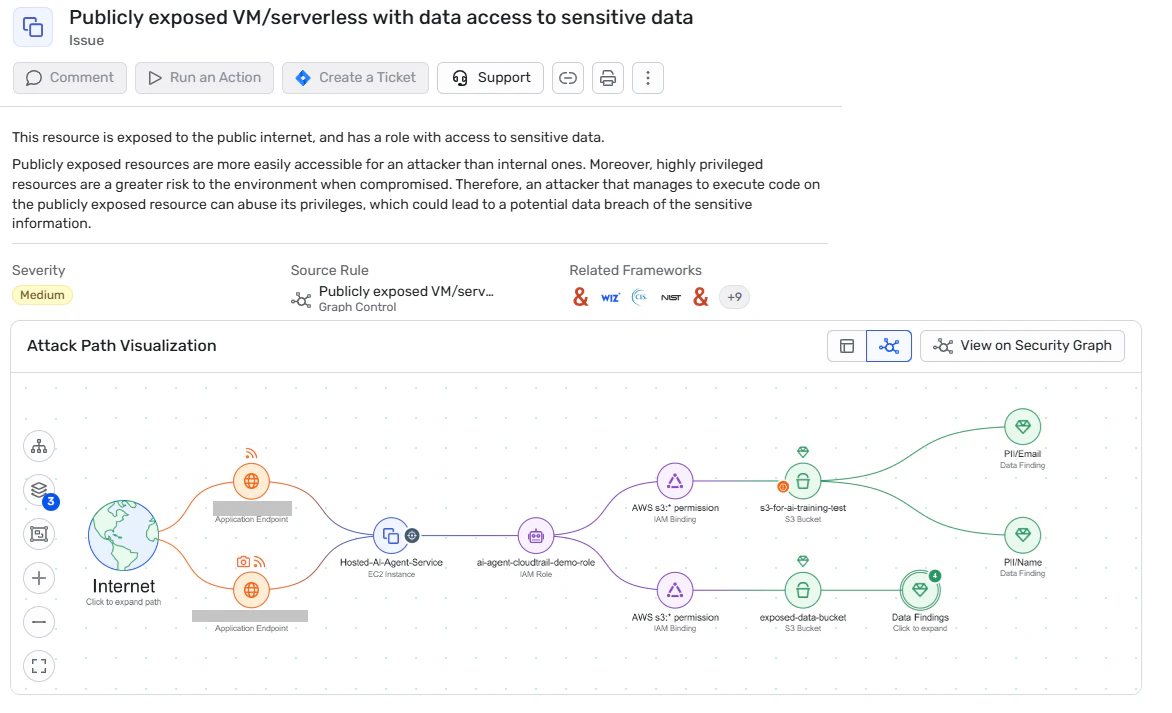
New initiatives around FedRAMP, including the 20x program, double down on this broader view of risk through POA&M risk adjustment, explicitly moving away from simple vulnerability reporting to a more prioritized approach to risk remediation and mitigation. Wiz for Gov provides accelerated access to details necessary for these risk adjustments through the Wiz Security Graph, effectively automating the evidentiary burden for Information System Security Officers who must justify POA&M remediation timelines to their Authorizing Officials. Instead of a flat list, Wiz identifies "Toxic Combinations." For example:
Low Risk: A High-severity CVE on an internal, isolated server. (Low Likelihood, Low impact)
Critical Risk: The same High-severity CVE on a server that is publicly exposed and has a high-privileged identity attached to it. (High Likelihood, High impact)
By prioritizing remediation based on the NIST 800-53r5 definition of risk, organizations can implement FedRAMP Rev5's RA-5 (Vulnerability Monitoring) and RA-07 (Risk Response) controls, managing vulnerabilities in accordance with their risk tolerance and focusing on the top issues that actually represent a path for an attacker.

The newer FedRAMP 20x framework expands upon this methodology for prioritizing risk remediation based upon impact through KSIs such as SC-06 and MLA-05 which call for risk-informed, prioritized approaches for security patching and vulnerability remediation.
Automating the ConMon Cycle
Continuous monitoring isn't just about finding risks; it’s about the "Agile Foundation" previously discussed in Lesson Three of Part 1. Wiz for Gov helps automate the evidence collection needed for monthly ConMon reports. This table highlights several of these FedRAMP controls.
| FedRAMP Rev 5 Requirement | Wiz for Gov Capability |
|---|---|
| Configuration Settings (CM-6) | Continuous assessment against CIS benchmarks and FedRAMP-specific configuration baselines |
| Information System Component Inventory (CM-8) | Automated, real-time discovery of all cloud resources and technologies |
| Vulnerability Scanning (RA-5) | Agentless scanning of operating systems, applications, and libraries without performance impact |
| Risk Response(RA-7) | Respond to findings from security and privacy assessments, monitoring, and audits in accordance with organizational risk tolerance |
| Protection of Information at Rest (SC-28) | Discovery and protection of sensitive data to protect against unauthorized disclosure |
Turning "Audit Time" into "Uptime"
By using Wiz for Gov to handle the heavy lifting of proactive risk management, Wiz has been able to significantly reduce the administrative burden of our own FedRAMP High ConMon. This automation allows our security team to act as partners to our developers, providing them with clear, prioritized instructions rather than "walls of red" in a spreadsheet.
In the next part of this series, we will look at Preventative Risk Management, and how we "shift left" to build securely by design within the software development lifecycle to stop these risks from reaching production in the first place.