


Container Security: A refresher
Container security is the comprehensive protection of applications, images, and infrastructure throughout the containerized development lifecycle. Unlike traditional security approaches, container security must address dynamic, ephemeral workloads that can spin up and disappear within seconds.
This creates unique challenges. Traditional security tools designed for static infrastructure often miss vulnerabilities in containers that exist only briefly. The shared kernel architecture means a single compromised container can potentially impact an entire host system.
Container Security Cheat Sheet
Get actionable best practices with code examples, diagrams, and top open-source tools for every stage of the container lifecycle.

Why container security is crucial across the software development lifecycle
Container vulnerabilities multiply across three critical stages where traditional security fails to provide adequate protection.
Development risks emerge from insecure base images and misconfigurations baked into containers before they ever reach production. Deployment vulnerabilities surface through orchestration misconfigurations and inadequate network controls that expose applications. Runtime threats become invisible due to the ephemeral nature of containers, making detection and response nearly impossible with conventional monitoring.
Each stage compounds risk. A vulnerability introduced in development can remain hidden through deployment and become exploitable at runtime, creating attack paths that span your entire infrastructure.
The more widely companies use containers, the more likely they are to call security their top challenge with containers.
What is the shared responsibility model in container security?
Shared responsibility in container security divides protection duties between cloud providers and users, with clear boundaries that determine who secures what.
Cloud providers secure the infrastructure layer—physical hardware, hypervisors, and managed Kubernetes control planes like EKS or GKE. For example, in GKE, control plane instances are single tenant, meaning each runs components for only one customer. This helps ensure the underlying platform remains available and protected from infrastructure-level attacks.
Users secure everything above that layer—container images, application code, secrets management, network policies, and access controls. This includes scanning images for vulnerabilities, configuring proper RBAC, and monitoring runtime behavior.
The critical gap occurs when users assume cloud providers handle more than they actually do. A misconfigured container with excessive permissions remains your responsibility, even when running on a managed Kubernetes service.
Key components of container architecture to secure
Container architecture security requires protecting interconnected components where failure in one area compromises the entire system. There are four key components to focus on:
Container images serve as the foundation—a single vulnerable base image can affect hundreds of running containers. Scan all images for vulnerabilities and use only trusted and minimal ones.
Container registries act as distribution points where compromised images can spread malicious code across your entire infrastructure.
Container orchestrators like Kubernetes manage deployment and networking, making misconfigurations here particularly dangerous since they can expose entire clusters.
The container runtime engine provides the final execution layer. If compromised, it can break container isolation with container escape vulnerabilities and provide attackers with host-level access, potentially affecting every workload on that system.
The potential impacts of compromise for these components can be summarized as follows:
| Components | Potential Impact If Compromised |
|---|---|
| Container images | Malicious code executionCompromise of the container's applicationLateral movement within the containerized environment |
| Registries | Distribution of malicious container imagesCompromise of any containers using the corrupted images |
| Orchestrators | Breach of all containerized applicationsUnauthorized access to dataDisruption of containerized services |
| Container engine | Full system compromiseLoss of dataUnauthorized access to all containers |
What are the common challenges in securing containers?
Container security challenges stem from fundamental characteristics that make traditional security approaches ineffective.
Dynamic infrastructure means containers appear and disappear faster than security tools can track them. Unlike virtual machines that run for weeks or months, containers may exist for only minutes, making continuous monitoring and patch management nearly impossible with conventional approaches.
Layered image complexity creates vulnerability multiplication. Each container image consists of multiple layers from different sources, meaning a single container might inherit vulnerabilities from its base OS, middleware, libraries, and application code simultaneously.
Ephemeral workloads eliminate the traditional security model of "harden once, protect forever." Since containers are constantly replaced rather than updated, security must be built into images and orchestration policies, rather than applied to running systems.
Supply chain attacks exploit the chain of images and components pulled from various sources. If any link in this chain is compromised, such as a malicious image in a public registry, it can propagate across your entire infrastructure.
Addressing these challenges requires combining container-specific security tools, best practices, and a thorough understanding of the container lifecycle and architecture. Organizations also have to remain current on the latest container threats and vulnerabilities.
Ground-level practices to fortify your container security
In the dynamic landscape of container security, it’s crucial to implement comprehensive security measures that address threats. These practices should be incorporated into every stage of the software development lifecycle to ensure a robust defense against potential breaches:
1. Ensure secure container images
Always verify the origin of your container images, especially when pulling from public repositories like Docker Hub. Regularly perform container image scanning to identify vulnerabilities before deployment. Use minimal, well-maintained base images from trusted sources to reduce the attack surface and improve your overall security posture. This reduces the risk of introducing vulnerabilities into your production environment.
2. Reduce the attack surface
Minimizing potential attack vectors is a fundamental security practice. This can be achieved by eliminating unnecessary software, services, and open network ports: the fewer components and services you have, the fewer opportunities for hackers.
3. Leverage container security tools
Various tools are available to help secure container environments. These include vulnerability scanners to identify potential weaknesses, configuration checkers to ensure best practices are followed, and runtime security monitoring tools to detect and respond to threats in real time.
To be effective, a container security solution must be able to discover and scan containers, hosts, and clusters across cloud-managed and self-managed Kubernetes environments, including serverless containers such as Fargate ECS as well as standalone containers running on VMs.
4. Prepare an incident response plan
Despite best efforts, security incidents can still occur, including those involving container technologies like Docker and Kubernetes. A well-defined response plan can help minimize damage and downtime.
This plan should specifically outline how to identify and recover from a security incident involving containers. It should cover potential scenarios such as container breakouts, image vulnerabilities, and misconfigurations. Like any good plan, it should also be regularly updated and tested to ensure its effectiveness and to keep up with evolving threats.
5. Implement regular audits
Regular audits of container activities, configurations, and components are crucial in maintaining a secure container environment. These audits can help detect any irregularities or deviations from standard operations, which could indicate a potential security issue. This includes auditing container images for vulnerabilities, checking container runtime configurations, and monitoring inter-container communications.
Audit logs from your container orchestration and runtime platforms should be monitored and analyzed regularly to identify trends and detect anomalies. This aids in maintaining the integrity of your containerized applications and infrastructure.
Kubernetes audit logs and reports mapped to the Center for Internet Security (CIS) Foundation Benchmarks for Kubernetes can help you assess the security of your Kubernetes environments and ensure compliance.
Watch 12-min demo
See how Wiz discovers, prioritizes, and remediates risks across your containerized cloud environment.

6. Enforce strict access controls
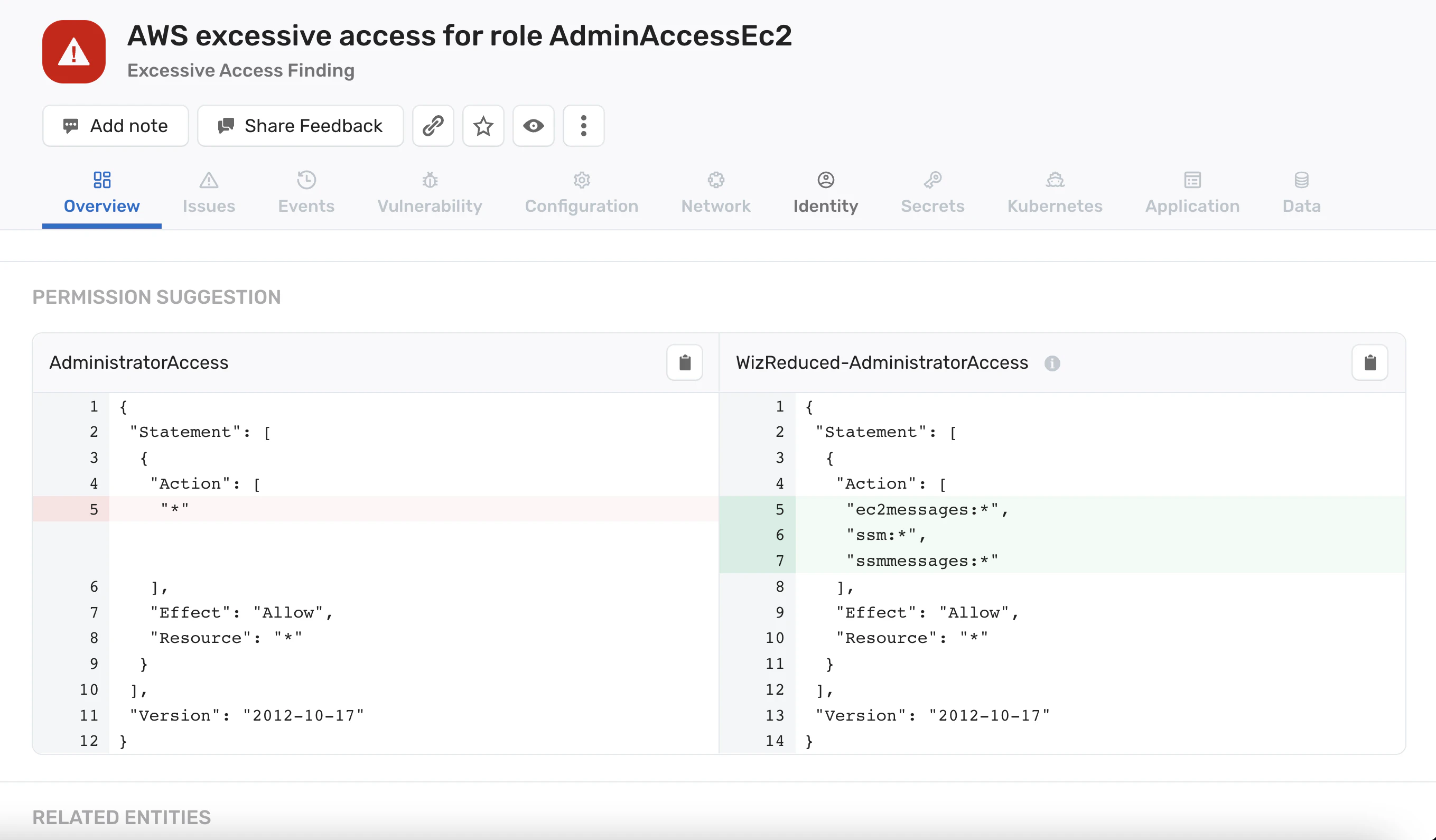
Container registries, like Docker Hub or private ones, act as central repositories for your container images. Enforcing strict access controls on these registries is vital to prevent unauthorized access and potential image tampering. This involves:
Role-based access control (RBAC): Implement RBAC to assign granular permissions to users and groups. Restrict actions like pushing or pulling images based on specific needs.
Least privilege: The principle of least privilege (PoLP) dictates that a process should have only the permissions it needs to function and nothing more. In a container environment, this includes limiting container permissions, using read-only file systems where possible, and controlling access to system resources
Multi-factor authentication (MFA): Enable MFA for all registry access. This adds an extra layer of security by requiring a second verification factor beyond just a username and password.
7. Update and patch regularly
It's essential for companies to regularly carry out updates and apply patches. This includes not only the container runtime and orchestration tools but also the applications running within the containers and the host systems themselves. Only then can you ensure a continuously secure environment.
8. Protect container orchestration
Container orchestration systems like Kubernetes and Amazon Elastic Container Service (ECS) can be complex and have their own set of security considerations. Wiz's Kubernetes Security Report found that 78% of Kubernetes clusters are publicly accessible, underscoring the importance of securing these environments from the start.
Protecting Kubernetes entails securing API access, using network policies to control traffic, regularly checking your orchestration configurations, patching critical components such as Ingress NGINX vulnerabilities, and leveraging built-in security features like role-based access control (RBAC).
For Amazon ECS, some best practices include implementing AWS' shared responsibility model, zero-trust identity and access management (IAM), and end-to-end encryption. More details on securing ECS can be found in the AWS documentation.
Open-source container security tools by use case
There are various tools that are useful to implement these best practices. The leading open-source tools can be found in the table below:
| Use Case | Open Source Tools |
|---|---|
| Ensuring secure container images | Clair, Docker Bench |
| Reducing the attack surface | CIS Docker Benchmark, Kubernetes Pod Security Policies |
| Leveraging container security tools | Falco, OpenSCAP |
| Preparing an incident response plan | TheHive, FIR (Fast Incident Response) |
| Implementing regular audits | Auditd, GRR |
| Enforcing strict access controls | Kubernetes RBAC, Docker user namespaces |
| Updating and patching regularly | Watchtower, Anchore Engine |
| Protecting container orchestration | Kubernetes Network Policies, RBAC |
By implementing these ground-level practices, you can establish a strong foundation for your container security. However, as threats evolve, you will need to revise your security measures and look for more exhaustive solutions.
Go beyond the basics of container security with Wiz
While basic security practices form the foundation of a secure container environment, they often fall short in addressing the complex and evolving landscape of threats. Generic advice, while helpful, may not always be applicable or effective in every situation. This is where tailored, actionable insights can provide greater value, helping you navigate your specific environment's unique challenges.
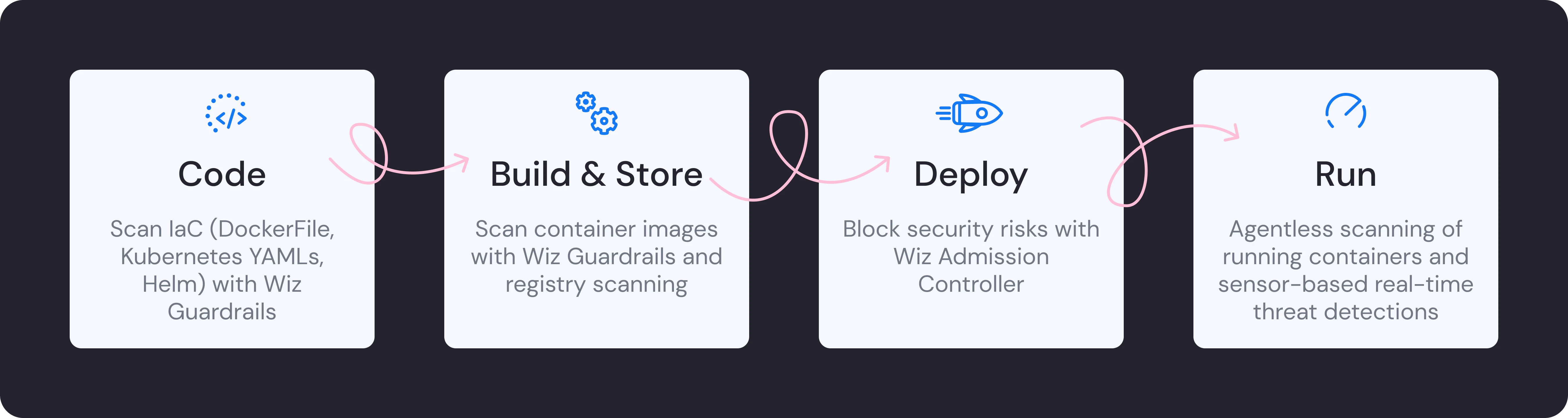
At Wiz, we understand the complexities of containers and Kubernetes security. Our platform is designed to provide the tools you need to secure your container images across the lifecycle, from development to deployment and runtime.
Wiz provides a comprehensive container security solution that helps implement best practices through various features and capabilities. It connects directly to Kubernetes clusters via API to scan for vulnerabilities, configuration issues, network, and identity exposure. Wiz analyzes containerized environments for risks and represents them on the Security Graph, which models relationships between resources and risks.
Key ways Wiz helps implement container security best practices include:
Scanning container images for vulnerabilities, malware, and exposed secrets, using both agentless workload scanning and direct scans of container registries.
Evaluating container configurations and the architecture of Kubernetes clusters to identify potential security issues.
Assessing the effective permissions of containers to prevent excessive privileges that could be exploited by malicious actors.
Providing a contextual cloud risk assessment that generates context-rich issues for prioritization and remediation.
Integrating with CI/CD pipelines to enforce security policies early in the development lifecycle ("shift left" approach).
Offering the Wiz Admission Controller to defend Kubernetes clusters from unsafe deployments based on unified security policies.
Delivering secured container images continuously maintained with WizOS, kept at near-zero CVEs to reduce inherited vulnerabilities and supply chain risk while giving developers a trusted starting point.
By leveraging these capabilities, organizations can proactively protect their containerized environments and ensure security best practices are consistently applied.
Securing your container environment is a journey, not a destination. As your partner in this journey, Wiz is committed to providing you with the insights, tools, and support you need to navigate the complex landscape of container security. Ready to see how these capabilities work in your environment? Get a demo to explore how Wiz secures containers across your entire cloud.
See Wiz in Action
Explore how Wiz unifies container image scanning, Kubernetes posture management, and runtime protection in a single platform.

Other security best practices you might be interested in: