


What is zero trust security?
Zero trust security is a security model that removes implicit trust from access decisions and treats identity as the anchor for policy decisions, working in concert with device, workload, data, and behavioral context. Instead of assuming anything within the network perimeter is safe, the model continuously validates user identity, device posture, permissions, and surrounding context before and during sessions to grant access to applications, data, or workloads. For CISOs, adopting zero trust limits the blast radius and reduces exposure as cloud environments, software as a service, and remote work erode traditional boundaries.
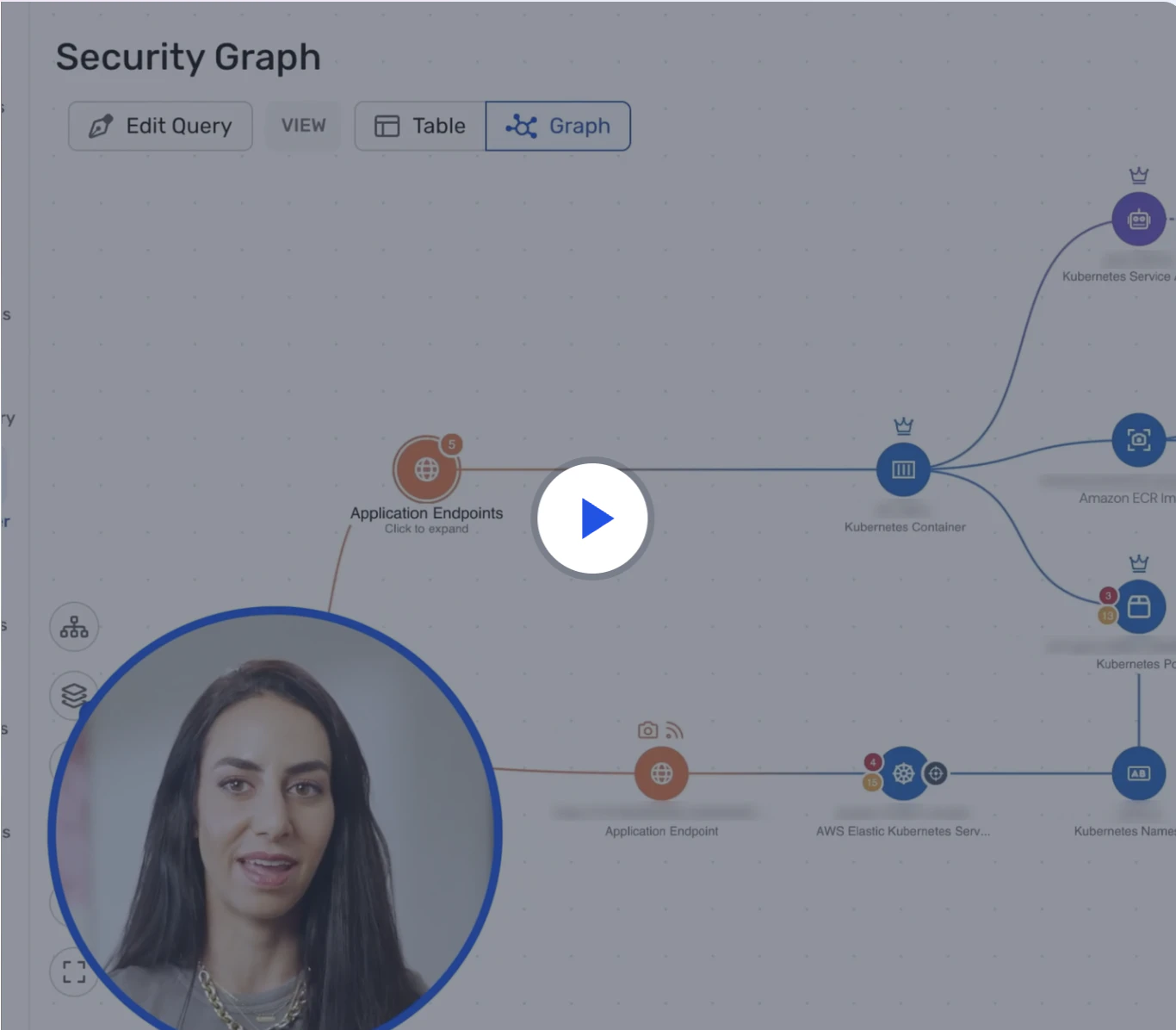
Watch 12-minute demo
Watch the demo to learn how Wiz Cloud finds toxic combinations across misconfigurations, identities, data exposure, and vulnerabilities—without agents.
Watch now
Why implement zero trust security?
In today’s risk environment, identity failures, cloud misconfigurations, and third-party access paths drive most security incidents. Zero trust security offers CISOs and CIOs a structured security framework to manage risks while accelerating cloud velocity, meeting regulatory requirements, and strengthening business resilience. Rather than rely on a traditional network perimeter, zero trust architecture and security measures enforce consistent access control and continuous verification across users, apps, and cloud environments.
Several pressures make implementation urgent:
Identity-driven attacks dominate modern breaches: Ransomware groups and supply chain attackers exploit stolen credentials, excessive permissions, and weak authentication—bypassing firewalls entirely. Zero trust security minimizes impact by enforcing least-privilege access and limiting lateral movement following compromise.
Cloud adoption expands the attack surface: Multi-cloud and software as a service environments blur responsibility across providers, platforms, and internal teams. Zero trust security offers a repeatable framework to manage user access, workloads, and APIs across cloud-based infrastructure while avoiding reliance on static network controls or broad VPN access.
Regulatory and board expectations continue to rise: Guidance from NIST and the Cybersecurity and Infrastructure Security Agency (CISA) frames zero trust as a risk management best practice. Today, boards expect more than tool-level metrics. They demand measurable improvements in security posture, audit readiness, and blast radius reduction.
Remote work and third-party access require tighter control: Persistent remote access, contractor use cases, and machine-to-machine traffic expose weaknesses in traditional perimeter models. Zero trust network access replaces broad VPN connectivity with application-level access policies to improve security and the user experience.
Industry research indicates that while many organizations adopt elements of zero trust, few report mature implementations because of fragmented tooling and unclear ownership. Siloed ownership and implementation gaps underscore why zero trust security functions best as a long-term security strategy rather than a one-time deployment.
For security leaders, implementing zero trust establishes a common operating model that aligns identity, network security, and cloud security controls. Alignment empowers teams to prioritize risk, demonstrate progress to executive stakeholders, and sustain secure growth across evolving environments.
How do you implement zero trust security in practice?
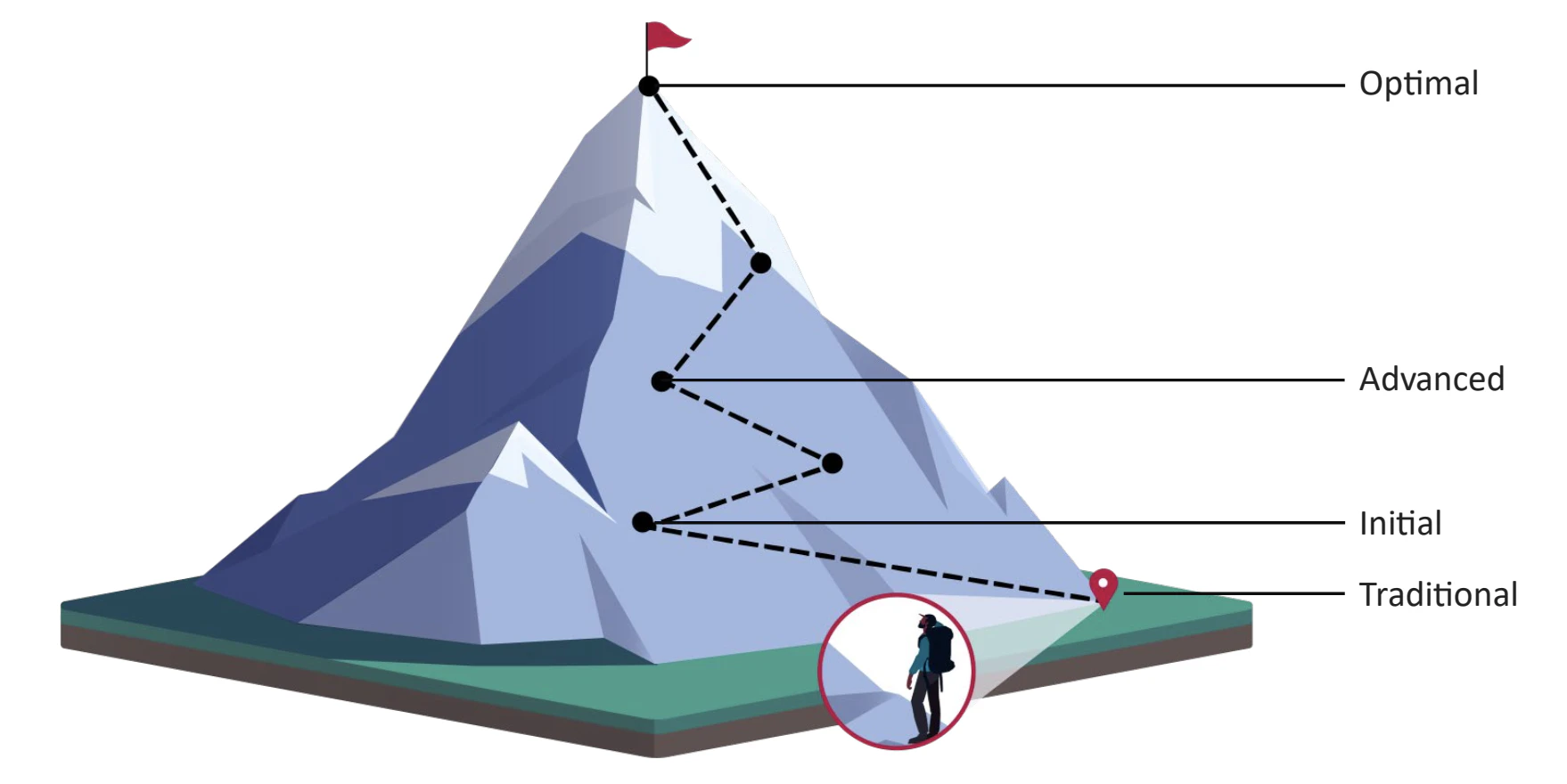
Zero trust security often unfolds as a multi-phase program. Most organizations make progress over multiple quarters (and often years) as they evolve access policies, tooling, and operating models. Effective programs avoid disruptive cutovers and build momentum by starting from an existing strength—like identity, network controls, or data protection—before expanding.
Successful zero trust efforts establish clear ownership across security, infrastructure, and application teams. Each phase benefits from defined success measures, executive visibility, and alignment with business priorities, including cloud adoption, regulatory readiness, and operational resilience.
The five steps below outline the pragmatic roadmap CISOs commonly follow to operationalize zero trust security:
1. Create a specialized zero trust security team
A dedicated zero trust security team anchors long-term progress and prevents fragmentation by aligning all stakeholders on the same information. The group unites leaders from security architecture, identity and access management (IAM), cloud security, and network security while integrating direct input from IT operations and application teams. Establishing central accountability ensures the team enforces access policies consistently across cloud environments and on-premises systems.
The zero trust security team sets the security strategy, sequences implementation phases, and governs security controls. Organizations frequently face challenges when ownership blurs or priorities conflict between groups. The team tracks early success through shared access standards, reduced tool overlap, and improved coordination between security and infrastructure owners.
2. Choose the right zero trust implementation on-ramp
Zero trust programs succeed faster when they build on existing capabilities. Many organizations start with identity because authentication and user identity already drive most access decisions. Other organizations prioritize network segmentation or data protection when architectural or regulatory factors demand it.
The chosen on-ramp shapes early tooling and policy focus, whether it centers on IAM, zero trust network access, or data-centric controls. Simultaneously pursuing multiple on-ramps frequently stalls programs. Teams measure progress when access policies shift from static rules to context-aware decisions and access paths become easier to audit and explain.
3. Strengthen user, device, and application security
As zero trust programs mature, controls evolve beyond identity to incorporate endpoints, applications, and workloads. Continuous authentication, device posture checks, and application-level access control reduce reliance on implicit trust and static credentials. Implementation typically introduces multi-factor authentication, endpoint detection and response, and tighter governance over software as a service and cloud-native apps.
Security teams frequently balance stronger controls with user experience concerns at this stage. Phased rollouts and clear communication effectively limit friction. Progress metrics include broader MFA coverage, reduced dependence on shared credentials, and improved visibility into user and device access patterns across sensitive applications and data.
4. Enhance network security and infrastructure
In a zero trust architecture, network security still matters—but identity, device posture, and contextual signals now define the primary trust boundaries. Microsegmentation, software-defined networking, and policy-driven controls curb lateral movement and limit the blast radius of compromised credentials or workloads. Teams apply these mechanisms across data centers, cloud environments, and hybrid infrastructure.
Legacy environments often stall segmentation efforts due to inherent complexity. Focusing on high-risk assets through incremental changes bypasses this friction and delivers faster results over a sweeping redesign. Success metrics include fewer unnecessary network paths, improved containment during simulated incidents, and tighter alignment between access policies and observed network traffic.
5. Continuously monitor and refine your zero trust strategy
Zero trust security relies on ongoing validation and adjustment. Access decisions evolve as users shift roles, applications migrate between environments, and threat intelligence surfaces new risks. Continuous monitoring aligns security policies with business workflows and emerging attack techniques.
This phase prioritizes telemetry, analytics, and automation while preserving human judgment for critical decisions. Mature programs prove value through faster detection of anomalous access patterns, improved incident response timelines, and consistent enforcement of access policies across multi-cloud environments.
These steps collectively empower organizations to transition from perimeter-based defenses to a resilient zero trust operating model that adapts as infrastructure and threats evolve.
Guide to Data Governance and Compliance
Straightforward, 7-step framework to help you strengthen your cloud governance approach with confidence.

What challenges come with implementing zero trust security?
Zero trust security requires more than new tools or updated access policies. Most organizations experience friction because zero trust mandates an operating model shift across people, processes, and technology. Implementation often stalls when teams underestimate the coordination required or attempt to automate controls before establishing reliable data and governance cloud security foundations.
Organizations frequently encounter the following challenges as they move from planning to execution:
Data quality and integration gaps
Zero trust security relies on accurate, real-time context regarding user identity, permissions, devices, applications, and network traffic. Many environments struggle with fragmented data across identity providers, cloud platforms, security tools, and legacy systems. Incomplete or inconsistent data undermines access decisions and creates blind spots that attackers exploit.
Security leaders can reduce this risk by prioritizing integration early to establish authoritative data sources for identity, assets, and access policies. Practical actions include normalizing identity data across cloud and on-premises systems and validating permissions against actual usage rather than assumed roles. Teams demonstrate progress by basing access decisions on current context instead of static inventories.
Over-automation and loss of human judgment
Automation plays a critical role in scaling zero trust security, but excessive automation without oversight introduces new risks. Rigid enforcement based on incomplete signals can disrupt business workflows or lock out legitimate users, particularly during incidents or role transitions.
Effective programs balance automation by integrating clear escalation paths and human review. Security teams often establish guardrails to permit automated access decisions under normal conditions while requiring manual validation for high-risk changes. Organizations achieve success when automation reduces routine workload without increasing false positives or operational disruptions.
Skill gaps and change fatigue in the SOC
Zero trust shifts how security teams investigate incidents, analyze access paths, and respond to threats. Analysts accustomed to perimeter-focused alerts may struggle to interpret identity-centric telemetry and application-level signals. Overlapping initiatives also trigger change fatigue across the security operations center.
Targeted training and phased adoption help teams adapt without overwhelming them. Many organizations align zero trust milestones with existing workflows, such as incident response and threat detection, rather than creating parallel processes. Success indicators include lower alert volume, clearer root cause analysis, and faster containment.
AI-specific risks and stakeholder trust
AI adoption introduces new challenges for zero trust security. AI services often access sensitive data, operate across multiple cloud environments, and rely on service identities that lack clear ownership. Ambiguous ownership and distributed operations complicate access control, monitoring, and accountability.
Security leaders neutralize these risks by extending zero trust principles to machine identities, application programming interfaces, and data pipelines. Clear policies governing model access, training data, and inference endpoints build stakeholder trust while shrinking exposure. Teams prove progress when they can explain and audit how AI systems access sensitive information across environments.
Recognizing and addressing these challenges early allows organizations to sustain momentum and avoid common pitfalls. Zero trust security succeeds when teams embrace it as an ongoing transformation—not a one-time implementation.
An actionable zero trust security checklist
Checklists simplify complex security transformations by providing a consistent structure. A reliable zero trust security checklist streamlines prioritization and tracks implementation progress over time. Most organizations advance by establishing foundational controls first, later layering advanced capabilities as maturity, staffing, and budget allow. Use and periodically revisit the following checklist to validate coverage, close gaps, and align controls with evolving risk:
Identity and access management
IAM establishes core trust decisions within a zero trust security model by pairing foundational controls with advanced measures. These policies define who can access resources and refine how and when that access occurs.
Foundational controls:
Enforce least-privilege access through role-based or attribute-based models to ensure users have only the permissions they need for their roles.
Mandate multi-factor authentication for all users and tighten enforcement for privileged and remote access.
Review and validate user access continuously as roles, projects, and employment status change.
Advanced capabilities:
Implement just-in-time access and privileged access management to reduce the number of standing permissions.
Use identity analytics to identify anomalous authentication patterns and risky permission combinations.
Device and endpoint security
Endpoint security aligns access decisions with device health and behavior. Foundational controls set minimum posture requirements, while advanced controls strengthen containment and early detection.
Foundational controls:
Validate device posture before granting access, checking operating system versions, patch levels, and security configurations.
Deploy endpoint detection and response to support continuous monitoring and investigation.
Encrypt device communications and data storage to reduce exposure from lost or compromised endpoints.
Advanced capabilities:
Apply endpoint isolation techniques to contain compromised systems and prevent lateral movement.
Use proactive threat hunting to identify suspicious endpoint behavior before alerts escalate.
Network security
Network security within a zero trust architecture focuses on controlling traffic flows rather than defending a single perimeter. Zero trust models prioritize foundational segmentation controls before applying advanced techniques that respond dynamically to risk.
Foundational controls:
Apply microsegmentation to restrict unnecessary connectivity between applications and services.
Replace broad VPN access with zero trust network access to enforce application-level access policies.
Limit network permissions to the absolute minimum for every user and workload.
Advanced capabilities:
Use software-defined networking to dynamically adjust segmentation based on identity and context.
Monitor network traffic continuously to identify unusual east-west movement and data exfiltration patterns.
Application and data security
Application and data security protect the assets attackers target. Foundational controls reduce exposure, while advanced controls strengthen runtime and interface-level defenses.
Foundational controls:
Enforce identity-aware access to applications through single sign-on and adaptive authentication.
Encrypt sensitive data at rest and in transit to limit exposure during a compromise.
Audit data access regularly to ensure alignment with business goals and compliance requirements.
Advanced capabilities:
Apply runtime application protection and application programming interface security to minimize exploitability.
Assess advanced encryption methods for sensitive processing within untrusted environments.
Threat detection and response
Threat detection and response connect zero trust controls to real-world security outcomes. Advanced capabilities, including behavioral analysis and threat intelligence, reinforce foundational monitoring and automation.
Foundational controls:
Monitor access activity and behavior in real time to identify deviations from expected patterns.
Automate security policy enforcement whenever confidence and context support the action.
Conduct regular security assessments and red team exercises to periodically validate controls.
Advanced capabilities:
Leverage user and entity behavior analytics to surface subtle threats that bypass traditional alerts.
Integrate threat intelligence to support proactive detection and quicker response.
Governance and compliance
Governance and compliance provide the structure needed to sustain zero trust over time. Foundational controls lock in consistency, and advanced practices drive long-term maturity and adaptability.
Foundational controls:
Run continuous validation and audits for access policies and security controls.
Apply zero trust principles consistently across hybrid and multi-cloud environments.
Align policies with recognized standards like NIST and CISA.
Advanced capabilities:
Use maturity models, like the zero trust maturity model, to guide long-term planning.
Update security policies regularly to keep pace with evolving threats, technologies, and regulatory requirements.
What tools and technologies enable a zero trust security framework?
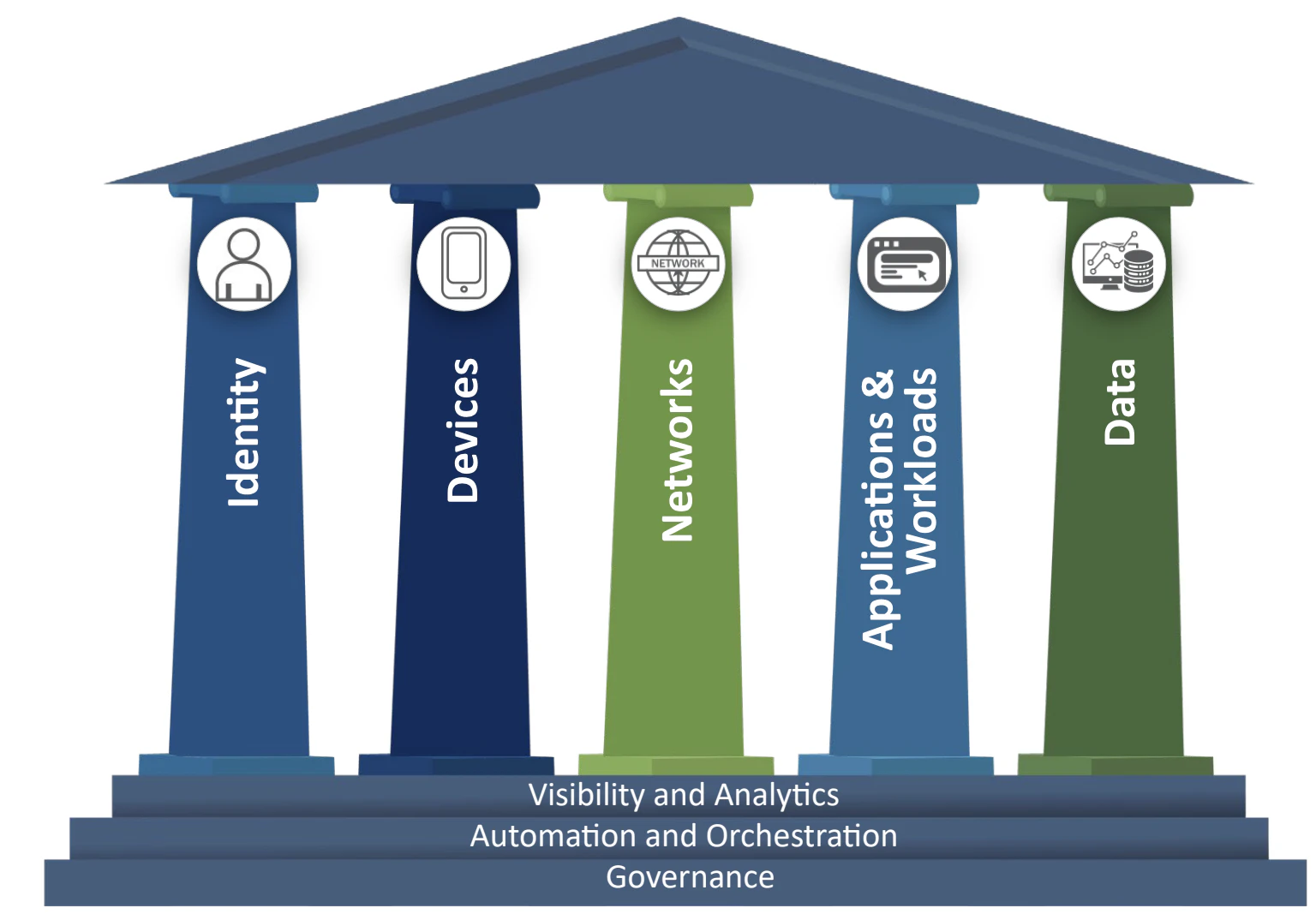
Zero trust security relies on coordinated technologies that work together across identity, devices, networks, applications, and data. No single tool delivers zero trust on its own. Effective programs integrate controls to ensure that access decisions remain consistent, observable, and enforceable across cloud environments, data centers, and software as a service platforms.
These categories represent the core security building blocks of zero trust. Each supports specific pillars alongside cross-cutting capabilities like visibility, automation, and governance:
| Technology | What it does | Zero trust role |
|---|---|---|
| Identity and access management | Supports authentication, authorization, SSO, RBAC, ABAC, and MFA across users, service accounts, and workloads | Establishes identity as the primary control plane and enforces least-privilege access and continuous verification |
| Privileged access management | Enables just-in-time access, session monitoring, and credential rotation for admins and automation workflows | Limits blast radius by shrinking the window of elevated permissions while supporting audit and compliance requirements |
| Zero trust network access and SASE | Grants access to specific apps based on user identity, device posture, and context rather than broad network connectivity | Replaces VPNs with application-level access decisions to reduce lateral movement |
| Cloud-native application protection platforms | Delivers visibility into workloads, identities, permissions, vulnerabilities, and misconfigurations across multi-cloud environments | Correlates identity and exposure data to enforce least-privilege access, identify toxic combinations, and prioritize remediation |
| Network detection and response | Analyzes network traffic patterns to detect anomalous movement, command-and-control activity, and data exfiltration | Supports continuous monitoring by alerting when access controls fail or when attackers attempt lateral movement |
| Data security and data loss prevention | Classifies data, monitors access and usage, and enforces policies to prevent unauthorized sharing or exfiltration | Reinforces zero trust at the data layer by integrating with identity systems to reflect user role, device posture, and risk context |
| SIEM and SOAR | Aggregates identity, endpoint, application, and network signals to support threat detection, investigation, and response | Connects telemetry across zero trust controls while automating response and ensuring consistent enforcement |
| Policy decision and enforcement points | Evaluates context, risk, and policy in real time to enforce decisions at the identity, network, application, or data layer | Translates zero trust intent into action because the separation of decision logic and enforcement improves scalability and auditability |
How Wiz accelerates zero trust implementation in cloud environments
Zero trust in the cloud relies on continuous verification, accurate context, and consistent enforcement across rapidly changing environments. Organizations often struggle to operationalize zero trust because they lack visibility into how identities, permissions, workloads, and exposure intersect across multi-cloud infrastructure.
Wiz accelerates zero trust by closing these visibility and context gaps. Our agentless CNAPP maps the actual relationships between users, service identities, applications, and workloads. This mapping exposes excessive permissions, implicit trust paths, and risky access routes that expand blast radius. By analyzing effective cloud permissions across providers—and correlating them with vulnerabilities, misconfigurations, network exposure, and sensitive data—Wiz empowers teams to enforce least-privilege access and continuously validate trust as environments change.
By consolidating identity context, risk prioritization, and cloud-wide visibility into a single platform, Wiz makes zero trust measurable and actionable across multi-cloud environments.
Need a practical blueprint for putting this into action?
Download the Zero Trust Foundation guide to design, implement, and scale zero trust in the cloud—complete with architectural guidance, control mapping, and real-world implementation examples.
Accelerate your Zero Trust journey
See why CISOs at the fastest growing organizations trust Wiz to help them ensure Zero Trust in their cloud environments.

FAQ about zero trust security
Below are answers to common questions about zero trust security: