



What is managed detection and response?
Managed detection and response (MDR) is a cybersecurity service that combines automated threat detection with expert human analysis to provide continuous monitoring and incident response. These services include a dedicated team of security experts who investigate incidents and take action to stop attacks. When they detect suspicious activity, automated playbooks respond immediately while human analysts conduct deeper investigation and remediation.
This approach delivers comprehensive protection through both advanced technology and specialized expertise. It also ensures that your cloud environment stays secure around the clock, which is critical in a landscape where U.S. organizations reported 1,732 data compromises in the first half of 2025 alone.
Incident Response Plan Template
Build a structured cloud incident response playbook so your team is ready when MDR surfaces a real threat.

How does managed detection and response work?
MDR collects and analyzes security data—like endpoints, cloud workloads, and network activity—from across your environment and uses automated tools to scan for suspicious behavior. Meanwhile, a team of security experts reviews alerts, investigates incidents, and takes action to contain threats.
Often, MDR providers also use a mix of automated playbooks and hands-on investigation to respond to incidents and work directly with your team to remediate issues. This service is typically available 24/7 so you can address threats quickly, even outside of business hours.
What are the key detection and response technologies in MDR?
While MDR is the service, it relies on specific technologies to see and store data from your environment. Depending on your infrastructure, an MDR provider might use one or all of the following:
Security information and event management (SIEM): This central library collects and aggregates log data from every corner of your network (like servers, apps, and firewalls). While SIEM is generally great for compliance and long-term storage, MDR providers use it to spot long-term patterns that a single alert might miss.
Endpoint detection and response (EDR): This process focuses on the edges of your network (like laptops, desktops, and servers) and monitors file activity and process execution to catch malware at the device level.
Extended detection and response (XDR): As the evolved version of EDR, this practice breaks down silos by pulling data from endpoints, networks, and firewalls into a single view, which allows for faster correlation of complex attacks.
Cloud detection and response (CDR): This monitors for misconfigurations and threats that target cloud native workloads, specifically within cloud environments (like AWS or Azure).
In the past, companies typically managed their own SIEM, which often led to alert fatigue when they had thousands of notifications but no one to check them. But modern MDR solves this issue by sitting on top of SIEM, EDR, XDR, and CDR. This means that while the SIEM or XDR collects the data, the MDR service provides a human team to investigate and stop the threat.
The benefits of managed detection and response
Beyond simple monitoring, MDR also offers a proactive shield for modern enterprises by transforming reactive security into a streamlined operation. This reduces dwell time and strengthens your overall cloud resilience.
Here are some of MDR’s other benefits:
24/7 monitoring and response: MDR provides around-the-clock coverage to detect and handle threats at any time.
Expert investigation: Security analysts review alerts, investigate incidents, and help you understand the impact and next steps.
Faster response: Automated playbooks and human expertise work together to contain threats quickly, which reduces potential damage.
Reduced alert fatigue: Teams filter out false positives and focus on real threats so noise doesn’t overwhelm your team.
Scalable security: MDR is especially helpful for organizations with limited in-house security resources or expertise.
What security challenges does MDR address?
Modern cybersecurity is facing escalating challenges since threat actors are developing increasingly sophisticated attack methods to match technological advances. But MDR addresses these critical security gaps through expert-driven threat hunting and response capabilities.
Below are some common threats that MDR can help teams resolve:
The complexity of modern threats
Today, cloud infrastructure and supply chains are at growing risk from sophisticated ransomware attacks, among other threats. This means that traditional perimeter security isn’t enough to keep you safe.
Cloud environments can also grow and shrink on demand, which makes it difficult to see connections between resources and to know where your true risks lie. And the explosion of APIs and microservices—along with new technologies like AI—introduces new vulnerabilities, too.
Promoting greater collaboration among dev, ops, and security can help teams address this increased complexity.
How MDR helps: MDR helps you keep ahead of threats by providing access to the latest threat intelligence, advanced analytics, and expert analysis.
Resource constraints
Cybersecurity talent shortages create significant operational challenges for organizations that want to build their internal security capabilities. Finding and retaining skilled security professionals has also become increasingly difficult due to global talent gaps and budget constraints. As a result, many organizations struggle to maintain continuous monitoring coverage.
Without adequate staffing, security teams can’t effectively respond to threats around the clock, which allows for dangerous gaps in protection.
How MDR helps: MDR takes pressure off internal teams by offering access to a dedicated 24/7 SOC team, which frees up internal resources for other tasks.
The need for proactive approaches
Traditional security tools usually work by reacting to known threats that are trying to access your environment. But this doesn’t protect you against novel or zero-day attacks. As a result, modern security strategies need a more integrated, intelligent approach that includes threat hunting, analytics, and automation to stop threats before they can cause damage.
How MDR helps: MDR uses analytics to identify and address threats before they cause major damage. And because it correlates data from all your security services, it can offer a context-rich approach that individual tools can’t.
What’s the difference between MDR and traditional managed security services?
A managed security service provider (MSSP) is a third-party partner that monitors your networks for threats, alerts you to possible incidents, and may offer additional IT services like technology management and compliance support.
MDR and MSSPs are both outsourced services that complement and boost your in-house security capabilities with a mix of human and automated services. The biggest difference, however, is that MDR provides active threat hunting and expert investigation.
Think of traditional managed security services like a home security system. When there’s a problem, the system will sound an alarm, but you still need to respond to it. The security system focuses on monitoring and won’t investigate or respond to threats. This is considered a passive approach, even if a human team is sometimes involved in monitoring.
MDR, on the other hand, is like having an on-site security guard. It actively patrols your cloud estate, searching for threats and vulnerabilities. It also provides active threat hunting and expert investigation from skilled analysts and will take action to neutralize any threats it detects.
Here are the main similarities and differences between MDR and MSSP solutions:
| Feature | MSSP | MDR |
|---|---|---|
| Event response | Alerts you to breaches | Actively remediates threats |
| Solution set | Mainly focuses on prevention | Detects, responds to, and prevents threats |
| Proactive or reactive? | Is mainly reactive since it responds to identified breaches | Combines proactive threat hunting with reactive incident response |
| Human oversight and 24/7 monitoring | Provides generally automated systems, with some human intervention | Offers a human analyst team that monitors and responds to threats 24/7/365 |
| Cost | Typically lower | Generally higher |
Watch 5-min demo
See how Wiz Defend brings active threat detection and response to your cloud environment.

Is MDR still helpful if you already have an internal SOC?
MDR provides value, regardless of your existing security infrastructure, by enhancing your organization’s capabilities rather than replacing them. As a result, organizations of all sizes and security maturity levels benefit from MDR’s expert-driven approach to threat detection and response.
Here’s a breakdown of what benefits different organization sizes often see:
Smaller organizations
If you run a smaller organization, you likely have a smaller team, but they’re often extremely busy and stretched to their limit.
Rather than staff up a full SOC that includes 24/7/365 response capabilities—and a prohibitive price tag to boot—MDR is a great alternative. With it, your organization will get the benefits of round-the-clock monitoring, threat hunting, and incident response capabilities without needing to build and maintain those capabilities in-house.
Larger enterprises
If you’re at a larger enterprise, you may already have an SOC in-house. But with cloud’s scalability and ephemerality, it can be tough to handle fluctuating security demands, especially when you consider the specialized expertise that cloud environments require.
Here, MDR acts as an add-on for your existing SOC capabilities. For instance, it offers advanced analytics, as well as AI and machine learning capabilities, to catch threats that in-house teams might miss. That’s especially important in industries where security matters, like finance, healthcare, or manufacturing.
MDR can also reduce your mean time to remediation and boost your security maturity so you can foster a greater degree of trust as you grow.
Getting the most from your MDR solution with Wiz
MDR’s effectiveness depends on your security tool integration, which means it doesn’t work best when you operate it as an isolated solution. Most organizations already have deployed multiple security tools, but siloed implementations limit MDR’s ability to correlate data and provide comprehensive threat visibility. That’s because they could slow down your MDR team or leave them with blind spots, which means they can’t track your environment effectively.
To solve these issues, you can try out an integrated security platform. These platforms maximize MDR’s value by providing unified data access and eliminating blind spots that occur when tools operate independently. Unified security platforms also significantly enhance MDR’s capabilities by providing comprehensive data access and contextual intelligence.
When security tools operate within a cloud native application protection platform (CNAPP) in particular, MDR teams gain complete visibility across your cloud environment, which enables faster threat detection and more effective response. And while a CNAPP gets all your security tools working together, it shouldn’t lock you in. Instead, an effective solution should let you choose the tools and services (including MDR) that will best defend your organization from code to cloud.
For example, Wiz, a true CNAPP solution, works with numerous industry-leading MDR providers. When you integrate Wiz with your existing MDR solution, you’ll gain these benefits:
Streamlined MDR integration with direct ingestion of Wiz security alerts
Enhanced MDR effectiveness with critical cloud environment data and context
Automated information sharing between Wiz and the MDR provider
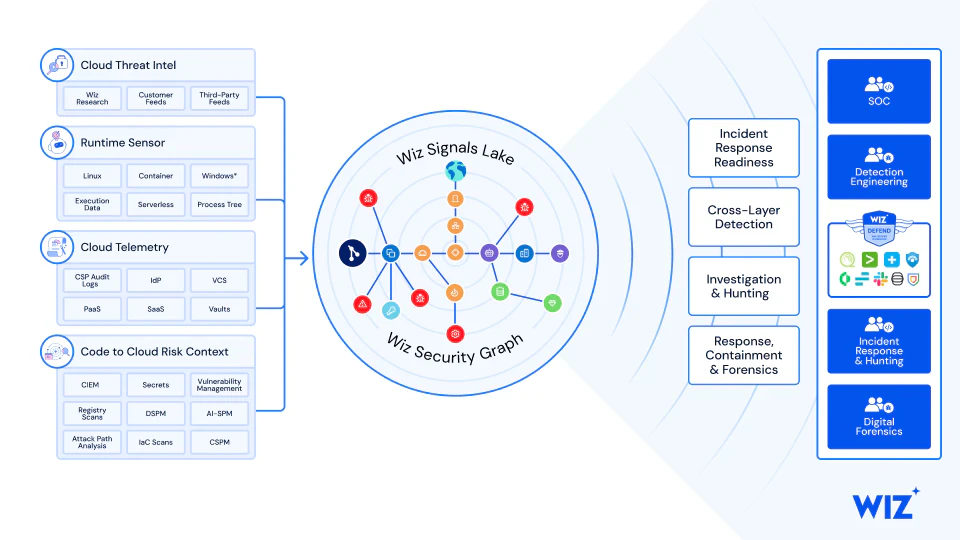
Additionally, Wiz Defend provides real-time forensics capabilities that accelerate MDR investigation and response times. The platform also delivers comprehensive threat context through these data sources:
Security Graph analysis: Maps relationships between cloud resources and potential attack paths
Runtime sensor data: Captures real-time workload behavior through eBPF-based monitoring
Cloud audit logs: Provides complete visibility into cloud service provider activities
This integrated approach gives MDR teams the detailed context they need for rapid threat resolution and effective incident response.
Strengthen your security strategy with expert MDR integration
Combining MDR with a unified security platform like Wiz gives your team the context, automation, and expert support they need to respond to threats quickly and confidently. And by integrating MDR with Wiz, you can streamline investigations, reduce response times, and ensure that your cloud environment is protected around the clock. Ready to see how unified cloud security enhances your MDR capabilities? Get a demo to explore how Wiz integrates with your existing detection and response workflows.
See Wiz and MDR in action
Discover how Wiz gives MDR teams the cloud context they need for faster threat resolution and effective incident response.
