



What is AI model security?
AI model security protects AI model artifacts from attacks targeting unique vulnerabilities across the model lifecycle, from initial training through production deployment and runtime use.
What distinguishes AI model security from traditional application security is that models are probabilistic and shaped by data, not static code. This creates new attack surfaces that conventional security controls were never designed to address. Adversarial inputs can manipulate predictions, carefully crafted prompts can bypass language-model guardrails, and repeated queries can unintentionally reveal sensitive training data. For a broader perspective on how securing AI systems differs from using AI to improve security, see 2 Types of AI Security.
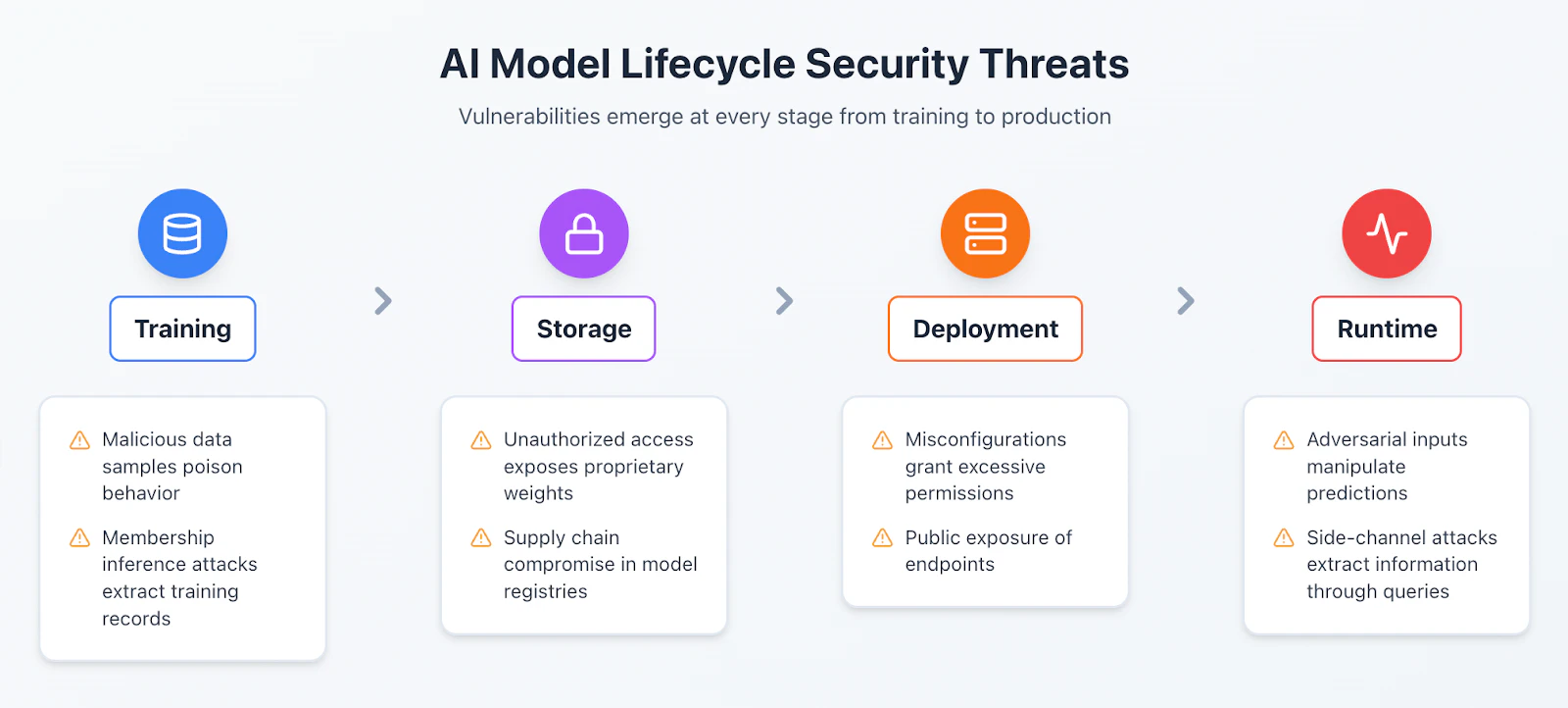
The assets at risk, collectively known as model artifacts, span the entire lifecycle. Training data, model architectures, learned weights, hyperparameters, versioned checkpoints, and inference endpoints each represent a different failure mode. Poisoned training data corrupts the model's behavior at its core; stolen weights expose intellectual property and provide blueprints for crafting adversarial attacks; misconfigured endpoints become launchpads for prompt injection or data exfiltration.
As models progress through their lifecycle, the threat landscape shifts too (see Figure 1). Early weaknesses can propagate forward, while runtime exposure introduces entirely new ways to influence or extract model behavior. Securing AI models, therefore, requires lifecycle-aware controls that account for how models are built, stored, accessed, and queried.
AI Security Starter Pack
Get foundational frameworks and checklists for securing AI models across the full lifecycle.

Why AI model security matters for enterprise
Enterprise AI adoption has outpaced security readiness at an alarming rate. Our State of AI in the Cloud found 74% of cloud environments now run AI services, with self-hosted models comprising 72% of workloads. This shift from managed services to self-trained models has dramatically expanded the attack surface, with a recent IBM report highlighting that 13% of organizations have experienced AI model breaches in 2025.
Cloud amplifies AI model risks in specific ways:
Cross-region model replication creates inconsistent access controls, as a model secured in us-east-1 might be exposed in eu-west-1.
Shared multi-tenant training infrastructure can expose model weights and training data through side channels or misconfigurations.
Ephemeral training environments create lineage blind spots. API-exposed models face internet-scale threats.
Public registries like Hugging Face mean unvetted models flow into workloads, potentially introducing backdoors.
Cloud self-service accelerates shadow AI by enabling model deployment beyond centralized governance.
When AI models are compromised, the impact extends far beyond a single system (see Figure 2).
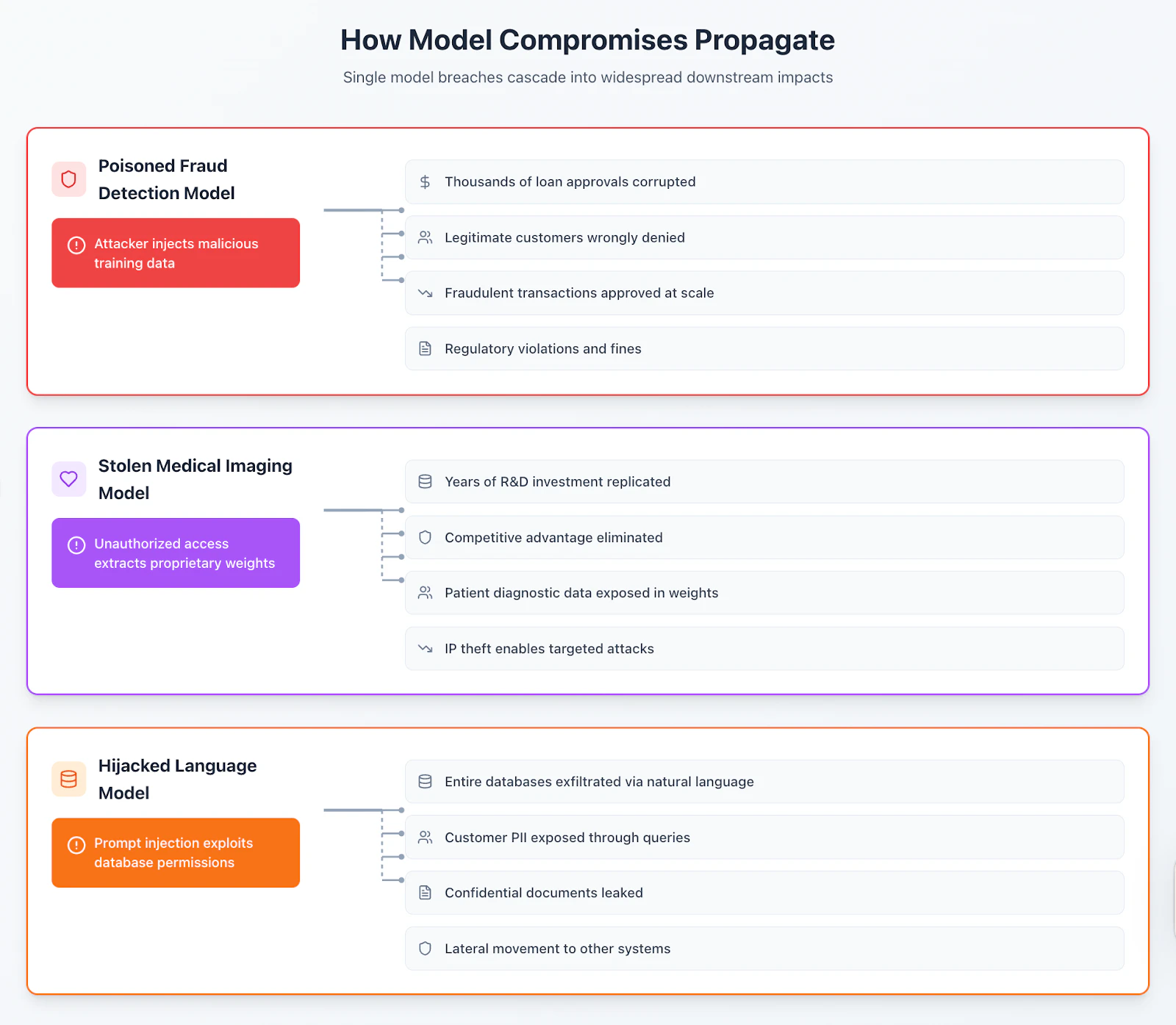
In finance, healthcare, and autonomous systems, these risks directly threaten safety and compliance. As adoption accelerates, attackers are actively exploiting these gaps.
The AI model security challenge
AI models introduce security challenges that most existing controls weren’t designed to handle. This isn’t because they are inherently unsafe, but because they change how risk is introduced and managed. Model behavior can evolve through retraining, redeployment, or new data connections, often without the kinds of code changes security teams are used to reviewing.
That shift has real consequences for protection. Sensitive information may become embeddedver directly in model weights, and those weights can't be encrypted or meaningfully obfuscated without breaking functionality. Attackers don't need source code access to extract value. Simply interacting with an exposed inference endpoint can reveal insights about training data or model behavior through carefully crafted queries.
These technical challenges are compounded by a security ecosystem that is still catching up to the pace of AI adoption. Mature application security programs rely on established scanners, analyzers, and review workflows. Comparable guardrails for AI systems are still emerging, leaving many organizations to deploy models before consistent security controls are in place.
The result is a widening maturity gap. Research from Wiz indicates that 25% of organizations lack visibility into which AI systems are operating in their environments, limiting even basic governance and control. As AI adoption accelerates, deployment continues to outpace review capacity. Unvetted models reach production, increasing systemic risk that traditional processes were never designed to manage.
For real-world examples of how these challenges manifest in cloud-based AI infrastructure, see the Wiz & Hugging Face Case Study.
Understanding the AI threat landscape
Effective defense requires understanding how attackers exploit model-specific vulnerabilities across the development and deployment lifecycle.
Data poisoning injects malicious training samples to embed backdoors, degrade targeted accuracy, or enable data extraction.
Adversarial attacks craft inputs to fool models, ranging from imperceptible image perturbations to prompt injections that bypass guardrails. These exploit statistical learning patterns rather than implementation bugs.
Model theft extracts proprietary models through storage exfiltration, query-based reconstruction, or infrastructure compromise. Stolen models replicate R&D investment and enable targeted attacks.
Supply chain vulnerabilities compromise pipelines through backdoored pretrained models, malicious framework dependencies, and poisoned datasets.
Model hijacking exploits over-permissioned systems: language models with database access become natural language injection vectors, AI agents with cloud permissions can be manipulated to exfiltrate data or escalate privileges. Even verbose errors can leak sensitive information.
The rapid maturation of these attack techniques, combined with expanding enterprise AI adoption, creates an urgent need for specialized defenses. For comprehensive coverage of the evolving threat landscape, explore AI security risks in detail.
Inside MCP Security: A Field Guide
Explore emerging risks in AI agent protocols and how they map to the threat landscape covered above.

Essential AI model security capabilities
Securing AI models requires purpose-built capabilities that address their unique characteristics across the full lifecycle. While cloud security provides the foundation, effective AI security spans multiple control layers, from asset visibility and artifact integrity to data protection and runtime monitoring. Five AI-specific capabilities are essential for comprehensive protection:
Discovery & Inventory: Continuously identifies AI assets across cloud environments, including training jobs, inference endpoints, model registries, and supporting infrastructure. This includes tracking versions, lineage, shadow AI, and infrastructure exposure paths.
Supply Chain Protection: Reduces the risk of compromised components reaching production by verifying provenance, scanning pretrained model artifacts and ML frameworks for malicious code or unsafe constructs, enforcing approved registries, and maintaining a Model Bill of Materials.
Data Security & Classification: Protects sensitive training data and outputs by classifying datasets, identifying risky access paths, monitoring data flows, detecting inference-based leakage, enforcing residency requirements, and minimizing unnecessary PII.
Access Controls & Secrets Monitoring: Validates least privilege across training infrastructure, registries, and inference endpoints by identifying over-privileged identities, exposed secrets, and misconfigurations that enable unauthorized access or automation abuse.
Model Artifact and Deployment Integrity: Detects unauthorized model modifications, unsafe serialization formats, and unapproved deployments by monitoring model artifacts, configuration drift, and runtime execution behavior at the system level.
These capabilities work together through AI Security Posture Management (AI-SPM), which continuously evaluates AI-specific risks while integrating with existing cloud security workflows.
Best practices for implementing AI model security
Securing AI models requires a strategic approach that treats security as an enabler of innovation. Use this practical checklist to assess your current posture and identify gaps across five critical areas with some key controls:
Secure the model development pipeline
Separate training environments using isolated VPCs or accounts
Version control all artifacts (weights, architectures, scripts, datasets)
Require code review for all pipeline changes
Enforce reproducible builds to prevent configuration drift
Continuously scan the training infrastructure for vulnerabilities
Restrict network egress to approved sources
Continuous monitoring & testing
Detect attacks early and validate defenses proactively.
Track performance drift as a poisoning indicator
Monitor endpoints for adversarial patterns
Test against OWASP LLM Top 10 in staging
Conduct red team exercises targeting deployment architecture
Maintain comprehensive access logs
Data governance
Protect sensitive data throughout the model lifecycle.
Classify training data by sensitivity
Implement data minimization to remove unnecessary PII
Monitor access patterns for unauthorized movement
Enforce purpose limitation
Maintain lineage tracing outputs to sources
Apply retention policies
Supply chain vetting
Prevent compromised components from reaching production.
Establish approved registries treating public repos as untrusted
Verify integrity through checksums
Maintain SBOM and AI-BOM
Scan pretrained models for malicious code
Implement governance boards approving external models
Adversarial testing & validation
Identify vulnerabilities before production deployment.
Conduct red team exercises targeting extraction and poisoning
Benchmark against OWASP and NIST AI RMF
Generate adversarial examples during development
Test jailbreak resistance
Validate controls to prevent identified attacks
These practices must evolve alongside changing threats and build on core cloud security foundations, with AI-specific controls layered over identity, network, and vulnerability management. For detailed implementation guidance, see our AI Security Best Practices (Full Guide).
How Wiz secures AI models across the entire lifecycle
Wiz AI-APP secures AI systems across the entire model lifecycle at the cloud and infrastructure level by unifying AI Security Posture Management (AI-SPM), model artifact scanning, data protection, attack path analysis, code security, and runtime detection within a single cloud-native platform.
Rather than evaluating AI models in isolation, Wiz connects findings across cloud environments to surface exploitable conditions and attack paths, providing full context instead of isolated vulnerabilities.
Consider a common scenario: A publicly exposed VM running training workloads with direct access to sensitive training data.
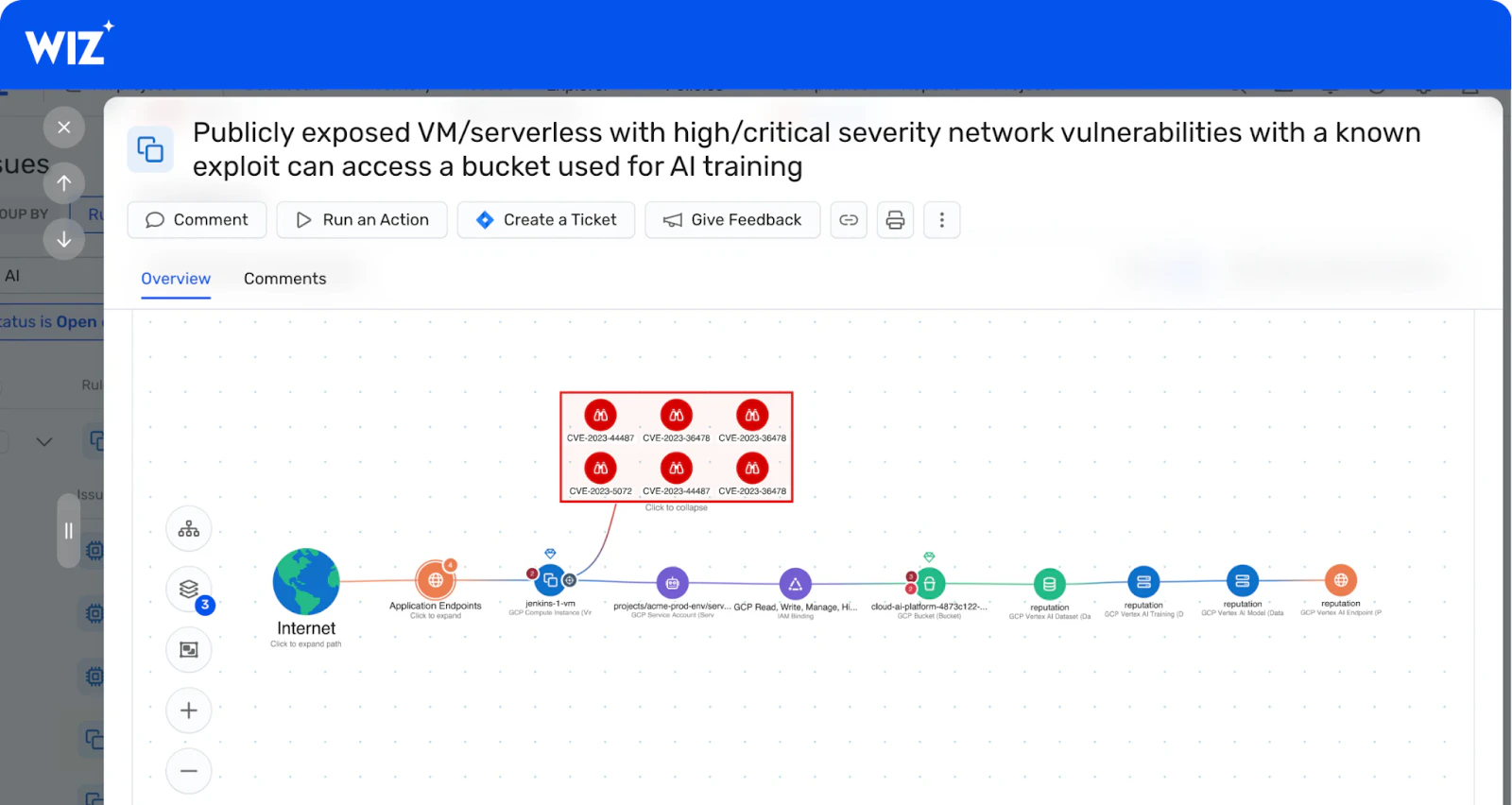
In this scenario, cloud exposure combined with identity permissions and data access creates conditions that could enable training data tampering or the introduction of compromised model artifacts during retraining – potentially degrading model integrity and leading to harmful downstream decisions at scale. Wiz AI-APP helps security teams surface and disrupt this attack chain early with:
AI-BOM Discovery: Identifies AI assets through agentless scanning, including exposed compute resources, training infrastructure, data buckets, supported model weights and binaries, and inference endpoints across cloud and self-hosted environments.
Security Graph: Connects AI assets with cloud identities, permissions, and network exposure, revealing over-privileged credentials and publicly accessible infrastructure with direct paths to sensitive training data and model artifacts.
Supply Chain Protection: Helps prevent compromised model artifacts from entering production by scanning supported binaries and enforcing approved sources before they reach training or deployment pipelines.
DSPM for AI: Classifies training data and outputs to identify sensitive information such as PII and intellectual property, highlighting where AI workloads have unnecessary or risky access.
Attack Path Analysis: Maps exploitable paths where exposure, identity misconfigurations, and sensitive data access intersect to reveal conditions that could enable data poisoning, unauthorized model modification, or deployment of compromised artifacts.
Code Security: Scans AI pipelines, dependencies, and supported model artifacts for embedded malicious code and unsafe serialization patterns that could introduce risk into training or deployment workflows.
Runtime Detection: Monitors AI workloads and supporting infrastructure for anomalous system-level behavior, such as unexpected process execution, suspicious network activity, or unauthorized access patterns that may indicate active exploitation.
By unifying AI posture, artifact scanning, runtime signals, and cloud context, Wiz transforms fragmented findings into prioritized, actionable intelligence that helps organizations reduce real AI risk across training, deployment, and inference environments without relying on speculative analysis of model internals.
Want to see what Wiz would find in your environment?Access the AI Security Assessment Sample Report to see real-world attack paths, risk prioritization, and remediation guidance across the entire AI lifecycle. Want to see how these capabilities map to your own environment? Get a demo to explore how Wiz unifies AI security posture management with full cloud context.
See Wiz AI-SPM in Action
Discover how Wiz connects AI assets, cloud identities, and attack paths in a single platform.
