



What is vulnerability prioritization?
Vulnerability prioritization is the process of evaluating and ranking discovered security vulnerabilities based on the actual risk they pose to your specific environment, so your team fixes the issues most likely to result in a breach first. Without it, you are either trying to patch everything (impossible at scale) or patching the wrong things (high severity scores on workloads nobody can reach).
The NIST National Vulnerability Database publishes tens of thousands of new CVEs (Common Vulnerabilities and Exposures) every year. FIRST's 2026 Vulnerability Forecast projects a median of roughly 59,000 CVEs in 2026. No security team has the remediation capacity to address all of them, and not all of them matter equally in every environment.
Prioritization sits at the center of the vulnerability management lifecycle. Scanning finds issues. Prioritization determines what matters. Remediation fixes them. Think of it as the decision layer that determines whether your vulnerability management program actually reduces real risk or just generates busywork.
Vulnerability Management Buyer's Guide
This guide helps your security and dev teams finally start speaking the same language while giving you everything you need to objectively choose or replace your VM solution.

Why vulnerability prioritization matters
Scanning tools generate thousands of findings, but security teams are small and engineering bandwidth is finite. It matters because 80% of cloud intrusions in 2025 started with a vulnerability, exposed secret, or misconfiguration. Without a way to separate signal from noise, teams default to sorting by CVSS score and working top-down. That approach ignores whether a vulnerability is reachable, exploitable, or sitting next to sensitive data.
Getting this wrong has real consequences. The 2019 Capital One breach is a well-known example: a misconfigured web application firewall (WAF) allowed a server-side request forgery (SSRF) attack to reach the Amazon EC2 instance metadata service, which exposed temporary AWS Identity and Access Management (IAM) credentials. The highest-risk condition was the attack chain, not a single top-rated CVE. As detailed in the U.S. Department of Justice case, the most dangerous exposure came from a chain of misconfigurations and an overprivileged IAM role, not a single critical-rated CVE. Teams that only chase high CVSS scores would have missed it entirely.
Cloud environments make this harder. New workloads spin up constantly, permissions shift, and network exposure changes daily. Static, point-in-time ranking cannot keep pace. You need continuous, context-aware prioritization that reflects what your environment actually looks like right now.
Vulnerability prioritization also supports compliance. Frameworks such as PCI DSS 4.0, FedRAMP, SOC 2, and HIPAA expect organizations to assess vulnerability risk, assign remediation timelines, and show that the highest-risk issues are addressed first. PCI DSS 4.0, for example, explicitly requires a risk-based approach to identifying and managing vulnerabilities, which makes prioritization a practical control as well as an operational one.
How does vulnerability prioritization work?
The process moves from discovery through contextual enrichment to a ranked queue of actionable issues. Each stage adds a layer of signal that raw CVE data alone cannot provide.
Discovery and inventory
You cannot prioritize what you cannot see. The process starts with a complete, continuously updated inventory of every workload, container, serverless function, and managed service across your environment. Agent-based approaches often leave gaps in ephemeral or containerized workloads that spin up and disappear before an agent can be installed. Agentless, API-based scanning closes those gaps by querying the cloud provider directly.
If your scanning only covers a portion of workloads, your prioritization is making decisions based on incomplete information. That is a risk in itself.
Contextual enrichment
Raw CVE data tells you a vulnerability exists. Context tells you whether it matters. This is where prioritization diverges from simple severity sorting: each finding is enriched with environmental factors that determine real-world exploitability. The same principle applies to AI workloads, where model pipelines, inference services, and connected data stores introduce additional context such as training data exposure, service permissions, and access to sensitive prompts or datasets.
| Prioritization signal | What it answers | How it shifts priority |
|---|---|---|
| Network exposure | Is this workload reachable from the internet? | Internet-facing assets jump to the front of the queue |
| Identity permissions | What can an attacker do after exploitation? | Admin-equivalent roles dramatically increase blast radius |
| Data sensitivity | Is PII, financial data, or secrets accessible? | Proximity to sensitive data raises business impact |
| Exploit availability | Does a public exploit or active campaign exist? | Known exploits move from theoretical to urgent |
| Runtime status | Is the vulnerable package actually loaded in memory and executing? | Installed-but-not-running findings drop in priority |
| Misconfiguration correlation | Do surrounding misconfigs amplify the risk? | Disabled logging or public storage buckets compound exposure |
Here is what this looks like in practice: imagine a medium-severity CVE on a container that is directly internet-facing, running with an IAM role that has admin-equivalent access to a database containing PII, and the vulnerable package is confirmed loaded at runtime. No single finding in that chain scores above medium in isolation. Together, they spell fix now. Evaluating these signals in isolation still leaves gaps. The highest-fidelity prioritization comes from a unified model that maps the relationships between the CVE, the workload, its network exposure, its permissions, the data it can reach, and its runtime state in one view.
Attack path analysis
Modern prioritization models relationships between findings, not just individual CVEs. The scenario above is an example of what practitioners call a toxic combination: multiple individually moderate findings converging on the same resource to create a critical, exploitable path.
Identifying these requires a graph-based view of the environment that connects vulnerabilities to infrastructure, identity, data, and network context. Flat-list prioritization that scores each finding independently will miss the most dangerous combinations every time. Building that graph also requires complete asset coverage. If the inventory misses ephemeral containers, auto-scaled instances, or serverless functions, the attack paths it surfaces will be incomplete.
Prioritized output and remediation routing
Prioritization without a path to action is just analysis. The output should be a ranked queue with clear ownership and remediation guidance that routes directly into developer workflows.
A well-structured output includes:
Risk-ranked queue: Issues ordered by actual exploitability and business impact, not just CVSS score.
Clear ownership: Each finding routed to the team or individual responsible for the affected resource.
Remediation guidance: Specific fix instructions, not just a CVE description.
SLA tracking: Defined timelines for remediation based on risk tier
Leading approaches are also incorporating AI-powered remediation guidance that generates fix recommendations tailored to the affected resource and its context, which helps developers act without needing to reverse-engineer every finding from scratch.
Watch 12-min demo
Watch how Wiz connects vulnerabilities to real attack paths in a live environment. .

Vulnerability prioritization methods: legacy vs. modern
The industry has shifted from static severity scores to context-aware, risk-based approaches. The core realization driving this shift: vulnerability severity and vulnerability risk are not the same thing.
| Method | What it measures | Strengths | Limitations | Best used as |
|---|---|---|---|---|
| CVSS | Technical severity of a vulnerability | Standardized, widely supported, easy to operationalize | Does not know your environment | Baseline severity signal |
| EPSS | Probability of exploitation in the next 30 days | Adds exploit-likelihood context | Global estimate, not environment-specific | Exploit intelligence input |
| CISA KEV | Confirmed active exploitation | High-confidence urgency signal | Reactive and limited in scope | Immediate review list |
| SSVC | Action-oriented decision outcome | Useful for triage and governance | Depends on accurate organizational inputs | Decision framework |
| Runtime and environmental context | Actual exposure and blast radius in your environment | Identifies real attack paths and toxic combinations | Requires complete asset and relationship visibility | Primary prioritization layer |
Legacy: CVSS-based prioritization
The Common Vulnerability Scoring System (CVSS) has been the historical default. It assigns a base score from 0 to 10 based on factors like attack vector and impact. CVSS also defines temporal and environmental scores, but most organizations only use the base score because the environmental component requires manual input they do not have.
The limitation is straightforward: CVSS does not know your environment. A CVSS 9.8 on an air-gapped internal workload is not the same priority as a CVSS 7.5 on an internet-facing service with admin permissions. FIRST's own guidance explicitly states that base scores should not be used alone for prioritization.
Modern method: EPSS (Exploit Prediction Scoring System)
The Exploit Prediction Scoring System uses a data-driven model to estimate the probability that a CVE will be exploited in the wild within the next 30 days. It complements CVSS by adding an exploitability dimension that severity scores lack.
However, EPSS predicts exploitation likelihood globally, not in your specific environment. A CVE with high EPSS is more likely to be exploited somewhere, but whether it matters to you still depends on whether the vulnerable asset is reachable and what it can access.
Modern method: CISA Known Exploited Vulnerabilities (KEV)
The CISA KEV catalog lists CVEs confirmed to be actively exploited. KEV entries carry remediation deadlines for federal agencies under Binding Operational Directives and serve as a high-confidence signal for all organizations. The limitation: KEV is reactive, limited in scope, and does not tell you whether the vulnerable asset is exposed in your environment.
Modern method: SSVC (Stakeholder-Specific Vulnerability Categorization)
SSVC is a decision-tree framework developed by CERT/CC and adopted by CISA. Instead of producing a numeric score, it outputs action-oriented outcomes (Track, Track*, Attend, Act) based on exploitation status, exposure, and mission impact. SSVC is a decision framework, not a data source. It still requires accurate inputs about your environment to produce useful outputs.
Modern method: runtime and environmental context
The most advanced approaches go beyond global scoring models entirely. They validate whether vulnerable code is actually loaded in memory and executing, whether the workload is reachable from the internet after accounting for security groups, NACLs, and WAFs, and whether the identity attached to the workload has permissions that would amplify an attacker's reach.
This is where toxic combinations surface. A graph-based view of the environment connects vulnerabilities to infrastructure, identity, data, and network context to reveal attack paths that no single scoring model can detect. Runtime and environmental context evaluates:
Runtime validation: Is the vulnerable library actually loaded and executing, or just installed?
Effective network exposure: Is the workload reachable after evaluating all layers of network controls?
Identity blast radius: What can an attacker access after exploiting this workload?
Data proximity: Is sensitive data (PII, financial records, secrets) accessible from this resource?
Compounding misconfigurations: Do surrounding misconfigs (e.g., disabled logging, public S3 buckets) amplify the risk?
Tools and technologies for streamlining prioritization
Security teams continue to face a high number of threats, vulnerabilities, and increasingly sophisticated attackers. For instance, in June 2025, Cybernews announced a shocking investigation of a data breach that exposed 16 billion passwords across platforms like Facebook, Apple, and GitHub. Cases like these remind us of the critical importance of automated security solutions in maintaining continuous, effective cloud security while leveraging contextualization and prioritization.
While consistent real-time vulnerability detection is important, your cloud security solution’s ability to evolve and adapt to novel threats is, too. Below are ways you can prioritize vulnerabilities to save time and prevent a greater impact on your organization’s bottom line:
Vulnerability scanners
Vulnerability scanners help you locate risks across your workloads, systems, and applications. In particular, agentless scanning rapidly identifies vulnerabilities and provides valuable insights without requiring extensive manual maintenance.
Your scanner should also work seamlessly across systems and applications for a more comprehensive view of your multi-cloud environment.
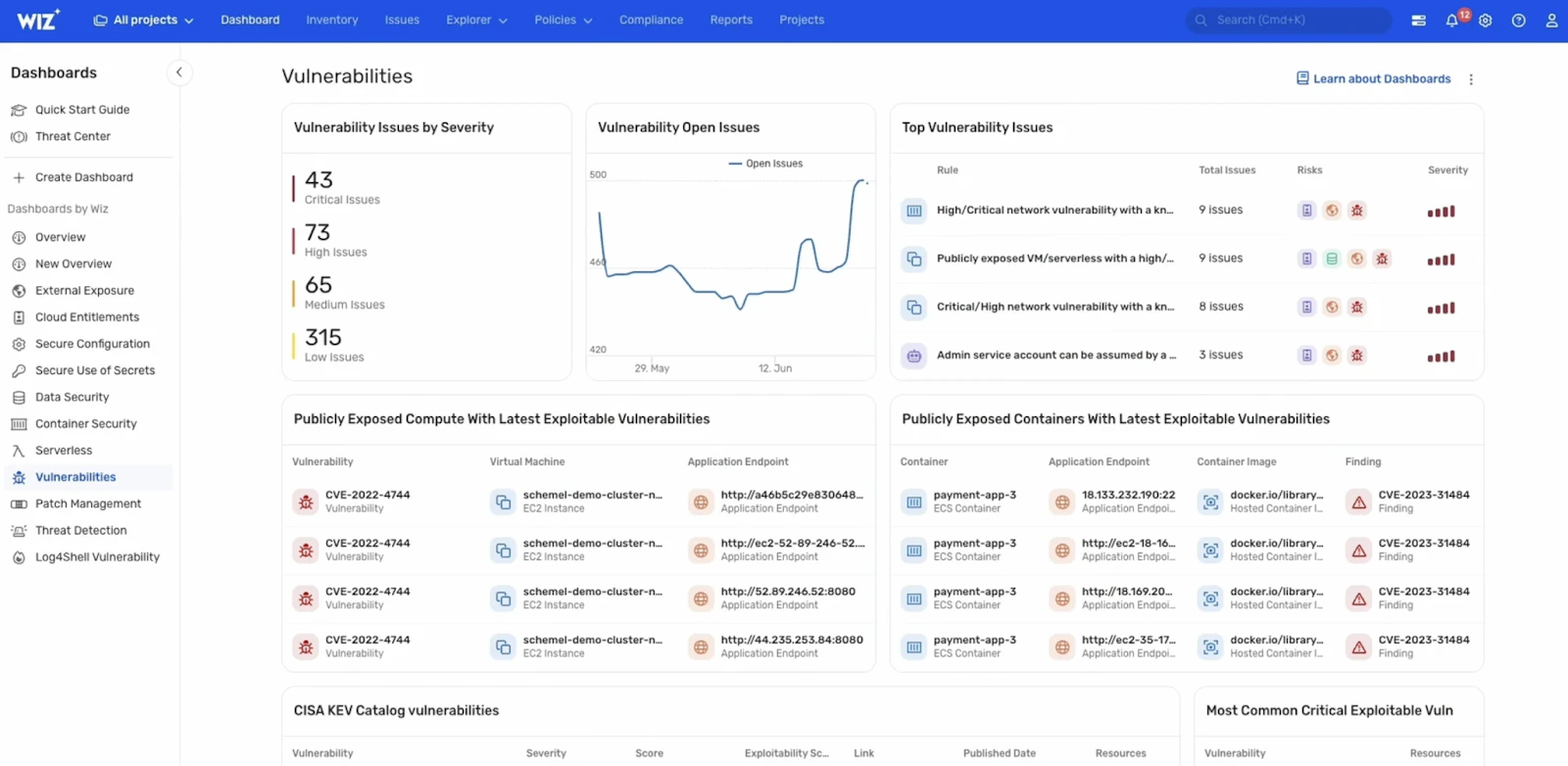
Making detection easier and more efficient allows you to implement a more thorough shift-left approach. That way, your DevSecOps team can find vulnerabilities before you deploy your applications, which saves you time and money and keeps users safer.
Prioritization platforms
Without prioritization, your team will face overwhelming alert fatigue. This makes it nearly impossible to address the most pressing vulnerabilities first in a sea of new risks. To combat this, effective prioritization platforms consider the threat impact through the lens of your unique business context.
Wiz’s platform, for example, matches vulnerabilities in the following areas:
Cloud configuration
Lateral movement
Identity exposure
These connections help you pinpoint which issues pose the most significant threats in your environment.
Threat intelligence feeds
Along with maintaining security for your organization, it’s vital to assess and understand threats in the wild. Alternatively, novel cyberattacks could come knocking at your door, which could impact your cloud security management. Integrating real-time threat intelligence, such as KEV or Wiz’s Cloud Threat Landscape, can inform your team about these issues worldwide.
Threat intelligence tells you which vulnerabilities attackers are exploiting right now, so you can move active threats to the front of the queue. A CVE being weaponized in the wild changes its priority even if its severity score has not moved.
Real-time feeds like the CISA KEV catalog or Wiz’s Cloud Threat Landscape surface the issues under active exploitation worldwide, which helps your team fold current attacker activity into cloud vulnerability management decisions.
Intelligence feeds only help when paired with your environment. A CVE trending in the wild still needs context: is the affected asset reachable, and what can it access, before it earns a spot at the top of your queue. That is why teams combine threat feeds with a unified platform that adds cloud context to every finding.
How Wiz prioritizes the vulnerabilities that lead to breaches
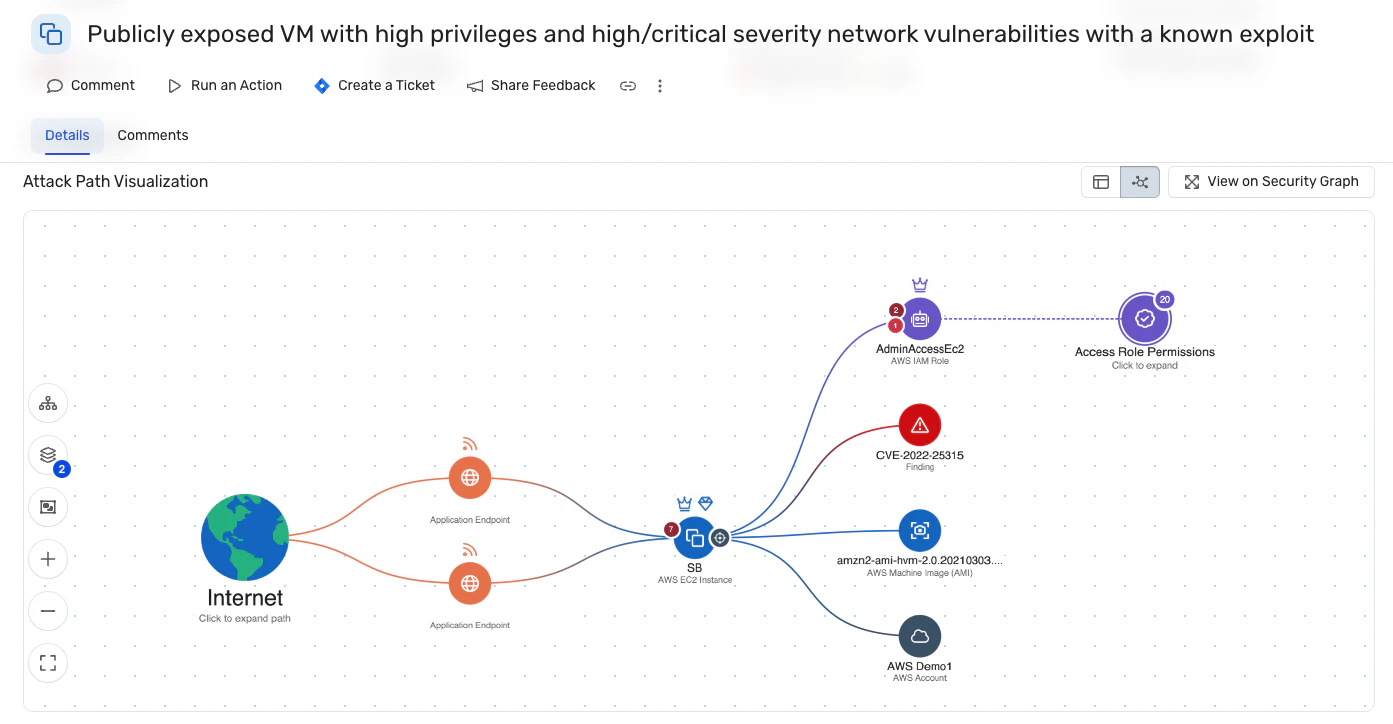
Most tools flood your team with high-CVSS alerts. Wiz prioritizes vulnerabilities by connecting them to your actual cloud environment, mapping every finding to the resources, identities, network paths, and data around it, rather than scoring them in isolation. The Wiz Security Graph maps every vulnerability to the resources, identities, network paths, and data around it, revealing attack paths and toxic combinations that represent real risk.
Our agentless scanning discovers vulnerabilities across VMs, containers, and serverless functions, then immediately enriches each finding with cloud context: Is it internet-facing? What permissions does it have? Is sensitive data accessible? Are there compounding misconfigurations? This cuts through the noise and surfaces what actually matters.
Key capabilities include:
Wiz Sensor: A lightweight eBPF-based sensor that adds runtime validation, confirming which vulnerable packages are actively loaded and executing versus just installed. This lets you confidently deprioritize dormant findings and focus on packages that are exploitable right now.
Wiz Unified Vulnerability Management: Consolidates findings from third-party and on-prem scanners, enriching them with the same graph-based context. You get one prioritized queue with clear ownership, AI-powered remediation guidance, and faster MTTR.
Wiz AI-APP: Extends the same contextual prioritization to AI workloads, including model pipelines, inference services, and connected data stores, so risks like data exposure, overprivileged access to training data, and misconfigured AI services are prioritized within the same unified framework.
Get a demo to see how Wiz connects vulnerabilities to cloud context, surfaces the attack paths that matter, and routes prioritized findings to the teams that can fix them.
Request a demo to explore how Wiz can secure your cloud environment.
Get a demo
Stop triaging by severity score alone and start fixing what attackers can actually reach. .
