



What is AI-APP?
An AI Application Protection Platform (AI-APP) is a purpose-built security solution that integrates visibility, risk assessment, and active defense across the AI lifecycle.
Instead of addressing individual layers of security in isolation, an AI-APP correlates signals from development, cloud infrastructure, and live runtime behavior. By mapping these connections into a unified security graph, it identifies actual, exploitable attack paths rather than generating standalone alerts for individual misconfigurations. Watch the video to learn more:
AI Security Starter Pack
Build a practical foundation for securing AI workloads across development, cloud, and runtime.

The shift to AI-native application architecture
Modern AI applications represent an entirely new class of workload. Unlike traditional deterministic software, today's AI workloads are assembled ecosystems connecting foundational models, non-deterministic autonomous agents, third-party APIs, and Model Context Protocol (MCP) servers.
In a security context, this changes the risk profile completely. An AI agent with MCP access can do things (like read customer databases, execute arbitrary code, or call external APIs) rather than just generate text. Because these AI applications behave differently across runs based on probabilistic outputs and real-time context, traditional AppSec tools and methodologies fall short.
To secure these highly dynamic workloads, a new category of security tooling has emerged: the AI Application Protection Platform (AI-APP).
Terminology note: This guide strictly uses "AI-APP" to describe the security platform that protects these workloads, and "AI application" or "AI workload" to describe the software being protected.
The four pillars of AI application risk
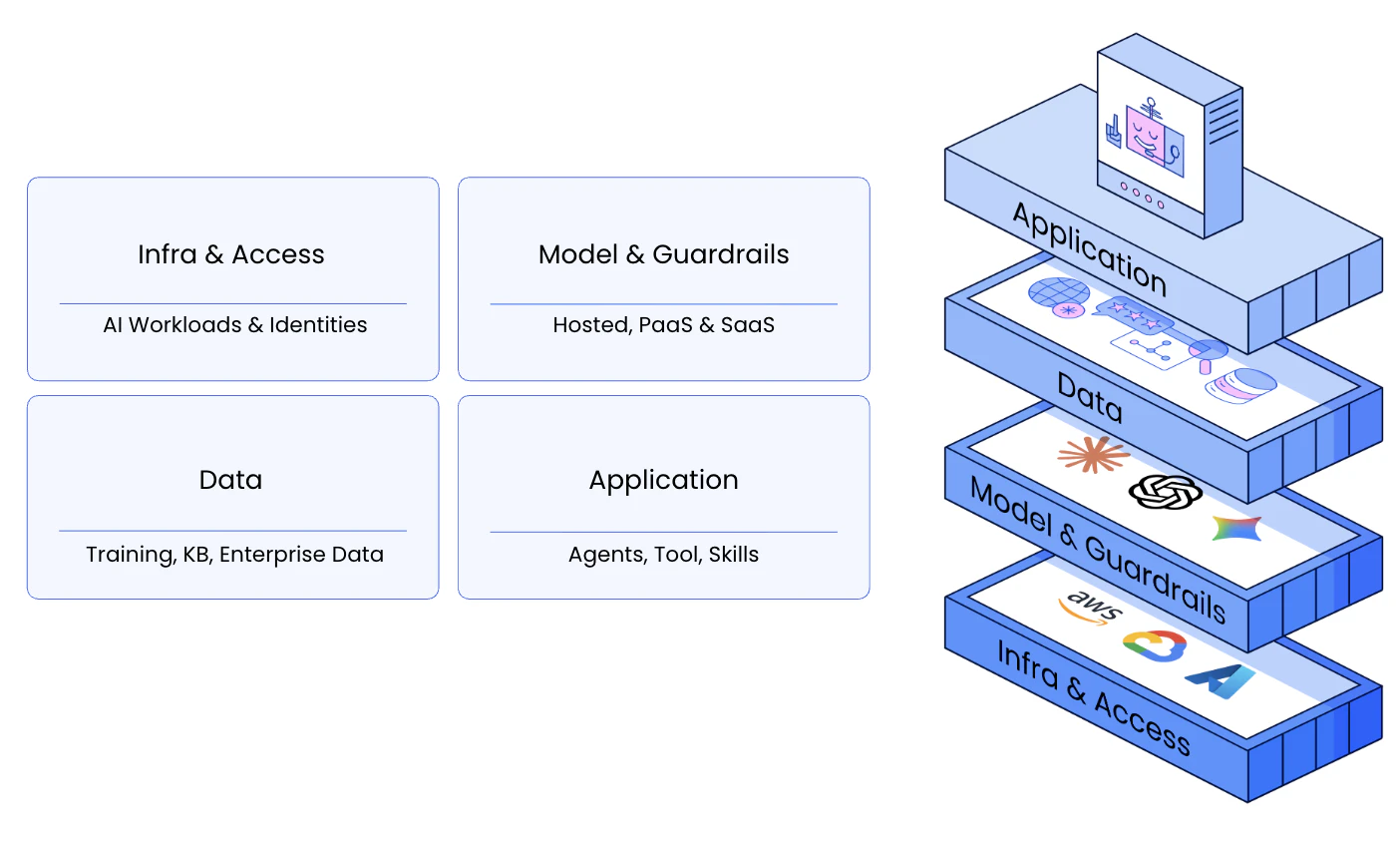
To protect AI applications, security teams need a clear mental model for where risk actually lives. The architecture breaks down into four interconnected pillars that map to how modern AI systems are built and operated.
| Pillar | What it covers | Example risks |
|---|---|---|
| Infrastructure & access | Cloud workloads, agentic identities, IAM roles, and underlying PaaS/SaaS environments | Publicly exposed inference endpoints, authentication bypasses, overly permissive IAM roles assigned to an AI agent's service account |
| Models & guardrails | Foundational and fine-tuned models, safety configurations, and deployment settings | Model poisoning through corrupted training data, missing output guardrails, misconfigured model-serving endpoints vulnerable to prompt injection |
| Application layer (agents & tools) | Autonomous agents, their granted capabilities, integrations, and MCP servers | An agent with unrestricted code execution tools, write access to production databases, or the ability to call arbitrary external APIs without validation |
| Data | Sensitive enterprise data, training datasets, knowledge bases used for retrieval-augmented generation (RAG), and inference logs | Unintentional data leakage through model responses, attackers manipulating an agent to exfiltrate private records from a connected knowledge base |
These pillars do not exist in isolation. The real danger comes from how they interact. Consider an exposed SageMaker endpoint (infrastructure) connected to an agent with write access to a production database (application layer) that can reach sensitive training data containing customer PII (data) and has no output filtering (models and guardrails). That combination creates a critical attack path that no single-pillar scanner would catch. This is why AI application security requires cross-layer context rather than siloed scanning.
How AI-APP works: connecting code, cloud, and runtime
To go beyond a single layer, AI-APP correlates signals from development, cloud infrastructure, and live runtime behavior to surface real, exploitable attack paths.
The platform operates across three core lifecycle stages:
Visibility (code and cloud): The platform discovers all AI services, agents, models, SDKs, and integrations across the environment, whether managed or self-hosted. It maps how models, prompts, APIs, MCP servers, and plugins are used, creating a unified AI-BOM that tracks artifacts from the developer's IDE all the way through to cloud deployment. This eliminates Shadow AI by surfacing what teams did not know was running.
Risk contextualization (cloud): Once the inventory is established, the platform evaluates AI security posture. It scans model configurations for weak guardrails, classifies whether each agent can read, write, execute, or expose data, and correlates these capabilities with cloud configurations, identity permissions, and network exposure. By connecting these signals in a unified security graph, it maps the exact attack paths an adversary could exploit rather than presenting a flat list of isolated findings.
Defend (runtime): Because AI agents can evolve and take unpredictable actions after deployment, the platform actively monitors live behavior. It detects malicious actions in real time, such as prompt injection attempts, anomalous data egress, rogue agent behavior, or an agent making a suspicious write operation to a database it should not be touching.
Inside MCP Security: A Field Guide
Examine how MCP servers, agent permissions, and connected tools create cross-layer security considerations.

The key differentiator of an AI-APP versus a collection of point tools is the security graph that connects all three stages. Code context reveals developer intent. Cloud context reveals deployment reality. Runtime context reveals live behavior. Evaluating these signals together is what allows security teams to identify true "toxic combinations" rather than drowning in disconnected alerts.
What to look for in an AI APP
Not all platforms claiming AI security capabilities are true AI APPs. When evaluating solutions to protect your AI workloads, demand these criteria:
Agentless discovery across multi-cloud environments: Automatically identifies managed AI services and self-hosted model infrastructure across AWS, Azure, GCP, etc., without relying on friction-heavy runtime agents.
AI-BOM and supply chain tracking: Inventories all AI software, SDKs, dependencies, models, and MCP connections, bridging code repositories with live cloud environments.
Tool and capability classification for agents: Explicitly classifies what each AI agent is authorized to do (read, write, execute) to accurately assess the blast radius of a compromised agent.
A unified security graph: Correlates code context, deployment reality, and live behavior to trace potential exploitation paths.
Attack-path prioritization: Shows how exposed AI services, over-privileged identities, and sensitive data connect into a single exploitable path, ranked by actual exploitability.
The business benefits of an AI application protection platform
When an AI-APP connects code, cloud, and runtime into a single model, the outcomes go beyond better security posture. They change how teams work together and how fast organizations can ship.
Accelerated, secure innovation: By embedding security into every stage of the AI pipeline, organizations can confidently adopt AI coding assistants, ship AI-powered features faster, and scale agent-based automation without letting innovation outpace control. Development teams are not blocked by security reviews because risk is assessed continuously and contextually.
Reduced time to remediation: Surfacing real, exploitable attack paths rather than thousands of isolated alerts means security analysts can focus on the exposures with the greatest potential impact. Tracing a runtime issue back to the underlying code or misconfiguration that caused it means developers can fix the root cause directly rather than patching symptoms.
Unified security governance across teams: An AI-APP bridges the gap between developers, data scientists, and security operations by giving everyone a single source of truth for all AI assets, risks, and compliance status. Instead of each team operating with a different view of risk, everyone works from the same contextual model.
Elimination of Shadow AI blind spots: Agentless discovery across multi-cloud environments surfaces AI services, models, and integrations that were deployed without security oversight. You cannot protect what you cannot see, and continuous inventory is the foundation for enforcing secure defaults.
Genpact achieved full visibility across its multi-cloud environment using this approach, accelerating the deployment of AI applications that are secure by design while improving the speed to remediate critical vulnerabilities.
Common pitfalls in securing modern AI
These are the most dangerous mistakes security teams make when trying to apply existing practices to AI workloads. Each one creates blind spots that attackers actively exploit.
Assuming existing AppSec tools are sufficient: Traditional infrastructure scanners flag cloud resources, and code scanners reveal developer intent, but neither can model how a non-deterministic agent will behave dynamically at runtime. Legacy tools cannot determine whether a vulnerability is actually exploitable in a specific cloud context, meaning they generate noise without actionable insight.
Ignoring the AI supply chain and Shadow AI: Developers frequently introduce new AI services, open-source models, SDKs, and dependencies into their environments without security oversight — only 37% of organizations have processes to assess AI tool security before deployment. Without an AI Bill of Materials (AI-BOM) that tracks what enters the codebase and what runs in production, teams lose track of their supply chain entirely, enabling Shadow AI to proliferate unchecked. According to the State of AI in the Cloud 2025 report, 85% of organizations now use some form of AI, yet most lack full visibility into what is actually deployed.
Evaluating AI risk without cross-layer context: Focusing on isolated vulnerabilities leads to alert fatigue. A publicly exposed endpoint might seem like a low-priority misconfiguration on its own. But if that endpoint connects to an AI agent with access to sensitive customer data and an unrestricted code execution tool, it becomes a critical, exploitable threat. Security teams fail when theycannot correlate signals across infrastructure, identity, data, and application behavior simultaneously.
Treating AI security as a standalone problem: Many organizations stand up a separate AI security initiative disconnected from their broader cloud security program. This creates yet another silo. AI workloads run on cloud infrastructure, use cloud identities, and access cloud-hosted data. Securing them means grounding AI risk in the same cloud context as everything else.
The Wiz approach: end-to-end context from code to runtime
The Wiz AI-Application Protection Platform (AI-APP) connects the full AI stack, mapping relationships across infrastructure, models, agents, tools, and data. This context helps surface risky combinations early.
It starts in development. Wiz Code scans CI/CD, repositories, and IDEs for exposed AI credentials, unsafe patterns, and vulnerable dependencies before they reach production.
In the cloud, Wiz Cloud discovers AI services, models, and integrations, including MCP connections. It evaluates configurations, maps attack paths, and extends (DSPM) to AI training data, so teams can clearly see how models, identities, and sensitive data connect.
At runtime, Wiz Defend monitors behavior out-of-band, detecting prompt injection, rogue agents, and anomalous data egress, risks that only appear with real inputs.
This creates a continuous loop, where code informs posture, posture informs runtime, and runtime insights flow back to developers.
Wiz also brings AI-powered agents into security workflows:
Red Agent simulates attacker behavior to validate exploitable paths
Blue Agent investigates alerts and supports threat hunting
Green Agent turns findings into prioritized fixes with AI-assisted remediation
Get a demo to see how Wiz connects code, cloud, and runtime into a single security graph for your AI workloads.Request a demo to explore how Wiz can secure your cloud environment.
See your AI application context in action
Explore how Wiz connects AI assets, identities, exposure, data, and runtime behavior in one security graph.
