
What is AI-powered threat hunting in cloud security?
AI-powered threat hunting is the use of artificial intelligence to proactively search for signs of attacker activity in your cloud environments, rather than waiting for alerts to fire. AI models analyze operational signals across your cloud footprint – logs, configuration changes, identity activity, and runtime behavior – to surface patterns that resemble attacker tactics and help you investigate them before they escalate into a breach.
Threat hunting by definition focuses on finding threats that are already active, whether an attacker has a foothold inside your environment or is probing for one. With AI, you give that hunter the ability to continuously read every log line, every API call, every identity action, and every runtime signal, without fatigue or sampling.
In practice, AI threat hunting means:
Machine learning models identify patterns that match attacker behavior, not just rule-based detections.
A unified view of your cloud activity combines audit logs, resource inventories, identity events, and runtime telemetry to understand how signals connect.
Multi-cloud signals are correlated automatically, spanning AWS CloudTrail, Azure Activity Logs, GCP Cloud Audit Logs, Kubernetes audit streams, and other sources – revealing behavior that would be invisible in isolated consoles.
Cloud Threat Report
Want to understand the threats hunters are tracking? Our report reveals the latest cloud attack patterns and techniques

Why AI threat hunting matters in modern cloud environments
Cloud environments change faster than traditional detection models can keep up. Teams deploy new services daily, rotate identities and roles frequently, and run workloads that may exist for only minutes before disappearing. This pace creates a level of signal volume and complexity where attackers can hide in plain sight.
Modern attacks exploit that reality. Instead of obvious exploits, threat actors increasingly rely on subtle behaviors: misconfigured IAM roles, exposed storage buckets, overly permissive service accounts, or forgotten resources that nobody is actively watching. These weak signals are easy to miss when they’re just single events, but they become meaningful when you connect identity, network, and data access together.
This is where AI becomes essential. AI threat hunting sits on top of all your cloud data and constantly looks for suspicious patterns – even when your team is offline. It joins weak signals across audit logs, identity events, runtime telemetry, and resource configuration to highlight the paths that could lead to real compromise.
Traditional tooling struggles because:
Data volume is massive: AWS CloudTrail, Azure Activity Logs, GCP Audit Logs, Kubernetes audit streams, SaaS apps, and runtime sensors can produce terabytes of data daily. With most enterprises now running in multiple clouds, the challenge multiplies.
Resources are short-lived: Containers and serverless functions may exist for minutes. By the time an analyst starts investigating, the workload – and its logs – may be gone.
Context is fragmented: Identity, network, configuration, and data exposure live in different products, each with partial visibility. Signals that look harmless in one console may reveal a pattern when connected to another.
AI helps address these challenges by reading everything and correlating it into a single view. Instead of handing you thousands of raw alerts, it points you to the suspicious behavior that matters right now – for example, an unexpected role assumption that led to access of a sensitive datastore.
Benefits and trade-offs of AI threat hunting
AI-powered threat hunting introduces new capabilities that make continuous detection possible at cloud scale. These systems process more data than humans could reasonably analyze and present context that helps teams investigate faster, without removing the need for human judgment.
Key benefits of AI threat hunting
Continuous coverage at cloud scale: An AI-driven threat hunting system can process the full stream of cloud logs and runtime signals, rather than relying on sampling or manual inspection. This makes it possible to detect activity in ephemeral workloads – short-lived containers, serverless functions, and other resources that are difficult to analyze after the fact.
Faster triage with automated investigation: Instead of analysts manually stitching together evidence, the platform can gather context automatically, map identity relationships, and summarize potential impact. Analysts start from a context-rich view of the behavior rather than a long list of raw events, reducing time spent on preliminary investigation.
Context-aware prioritization: Rather than focusing on unusual patterns alone, threat hunting platforms correlate identity behavior, network reachability, data access, and configuration details to highlight paths with potential impact. This shifts effort from chasing every anomaly to focusing on behavior that could lead somewhere meaningful.
Proactive, continuous hunting: Hunting becomes a continuous process, not an occasional effort. The system monitors for weak signals over time, which helps catch slow-moving attacks such as credential misuse or data exposure attempts that unfold gradually and might not trigger any single high-severity alert.
Important limitations and prerequisites
Visibility determines effectiveness: Threat hunting platforms depend on a complete picture of cloud activity. Centralized logging across all accounts – such as AWS CloudTrail organization trails, Azure Activity Logs, and GCP audit logs – is essential, along with sufficient history to understand baseline behavior.
Baseline quality matters: These systems learn what “normal” looks like from observed activity. If the environment is unstable or compromised during that learning period, the baseline can be skewed. Many teams plan a stabilization window as they adopt continuous threat hunting.
Cloud environments change quickly: As services, architectures, and access patterns evolve, what is “normal” also changes. Look for platforms that continuously update baselines and adjust to new behavior without forcing manual retraining or rule tuning.
Telemetry gaps create blind spots: Areas without logging or runtime telemetry remain invisible. For example, in-memory attacks or malicious processes running in unmonitored workloads may not appear in cloud activity alone. Runtime visibility matters alongside cloud logs.
Automation requires guardrails: Automated response capabilities should be designed with approval paths, least privilege, and change controls. High-impact actions should never execute without oversight. The goal is faster decision-making – not handing control to an automated system.
Human decision-making stays central: Threat hunting tools surface evidence and suggest likely paths, but analysts determine risk and choose how to respond. Actions such as isolating production resources, rotating credentials, or blocking access require human context and business judgment.
See Wiz in action
Discover how modern threat detection combines automation with expert analysis to catch sophisticated attacks. Schedule a demo to explore the capabilities
Book a demo

Where AI-powered threat hunting delivers the most value
Threat hunting in cloud environments is less about identifying a signature of a known attack and more about helping analysts make sense of large volumes of fragmented signals. Hundreds of small events – identity changes, runtime behavior, configuration drift, unusual API calls – only start to look meaningful when they’re viewed together.
AI becomes useful when it reduces the manual work required to find those patterns, by supplying context across accounts, identities, and workloads, and by highlighting where investigation is likely to matter. In practice, this shows up in several recurring scenarios that almost every cloud security team encounters.
Rapid triage of incoming alerts and events
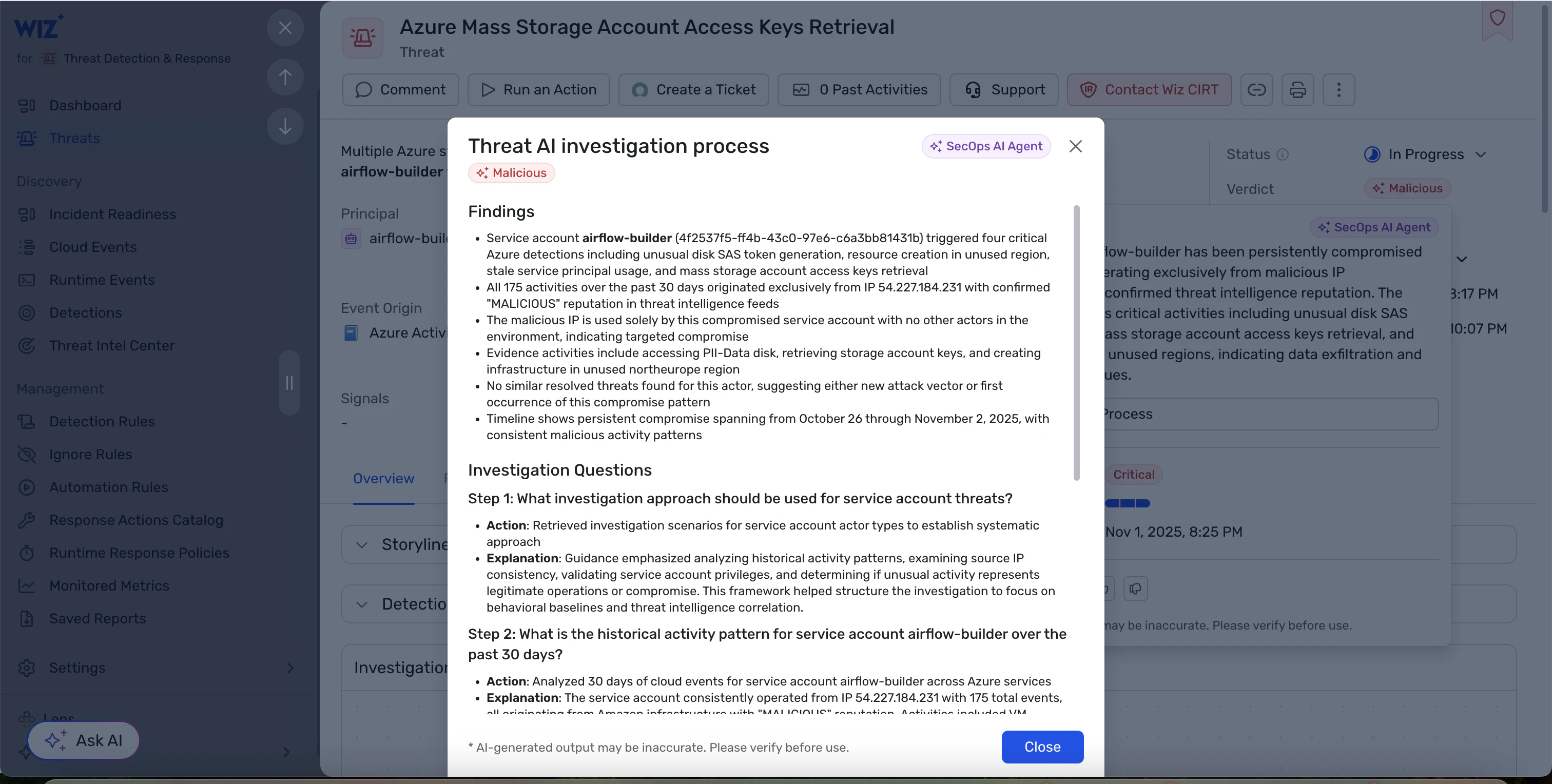
In a dynamic cloud environment, alerts come from many sources – runtime detections, cloud events, configuration changes, identity logs, third-party tools, etc. Manually pivoting across consoles to triage each alert is slow and error-prone.
An AI-powered hunting system helps by automatically collecting context across cloud resources, identities, workloads, and recent history. This yields a unified view of each alert, enabling analysts to quickly assess severity and blast radius instead of performing manual pivoting for every item.
This dramatically reduces time-to-investigate and helps SOCs keep up with volume without ballooning headcount.
Context-driven prioritization to focus on real risks
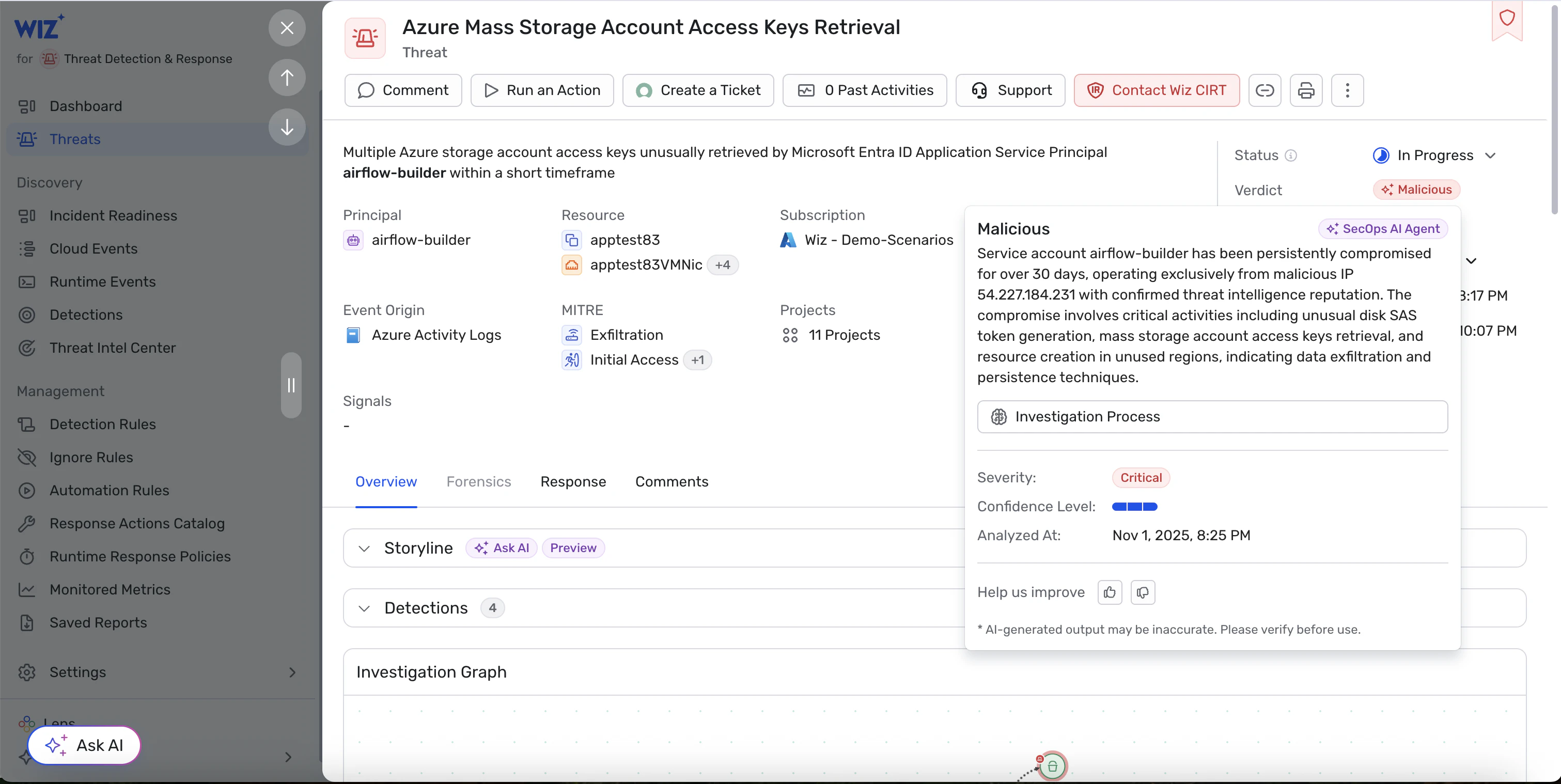
Not every alert or anomaly signals real danger. In cloud-native, many findings are noisy or benign in isolation. What matters is whether they combine – e.g. identity + exposed workload + sensitive data access + unusual behavior – to form an exploitable path.
Threat hunting platforms that merge signals across layers enable prioritization based on actual risk and context, not just alert volume. That helps teams focus on issues likely to impact critical assets rather than chasing every alert.
Root-cause & blast-radius analysis post-incident
When a compromise or suspicious behavior is detected, you often need to answer: How did this happen? What’s impacted? What else is at risk?
With a graph-based model of your cloud environment, threat hunting enables automated root-cause tracing and blast-radius estimation: you can map from a compromised identity or resource through the relationships to find what else could be affected, and which privileges or data could be exposed. This insight shapes effective containment and remediation – fast.
Detection in ephemeral, distributed, and multi-cloud workloads
Modern cloud infrastructure is dynamic: containers spin up and down quickly, serverless functions run briefly, workloads shift across accounts and regions. Traditional monitoring often misses this churn.
A continuous, exhaustive hunting approach – ingesting runtime telemetry, API logs, identity events – ensures coverage across ephemeral workloads and distributed environments. This helps catch exploitation or misuse that spans multiple accounts or happens in short-lived resources that might otherwise vanish before manual review.
Wiz’s approach to AI-powered threat hunting
Wiz brings AI into cloud threat hunting by combining automated investigation, narrative summaries, and AI security posture management in a unified platform. The goal isn’t to replace analysts, but to help teams understand events faster and act with context.
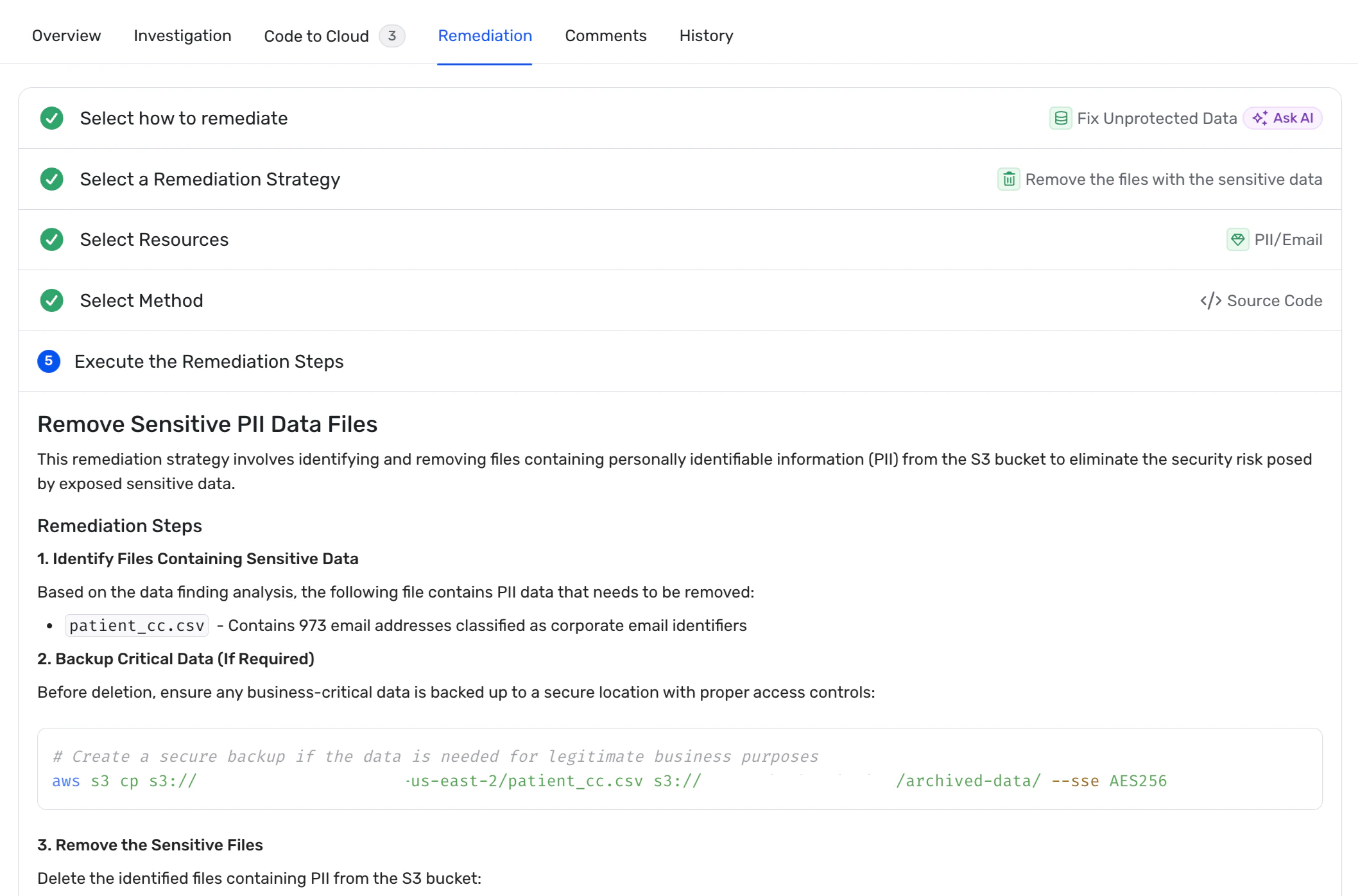
Wiz Defend includes an AI-generated threat storyline feature that condenses the full timeline of an incident into a clear narrative. Instead of pivoting across logs and consoles, analysts see what happened, how it unfolded, and why it matters, mapped directly to the affected identities and resources. This helps teams move quickly from detection to investigation.
The Wiz SecOps AI Agent goes further by automating early investigation steps. It analyzes cloud events, identity behavior, and runtime telemetry to provide a preliminary verdict and supporting summary, so analysts start with a reasoned view of the incident rather than a raw data stream.
Wiz also delivers AI Security Posture Management (AI-SPM) to help teams secure their AI systems. This includes AI asset inventory, misconfiguration detection, and scanning for malicious or tampered AI models. By pairing AI-SPM with threat hunting, Wiz helps organizations identify both attacks in progress and risks inside AI pipelines.
The promise of AI in threat hunting isn’t about replacing analysts. It’s about making investigation work easier to understand and faster to complete. Wiz condenses incident timelines into a clear narrative, automatically gathers context across accounts and identities, and provides a structured starting point for every investigation. This approach helps SOC teams scale without increasing alert fatigue or workload.
Explore how Wiz can streamline investigation, reduce pivots, and help your team respond with confidence. Request a demo.