

What is API testing?
API testing is a type of software testing that checks whether an application programming interface behaves the way it should. Instead of clicking through buttons and screens, you send requests straight to API endpoints and verify the responses, whether that response comes back as JSON, XML, or another structured format. In other words, it tests the logic layer of an application, not its look and feel.
This matters because APIs carry the business logic that decides how your application actually works. A login screen can look perfect while the authentication API behind it accepts almost any token. A checkout page can render cleanly while the payment API quietly returns another customer's data. Testing at the API layer surfaces these problems before they reach production.
API testing also fits naturally into continuous integration. You can automate checks as soon as the API contract is defined, run them on every change, and get feedback faster than UI-based testing allows, often before a user interface even exists.
API Security Best Practices Cheat Sheet
Want the essentials in one place before you go deeper? This cheat sheet is a quick reference for locking down the APIs you test.

Why API testing matters
Modern applications are stitched together from dozens or hundreds of APIs, and AI-assisted development is shipping new endpoints faster than ever. Every one of those calls is a place where poor validation, a configuration mistake, or a logic flaw can open a door. Attackers have taken notice, and APIs are now one of the most targeted parts of the modern application stack. Weak authorization and authentication are especially attractive, because they hand an attacker a direct path to data.
The business impact is direct. Wiz research found that 26% of breaches trace back to exploiting public-facing applications, and APIs are a large part of that exposed surface. Finding a defect during a pipeline run costs a few minutes; finding it after a breach costs far more.
Testing early also keeps pace with how teams build today. Microservices and distributed systems mean a single feature can touch many APIs, so verifying each one in isolation and in combination is the only way to catch issues before they compound. That is why API testing has shifted left into everyday development rather than sitting at the end of a release.
What is API security? Risks, Best Practices, and Tools
API security protects your APIs and the data behind them from threats. Learn the top OWASP risks, best practices, and how to secure APIs in the cloud.
Read more
How API testing works
At its core, an API test mimics a client. It sends a request to an endpoint, the server processes it against its business logic and data, and a response comes back. The test then compares that response against what you expected. Because there is no screen to render, the loop is fast and easy to repeat.
A single test usually validates a few specific things:
Status codes: whether the API returns the correct HTTP code for success, bad input, or an error.
Response schema and payload: whether the body matches the expected structure and values.
Response time: whether the endpoint answers within an acceptable window.
Authentication and authorization: whether the caller is who they claim to be and is allowed to do what they asked.
Error handling: whether the API fails safely and returns useful, non-leaky messages.
Types of API testing
Different test types answer different questions, and knowing when to apply each one helps you build coverage without piling on redundant checks. The table below summarizes the most common approaches.
| Type | What it checks | When to use it |
|---|---|---|
| Functional | Correct responses for valid and invalid inputs | The foundation for every endpoint |
| Unit | Individual functions or methods behind an endpoint | During early development, close to the code |
| Integration | How multiple APIs and services work together | When endpoints depend on each other |
| Contract | Whether an implementation matches its documented spec | To catch spec drift across environments |
| End-to-end | A full workflow across several APIs | To validate real user journeys |
| Load and performance | Behavior under high traffic and large data sets | Before peak events or launches |
| Security | Authentication, authorization, and exposure flaws | Continuously, on every meaningful change |
| Regression and fuzz | Old bugs returning, and reactions to malformed input | As the API evolves over time |
The API testing process, step by step
A repeatable process turns scattered checks into dependable coverage. Most teams follow a version of these steps:
Define scope and requirements: decide which endpoints, inputs, and outcomes you need to verify.
Set up a controlled environment: use stable test data and isolated services so results are consistent.
Design test cases: cover positive paths, negative inputs, and boundary or edge cases.
Execute the tests: send the requests and capture every response.
Validate responses: check status codes, payloads, timing, and authorization against expectations.
Report and triage: record failures with enough detail to reproduce them.
Integrate into CI/CD: run the suite on every commit so problems surface the moment they appear.
In practice, that last step is what keeps quality from slipping. When tests run automatically on each build, a broken endpoint fails the pipeline instead of reaching a customer.
Watch 12-min demo
See how testing, discovery, and prioritization come together in a real cloud environment.

Manual vs. automated API testing
Manual testing works best when an endpoint is new, ambiguous, or high-risk and needs human judgment about how the business logic should behave. Exploratory checks by an engineer often reveal odd corner cases that no script anticipated.
Automated testing carries the day-to-day load. Regression suites, contract checks, and pipeline gates should run without anyone watching, because manual effort cannot scale to the number of APIs a modern environment runs. The strongest programs use both: automation for breadth and speed, manual testing for depth on the areas that matter most.
API security testing
Security testing is where a "working" API and a safe API part ways. An endpoint can return the right data and still hand it to the wrong person. That is why security testing focuses on authentication, authorization, and data exposure rather than just correct output. A useful anchor here is the OWASP API Security Top 10, which describes the risks worth testing for first.
Several of those risks share a dangerous trait: the request is technically valid. In broken object-level authorization (BOLA), an attacker with real credentials simply changes an object ID and reads data they should never see. Broken authentication lets stolen tokens, weak session handling, or missing login rate limits through the front door. Excessive data exposure leaks fields the client never needed. You cannot block your way out of these, so you have to test that authorization logic is correct on every endpoint. Reviewing a catalog of common API vulnerabilities is a good way to build that test list.
Cloud environments raise the stakes. Wiz research found that 72% of cloud environments have publicly exposed PaaS databases lacking sufficient access controls, which is exactly the kind of sensitive data an exposed API can reach. There is also a discovery problem: you can only test the APIs you know about. Shadow APIs deployed outside the normal process and zombie APIs left running after a service is retired sit unmonitored between release and remediation, and no test suite covers an endpoint nobody has inventoried.
API testing tools
Most teams combine a few tools rather than relying on one. The table below shows common options and where each fits.
| Tool | Primary use |
|---|---|
| Postman | Interactive request building, functional tests, and shared collections |
| SoapUI / ReadyAPI | Functional and security testing for REST and SOAP APIs |
| JMeter | Load and performance testing |
| Rest Assured | Java-based automated API tests in code |
| Karate | Combined API test automation and assertions |
| Swagger / OpenAPI | Spec definition and contract validation |
For security specifically, teams often layer in dedicated scanners. A look at open-source API security testing tools is a practical starting point for evaluating options.
Best practices for reliable API testing
A few habits separate testing that reduces risk from testing that just fills a checklist. These API security best practices map cleanly onto everyday work:
Test authorization first: confirming an API works matters less than confirming not just anyone can use it.
Cover negative and edge cases: malformed input and boundary values expose more bugs than happy-path requests.
Enforce the contract: validate responses against the OpenAPI spec so drift is caught automatically.
Automate in CI/CD: run the suite on every build to keep pace with development.
Protect test data: keep sensitive values out of shared collections and logs.
Keep discovery continuous: an inventory built from documentation alone goes stale, so track APIs across code, traffic, and cloud.
What is an API gateway?
API gateways route, authenticate, and control traffic between clients and backend services. Learn how they work, their benefits, and their security limits.
Read more
Test every API in full cloud context with Wiz
Wiz API Security Posture Management (API-SPM) tests APIs in the context of the cloud they run in. It discovers every REST, GraphQL, and gRPC API through cloud connectors, integrations, and the Wiz Sensor, including the shadow and zombie endpoints teams usually miss. The Red Agent then runs AI-driven DAST through its API DAST Attacker module, reading application logic to simulate real attacks and check each API against the OWASP API Top 10. Pairing discovery with live testing is the core of API attack surface management.
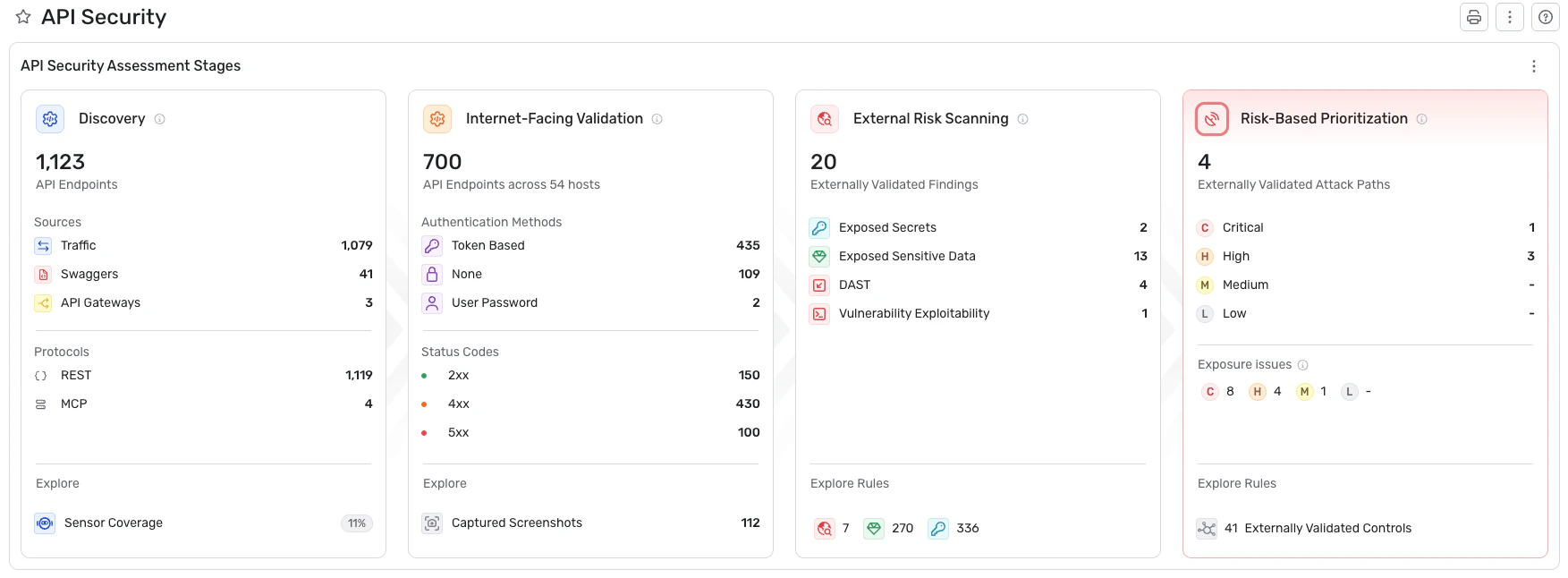
The Wiz Security Graph maps each API to the cloud resources and sensitive data it can reach. An internet-exposed endpoint connected to a database of customer records rises to the top as a toxic combination. To fix it, Wiz Code traces the flaw back to the exact repository and owner. This is how API security posture management works end to end.
The payoff is a shorter path from finding an API risk to fixing it. Your team works from a ranked view of what an attacker could actually reach, with the owner and repository attached to each item, so remediation starts without a round of triage.
Get a demo to watch Wiz trace that loop across your own APIs, from first discovery through the exploitable attack paths that matter most.
Secure APIs from code to cloud
Discover every API and see which risks are truly exploitable in your cloud.
