
What is a cloud security architect?
A cloud security architect designs the security model for cloud environments. That model includes the standards, patterns, controls, and guardrails that engineering teams use when building and operating in the cloud.
It helps to understand how the role differs from similar job titles: A cloud engineer builds and operates cloud environments. A cloud security engineer secures and monitors those environments day to day. A cloud architect designs broader infrastructure patterns for reliability, cost, and scalability. A cloud security architect sits across all of these roles: the architect defines the security framework, reference architectures, and guardrails that guide engineering and cloud teams.
In practical terms, a cloud security architect may define how identities should be managed, how networks should be segmented, how sensitive data should be protected, how cloud accounts or subscriptions should be organized, and how security checks should fit into development workflows.
The role sits between security strategy and cloud implementation. A cloud security architect doesn’t simply write a policy and hand it off: They translate business goals, compliance requirements, threat models, and engineering realities into designs that teams can actually use.
Depending on the organization, the role may support AWS, Azure, Google Cloud, Kubernetes, SaaS applications, AI services, and internal developer platforms. In a smaller company, one architect may cover many of those areas. In a larger enterprise, the role may be more specialized around identity, cloud infrastructure, application security, or regulated workloads.
AWS Security Specialty Exam Prep Guide
Adding an AWS Security Specialty certification to your resume signals deep cloud security expertise.

Why does cloud security architecture matter now?
Cloud environments change constantly. Developers create infrastructure through Terraform; workloads move across Kubernetes clusters; identities are created for humans and machines; and data flows through managed services, APIs, and SaaS platforms.
That speed makes traditional review cycles difficult. If security depends solely on periodic architecture reviews or manual approval steps, risky configurations can reach production before anyone notices.
Cloud security architecture turns security into a repeatable design system. Instead of reviewing every decision from scratch, architects define secure defaults, approved patterns, and automated guardrails that help teams move quickly without introducing risks.
As cloud environments have matured, the role has become more important. Modern cloud risk rarely stems from a single isolated issue. Instead, toxic combinations (for example, a public resource, plus an overprivileged identity, plus sensitive data) often form attack paths. Cloud security architects help teams design systems that reduce these combinations before they cause incidents.
What is Cloud Security Architecture? Principles, Framework, and Assessment
Cloud security architecture is a blueprint for controls. It defines how identity, network boundaries, data protections, and monitoring fit together so teams can build and run cloud services with fewer surprises.
Read more
What does a cloud security architect do?
The exact responsibilities vary by company, but many cloud security architects work across a few core areas:
Secure reference architecture
Cloud security architects create design patterns that teams can reuse. These may include landing zone architectures, account or subscription structures, network segmentation models, logging patterns, encryption standards, and workload isolation rules.
A good reference architecture does more than present a diagram. It explains why the design exists, which risks it reduces, which teams own each control, and where exceptions are allowed. That context helps engineering teams build consistently without turning every project into a new security debate.
Identity and access design
Identity is one of the most important parts of cloud security architecture. Architects define how users, services, workloads, and third-party tools receive access. They set rules for least privilege, role assumption, service accounts, secrets handling, workload identity federation, privileged access management, and machine identity lifecycle governance across service principals, managed identities, and workload tokens.
This work matters because excessive permissions can turn a small exposure into a large breach. A misconfigured workload is bad. A misconfigured workload with broad access to data, keys, and production systems is much worse.
Network and data protection standards
Cloud security architects design how systems communicate. That includes private connectivity, ingress and egress controls, segmentation, firewall rules, service-to-service communication, and exposure management.
They also define data protection standards, including encryption requirements, key management, backup expectations, retention rules, and controls for sensitive datasets. In regulated environments, this work often maps directly to compliance requirements.
Policy as code
Security architecture becomes more effective when it’s enforced through automation. Cloud security architects often work with platform and DevOps teams to turn standards into policy-as-code (PaC) checks.
For example, a standard may require that storage buckets cannot be public, that production databases must be encrypted, and that admin roles cannot be assigned broadly. A policy guardrail turns those standards into checks that run in CI/CD pipelines or cloud control planes before a risky change reaches production.
Common tools and patterns in this area include Terraform, CloudFormation, Pulumi, Open Policy Agent, Kyverno, admission controls, cloud-native policy services, and infrastructure-as-code (IaC) scanning.
Threat modeling and design review
Cloud security architects review systems before they’re built or expanded. They look at how the system handles identity, data, network exposure, dependencies, monitoring, and failure scenarios.
Threat modeling gives that review structure. Instead of just asking whether a system passes a checklist, the architect asks what could go wrong: Which paths could an attacker take? Which controls would slow them down? What evidence would the team need during an incident?
Security roadmap and risk prioritization
Architects also help leadership understand which security investments matter most. They may contribute to risk registers, roadmap planning, architecture decision records, and compliance programs.
This requires more than technical depth. A cloud security architect needs to explain why one risk matters more than another, what the business impact could be, and which fix would reduce the most risk without creating unnecessary friction for engineering teams.
Watch 12-min demo
See how Wiz gives cloud architects unified visibility across multi-cloud environments—the kind of hands-on platform experience that strengthens any resume.

Essential skills for cloud security architects
Cloud security architecture is a senior role because it combines technical breadth, design judgment, and communication skills. You don’t need expert-level knowledge of every tool, but you do need to understand how the pieces interact.
Cloud platform fundamentals
A cloud security architect should understand the core services and security models of at least one major cloud platform, with working knowledge of the others. Important areas include account structure, networking, IAM, logging, encryption, storage, compute, containers, serverless, managed databases, and cloud security services.
Identity and permissions
IAM is a load-bearing skill for this role. Cloud security architects should understand roles, policies, trust relationships, permission boundaries, service principals, federation, secrets, keys, and privileged access.
They should also understand the difference between theoretical least privilege and practical least privilege. The goal is not to block engineering work. The goal is to design access patterns that are narrow enough to reduce the blast radius and usable enough for teams to maintain.
Infrastructure as code and automation
Infrastructure as code (IaC) is where many cloud standards become real. Architects should be comfortable reading Terraform, CloudFormation, Pulumi, or similar templates. They may not write production modules every day, but they need to review infrastructure code credibly and understand where guardrails should run.
Automation also helps architecture scale. A standard that exists only in a document is easy to ignore. A standard that appears in templates, modules, CI checks, and policy engines is much more likely to shape real environments.
Containers and workload security
Many cloud environments run containerized workloads, so Kubernetes and container security are common expectations. Architects should understand clusters, namespaces, network policies, ingress, secrets, RBAC, admission controls, image registries, and runtime visibility.
They don’t need to memorize every Kubernetes object, but they should know how workload design affects isolation, identity, network exposure, and incident response.
Compliance and risk frameworks
Cloud security architects often work with frameworks such as the AWS Well-Architected security pillar, NIST Cybersecurity Framework 2.0, CIS benchmarks, ISO 27001, SOC 2, PCI DSS, HIPAA, or other industry-specific requirements. Strong cloud security architects know how architecture decisions map to control objectives and evidence and audit expectations.
Communication and influence
A cloud security architect spends a lot of time writing and explaining. They write standards, review designs, document tradeoffs, and translate risk for engineers, auditors, executives, and product teams.
Strong communication matters because architecture only works if other teams can follow it. A design that’s correct on a technical level but too complex to adopt will fail in practice.
Cloud security architect career paths
Most cloud security architects start with hands-on technical experience and gradually take on design ownership. There’s no single required path, but several common routes prepare people well for the role.
| Previous role | What transfers well | What to build next | Architecture focus |
|---|---|---|---|
| Cloud engineer | Cloud services, infrastructure operations, automation | Security design, IAM depth, compliance mapping | Secure landing zones and guardrails |
| Cloud security engineer | Posture management, incident response, vulnerability context | Architecture documentation and long-term design strategy | Risk-based cloud security patterns |
| DevOps or platform engineer | CI/CD, IaC, developer workflows, Kubernetes | Threat modeling and policy design | Secure developer platforms |
| Network security engineer | Segmentation, routing, firewalling, connectivity | Cloud networking and identity-aware access | Cloud network security architecture |
| Security analyst or GRC specialist | Risk frameworks, audit requirements, control mapping | Hands-on cloud and IaC experience | Compliance-aligned cloud design |
You don’t need to choose your final specialization immediately. Early on, it’s more useful to build broad experience across cloud infrastructure, identity, networking, automation, and security operations. Over time, you can specialize in areas such as identity architecture, cloud platform security, Kubernetes security, AI security, or regulated cloud environments.
Building hands-on cloud security architecture experience
Certifications can help, especially when changing roles or proving baseline knowledge. Useful options include AWS Certified Security Specialty, Google Professional Cloud Security Engineer, Microsoft Certified: Azure Security Engineer Associate, CCSP, CISSP, HashiCorp Terraform Associate, and CKA for Kubernetes-heavy environments.
Still, hands-on work usually matters more than certifications alone. A strong learning path for cloud security architecture looks like this:
Pick one cloud platform and deeply understand its identity, networking, logging, and encryption model.
Build a small landing zone with separate environments for development, staging, and production.
Use Terraform or another IaC tool to define the environment.
Add IAM boundaries, private networking, encryption defaults, and centralized logging.
Write policy checks that block risky changes before deployment.
Deploy a containerized workload and define its network, identity, and secret access.
Create a simple threat model for the workload.
Document the architecture, tradeoffs, risks, and exception process.
Break the design on purpose, then improve the guardrails.
Publish or share the project in a way that clearly explains your decisions.
This type of project shows more than tool familiarity. It shows that you can design, explain, test, and improve a secure cloud environment.
Salary expectations and job market outlook for cloud security architects
Cloud security architect compensation varies by location, industry, seniority, company size, and whether the number reflects base salary or total compensation.
In the U.S., salary aggregator data commonly places cloud security architect compensation in a wide range. Glassdoor data from 2026 lists the average U.S. cloud security architect salary at around $194,000, with a typical range of roughly $158,000 to $242,000.
Principal and staff-level roles, large technology companies, and roles with equity or bonus-heavy compensation may pay more. Regulated industries may also value architects who understand compliance, identity, data protection, and cloud security controls.
The broader job outlook is strong. The U.S. Bureau of Labor Statistics projects that employment for information security analysts will grow by 29% from 2024 to 2034.
Cloud security architect is a more senior and specialized role than the BLS information security analyst category, but the same market forces apply: cloud adoption, identity complexity, regulatory pressure, AI adoption, and the need to secure distributed environments.
Cloud architect resume: Tips, skills, and examples
Hiring managers scanning cloud architect resumes look for two things quickly: technical depth across platforms and the leadership ability to drive architectural decisions across teams. A strong cloud architect resume reflects both.
Read moreCommon challenges cloud security architects face
Cloud security architects are often asked to solve problems that cross team and tool boundaries. A few challenges show up repeatedly.
Multi-cloud inconsistency
AWS, Azure, and Google Cloud don’t use the same identity models, network defaults, logging formats, or managed service controls. Architects need to create standards that are consistent enough for governance but flexible enough to work across different platforms.
Identity sprawl
Cloud environments create many identities: employees, contractors, service accounts, workloads, CI/CD systems, third-party tools, and AI agents. Each identity needs the right access, and unused or excessive permissions create unnecessary attack paths.
Tool fragmentation
Many organizations use separate tools for cloud posture, workload protection, identity analysis, code scanning, vulnerability management, and incident response. Each tool may be useful on its own, but disconnected findings make it harder to understand which risks matter most.
Prioritization
Not every misconfiguration or vulnerability carries the same risk. A low-severity issue involving sensitive data and an exposed identity may require more attention than a high-severity finding buried in an isolated development environment. Architects need context to separate real business risk from alert volume.
AI and new workload patterns
AI services introduce new architecture questions. Where is training data stored? Which identities can access models? Are model endpoints exposed? Which teams are using managed AI services? Are AI agents receiving permissions that are too broad?
Cloud security architects don’t need to become machine learning engineers, but they do need to understand how AI workloads change data, identity, and runtime risk.
How Wiz supports cloud security architects
Cloud security architects need to answer difficult questions across large environments:
Which cloud resources are exposed?
Which identities are overprivileged?
Which workloads touch sensitive data?
Which findings combine into real attack paths?
Those questions are hard to answer when code, cloud, identity, runtime, data, and AI context live in separate tools. Wiz helps connect that context so cloud security architects can see how risks relate to each other, rather than reviewing isolated findings one by one.
The Wiz Security Graph maps code-to-cloud risk and surfaces real attack paths by correlating vulnerabilities, misconfigurations, network exposure, identity access, and sensitive data in a single risk picture. For cloud security architects, this creates a scalable, secure-by-design foundation without the operational overhead and developer resistance associated with deploying and maintaining agents across every workload. Wiz uses API-driven connectors to provide agentless visibility across virtual machines, containers, and serverless environments, helping teams establish broad coverage quickly and reduce agent fatigue. Architects can then prioritize findings based on reachability, blast radius, and business impact, while using customizable Cloud Configuration Rules (CCRs) and Wiz Code to scan infrastructure as code (IaC) early and apply consistent guardrails across multi-cloud environments before risky configurations reach production.
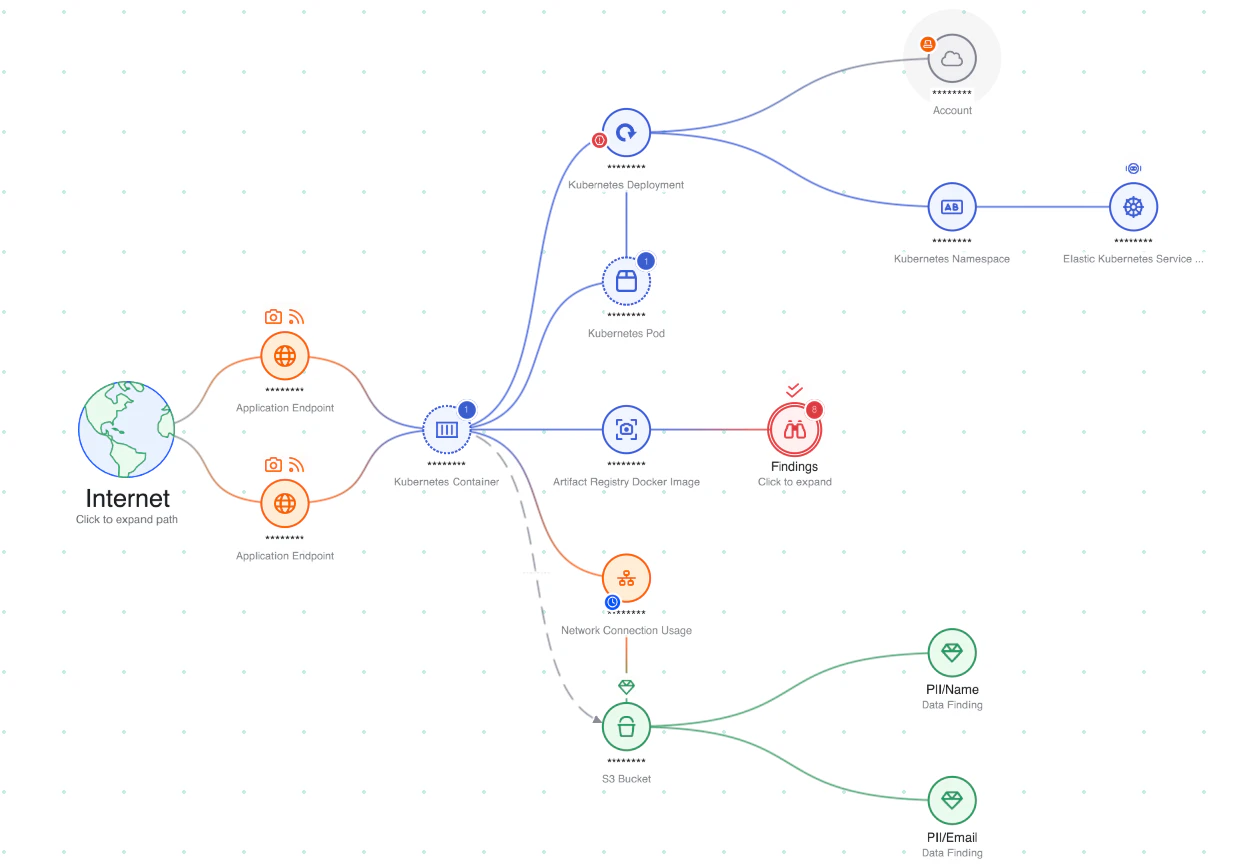
The result is a clearer operating model for cloud security architecture. Architects can define standards, continuously validate them, connect risks across domains, and help teams fix the issues that matter most.
Ready to see how the Wiz Security Graph helps prioritize cloud architecture risk? Request a demo to experience how Wiz unifies context across your cloud environment.
See for yourself...
Learn what makes Wiz the platform to enable your cloud security operation
