
What is a director of compliance?
A director of compliance is the leader responsible for making sure your organization follows regulatory requirements, industry standards, and internal security policies. This means they turn “what we must do” into “what we will build and operate” across your cloud.
This role sits between legal, security, and operations. Legal helps interpret obligations, security helps define controls, and operations and engineering help implement them in real systems.
Compliance is meeting external requirements and internal commitments. Security is preventing, detecting, and responding to threats. They depend on each other because many compliance requirements are demonstrated through security controls operating effectively in production.
In cloud-native organizations, the director of compliance role goes beyond classic IT checklists. It covers infrastructure as code, containers, Kubernetes, serverless, and APIs, because that is where risk lives and where auditors expect evidence.
A big part of the job is translation. A requirement like “restrict access” becomes specific actions like least privilege IAM roles, strong authentication, and tight network paths to sensitive systems.
The job has also shifted from audit scramble to continuous readiness. Instead of collecting proof at the end, you build systems that keep proof as you operate.
Regulatory compliance: Following laws and rules that apply to your business.
Security governance: Deciding what “good security” looks like and making it consistent across teams.
Compliance frameworks: Organized sets of controls, like SOC 2, ISO 27001, or NIST.
Audit readiness: Being able to show evidence of controls quickly, without panic.
Guide to Data Governance and Compliance
This Guide to Data Governance and Compliance in the Cloud provides a straightforward, 7-step framework to help you strengthen your cloud governance approach with confidence.

Core responsibilities of a director of compliance
A compliance director manages strategy and execution at the same time. In practice, that means setting direction, then working with teams to make controls real in cloud configurations and workflows.
Regulatory framework management
Regulatory framework management is choosing which rules apply and keeping them current. This starts with understanding what data you handle, where you operate, and what your customers demand.
Common examples you may need to handle include GDPR, HIPAA, PCI DSS, SOC 2, and ISO 27001. In cloud security, the hardest part is not picking a framework, it is mapping it to technical reality across accounts, regions, and services.
The director of compliance maps high level requirements to cloud controls. They also track changes in regulations and turn those updates into new controls, new checks, or new evidence requirements.
Running multiple frameworks at once is normal and messy. Different teams may run different platforms, and different environments may need different control implementations.
Framework selection: Identify what applies based on industry, geography, and data type.
Control mapping: Translate requirements into technical controls in cloud infrastructure.
Change management: Track updates to regulations and adjust controls without breaking delivery.
Multi framework overlap: Reduce duplicate work by reusing controls across frameworks.
Risk assessment and management
Risk assessment is finding what could go wrong and what would happen if it does. In cloud risk management, this is not abstract, it is tied to real paths like “public endpoint → vulnerable workload → high privilege identity → sensitive data.”
A compliance director runs risk assessments to spot compliance gaps and security weaknesses. They prioritize risk based on business impact, how likely it is, and what the regulatory fallout could be. That's why modern programs tie risk scoring to context like external exposure, privilege level, and reachable sensitive data, not just a control checklist.
They also build a risk treatment plan. That plan decides what you will fix, what you will mitigate with compensating controls, and what you will formally accept with leadership sign off.
Progress tracking matters because the board and executives want clarity. The compliance director reports where the risk is, what changed, and what is still open.
Risk assessment: Identify compliance gaps and security vulnerabilities tied to real cloud resources.
Prioritization: Rank risks by impact, likelihood, and regulatory consequence.
Treatment planning: Choose fix, mitigate, accept, or transfer.
Executive reporting: Track remediation and communicate what is improving and why.
Policy development and enforcement
A security policy is a rule your organization adopts. This means it tells teams what they must do, like “encrypt storage” or “use least privilege.”
Good policies are specific enough to implement and flexible enough to operate. Bad policies are either vague slogans or strict rules that teams bypass.
Policy as code turns policies into automated checks. This means a rule can evaluate infrastructure as code or cloud configurations and flag or block noncompliant changes.
Exceptions are part of reality, so you need a controlled process. A compliance director sets up a path for exceptions with approvals, time limits, and audit trails, so you can move fast without losing control.
Regular policy reviews keep policies aligned with how you actually build. Cloud architectures change quickly, so policies must keep pace.
Policy writing: Create clear, implementable security policies tied to real controls.
Policy as code: Enforce policies automatically in code and cloud workflows.
Exception handling: Allow safe exceptions with approvals and traceable records.
Policy maintenance: Review and update policies as architectures and threats change.
Audit coordination and evidence collection
Audit coordination is managing the process of proving your controls work. This includes prepping evidence, answering auditor questions, and making sure the story is consistent.
Evidence collection is easier when it is continuous. In cloud environments, evidence should come from your systems of record, like configuration data, logs, access reviews, and ticketed remediation.
A strong audit trail shows control effectiveness over time. For example, it is more convincing to show that encryption stayed enabled and that exceptions were tracked, not just a screenshot from audit week.
Modern platforms can automate large parts of evidence gathering, but the director of compliance still validates that the evidence matches the control. Automation helps, but it does not replace judgment.
Audit management: Plan audits, coordinate interviews, and keep evidence organized.
Continuous evidence: Collect proof as you operate, not only before audits.
Audit trails: Show control effectiveness across time, not just at one moment.
Evidence validation: Confirm that evidence actually proves the control, not just activity.
Training and awareness programs
Training and awareness is making sure people know what is expected of them. This means training must match roles, so developers learn different things than finance or HR.
Developer training should connect compliance requirements to real engineering behavior. For example, “protect secrets” becomes “do not hardcode tokens, use a secret manager, and restrict runtime permissions.”
Compliance training must be measured and improved. A common failure mode is treating training as a checkbox, which creates completion but not behavior change.
Audit findings and incidents are feedback. A strong compliance director uses those events to adjust training so teams stop repeating the same mistakes.
Watch 12-min demo
Watch the demo to learn how Wiz Cloud finds toxic combinations across misconfigurations, identities, data exposure, and vulnerabilities—without agents.
Watch now
Essential skills and qualifications for modern compliance directors
Cloud compliance requires a mixed skill set. You need enough technical depth to understand what teams are doing and enough regulatory strength to defend your program to auditors and leadership.
Technical cloud security knowledge
Cloud security knowledge is understanding how cloud services actually work and where compliance controls must live. This means you can reason about risk in IaaS, PaaS, and SaaS systems, and you understand what the cloud provider secures versus what you must secure.
Where controls live in cloud-native environments:
Identity plane: SSO integration, IAM policies, service accounts, federated identity (AWS IAM, Azure AD, GCP IAM)
Network plane: Ingress/egress rules, VPC configurations, private endpoints, WAF policies
Data plane: Encryption at rest and in transit, data classification, key management (KMS)
Build plane: CI/CD pipeline security, IaC scanning, artifact signing, secrets management
Runtime plane: Kubernetes admission controllers, serverless function permissions, container security
Audit plane: CloudTrail, Azure Activity Logs, GCP Audit Logs, SIEM integration, log retention
You also need working familiarity with containers, Kubernetes, serverless, and API security. These are common areas where misconfigurations and identity mistakes create real exposure.
Identity and access management matters because permissions are often the shortest path to impact. Network segmentation and encryption also matter because they reduce blast radius and protect sensitive data.
CI/CD and infrastructure as code knowledge is important because most cloud is created by pipelines. If you cannot put controls in the pipeline, you will always be reacting after deployment.
IaaS, PaaS, SaaS: Know the shared responsibility differences and where controls must live.
IAM: Understand roles, policies, service accounts, and least privilege patterns.
Network and encryption: Know how reachability and data protection change real risk.
CI/CD and IaC: Know how to shift controls left so issues do not reach production.
Regulatory and framework expertise
Framework expertise is knowing how frameworks are structured and how auditors test them. This means you understand what controls exist, what counts as evidence, and what “effective” looks like.
Frameworks overlap, but they do not match perfectly. A compliance director reduces duplicated controls by mapping requirements to a smaller set of core controls with clear owners.
Staying current requires a steady cadence, not a once a year review. In practice, that means using legal counsel, industry groups, and internal change management to track what changed and what it affects.
Translation is the key skill. You must turn policy language into controls teams can implement and measure.
Framework fluency: Understand control intent and testing approach.
Overlap mapping: Reuse controls across frameworks to reduce effort.
Change tracking: Keep up with evolving requirements and guidance.
Control translation: Convert requirements into technical, testable controls.
Cross-functional collaboration abilities
Collaboration is the day to day job. You are successful only if security, engineering, and operations can adopt controls without constant friction.
You must communicate clearly with executives and boards. This means you explain risk using business impact, not only technical detail.
You also need a strong working relationship with auditors. That means responding quickly, staying consistent, and making it easy for them to validate controls without slowing your teams.
Good collaboration also means knowing when to push and when to adapt. Compliance is not “no,” it is “yes, safely.”
Engineering alignment: Fit controls into how teams ship and operate.
Security partnership: Align compliance controls with threat detection and response.
Executive communication: Translate technical risk into business impact.
Auditor management: Keep audits efficient and predictable.
Automation and tooling proficiency
Automation proficiency is knowing what tools can do and where they fail. This matters because manual compliance does not scale in multi-cloud environments.
You need to evaluate platforms for automated scanning, reporting, and evidence. You also need to understand how policy as code and automated remediation workflows reduce risk faster than tickets alone.
Measuring effectiveness is part of the job. If you cannot show that your compliance investment reduces risk and effort, you will not keep support long term.
Key metrics compliance directors track:
Audit findings by severity: Number of high/medium/low findings per audit cycle, trending over time
Time-to-evidence: Average time to produce requested evidence during audits (target: hours, not days)
Continuous monitoring coverage: Percentage of controls with automated, continuous assessment
Exception aging: Average age of open exceptions, percentage past expiry date
Patch SLA adherence: Percentage of scoped systems meeting defined remediation timelines
Drift mean-time-to-remediation (MTTR): Average time from drift detection to compliant state restoration
Policy adoption rate: Percentage of CI/CD pipelines with policy-as-code enforcement enabled
Automation scope: Know what can be automated safely and what needs review.
Tool evaluation: Choose tooling that supports continuous compliance and evidence.
Workflow design: Build policy and remediation flows that reduce back and forth.
ROI thinking: Track time saved and risk reduced, not just tool adoption.

How compliance directors integrate with security operations
Compliance works best when it is built into security operations. This means compliance is not a separate program, it is a layer of intent and evidence on top of how you already secure and run cloud systems.
Aligning compliance controls with security posture management: Security posture management checks cloud configurations against safe baselines. Compliance requirements become posture rules that check for issues like public storage, missing encryption, or weak identity controls. Posture data gives you evidence of controls applied consistently and shows when drift happened and how it was fixed. Continuous assessment makes posture useful for both security and compliance because point in time checks are weaker in cloud environments that change constantly.
Integrating compliance into vulnerability management: Vulnerability management finds and fixes known software flaws across VMs, containers, and serverless packages. Compliance changes how you prioritize vulnerabilities by combining severity with exposure and asset criticality. A compliance director tracks remediation timelines because some frameworks expect defined patch SLAs, and evidence includes the vulnerability finding, the fix, and proof that the fix reached production.
Embedding compliance in incident response: Incident response is the process you follow when something goes wrong. Compliance adds specific requirements during incidents, including breach notification timelines (such as GDPR's 72-hour requirement or HIPAA breach rules), customer contract obligations, and documentation expectations for post-incident audits. A compliance director makes sure the plan covers those needs before an incident happens, and documentation becomes evidence of what happened, what you did, and whether controls performed as expected.
Supporting DevSecOps with compliance guidance: DevSecOps builds security into how you ship software, which means compliance controls must live in the same places developers work, like pull requests and CI pipelines. A compliance director provides guidance that teams can act on, and automated compliance checks in CI/CD reduce late surprises by giving developers feedback while they still have context. The goal is guidance, not gatekeeping.
Career path and compensation for compliance directors
Most compliance directors start closer to the work and grow into strategy. This means you build your base in audits, controls, and security operations before you lead the full program.
Typical career progression
A common path is compliance analyst to senior compliance analyst to compliance manager. As you move up, you shift from doing tasks to building systems that scale across teams.
Some directors come from security operations, GRC, or audit backgrounds. The shared skill is learning how to turn requirements into controls, then proving those controls work.
The step from tactical to strategic is real. You stop owning single audits and start owning the operating model.
Many directors can grow into chief compliance officer or CISO roles. That usually requires showing you can lead cross functional change, not just pass audits.
Salary ranges and factors
Compensation varies by industry, company size, and how complex your environment is. The more cloud platforms, frameworks, and audit scope you own, the more the role typically pays.
Compensation drivers for compliance directors:
Framework scope: Number of concurrent frameworks (SOC 2, ISO 27001, HIPAA, PCI DSS, FedRAMP)
Cloud complexity: Number of cloud providers, accounts/subscriptions, and regions managed
Regulated data types: PII, PHI, PCI, classified data, or financial records
Geographic scope: Single-region vs. global operations with varying regulatory requirements
Audit cadence: Annual vs. continuous audit cycles, customer security review volume
Team size: Individual contributor vs. managing analysts and GRC specialists
M&A integration: Responsibility for acquiring and integrating compliance programs
Cloud security expertise can increase compensation because it reduces translation gaps with engineering teams. In practice, directors who can understand real cloud attack paths can focus programs on higher impact controls.
Team size and audit complexity also matter. A director managing multiple frameworks across multiple business units usually has broader scope than one supporting a single product.
Highly regulated industries often pay more because the cost of failure is higher. The role may include more audits, more reporting, and tighter remediation expectations.
Professional development and certifications
Certifications are common because they give a shared vocabulary for auditors and teams. Examples include CISA, CISSP, and CRISC.
Cloud focused certifications also help because you need to understand how controls work in AWS, Azure, and GCP. Privacy certifications like CIPP can matter if your compliance program includes privacy obligations.
Ongoing learning matters because frameworks evolve and cloud services change. The best compliance directors keep technical skills current so controls match how systems are built today.
Maintaining both regulatory and technical depth keeps you credible. When you can speak to both auditors and engineers, you can move faster with less friction.


How Wiz supports cloud compliance programs
Wiz helps compliance teams meet regulatory requirements through automated assessment, continuous monitoring, and unified visibility across all cloud environments. Instead of jumping between tools and accounts, you get a single view of your assets, their configurations, and their risk context.
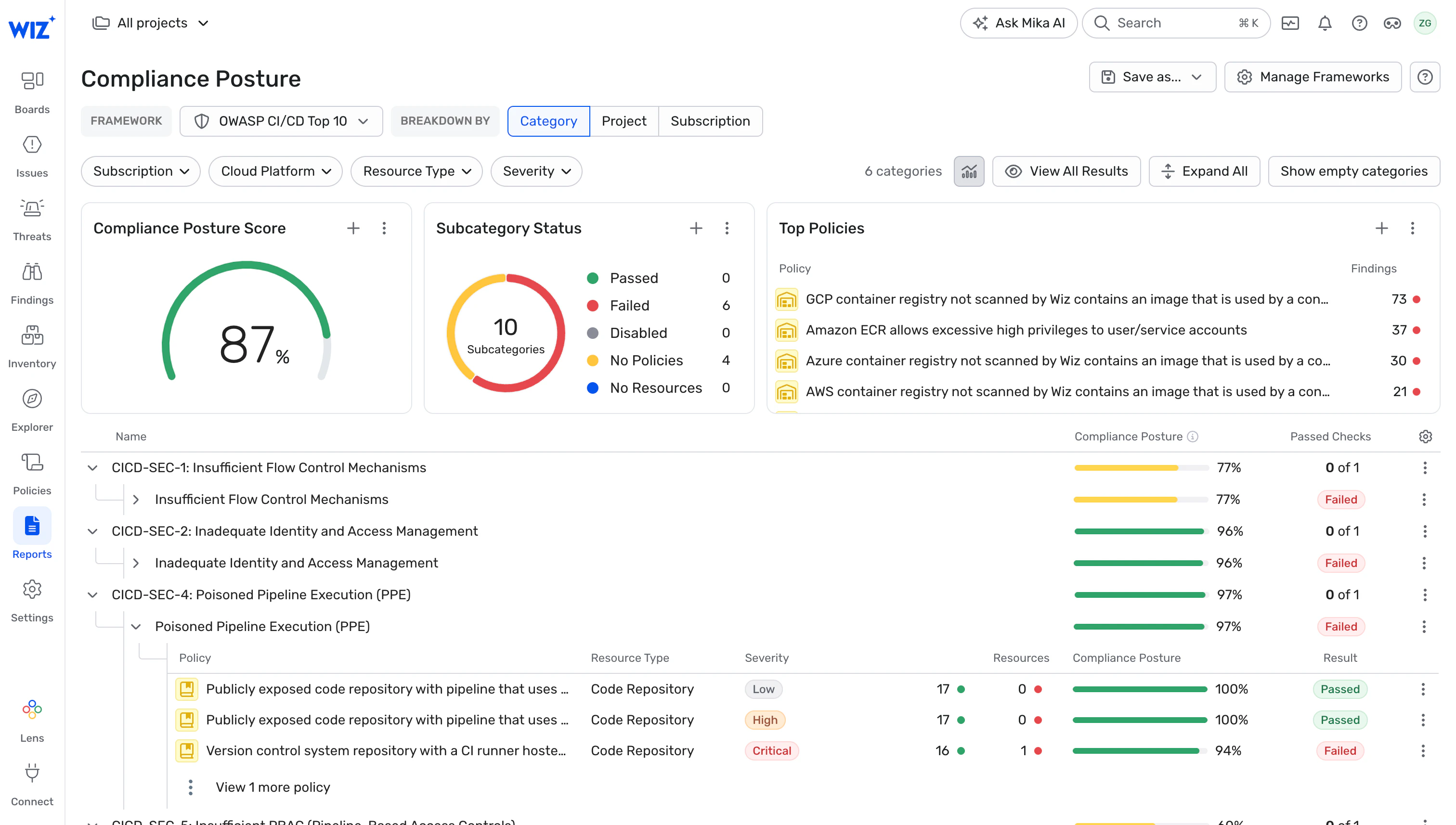
Evidence collection becomes continuous rather than manual. Wiz scans your cloud against compliance frameworks and maintains historical posture data, so you can demonstrate how controls performed over time, not just at a single point during audit week.
The Security Graph connects compliance findings to real attack paths, so you can prioritize based on actual risk. A misconfiguration matters more when it creates a path to sensitive data through vulnerable workloads and overprivileged identities, and the graph shows you exactly when that happens.
Agentless scanning provides broad coverage without operational overhead. You avoid gaps from missed systems or unmanaged workloads, and your teams avoid deploying and maintaining agents across your environment.
Wiz Code shifts compliance checks left by scanning infrastructure as code before deployment. This means you catch risky configurations early, when fixes are fast and cheap, before they reach production.
Built-in dashboards track compliance posture over time, and AI-powered remediation guidance helps teams resolve issues faster while maintaining the audit trail you need for evidence.
Wiz also surfaces toxic combinations—clusters of issues that create serious risk when they occur together. This helps you move from checkbox compliance to risk-based compliance, where you focus effort on what actually threatens your environment. Get a demo to see how Wiz can help you build continuous compliance into your cloud security program.
See for yourself...
Learn what makes Wiz the platform to enable your cloud security operation
