


What is container runtime security?
Container runtime security is the set of practices, tools, and controls that protect containers during active execution in production environments. Securing containers during live operation requires different controls from checks at build time. Container runtime security monitors and enforces protections during the execution phase of operating system virtualization, when containers gain network access, load dependencies, and activate permissions, revealing actual attack surfaces. That distinction matters because vulnerabilities that appear harmless in a static scan often turn exploitable once a container is live and connects to cloud infrastructure, identities, and sensitive data.
Each phase of the container lifecycle presents distinct security challenges:
Build-time security: Scans container images and code to catch known vulnerabilities in the CI/CD pipeline.
Deployment security: Enforces admission control policies and validates configurations to ensure containers launch with proper permissions and network restrictions.
Runtime security: Monitors active containers for behavioral anomalies, privilege escalation attempts, and threats that only emerge when workloads execute with live network connections and loaded libraries.
Threats mitigated at build time can resurface at runtime. Configuration drift might reintroduce a patched vulnerability by altering file permissions or dependency versions that differ from the scanned baseline. Continuous security across the entire lifecycle catches these gaps before attackers exploit them.
Security teams, developers, and platform engineers share responsibility for runtime protection. While shifting left catches issues early, runtime security ensures those controls remain effective as containers enter dynamic environments where configurations can drift.
Most prevalent threats at runtime
Runtime threats exploit active conditions that build-time vulnerabilities can’t predict. While static scans identify known bugs, the following threats only manifest when containers interact with live networks, identities, and host kernels.
| Threat | Description |
|---|---|
| Configuration drift | Unintentional post-deployment changes alter a container's secure baseline, manifesting as live file or network modifications, often due to manual errors or automated processes. Static scans miss these gaps because the drift occurs after the initial build phase. |
| Malicious code execution | Code injections insert malicious logic into applications, triggering data breaches and system crashes as logic paths activate. Static scans miss these attacks since they exploit live memory and unvalidated inputs. |
| Malware in container images | Malware enters through untrusted repositories or compromised dependencies, manifesting as active payloads triggered only after containers go live. Static scans can’t catch these threats because hidden code stays dormant until it reaches production. |
| Privilege escalation attacks | Exploits gain higher privileges within a container or host system, resulting in unauthorized access to underlying resources. Static scans can’t catch these risks since escalation paths rely on dynamic process interactions that aren’t present in static images. |
| Kernel exploits | Vulnerabilities in the shared host kernel compromise all containers on a node, breaking isolation across every workload. Static scans miss these flaws because the host kernel exists outside the container image. |
| Secrets leakage | Unwanted exposure of sensitive information, such as API keys or database credentials, occurs when secrets leak into logs, memory, or runtime settings during use. Static scans miss these leaks because the secrets only appear once the container is active. |
Understanding these threats helps organizations secure their container environments during runtime. The following section will explore how container runtime security actually works at the kernel level.
Advanced Container Security Best Practices [Cheat Sheet]
What's included in this 9 page cheat sheet? 1. Actionable best practices w/ code examples + diagrams 2. List of the top open-source tools for each best practice 3. Environment-specific best practices

How container runtime security works
Container runtime security combines controls and detections that monitor container activity in real time, blocking or alerting when behavior violates your rules. In practice, that means controlling what processes can do on the host kernel and spotting activity that doesn’t match how the workload normally runs.
Most runtime controls sit near the Linux kernel because workloads ultimately request access to files, networks, and privileges there.
Five core building blocks show up across nearly every approach:
System call monitoring and filtering: A system call is a request a process makes to the kernel, like opening a file or creating a network connection. Security tools intercept these requests at the kernel interface to validate hardware interaction against security policies. Runtime tools monitor these calls to flag patterns of command execution, persistence, or escape attempts linked to malicious code.
Seccomp profiles: Seccomp is a Linux feature that lets you allow or deny specific system calls for a container. Tight profiles prevent risky actions, even if an attacker gets code execution within the container. Isolation removes the low-level functions exploited during runtime attacks to stop kernel exploits.
Linux capabilities: Capabilities split “root power” into smaller privileges, like the ability to change network settings. Dropping capabilities limits what an attacker can do after a compromise, even if the process runs as UID 0 inside the container. The restriction directly counters privilege escalation.
AppArmor or SELinux policies: AppArmor and SELinux are mandatory access control systems that constrain which files, paths, and actions a process can access. They reduce the blast radius when an app is exploited, especially around sensitive host paths or mounts. Enforcement ensures compromised apps can’t access unauthorized data, preventing secrets leakage.
Behavior rules and anomaly detection: This is where security teams define “expected behavior,” like which binaries can run, which outbound destinations are normal, and what files should never be modified. The baseline catches configuration drift that static scans miss.
Imagine a web API container that normally runs a single binary but suddenly spawns /bin/sh to make outbound connections to an unfamiliar IP on a high port. Even if the image scan shows only low-severity CVEs, runtime signals like unexpected shell execution and new egress are often the first clues to a compromised container serving as a foothold.
Effective defense requires layering two distinct security modes:
Enforcement (seccomp, AppArmor): Proactive hardening to block unauthorized actions at the kernel level.
Detection (behavioral baselining): Active visibility that triggers alerts the moment logic deviates from a known standard.
The goal is simple: make high-risk actions harder to perform and make suspicious behavior easy to spot. Runtime security works best when you pair prevention controls like seccomp and capability dropping with detection tuned to active workloads, ensuring resilience against threats static scans miss.


Runtime security in Kubernetes
In Kubernetes environments, runtime security extends beyond individual container controls to encompass orchestration-layer protections. Kubernetes adds orchestration-layer attack surfaces that don't exist in standalone containers. Vulnerabilities in the NodeRestriction admission controller, for example, could allow users to delete their own node objects. Exposed etcd interfaces, misconfigured API servers, and overly permissive network policies create entry points that attackers target specifically because they provide cluster-wide access rather than single-container compromise.
Kubernetes-specific threats
Kubernetes environments face orchestration-specific threats:
Exposed etcd interfaces: Since etcd stores all cluster state and secrets, direct access lets attackers read credentials, modify configurations, or delete workloads across the entire cluster.
Insecure API server configurations: Anonymous authentication or missing role-based access control (RBAC) allows attackers to create pods, exfiltrate secrets, or pivot to other cloud resources.
Misconfigured network policies: Default allow-all policies let compromised pods communicate freely, enabling lateral movement to databases, internal APIs, and other sensitive services.
Runtime security in Kubernetes extends beyond individual container controls to include orchestration-layer protections. In modern DevOps cultures, security no longer stays confined to specialized security teams—it’s a shared responsibility across platform teams, developers, and security teams.


Security policies and best practices
Implementing and enforcing security policies can significantly reduce attack risks. Some best practices include:
Pod Security Admission: Use built-in Kubernetes controls to enforce pod security standards and restrict resource access.
RBAC: Enforce RBAC to ensure that users and processes operate with the minimum necessary access rights, shrinking the potential attack surface.
Network policies between pods: Apply strict ingress and egress rules to isolate workloads.
Security audits and continuous compliance: Use Kubernetes auditing to identify and fix vulnerabilities and track compliance as configurations evolve.
The next section explores strategies to discover runtime risks in your environment to further strengthen your security posture.
Container Security Buyer's Guide
Learn what makes Wiz the platform to enable your cloud security operation

Discovering and responding to runtime risks
Finding runtime risks before an attacker does requires visibility into what a container is actually doing in production. A static scan misses live threats, so a team should deploy these strategies to detect and remediate an active exploit:
Continuous real-time scanning
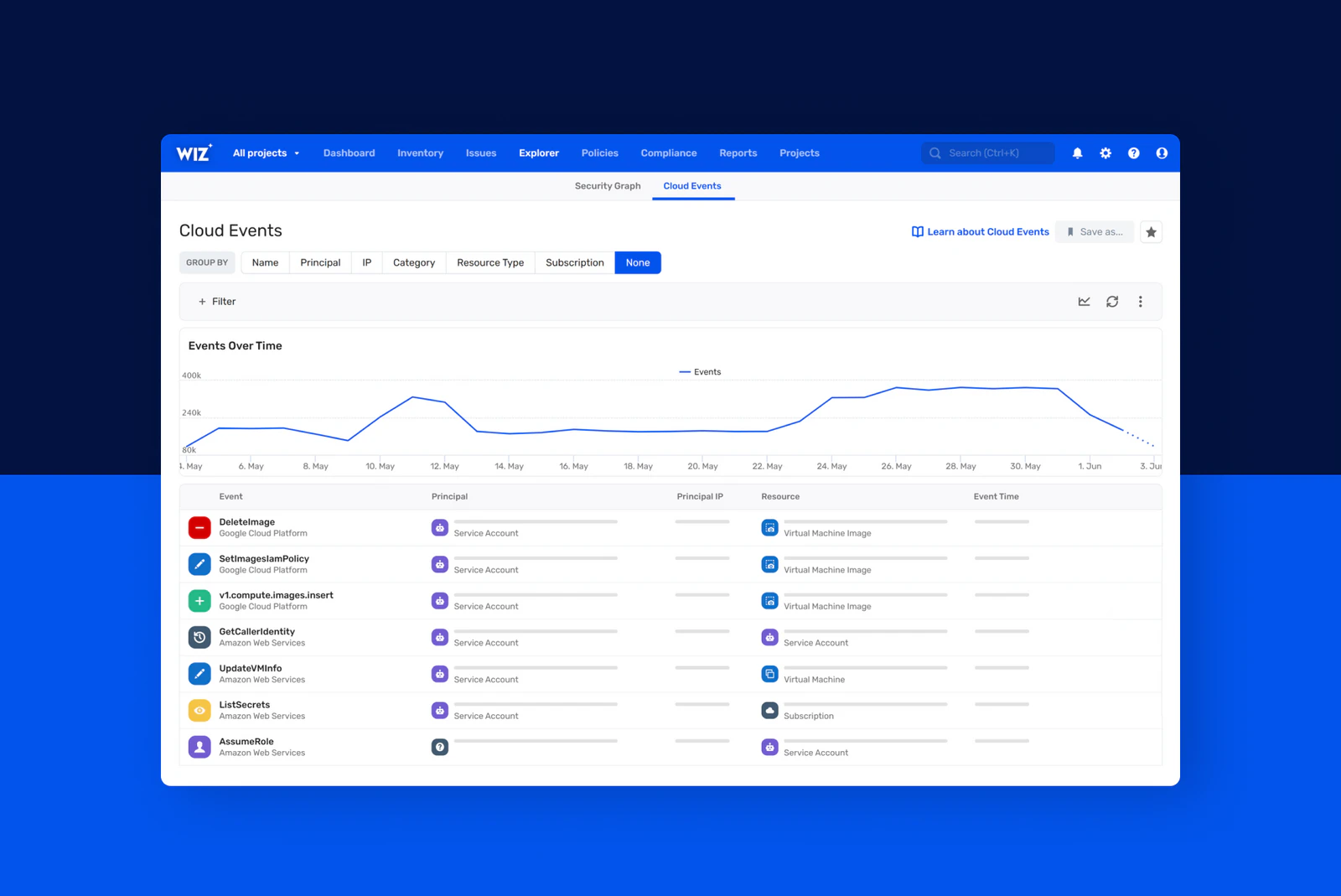
Real-time monitoring tracks system calls, network connections, and process execution as they occur. When a container spawns an unexpected shell, attempts to access the host filesystem, or initiates outbound connections to unknown endpoints, alerts trigger immediately rather than waiting for a scheduled scan.
Mapping and analysis
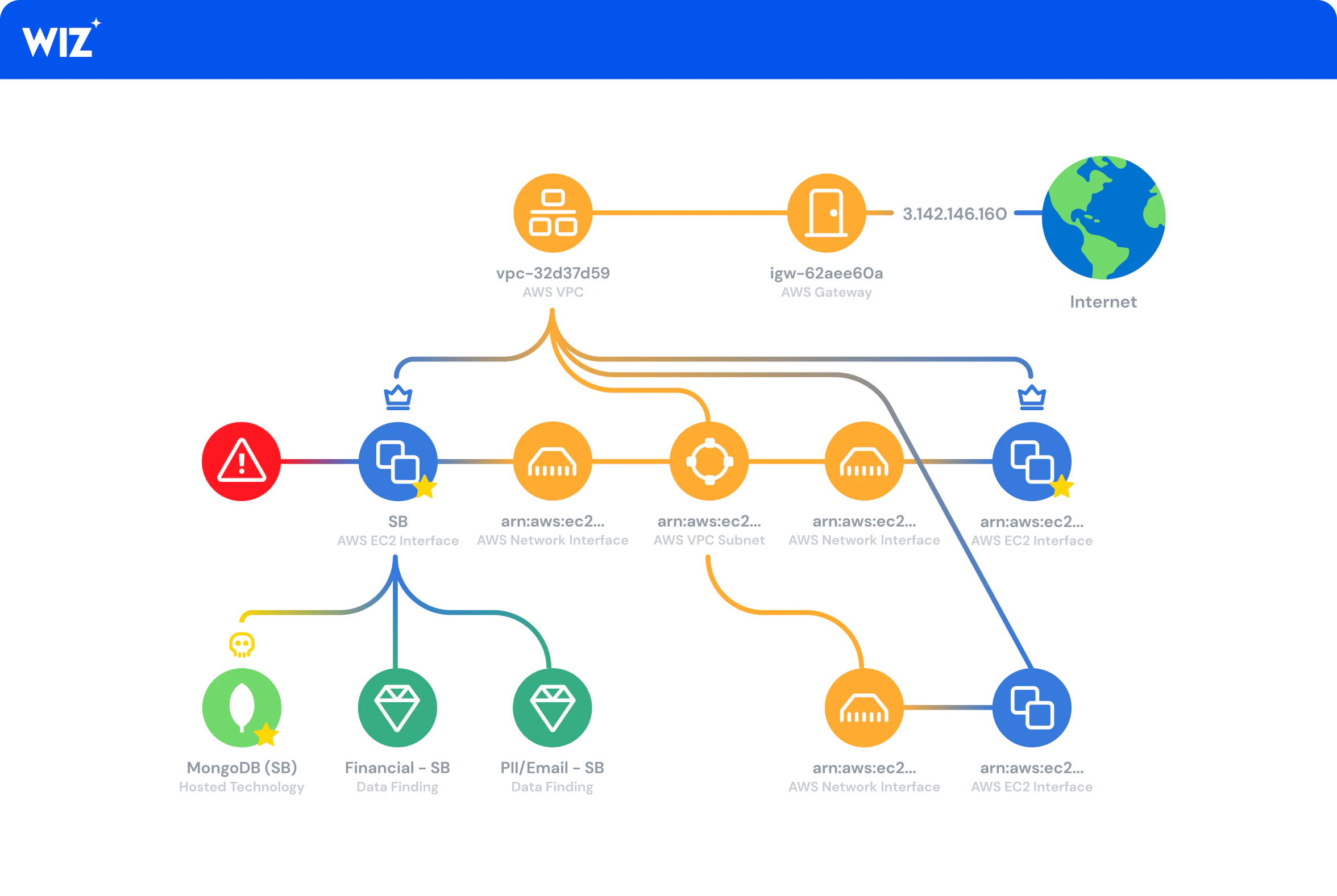
Mapping shows which containers can reach which services, what permissions they hold, and how data flows between components. Visibility reveals attack paths that individual container scans miss, such as a low-privilege container that can access a database through an overly permissive network policy or service account.
Snapshot scanning
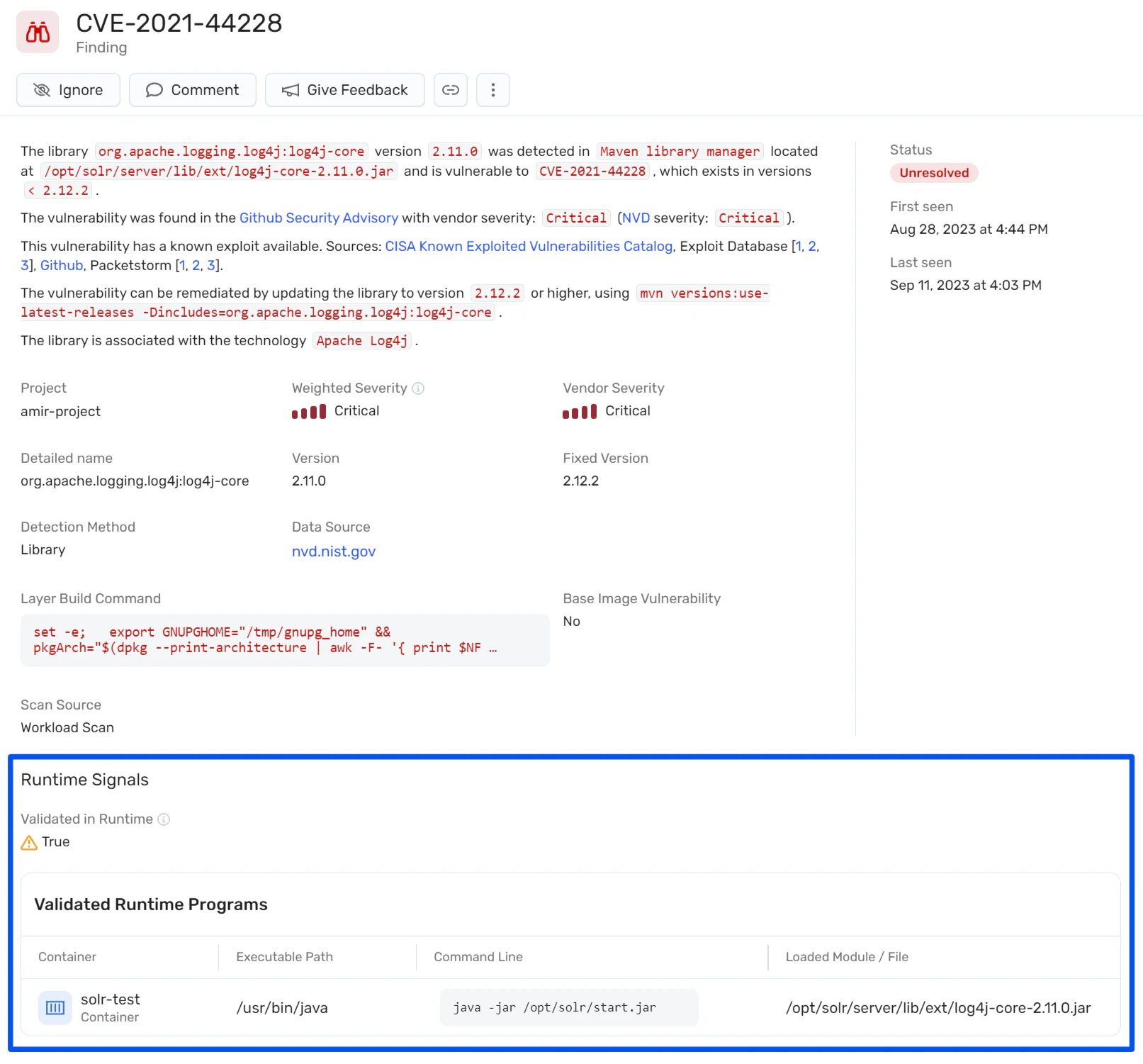
Snapshot scanning captures the state of running containers at specific intervals and analyzes their contents for vulnerabilities. These snapshots reveal which packages and libraries actually load into memory compared to what was present in the original image. Capturing this data uncovers drift from the scanned image and identifies vulnerabilities introduced by runtime package installations.
Behavioral analytics
Behavioral analytics establishes baselines for normal container activity, including typical system calls, network connections, file access patterns, and resource usage. When a container that normally reads only from a database suddenly writes to the filesystem or initiates connections to external IPs, the deviation triggers investigation. Monitoring baselines catches attacks that use legitimate binaries in unexpected ways.
Standalone runtime tools often don’t include cloud context. Effective runtime response requires unified visibility across the cloud environment, so platforms must correlate these signals to show which runtime risks create actual attack paths. Connecting workload identity, network exposure, and data access reduces noise and ensures teams focus on what matters.
Container Runtime Security
Container runtime security is the combination of measures and technology implemented to protect containerized applications at the runtime stage.
Read more

Wiz's approach to container runtime security
Wiz Runtime Sensor catches threats as they happen by monitoring every process and container on your cluster nodes. The sensor spots malware execution, reverse shell attempts, and sensitive file modifications in real time through kernel-level visibility and behavioral monitoring. Beyond detection, the sensor validates which vulnerabilities actually load into memory during execution. Comparing active execution against theoretical risks allows teams to prioritize remediating the risks that matter most. For example, a CVE in a package that never runs poses less risk than one in an actively loaded library.
For teams building new containers, WizOS offers minimal, secured base images with near-zero CVEs. Starting from a trusted foundation reduces inherited risk before containers ever reach production. The sensor injects these runtime signals into the broader Wiz CNAPP. By correlating runtime events with cloud identities, network exposure, and data access, Wiz cuts alert fatigue and exposes critical attack paths that siloed tools miss.
According to Wiz Research's Kubernetes Security Report, the proportion of publicly exposed pods with high or critical-severity vulnerabilities dropped 50% between 2023 and 2024. The decline reflects improved vulnerability management practices across the industry as teams adopt unified visibility. Consolidating your security stack ensures that every deployment stays secure from code to runtime.
Ready to see Runtime Sensor and WizOS in action? Request a demo today.
Agentless Container Security
See how teams achieve comprehensive container security without slowing down development. Schedule your personalized demo.
