


What are threat detection tools and why they matter for cloud security
Threat detection tools watch your cloud environment for trouble. They analyze logs, identity activity, and runtime behavior to spot attacks, policy violations, and suspicious activity as they happen.
Cloud detection commonly relies on cloud audit logs, control plane activity, identity and access behavior, workload and container runtime signals (including eBPF-based telemetry for kernel-level visibility), and endpoint and network telemetry. These data sources provide comprehensive coverage across infrastructure, identity, and application layers.
Cloud teams use threat detection to identify active compromise or abuse, detect misconfigurations being exploited, and respond to suspicious identity and access activity.
Detection is most effective when paired with environment context and preventive controls. Context enrichment, such as asset relationships, identity permissions, and exposure status, transforms isolated alerts into prioritized incidents with clear remediation paths. Without context, alerts can become overwhelming noise rather than actionable intelligence.
The 2026 Cloud Threat Report
See the latest cloud attack trends shaping detection strategies.

See Wiz Defend in Action
Key capabilities to evaluate
Not all detection tools are created equal. The capabilities below separate platforms that generate actionable insights from those that bury your team in noise. When evaluating options, go beyond surface-level feature lists and ask vendors to walk through real examples of how each capability operates in practice.
Telemetry coverage
A detection tool is only as good as what it can see. Gaps in telemetry coverage translate directly into blind spots where attackers can operate undetected. In cloud environments, those gaps tend to appear at the seams: cross-account activity, short-lived workloads, third-party SaaS integrations, and identity provider events that live outside traditional infrastructure monitoring.
[Lottie Block] 1727347000-cloud-incident.json
Evaluate coverage across cloud audit logs, identity providers, container and Kubernetes activity, and runtime signals. Pay close attention to how each platform handles multi-cloud environments. Some tools add coverage for additional clouds as an afterthought, resulting in fragmented data models and detections that don’t translate consistently across providers. Others treat multi-cloud as a core design principle, normalizing telemetry into a unified schema so the same detection logic works regardless of whether activity originates in AWS, Azure, or GCP.
Deployment friction is another critical factor. Agent-based approaches can provide deep runtime visibility but introduce significant operational overhead, especially in environments built around ephemeral containers and autoscaling workloads. Maintaining agents across thousands of short-lived resources is non-trivial. Agentless, API-based approaches reduce that burden but may sacrifice certain low-level signals. The strongest platforms offer both and allow teams to choose the right balance based on workload risk and operational capacity.
Detection methods
Most detection platforms advertise a broad mix of techniques: rules, signatures, behavioral analytics, anomaly detection, and machine learning. The more important question is how effectively these methods work together, particularly for cloud-native attack patterns.
Rules-based detections remain essential for catching known bad activity such as malicious binaries, connections to known threat infrastructure, or API actions that should never occur in a production environment. However, many modern cloud breaches rely on living-off-the-land techniques, where attackers use legitimate credentials and native cloud services in unexpected sequences rather than obvious malware.
Detecting these attacks requires behavioral baselines that understand what is normal for a given identity, workload, or service, combined with sequence-aware logic that recognizes suspicious chains of activity. Be cautious of platforms that generate anomaly alerts without meaningful context. An alert stating “unusual API call volume” rarely drives action. An alert explaining that a service account that normally performs read-only storage access just created new access keys, elevated privileges, and accessed sensitive resources from an unfamiliar network is immediately actionable.
The difference lies in whether the detection engine understands relationships and intent, not just statistical deviation.
Context enrichment
Context is where most detection tools either deliver value or create friction. When an alert fires, analysts often spend their first thirty minutes manually gathering basic information: what resource is affected, what permissions the identity has, whether the asset is exposed to the internet, and whether sensitive data is involved.
Platforms that share a unified data model with cloud security posture management eliminate much of this manual work. When asset relationships, identity permissions, exposure paths, and data classifications are already known, the detection engine can surface this context automatically at alert time.
This isn’t simply a productivity improvement. Context fundamentally determines risk severity. A compromised identity with limited access to development systems presents a very different threat than one with administrative permissions over production environments containing regulated data. Tools that lack this enrichment tend to either flood teams with low-value alerts or miss the combinations of conditions that truly signal material risk.
Effective context enrichment allows security teams to prioritize based on business impact, not just technical indicators.
Automation and investigation support
Cloud incidents unfold rapidly. With valid credentials, attackers can enumerate resources, escalate privileges, and establish persistence within minutes. Investigation workflows that rely on manual log searches, spreadsheet tracking, and constant tool switching struggle to keep pace.
Evaluate how the platform supports investigations end to end. Strong tools automatically assemble timelines of related activity, trace blast radius through asset and identity relationships, and highlight both what happened and what could have been accessed based on effective permissions.
Look for guided or automated response actions that remove repetitive work while keeping humans in control of critical decisions. Suggested containment steps, one-click credential revocation, or automated isolation of compromised workloads can dramatically reduce response time.
The goal is not full automation of incident response. It is eliminating the mechanical work that slows analysts down so they can focus on validation, decision-making, and proactive threat hunting.
Operations and governance
Even the most advanced detection capabilities can fail if operational realities make a platform difficult to scale, govern, or justify financially. These practical considerations often determine long-term success.
Cost model clarity Pricing structures vary widely across the market. Per-GB ingestion models can force uncomfortable tradeoffs between cost control and comprehensive visibility. Per-asset pricing scales more predictably but may penalize environments with high churn and ephemeral resources. Understand not only current spend but how costs evolve as your cloud footprint grows.
Retention and compliance Different regulatory frameworks impose different log retention requirements. Confirm that required retention periods are supported without cost structures that make compliance impractical. Also verify that stored logs meet tamper-evidence and auditability expectations.
Data residency Organizations operating across regulated regions must confirm where detection data is stored and processed. Regional deployment options are often a requirement rather than a preference.
Access control and multi-tenancy Granular RBAC is essential for enforcing least privilege while supporting collaboration between analysts, investigators, administrators, and compliance teams. For MSSPs and large enterprises, multi-tenant isolation is critical to ensure both confidentiality and operational clarity.
Integration and augmentation Detection tools rarely operate alone. Confirm seamless integration with SIEM platforms for long-term analysis, SOAR for response automation, ticketing systems for workflow management, and MDR providers for 24/7 monitoring.
Tool categories
The threat detection landscape has evolved into several overlapping categories, each designed to address different parts of the attack surface. While vendors increasingly blur these boundaries, understanding the original strengths and limitations of each category helps clarify what problems a given platform is actually built to solve and where blind spots are likely to remain.
No single category fully covers modern cloud environments on its own. Most security teams end up combining tools across multiple layers, which makes integration quality and shared context just as important as individual detection capabilities.
Cloud Detection and Response (CDR)
Cloud Detection and Response platforms are built specifically to detect threats that operate through cloud control planes, identities, and managed services rather than traditional network perimeters or host-level malware.
These tools ingest cloud audit logs such as AWS CloudTrail, Azure Activity Logs, and GCP Cloud Audit Logs alongside identity provider events and workload telemetry. Their detection logic focuses on cloud-native attack techniques: abuse of IAM permissions, API-driven resource manipulation, unauthorized service creation, data exfiltration through object storage, cryptomining in compromised workloads, and persistence mechanisms implemented through cloud configuration changes.
The category emerged because traditional security tools struggled to interpret cloud activity. An API call that creates a new access key, modifies a trust policy, or exposes a storage bucket is often more indicative of compromise than any single process execution on a host. CDR platforms understand these control plane actions and the cloud-specific relationships between identities, resources, and permissions.
However, CDR tools vary widely in depth. Some primarily rely on log correlation with limited asset context, while more advanced platforms integrate runtime signals and posture data to understand not just what happened, but what risk it created. When evaluating CDR solutions, it’s important to assess whether detections incorporate exposure paths, effective permissions, and data sensitivity or whether alerts remain largely log-driven.
Endpoint Detection and Response (EDR) and Extended Detection and Response (XDR)
EDR platforms focus on activity occurring directly on endpoints and servers, monitoring process execution, file system changes, memory behavior, and network connections to identify malware, ransomware, lateral movement, and suspicious post-exploitation techniques.
XDR extends this model by correlating endpoint telemetry with additional data sources such as email security, identity activity, and network traffic. The goal is to provide broader attack visibility and reduce alert fragmentation across point solutions.
These tools remain essential for detecting host-level compromise, particularly in environments with traditional servers, employee laptops, and containerized workloads that execute untrusted code. They excel at catching malicious binaries, privilege escalation on hosts, credential dumping, and attacker movement between machines.
Generally EDR/XDR is most effective when paired with cloud-native detection rather than used as a standalone defense in cloud-heavy environments.
Security Information and Event Management (SIEM) and Security Orchestration, Automation and Response (SOAR)
SIEM platforms aggregate logs from across infrastructure, applications, cloud services, and security tools into a centralized repository for correlation, search, and long-term retention. They serve as the historical record of security activity and often underpin compliance reporting and forensic investigations.
SOAR platforms sit on top of SIEMs or ingest alerts directly from detection tools, orchestrating automated workflows such as enrichment, ticket creation, notification, and response actions.
Together, SIEM and SOAR form the operational backbone of many security operations centers. They enable cross-environment visibility and provide flexibility to build custom correlation logic tailored to an organization’s risk profile.
Behavioral anomaly detection
Behavioral anomaly detection tools use machine learning to establish baselines of normal activity for users, devices, applications, or networks and flag deviations that may indicate compromise or insider threats.
These platforms can be effective at surfacing novel attacks that bypass signature-based detection, particularly credential misuse, abnormal data access patterns, and unusual communication behaviors.
The primary challenge is signal-to-noise ratio. Without deep contextual understanding of assets, permissions, and business processes, many deviations are benign but appear statistically unusual. Over time, teams may learn to deprioritize anomaly alerts because too many lack clear risk relevance.
Anomalies become far more actionable when combined with contextual enrichment: knowing whether unusual activity affects sensitive systems, involves privileged identities, or intersects with exposed resources. Without that layer, behavioral detection often functions as an early warning system that still requires substantial manual investigation.
Combining categories effectively
Most organizations deploy a combination of these categories rather than relying on a single tool. A typical stack might include EDR for host-level threats, CDR for cloud-native activity, and SIEM/SOAR for centralized correlation and response.
The challenge is that these tools frequently operate in silos. Each maintains its own asset inventory, identity mappings, and event context. When a multi-stage attack spans endpoints, cloud services, and identity systems, analysts must manually stitch together activity across platforms.
This manual correlation slows investigations, increases cognitive load, and raises the likelihood that related signals go unconnected. The more complex the environment becomes, the harder it is to maintain situational awareness across disconnected tools.
Why platforms are gaining traction
The traditional best-of-breed approach made sense when environments were smaller and attack surfaces were more clearly segmented. In modern cloud environments, where identities span services, workloads are ephemeral, and misconfigurations directly create attack paths, siloed detection increasingly breaks down.
Unified platforms aim to bring posture management, detection, and response onto a shared data model that understands assets, identities, configurations, exposure paths, and activity in a single system.
Context at detection time
When detection operates on top of a unified asset and identity graph, alerts automatically arrive enriched with meaningful risk context.
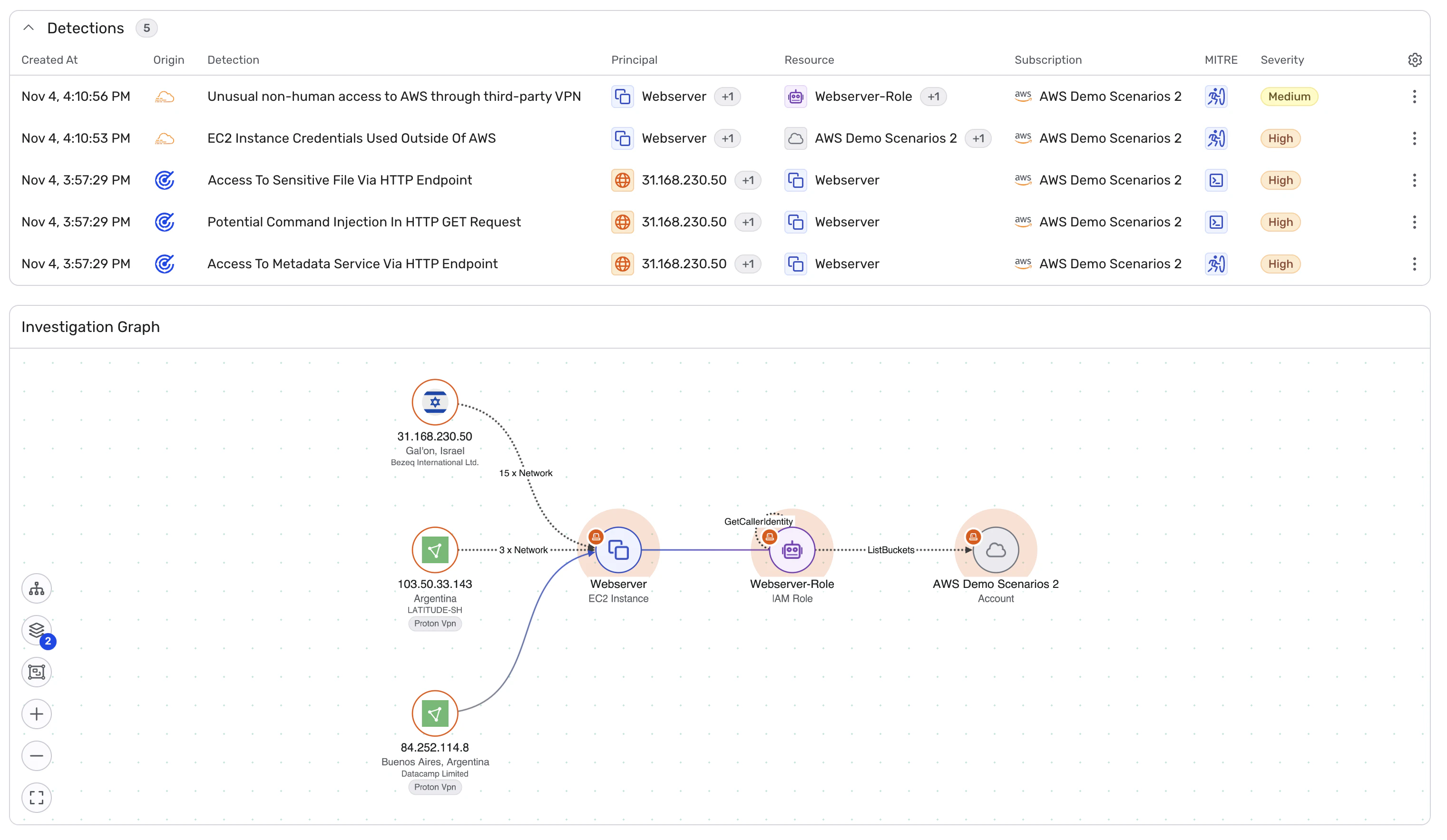
Instead of seeing a raw event such as “access key created” or “unusual API call,” analysts immediately understand:
Which resource is involved and its business criticality
Whether it is exposed to the internet or reachable from other compromised assets
What permissions the identity has across the environment
Whether sensitive or regulated data is at risk
This shifts investigations from basic fact-finding to decision-making. Teams start every alert already knowing what’s at stake.
Detection logic that spans domains
Unified platforms enable detections that correlate across traditionally separate security domains.
For example, identifying a public-facing storage bucket is a posture management finding. Observing suspicious access patterns is a detection signal. Knowing that the bucket contains sensitive data is a data security insight. A unified system can combine all three into a single high-confidence, high-severity alert.
In siloed architectures, these signals live in different tools and are rarely correlated in real time. While SIEMs can connect them through custom rules, the effort required means most organizations never fully implement this level of correlation.
Unified detection makes these cross-domain insights native rather than aspirational.
Faster response and lower operational friction
Because unified platforms share a common understanding of assets and relationships, response actions can be far more precise.
Containment can target the exact identity, workload, or access path involved rather than broad, disruptive measures. Investigation timelines automatically incorporate posture changes, activity sequences, and exposure context in one place.
Operationally, this reduces the constant pivoting between tools that slows response and exhausts analysts. It also lowers the long-term maintenance burden associated with keeping multiple correlation systems aligned as environments evolve.
Watch 5-min demo
See how Wiz Defend unifies detection, exposure context, and response in a single platform.

Practical integration, not replacement
Platforms don’t eliminate the need for SIEMs or endpoint tools. SIEMs still provide long-term retention and cross-environment analytics. EDR remains critical for host-level threats.
The shift is about where core cloud detection logic lives. By centralizing cloud-native detection and context in a unified platform, organizations dramatically improve speed, accuracy, and risk prioritization while still leveraging existing tools where they add value.
Examples of threat detection tools used by cloud security teams
These are representative examples to illustrate different approaches, not rankings. The market offers many options tailored to different needs.
Inclusion does not imply suitability for every environment. What works for one team might not work for another.
It is important to evaluate tools based on specific organizational needs. Consider your existing stack and team expertise when making a choice.
1.Wiz Defend: Cloud-native threat detection with exposure context
Wiz Defend detects threats within cloud environments by correlating activity with configuration, identity, and exposure context. This approach ensures that alerts are grounded in the reality of your specific infrastructure.
It uses the Wiz Security Graph to enrich detections with asset relationships and potential impact. This visualization helps analysts see how an asset connects to the rest of the environment.
See Wiz Defend in Action
This helps teams understand why a detection matters within their specific cloud environment. For instance, PROS enhanced real-time cloud detection and response, decreased threat response time by providing additional context surrounding alerts using Wiz Defend.
Wiz Defend is part of a unified platform that correlates active threats with configuration, identity, and exposure context to streamline triage and response. For example, when Wiz Defend detects suspicious API activity, it automatically enriches the alert with the identity's effective permissions, the resources the identity can access, whether those resources are internet-exposed, and which misconfigurations might enable privilege escalation, all from the same Security Graph that powers posture management.
Peer reviews consistently note comprehensive visibility across multi-cloud environments and ease of deployment without agents.
2. AWS GuardDuty: Managed threat detection for AWS environments
AWS GuardDuty analyzes AWS CloudTrail logs, VPC Flow Logs, DNS logs, and EKS audit logs to detect threats across AWS accounts. It identifies compromised instances, reconnaissance activity, and unauthorized access attempts using machine learning and threat intelligence feeds. Teams use GuardDuty for continuous monitoring of AWS control plane activity and network traffic without deploying agents. This is ideal for AWS-centric environments requiring native integration with AWS Security Hub and EventBridge.
3. Microsoft Sentinel: Cloud-native SIEM with analytics and automation
Microsoft Sentinel aggregates security data from Azure, Microsoft 365, on-premises systems, and third-party sources into a centralized SIEM. It uses built-in analytics rules, machine learning, and threat intelligence to detect attacks across hybrid environments. Security teams use Sentinel for unified investigation, automated response through playbooks, and integration with Microsoft Defender products. This is ideal for organizations standardizing on Azure and Microsoft security tools.
4. Google Security Command Center and Chronicle: GCP-native risk visibility and analytics
Google Security Command Center provides centralized visibility into GCP asset inventory, misconfigurations, and threats. Chronicle (Google's cloud-native SIEM) analyzes petabyte-scale security telemetry using Google's infrastructure. Teams use these tools for GCP-native threat detection, compliance monitoring, and integration with Google Workspace security. This is ideal for GCP-centric organizations requiring native integration with Google Cloud services.
5. CrowdStrike Falcon: Endpoint-led detection with expanded cloud and identity coverage
CrowdStrike Falcon is a detection and response platform built around continuous endpoint telemetry from laptops, servers, and cloud workloads. It monitors process execution, file activity, memory behavior, and network connections to identify malicious activity directly on hosts.
The platform is widely used to detect malware, ransomware, credential theft, privilege escalation, and host-level post-exploitation techniques, including many common lateral movement behaviors such as suspicious remote execution, abnormal authentication patterns, and unauthorized service creation between machines.
In recent years, CrowdStrike has expanded Falcon to include cloud workload protection, identity threat detection, and integrations with cloud environments. These additions allow teams to correlate endpoint activity with cloud and identity signals for broader incident visibility, though detection remains strongest at the host and workload level rather than in cloud control plane activity.
Falcon is a strong fit for organizations that want robust endpoint protection as a core security layer while extending visibility into cloud workloads and identity risks.
The platform consistently earns high ratings on G2 for detection quality and operational performance.
6. Microsoft Defender XDR: Integrated detection across endpoints, identity, and cloud
Microsoft Defender XDR combines detection signals from endpoint protection, identity services, and cloud workloads. This unification simplifies monitoring for organizations heavily invested in Microsoft products.
It is commonly used in Microsoft-centered environments seeking integrated security workflows. The seamless connection between tools reduces friction for security teams.
The tool supports investigation across hybrid and cloud-based assets. This flexibility is valuable for organizations with diverse infrastructure.
This solution is ideal for unified detection within Microsoft ecosystems. Organizations with Microsoft 365 E5 or Azure subscriptions can leverage existing licenses for integrated detection across endpoints, identities, and cloud workloads without additional per-seat costs.
Microsoft Defender XDR receives high ratings on G2 for its integration features.
7. SentinelOne Singularity: Autonomous endpoint and workload detection
SentinelOne focuses on AI-driven detection and response using endpoint and workload telemetry. This approach aims to automate the identification of threats without heavy manual intervention.
It is commonly applied to endpoint protection and cloud workload security. The tool is designed to stop attacks at the device level.
Teams often pair it with other tools for broader cloud context. This combination ensures coverage across both devices and cloud infrastructure.
SentinelOne Singularity has positive G2 review scores for its automated response features.
8. Palo Alto Networks Cortex XSIAM: Extended detection and automation platform
Cortex XSIAM aggregates telemetry from multiple sources to support detection and automated response. This centralization helps security operations centers (SOCs) manage vast amounts of data.
The platform emphasizes analytics, correlation, and SOC automation. These features help streamline the investigation process.
It is commonly used as part of a broader security operations ecosystem. Large enterprises often use it to coordinate their security efforts.
This tool is ideal for extended detection with security operations automation. It supports teams that need to automate complex workflows.
Palo Alto Networks Cortex XSIAM maintains solid G2 review scores for its automation capabilities.
How to measure threat detection success:
Track these key performance indicators (KPIs) to evaluate detection effectiveness and justify investment:
Coverage metrics: Percentage of cloud accounts monitored, percentage of workloads with runtime visibility, percentage of identities analyzed
Mean Time to Detect (MTTD): Average time from initial compromise to alert generation
Mean Time to Respond (MTTR): Average time from alert to containment action
Alert fidelity: Percentage of alerts that represent true security incidents vs. false positives
Automated containment rate: Percentage of incidents resolved through automated playbooks without manual intervention
Playbook adoption: Percentage of alert types with documented investigation and response procedures
Investigation efficiency: Average number of tools or consoles analysts must use to investigate a single incident
Establish baselines before implementing new detection tools, then track improvements quarterly to demonstrate ROI and identify optimization opportunities.
The future of threat detection tools: AI and automation
Threat detection platforms are increasingly being designed around reducing human bottlenecks in security operations. As alert volumes grow and attack speed accelerates, the limiting factor is no longer data collection but analyst time. AI and automation are becoming central to how modern tools triage alerts, conduct investigations, and execute response actions.
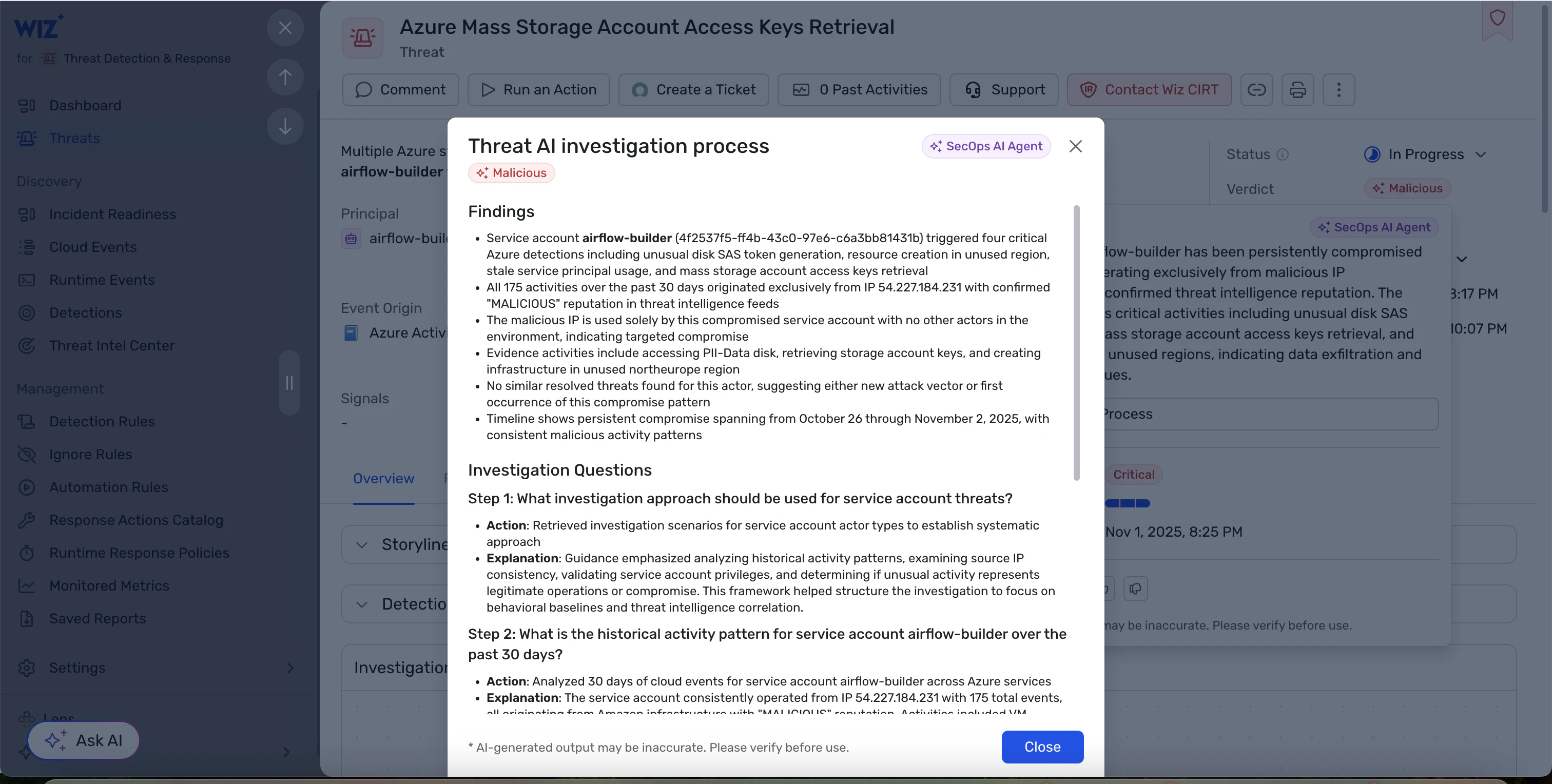
AI-assisted triage and investigation are reducing alert fatigue by automatically correlating events across telemetry sources, gathering relevant context, and surfacing high-confidence threats. Instead of analysts manually pivoting between log platforms, asset inventories, identity systems, and threat intelligence feeds, AI-driven systems can assemble complete investigation views in seconds.
Expect AI agents to increasingly investigate each detection end to end, producing transparent verdicts supported by supporting evidence and documenting their reasoning in natural language. Analysts remain in the loop, but time-to-decision drops dramatically from hours to minutes. For example, an AI agent might analyze a suspicious login, compare it against historical user behavior, verify effective permissions on the accessed resource, validate the source IP against known threat intelligence, and recommend whether to block the session, rotate credentials, or escalate for human review.
Automation is extending beyond analysis into real-time response and workflow orchestration. Modern detection platforms are shifting from simply generating alerts to executing predefined response actions automatically. This includes enriching alerts with relevant context, triggering investigation playbooks, isolating compromised workloads, revoking exposed credentials, blocking malicious IPs, and opening incident tickets with full evidence attached.
As these automated workflows integrate directly with cloud provider APIs, identity platforms, SOAR tools, and collaboration systems, response becomes faster and more consistent. The goal is not to replace human judgment, but to remove repetitive manual tasks that slow containment and contribute to analyst burnout. In cloud environments where attackers can escalate privileges and persist within minutes, automated investigation and containment are increasingly essential to effective defense.
Strengthen cloud security with Wiz’s threat detection and response platform
Modern threat detection is most effective when it is built natively for cloud environments and tightly integrated with exposure and risk context. Wiz delivers threat detection and response as a core part of its unified cloud security platform, enabling teams to identify active attacks and suspicious behavior across cloud infrastructure, identities, and workloads.
Wiz Defend provides cloud-native detection powered by continuous telemetry from cloud audit logs, identity activity, and workload runtime signals. Instead of generating isolated alerts, Wiz correlates active threats with asset relationships, effective permissions, exposure paths, and sensitive data context through the Wiz Security Graph. This allows security teams to immediately understand not just what happened, but why it matters.
The platform now includes the Blue Agent, an AI-powered threat investigator that automatically triages every detection with full transparency. When a threat triggers, Blue Agent gathers evidence across cloud telemetry, runtime signals, and identity context to produce a clear verdict on severity and required action. It shows every step of its reasoning, allowing analysts to validate conclusions and act with confidence while dramatically reducing manual investigation time.
Automated investigation capabilities work alongside the Blue Agent to assemble activity timelines, trace blast radius across connected resources, and surface high-confidence risks without manual correlation. This AI-enhanced approach means teams can investigate and respond to threats at machine speed while maintaining human oversight where it matters most. By unifying detection with posture management and exposure analysis, Wiz enables faster prioritization and more precise response to the threats that pose real business impact.
With native support across AWS, Azure, and GCP, Wiz helps organizations detect, investigate, and respond to cloud threats at the speed and scale of modern infrastructure.
See how Wiz Defend delivers cloud-native threat detection and response with built-in context and automation.Get a demo to experience unified detection, investigation, and response across your cloud environment.
Ready to see Wiz Defend in action?
Unify threat detection, exposure management, and response on a single platform built for cloud-speed operations.
