

What is the NIST CSF?
The NIST Cybersecurity Framework (CSF) is a voluntary, risk-based framework that helps organizations identify, assess, and manage cybersecurity risks. Unlike prescriptive standards such as NIST 800-171 or NIST 800-53 that specify exact controls, the CSF provides flexible guidance that organizations translate into security measures based on their specific risk profile. This adaptability makes it applicable across industries and organization sizes, from small manufacturers to Fortune 500 enterprises.
NIST released the first version of the CSF in 2014 to address growing cybersecurity concerns across critical infrastructure sectors. The framework became mandatory for U.S. federal agencies in 2017 through OMB memo M-17-25, though it remains voluntary for private sector organizations.
CSF 2.0, released in February 2024, introduced significant updates. The most notable change is the addition of Govern as a sixth core function, recognizing that cybersecurity risk management requires organizational leadership and accountability. Version 2.0 also contains new features that highlight the importance of governance and supply chains and improves alignment with frameworks like ISO 27001, making it easier for organizations to map controls across multiple compliance requirements.
Watch 12-min demo
Watch the demo to learn how Wiz Cloud finds toxic combinations across misconfigurations, identities, data exposure, and vulnerabilities—without agents.

What does the NIST CSF include?
While NIST does not certify businesses, organizations can document their cybersecurity maturity through internal assessments or third-party audits. Organizations can perform self-assessments using NIST's provided resources, such as quick-start guides and worksheets. NIST offers quick-start guides and worksheets on its site, including guides geared towards specific industries such as healthcare, to help prepare for NIST CSF self-assessment.
Let's explore a few key terms when it comes to understanding how the NIST CSF works: Core, Tiers, and Profiles.
Core
The CSF Core organizes cybersecurity activities into six high-level functions that represent the outcomes every organization should achieve. These functions work together continuously rather than sequentially.
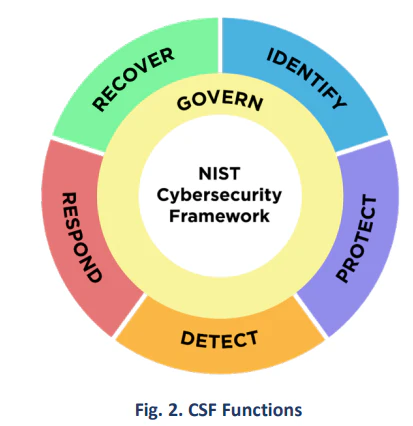
Govern (GV): Establishes organizational context, risk management strategy, and oversight for cybersecurity decisions. This function, new in CSF 2.0, integrates cybersecurity with business objectives and informs all other functions.
Identify (ID): Develops understanding of assets, business environment, and risk exposure to prioritize security efforts.
Protect (PR): Implements safeguards to ensure delivery of critical services, including access control, training, and data security.
Detect (DE): Defines activities to identify cybersecurity events through continuous monitoring and anomaly detection.
Respond (RS): Contains the impact of detected incidents through response planning, communications, and mitigation.
Recover (RC): Restores capabilities impaired by incidents and incorporates lessons learned into future planning.
Each function breaks down into categories and subcategories that provide specific guidance. For example, the Protect function includes categories for identity management, awareness training, data security, and protective technology.
Tiers
Implementation Tiers describe how an organization approaches cybersecurity risk management, ranging from Tier 1 (Partial) to Tier 4 (Adaptive). A critical point often misunderstood: tiers are not a maturity ladder where every organization should climb to Tier 4. Instead, the appropriate tier depends on your risk tolerance, regulatory requirements, and the criticality of specific systems.
Tier 1 (Partial): Risk management is ad hoc and reactive, with limited awareness of organizational cybersecurity risk.
Tier 2 (Risk Informed): Risk management practices are approved by management but may not be established as organization-wide policy.
Tier 3 (Repeatable): Formal policies define risk management practices, and the organization consistently applies them across the enterprise.
Tier 4 (Adaptive): The organization adapts cybersecurity practices based on lessons learned and predictive indicators, with real-time risk awareness integrated into decision-making.
An organization might operate at Tier 4 for systems handling sensitive customer data while maintaining Tier 2 for internal administrative systems. The goal is appropriate risk management, not universal Tier 4 achievement.
Profiles
Profiles translate the CSF into a practical roadmap by comparing where your organization is today against where it needs to be. This gap analysis drives prioritization and resource allocation decisions.
The Current Profile documents your organization's existing cybersecurity posture by assessing which CSF categories and subcategories you currently address and to what extent. The Target Profile defines your desired future state based on business requirements, risk tolerance, and regulatory obligations.
Comparing these profiles reveals gaps that inform your security improvement plan. For example, if your Current Profile shows limited capability in the Detect function while your Target Profile requires continuous monitoring for regulatory compliance, you can prioritize investments in detection capabilities and measure progress over time.


What are the main benefits of adopting the NIST CSF?
Adopting the NIST CSF delivers measurable security and business outcomes. Organizations that implement the framework systematically reduce their attack surface and establish accountability for security decisions.
The primary benefit is proactive risk reduction. By identifying and addressing vulnerabilities before incidents occur, organizations avoid the direct costs of breaches, including ransom payments, regulatory fines, and operational disruption, as well as indirect costs like reputational damage and customer churn.
The framework also creates accountability through measurable security objectives. You can tie CSF functions to specific metrics that track progress over time:
Identify: Percentage of assets inventoried, vulnerability remediation rates
Protect: MFA adoption rate, percentage of encrypted data at rest
Detect: Mean time to detect (MTTD), false positive rates
Respond: Mean time to respond (MTTR), incident containment rates
Recover: Recovery time objectives (RTOs), backup restoration success rates
Govern: Policy compliance rates, risk assessment completion percentages
For organizations pursuing regulatory compliance, CSF alignment demonstrates due diligence and maps directly to requirements in FISMA, CMMC, and industry-specific regulations.
How Wiz helps you align with the NIST CSF
Manual CSF assessments are point-in-time snapshots that become outdated the moment your cloud environment changes. For organizations operating at cloud scale, continuous compliance monitoring is the only practical approach.
Wiz automates NIST CSF alignment by continuously assessing your cloud environment against framework requirements. The platform provides automated compliance assessments across more than 100 frameworks, including NIST CSF, with real-time visibility into gaps and drift.
Wiz consolidates capabilities that map directly to CSF functions. Cloud security posture management (CSPM) addresses the Identify and Protect functions by discovering assets and detecting misconfigurations. Cloud workload protection (CWPP) supports Detect and Respond by identifying vulnerabilities and threats in running workloads. Cloud infrastructure entitlement management (CIEM) strengthens Protect by analyzing permissions and enforcing least privilege. Data security posture management (DSPM) extends Identify and Protect to sensitive data discovery and classification.
Rather than correlating findings across disconnected tools, Wiz's security graph connects risks across your entire environment. A vulnerability in isolation might be low priority, but that same vulnerability on an internet-exposed workload with access to sensitive data becomes critical. This context-aware approach helps teams focus remediation on the issues that actually matter.
Wiz automatically routes compliance issues to the right teams with context and remediation guidance, turning CSF alignment from a periodic audit exercise into an integrated part of how your organization operates.
100+ Built-In Compliance Frameworks
See how Wiz eliminates the manual effort and complexity of achieving compliance in dynamic and multi-cloud environments.
