

What is DSPM for AI?
Data security posture management (DSPM) for AI extends data security into the fast-moving flows behind AI systems. It covers environments where AI handles data. This includes training sets, vector databases, embedding stores, RAG pipelines, inference endpoints, and agent access paths.
Standard DSPM protects data in known places like relational databases, cloud storage buckets, and file shares. But it doesn’t track data once it moves into the layers where AI consumes and reshapes it. When classification tools hit chunked documents or dense vector embeddings, visibility drops off.
DSPM for AI fills that gap. It finds sensitive data inside AI-specific stores, tracks how it moves through ML pipelines, and maps who can access it and how it’s exposed.

To understand the value of DSPM for AI, let’s distinguish overlapping posture management disciplines:
CSPM (cloud security posture management) covers the underlying cloud infrastructure.
AI-SPM (AI security posture management) covers the configuration of the models, agents, and pipelines.
DSPM for AI covers the data layer directly extended into the AI environment.
Here's what this means: CSPM flags the misconfigured bucket; AI-SPM flags the exposed inference endpoint; but DSPM for AI identifies the sensitive PII inside your vector store.
The 4-Step Framework for AI Threat Readiness
Wiz has designed a 4-step framework to help organizations defend against rapid, automated exploitation in a post-Mythos world.

Why is DSPM for AI important?
AI changes how data moves, gets stored, and leaks. Once sensitive data enters a model or pipeline, you don’t get a clean undo button. That makes upfront visibility and control non-negotiable.
Here’s what DSPM for AI gives you:
Continuous sensitive data discovery: Finds and tracks sensitive data across training sets, vector stores, and pipelines as it moves.
LLM data leakage prevention: Stops sensitive data from ending up in prompts, responses, or models; this helps prevent unauthorized data exposure in public LLM prompts, as seen in the Samsung/ChatGPT incident.
Context-aware data protection: Understands how data is used and connected, not just what it looks like in isolation.
Regulatory-harmonized data classification: Tags AI data based on real compliance requirements so you know what actually matters.
Data residency and sovereignty enforcement: Keeps sensitive data in the right regions and systems as it flows through AI workloads.
Automated audit readiness: Maintains a clear record of where sensitive data lives and who can access it.
AI governance consistency: Connects data usage in AI systems back to internal policies and controls.
Measurable risk reduction: Shows actual data exposure risk, not just misconfigurations, so teams can prioritize what to fix.
There’s no cleanup step once sensitive data is in an AI model or pipeline. If you don’t catch it early, you’re left dealing with exposure you can’t easily undo.
CSPM vs DSPM: Why You Need Both
Discover the similarities between CSPM and DSPM, what factors set them apart, and which one is the best choice for your organization’s needs.
En savoir plus
How DSPM for AI secures data across the AI lifecycle
Here's how DSPM for AI works end to end across your AI stack, from managing raw data to monitoring live model traffic.
Discovery and classification
Pattern matching breaks on AI data. DSPM for AI uses NLP and context-aware classification to identify PII, PHI, financial data, source code, and other sensitive content across unstructured inputs and embeddings.

It scans across the full AI surface, including training buckets, vector databases like Pinecone, Weaviate, Milvus, and pgvector, embedding stores, model artifacts, and RAG pipelines. It also finds shadow AI services and maps what data they read and write.
Data lineage and pipeline visibility
Finding data isn’t enough. You need to track it as it moves and changes. DSPM for AI maps data flow from source to preprocessing, training, embeddings, vector stores, and inference endpoints. It tracks how data changes, so that classification follows the data, and not just the original source.

This lets teams answer real questions fast, like which embeddings came from restricted data, or what needs to be removed for a GDPR request.
Access control and governance
AI pipelines rely on constant data movement, which breaks static access control models. DSPM for AI evaluates least-privilege access across training job roles, inference service accounts, and AI agents. It flags risky IAM patterns like overprivileged roles, cross-account access, and standing access to sensitive training data that should only exist during specific pipeline runs. It also enforces separation between training and inference, so internet-facing services can’t query raw training data.
On top of that, DSPM for AI tracks AI agents with autonomous data access, so they don’t quietly bypass standard controls.
Runtime monitoring and incident response
DSPM for AI monitors model inputs and outputs in real time to catch data exfiltration, prompt injection, and abnormal query patterns against AI data stores.
It correlates runtime activity with data lineage and identity context, so detections aren’t isolated. When something triggers, it maps the full blast radius, including which sensitive data was accessed, which embeddings or datasets were involved, which models were queried, and which identities or agents initiated the activity.
This context lets teams move fast, whether that means revoking access, isolating a vector store, or stopping a pipeline before more data is exposed.
Does DSPM for AI support compliance?
Compliance requirements evolve as data moves through models, embeddings, and pipelines. You’re not just tracking source records anymore; you’re tracking how that data is reshaped, where it ends up, and who can access it at each step.
While overlapping regulations like the EU AI Act and GDPR create complexity, AI DSPMprovides a clear path to manage these requirements without manual audits.
EU AI Act
The EU AI Act requires strict control over training data quality, provenance, and ongoing monitoring for high-risk systems.
DSPM for AI tracks exactly which datasets feed which models and maintains a continuous record of data usage. This mapping allows teams to verify governance requirements before moving models into production. It also gives teams a clear way to audit how training data was sourced and handled across experiments.
GDPR and the Right to Be Forgotten
GDPR applies the moment PII enters an AI pipeline, including embeddings and derived data in vector stores.
DSPM for AI tracks how data is modified, so when an erasure request comes in, teams can identify and remove affected embeddings and models without tearing down entire pipelines. This makes it possible to handle deletion requests without disrupting production systems.
NIST AI RMF
The NIST AI RMF places heavy emphasis on transparent data governance, strict provenance tracking, and the continuous monitoring of AI inputs and outputs.
AI DSPM automates the evidence trail by continuously tracking data flows, giving teams a way to show active governance instead of relying on point-in-time checks. It also helps standardize how teams measure and report AI data risk across environments.
HIPAA, PCI DSS, and sector-specific requirements
Regulated data like PHI under HIPAA and cardholder data under PCI DSS requires stricter access control, logging, and protection across AI systems.
DSPM for AI extends these controls to AI data stores and workflows, enforcing least-privilege access, tracking data usage, and generating audit-ready evidence that maps activity to regulatory requirements across regions and industries.
Inside MCP Security: A Field Guide
AI agents introduce new data access patterns that compliance frameworks are still catching up to. Explore emerging security risks in agent protocols and tool integrations.

How to operationalize DSPM for AI
AI DSPMI only works if it's unified with how data flows through your pipelines. That means tying discovery, classification, and access control directly into training, embedding generation, and inference. It shouldn't be a separate scan after the fact.
Here's what to get right:
Auto-discover all AI services and map their data stores. Inventory SageMaker, Bedrock, OpenAI integrations, Hugging Face deployments, and any shadow AI tools your teams stood up without security review. Map which data stores each service reads from and writes to.
Scan training data and vector stores for sensitive content before training begins. Cover training buckets, vector databases, and embedding stores. Don't rely on regex alone. Use NLP-based classification for content encoded in embeddings and chunked documents. Once sensitive data trains a model, you can't extract it.
Lock down vector databases as sensitive data stores. Remove public access, enforce encryption at rest and in transit, and continuously re-scan as embeddings drift from source data controls. Vector stores don't inherit security controls from the databases they were built from.
Enforce least privilege on every AI identity. Scope service roles to specific pipeline runs rather than granting standing access to training data. Flag cross-account permissions and unused credentials tied to AI infrastructure. Don't allow raw sensitive data into embeddings without transformation or redaction.
Separate training environments from inference-serving environments. Training pipelines need broad data access. Inference endpoints should have narrow, scoped permissions. Mixing them gives production-facing services access to raw training data they should never touch.
Embed DSPM checks into CI/CD and MLOps pipelines. Scan for sensitive data exposure before models are trained, not after. Integrate classification and access control checks into your pipeline orchestration so risky configurations are blocked pre-deployment.
Enable logging for model inputs and outputs. Set alerts for data exfiltration patterns, prompt injection attempts, and anomalous access to AI data stores. Without I/O logging, you have no forensic trail when an AI-related incident occurs.
Map attack paths, not just individual findings. A misconfigured vector store is one finding. That store containing customer PII, accessible via an overprivileged service role, connected to a public inference endpoint is a critical attack path. Prioritize based on how findings chain together, not on isolated severity scores.
Validate third-party and vendor AI tools against your data security standards. External models, APIs, and SaaS AI services can introduce data exposure you don't control. Assess them the same way you assess any third-party vendor with access to sensitive data.
Schedule recurring AI data security reviews. AI infrastructure changes fast. New models, data sources, vector stores, and pipeline configurations appear constantly. Periodic reviews catch configuration drift and new exposures that automated scans miss between cycles.
How Wiz strengthens your AI security posture
Wiz AI-APP secures AI applications end-to-end by providing the context teams need to understand risks. Here are its strongest AI security features and capabilities:
It starts with discovery. Wiz maps AI systems across managed platforms like Bedrock, SageMaker, and Azure AI, SaaS tools like OpenAI and Copilot Studio, and custom-built applications. The Wiz Workload Explainer translates how applications are built into clear components, mapping models, agents, tools, and data flows even when they aren't documented in configuration.
The Wiz Security Graph connects those AI components to full cloud context. When Wiz finds sensitive data in a vector store, it doesn't stop at the data finding. It maps the attack path: the store is publicly readable, the service account accessing it has cross-account permissions, and the inference endpoint connected to it is internet-facing. That toxic combination surfaces as one prioritized finding, not three isolated alerts.
For teams building AI applications, Wiz Code traces infrastructure risks back to source code. If a Terraform module deploys an AI endpoint with an overprivileged execution role, Wiz identifies the root cause in code and routes the fix to the developer who owns it.
At runtime, Wiz detects active threats against AI workloads: data exfiltration, prompt injection, and unauthorized access to AI data stores. When a detection fires, the Blue Agent automatically investigates, gathering context and producing a verdict with full reasoning. The Green Agent maps root cause and remediation paths. The Red Agent validates exploitability by reasoning like an attacker. Wiz Workflows let teams define when agents act autonomously and when human approval is required.
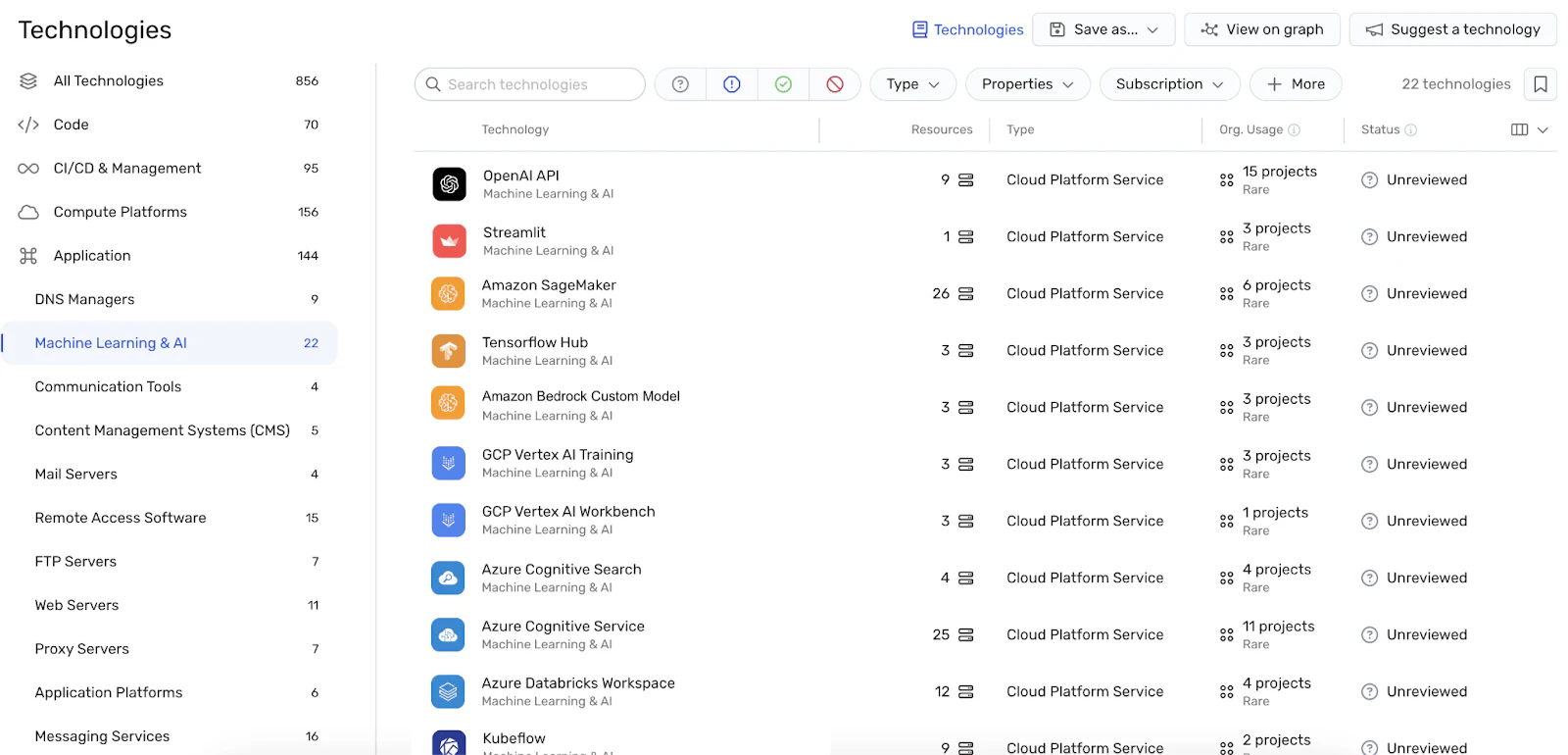
Ready to see how Wiz connects data sensitivity directly to model infrastructure, identity, and runtime context? Get a demo to experience AI-APP's unified approach to securing your AI stack.
See Wiz AI-APP in action
Discover how Wiz maps AI attack paths from data to model to endpoint, all in one unified security graph.
