

What is API scanning?
API scanning is the automated process of analyzing APIs to detect security vulnerabilities, misconfigurations, and logic flaws. This method sends simulated requests to your API endpoints and analyzes the responses to find weaknesses.
APIs have become a top attack vector as organizations expose more services to the internet and internal networks, with 99% of organizations experiencing API security issues in the past 12 months. Traditional application security focused on web interfaces and browsers, which often misses the backend data pipelines that APIs expose.
Modern scanning analyzes API specifications, endpoints, authentication methods, and data handling practices. It typically aligns with the OWASP API Security Top 10, which is the standard framework for understanding critical API risks.
Scanners generally operate in two distinct modes:
Authenticated scanning: The scanner uses valid credentials to test protected endpoints, ensuring deep coverage of internal logic and data access.
Unauthenticated scanning: The scanner acts as an external attacker without credentials to identify publicly exposed weaknesses.
Advanced API Security Best Practices [Cheat Sheet]
Download the Wiz API Security Best Practices Cheat Sheet and fortify your API infrastructure with proven, advanced techniques tailored for secure, high-performance API management.

How API scanning works
The process begins with discovery, where scanners identify every API endpoint in your environment. This step can happen automatically by analyzing network traffic or manually by importing specification files.
Scanners then parse API documentation, such as OpenAPI/Swagger files or Postman collections, to understand how the API is supposed to behave. This blueprint tells the scanner which parameters to test and what responses to expect.
There are two main analysis approaches:
Dynamic analysis tests the running API in real-time (often called API DAST). Unlike web DAST, which interacts with browser-rendered interfaces, API DAST sends programmatic requests directly to endpoints, tests authentication flows (OAuth, JWT), validates authorization logic, and analyzes structured responses (JSON, XML). API DAST is specification-driven when OpenAPI files are available, enabling targeted testing of documented parameters and expected behaviors.
Static analysis examines source code and configuration files without executing the API, complementing dynamic scanning by surfacing flaws in code paths that may not be exercised during runtime tests.
Scanners validate the API's responses to identify anomalies, such as leaking sensitive data in error messages. You can integrate these API security testing tools directly into CI/CD pipelines to run continuous scans with every code deployment. This establishes a baseline security posture, allowing you to detect deviations immediately.
Effective scanning also gathers context about the API's environment and data sensitivity. This helps you understand if a vulnerability affects critical data or just a test environment.


Types of API vulnerabilities detected by scanning
API scanning is designed to catch specific flaws that threaten data integrity and system availability. Two of the most impactful risks are Broken Object Level Authorization (BOLA) and Broken Function Level Authorization (BFLA), which consistently rank in the OWASP API Security Top 10. BOLA (also called IDOR—Insecure Direct Object Reference) occurs when APIs fail to verify that a user can access a specific object. For example, an attacker might change /api/users/123/orders to /api/users/456/orders in the URL to view another customer's order history. Scanners detect BOLA by testing object ID enumeration and cross-account access with different authenticated sessions. BFLA happens when APIs don't properly check function-level permissions, allowing regular users to invoke admin-only operations. An attacker might call DELETE /api/users/789 or POST /api/admin/reports even though their role shouldn't permit these actions. Detection requires role-based test accounts and systematic testing of privileged endpoints with lower-privilege credentials.
Another critical issue is excessive data exposure. This happens when an API returns more data than the client needs, relying on the client-side app to filter it out. Attackers can intercept this traffic to view sensitive information.
Scanners also detect injection vulnerabilities, such as SQL or command injection. In these scenarios, untrusted data is sent to an interpreter as part of a command or query.
Common API vulnerabilities include:
Mass assignment: APIs accept parameters that clients should not be able to modify, such as "isAdmin=true."
Security misconfigurations: This includes missing security headers, improper CORS settings, or weak encryption.
Rate limiting issues: APIs without limits allow attackers to flood the system, causing resource exhaustion and drawing disproportionate bot activity—44% of advanced bot traffic targets APIs despite their smaller surface area.
Server-side request forgery (SSRF): Attackers force the API to make requests to internal resources that should not be accessible.
Business logic flaws are unique to your specific application and are harder to detect. These flaws allow attackers to manipulate legitimate workflows, such as buying an item for zero dollars.
| Vulnerability Type | Risk Description | Detection Method |
|---|---|---|
| Broken Authentication | Allows account takeover | Abusing tokens and session IDs |
| Injection | Executes malicious commands | Fuzzing parameters and inputs |
| Excessive Data Exposure | Leaks private information | Analyzing response payloads |
| Mass Assignment | Modifies restricted fields | Supplying extra parameters |
Api security testing and API penetration testing are essential to identify these risks before they become incidents.
What are business logic vulnerabilities? Types, examples, and prevention
Business logic vulnerabilities are flaws in how an app enforces its own rules, letting attackers misuse valid features. See the types, examples, and prevention.
En savoir plus
API scanning in cloud-native environments
Cloud-native architectures introduce unique complexity to API security testing. Microservices architectures break applications into small, independent pieces, creating a vast web of internal APIs that must be secured. Cloud resources are often ephemeral, meaning they spin up and down dynamically. This makes continuous scanning vital because a static scan will quickly become outdated.
Scanning challenges in modern environments:
Serverless APIs: Functions-as-a-Service (FaaS) are event-driven and may lack always-on endpoints, making discovery and testing timing-sensitive since functions only execute in response to specific triggers.
Shadow APIs: These are undocumented APIs deployed outside of standard processes, creating hidden attack surfaces.
Service meshes: Kubernetes environments use meshes to manage traffic, which can obscure API visibility if scanners don't integrate with them.
Cloud-native APIs often use complex authentication mechanisms across multi-cloud environments. API gateways play a dual role in this landscape. They act as a central point for policy enforcement but can also mask backend vulnerabilities if not tested correctly.
Implementation challenges and best practices
One of the biggest hurdles in API scanning is managing false positives. Scanners may flag harmless behaviors as risks, causing alert fatigue for your security team.
Authentication and authorization complexity is another major challenge. Scanners must handle diverse schemes including OAuth 2.0/OIDC flows, JWT validation, mutual TLS (mTLS), and signed requests. Maintaining valid tokens during automated scans—especially with short-lived tokens or complex refresh flows—requires sophisticated credential management.
Best practices for effective implementation:
Balance testing depth: Comprehensive testing is valuable, but aggressive scanning can degrade production performance or trigger WAF and API gateway protections. Favor staging environments and production-safe scanning profiles with agreed maintenance windows.
Test data management: Use synthetic data instead of real customer data to avoid privacy leaks during testing.
Shift-left security: Enable developers to run scans early in the workflow to fix issues before code is merged.
Keeping pace with API changes is critical. Versioning can lead to "zombie APIs"—outdated versions that remain active and vulnerable. Use automated scanning for broad coverage and continuous monitoring, while targeted manual testing validates business logic and abuse-case scenarios that automated tools may miss.
Establish a schedule that scans critical APIs frequently. Define clear security policies that dictate acceptable risk thresholds for deployment. Using the right api security testing tools helps you automate this governance.
API scanning supports multiple compliance frameworks by demonstrating continuous security monitoring and vulnerability management. For SOC 2, scanning provides evidence of security monitoring controls (CC7.1) and vulnerability management processes (CC7.2). ISO 27001 requirements for secure development lifecycle (A.14.2) and technical vulnerability management (A.12.6) are satisfied through regular API testing. HIPAA technical safeguards for access controls (§164.312(a)) benefit from API authorization testing. PCI DSS requirement 6.6 mandates either web application firewalls or application security testing—API scanning fulfills the testing option for payment APIs. Maintain scan reports, remediation timelines, and exception approvals to demonstrate compliance during audits.
Watch 12-min Demo
Get a live demo of Wiz and discover how to automatically identify, secure, and prioritize risks across APIs in your cloud environment.
Watch demo
Prioritizing and remediating API security findings
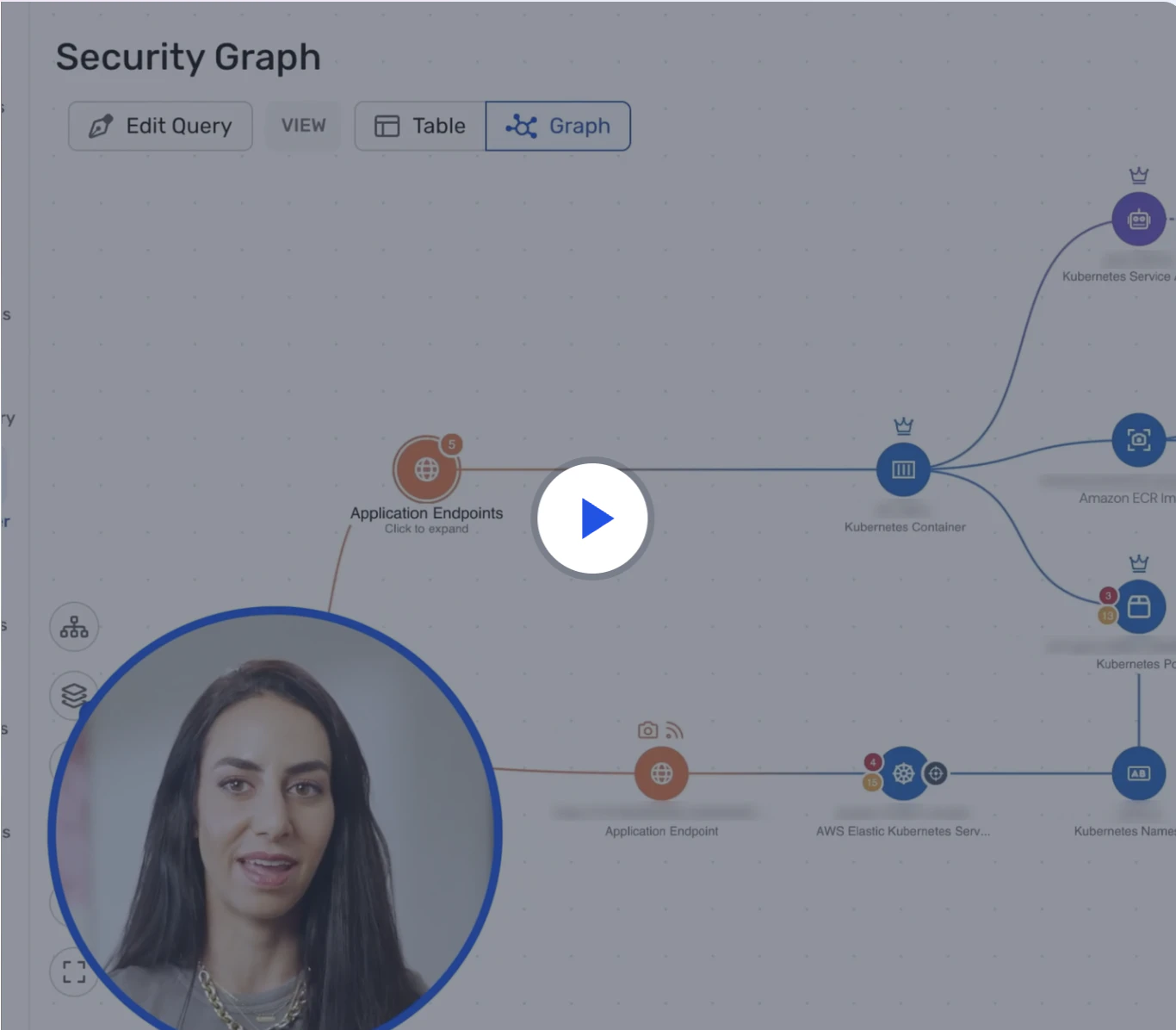
You cannot fix every vulnerability immediately, so you must prioritize based on real attack paths. Graph-based prioritization connects API findings with cloud infrastructure context—internet exposure, identity permissions, and data sensitivity—in a unified security graph. For example, an API injection vulnerability might be low priority if the API is internal-only, uses least-privilege service accounts, and accesses non-sensitive data. The same vulnerability becomes critical when the API is internet-facing, runs with admin credentials, and queries customer PII databases. This context-driven approach reduces alert fatigue by focusing remediation on vulnerabilities that create actual attack paths.
A vulnerability in an internal test app is less critical than the same vulnerability in a public-facing payment API.
Strategies for effective remediation:
Correlate risks: Connect API flaws with infrastructure context including internet exposure, identity permissions, and data sensitivity to see the full attack path. For example, a medium-severity API vulnerability becomes critical when the API is internet-facing, uses overprivileged service accounts, and accesses customer PII.
Identify toxic combinations: Recognize when multiple minor issues combine to create a critical attack path.
Trace to code: Use tools that link runtime findings back to the specific line of source code.
Assigning ownership is crucial for speed. Code-to-cloud correlation traces runtime API issues back to source repositories and code owners, enabling fixes at the origin. Modern platforms link API endpoints to the Git repositories, CI/CD pipelines, and development teams that deployed them. This allows you to automatically create Jira tickets assigned to the right team, with links to the specific code files and lines that need remediation. Integrate findings directly into existing ticketing systems to streamline the workflow and reduce mean time to remediation (MTTR).
Set Service Level Agreements (SLAs) for remediation based on severity. For example, critical vulnerabilities might require a fix within 24 hours. Always validate fixes by rescanning to ensure the vulnerability is truly resolved.
Measuring your progress is the final step. Report on metrics like time-to-remediate to demonstrate improvements in your API security posture.
API Security Checklist 2026: OWASP-Aligned, Code-to-Cloud Best Practices
An API checklist serves as a framework to help your security team systematically detect and tackle threats and vulnerabilities throughout the API lifecycle. Its end goal? To strengthen your overall security posture by standardizing API security efforts.
En savoir plusWiz's approach to comprehensive API security
Wiz API Security Posture Management (API SPM) provides a unified API security capability within the broader Wiz cloud security platform. It automatically discovers APIs across your cloud environment using the Wiz Runtime Sensor, external attack surface scanning, and API specifications so teams can maintain visibility as their API estate changes.
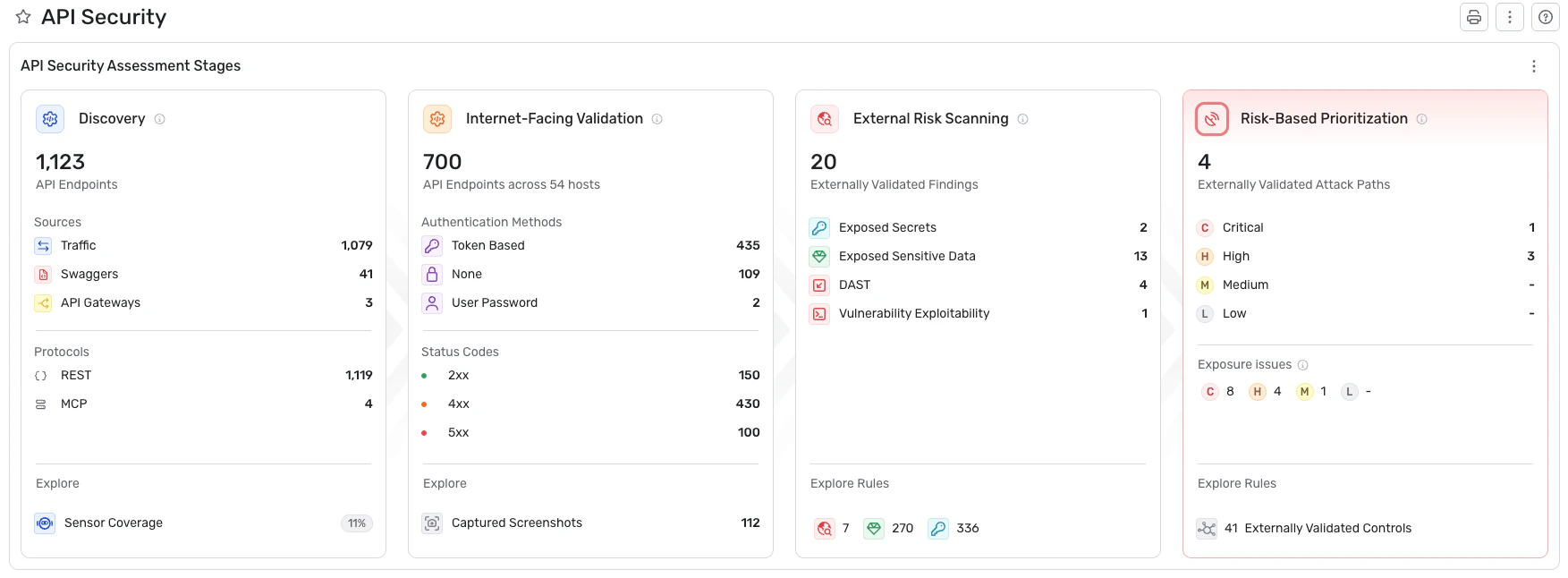
The platform correlates API vulnerabilities and posture findings with cloud infrastructure context through the Wiz Security Graph. This allows you to see how an API issue relates to internet exposure, identities, sensitive data, and downstream services, which matters even more in AI-enabled applications where APIs connect models, agents, and data stores.
That broader posture view is where Wiz API SPM adds real value beyond point-in-time scanning. It keeps a continuously updated inventory of managed, unmanaged, shadow, and zombie APIs, along with authentication and sensitive data context, so teams can spot drift, support compliance requirements, and focus scanning on the APIs that are actually exposed.
Wiz key capabilities:
Autonomous penetration testing: Deploys the Wiz Red Agent to proactively probe application logic and validate complex, multi-step API vulnerabilities.
Code-to-cloud correlation: Traces runtime API issues back to the specific owner and source code for fast fixes.
Dynamic scanning: Validates external exposure and enriches findings with internal cloud context.
Unified attack path analysis: Integrates API risks into the broader view of cloud security threats.
Ready to gain unified visibility into API risks across your entire cloud environment? Get a live demo to see how Wiz moves API security from reactive scans to proactive, context-driven risk reduction.
Secure your APIs with Wiz
Learn how Wiz gives security teams instant visibility into API exposure, misconfigurations, and attack paths — all in one platform.
