
What are AWS security risks?
While customers understand the AWS Shared Responsibility Model, security risks emerge from how they configure and operate their environments at scale. In complex, multi-account AWS environments, the interaction between IAM roles, permissions, services, and regions often blurs lines of ownership and accountability. This complexity can hide misconfigurations, overly broad permissions, and monitoring gaps, creating opportunities for attackers to exploit weaknesses across accounts and workloads.
Why the AWS risk has grown
Modern organizations rely on a growing set of AWS services across hundreds of accounts spanning multiple business units, VPCs, and regions. These environments often contain tens of thousands of IAM roles, access keys, and EC2 instances, each introducing new security vulnerabilities unless responsible parties govern them carefully.
As enterprises adopt multi-region or multi-cloud strategies, the scope of cloud services and risk expands. This scale increases the blast radius of potential data breaches, which complicates detection and response for security tools and teams.
For security and platform managers, this growth creates a governance burden. While AWS Organizations unifies management, the combination of visibility gaps, inconsistent security controls, and the sheer volume of API calls across environments makes it harder to maintain a cloud security posture at scale.
AWS Security Best Practices [Cheat Sheet]
This cheat sheet goes beyond the essential AWS security best practices and offers actionable step-by-step implementations, relevant code snippets, and industry- leading recommendations to fortify your AWS security posture.

Why do AWS security risks matter?
Unchecked AWS security risks can lead to costly consequences. These risks pose technical problems and expose organizations to major business liabilities.
The business impacts of unchecked AWS risk
Security incidents in AWS can cause significant financial, legal, and operational damage. According to IBM, the global average cost of a cloud breach in 2025 was $4.4 million. Rising regulatory penalties for data exposure—fueled by ongoing breach risks and new threats—contribute to this financial damage. A direct link exists between risk scale and business impact: expanding AWS accounts, services, and access roles broadens the potential attack surface. And the larger the surface, the greater the likelihood of a breach and the associated costs.
How multi-account and hybrid environments amplify risk
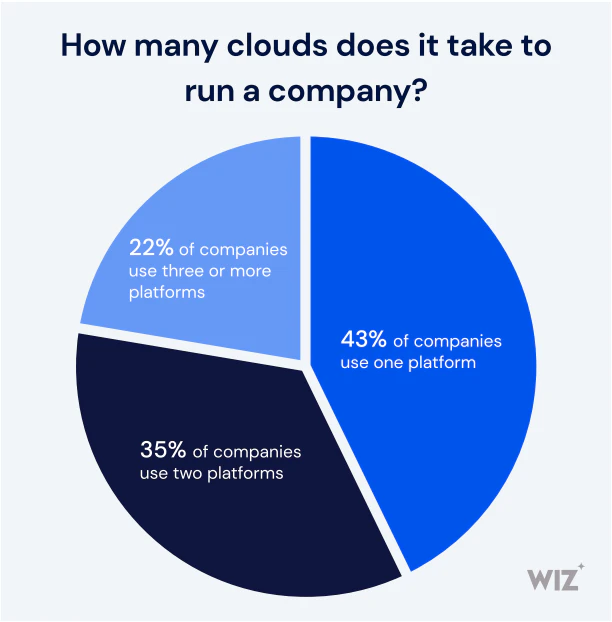
Organizations operating hundreds of AWS accounts and managing sprawling IAM roles often face visibility and control challenges. Misconfigurations or excessive permissions in just one account can cascade across connected environments, exposing sensitive data or critical workloads.
For instance, a compromised IAM role in a non-production account can lead to lateral movement into production systems when guardrails are missing, especially when roles allow cross-account assumption or when shared networking connects environments. This scenario becomes more likely in hybrid or multi-cloud environments, where enforcing consistent identity and network policies at scale proves difficult.
What this means for practitioners and managers
For cloud practitioners, the priorities are clear: identify and fix misconfigurations, limit excessive privileges, and ensure continuous monitoring.
For security leaders and IT managers, drive success through scalable governance by setting unified policies, measuring security performance with clear metrics, and deploying automation to consistently enforce guardrails across environments.
Together, both practitioners and managers must align on strategy and execution to secure AWS at scale.
What are common AWS security risks?
Security challenges in AWS environments fall into three broad categories: identity, data, and visibility. Each category presents unique risks and demands specific response strategies:
Identity risks
The most persistent identity-related risk stems from inadequate access and identity controls. IAM is often the top vulnerability in AWS because a single misconfigured role or leaked credential can open the door to wide-scale compromise.
Teams can address identity risks through these technical controls:
Rotate access keys regularly and remove unused credentials to reduce exposure windows as you move toward zero long-lived credentials through federation and temporary access.
Use temporary credentials through IAM roles or AWS Security Token Service instead of static keys.
Enforce least-privilege access by granting users and services only the permissions they require.
Audit IAM roles and policies routinely to identify excessive permissions and unused access.
Leverage AWS IAM Access Analyzer and IAM Policy Simulator to validate policy configurations.
Use service control policies (SCPs) to set organization-wide permission boundaries.
Expand IAM visibility to detect toxic permission combinations across accounts. For example, an IAM role with
s3:GetObjectpermissions attached to a publicly accessible EC2 instance creates a clear path from the internet to sensitive data.
Data risks
Data exposure remains a top cloud risk due to common misconfigurations, including public S3 buckets and insufficient encryption. Without secure defaults, sensitive data is vulnerable to public exposure or interception.
Teams can secure data through these implementation steps:
Enforce encryption by default using AWS Key Management Service or customer-managed keys. Encryption is only as effective as your key policies, so enforce strict separation of duties to ensure that compute roles can use encryption keys without the ability to manage or modify them.
Block public access to all S3 buckets using centralized S3 Block Public Access settings, and disable S3 Access Control Lists (ACLs) so access depends exclusively on bucket policies.
Use SSL/TLS protocols to provide encryption in transit across all services.
Enable default encryption settings for S3, Elastic Block Store (EBS), and Amazon Relational Database Service (RDS).
Perform routine audits to verify encryption status and access configurations.
Leverage Amazon Macie to automate sensitive data discovery and classification in S3.
AWS S3 Security Best Practices [Cheat Sheet]
Knowing the least privilege principle is crucial and forms the foundation of security best practices, but following it in practice isn’t always straightforward. With this cheat sheet, you have all the options at hand, together with reasons when to use them.
Download now

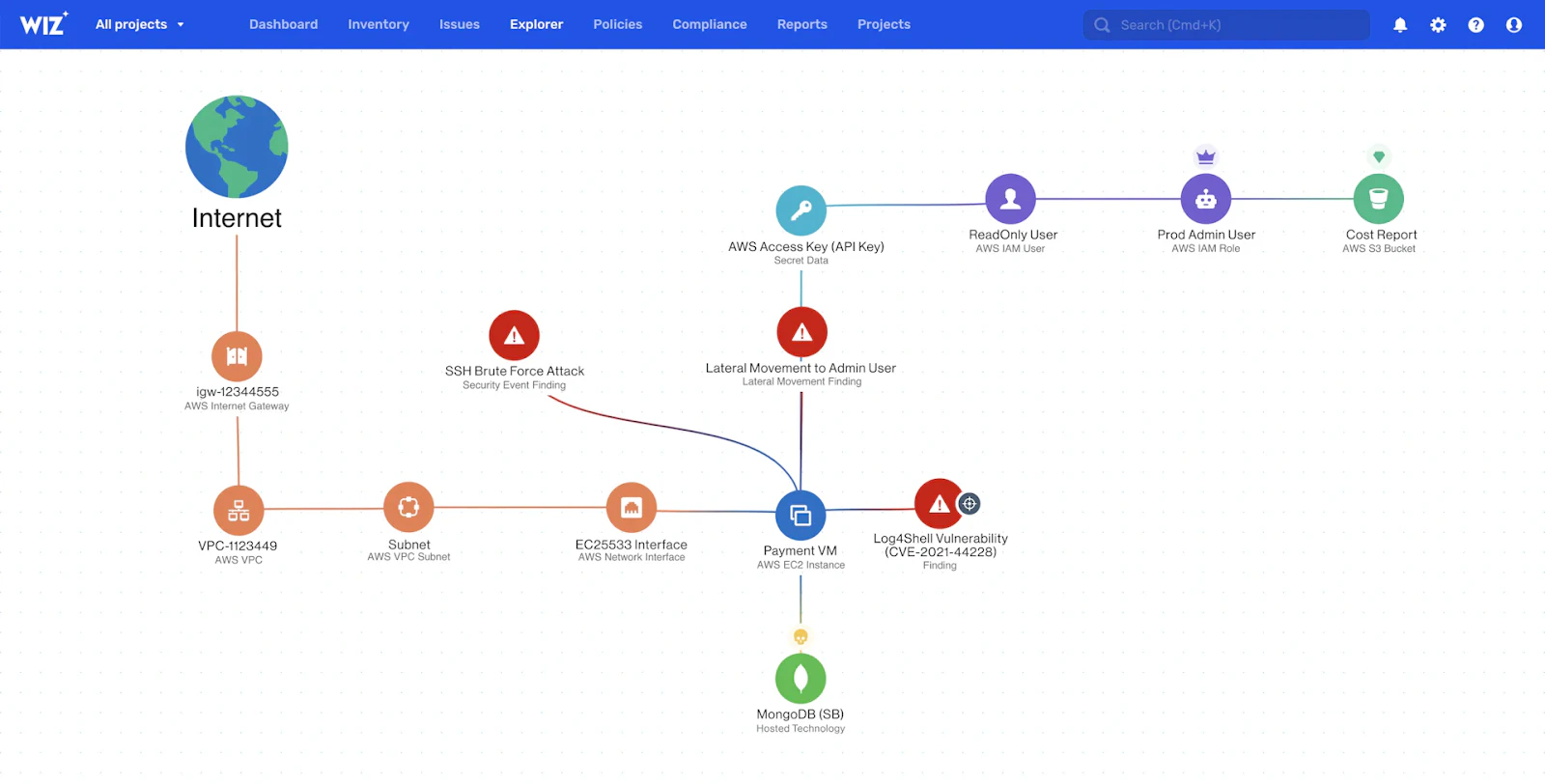
Many organizations lack sufficient visibility to identify misconfigurations, anomalies, or unauthorized access in time to respond effectively. This creates dangerous blind spots in monitoring, particularly in multi-account or multi-region environments.
Teams can mitigate visibility gaps with these steps:
Enable AWS CloudTrail in all regions and accounts to capture management and data events.
Aggregate logs using Amazon CloudWatch or a third-party SIEM platform for centralized analysis.
Deploy AWS Config to continuously evaluate resource compliance against defined rules. Focus Config rules on high-impact compliance failures, including public exposure, encryption gaps, and overly permissive access, rather than enabling every available rule.
Use tools like AWS Security Hub to centralize findings across services and provide a unified security view.
Adopt a platform like Wiz to detect drift and uncover hidden risks across identities, configurations, and workloads.
AWS Security Specialty Exam Prep Guide
Master the scenario-based reasoning and critical action sequences required for the SCS-C03 exam. Learn how to decode exam trigger phrases, lock down your incident response order of operations, and accelerate your path to certification.

What are best practices for mitigating AWS security risks?
While individual controls help reduce specific risks, AWS security only scales when teams standardize how they apply those controls across accounts, services, and environments. The following best practices form the strategic foundation that operationalizes identity, data, and visibility protections across AWS, transforming point solutions into a repeatable security program.
Implement least privilege IAM and use temporary credentials
Strong identity controls form the foundation of AWS security. Teams must eliminate overly permissive roles and transition away from long-lived static credentials by adopting IAM roles and federated identities instead of hard-coded access keys. Enforcing least-privilege access through fine-grained policies scoped to specific tasks enables organizations to regularly audit permissions, keys, and roles to remove unused access. To sustain least privilege over time, use automated permission right-sizing to align access with actual usage and block privilege creep as environments evolve.


Enforce encryption and continuous data discovery
Protecting sensitive data at rest and in transit is a baseline requirement for cloud security and compliance. Without consistent encryption and transport protections, misconfigurations can expose critical data through insecure connections. Default encryption ensures protection happens by design, not by exception. In addition, enforcing SSL/TLS prevents data interception as it moves between services, users, and external systems.
Effective data protection also requires visibility. As cloud environments expand, sensitive data often spreads beyond its original location. By continuously discovering and classifying sensitive data, security teams can align controls with actual data risk. This visibility helps prioritize remediation and adapt protections as compliance requirements evolve.
Enable full logging, guardrail enforcement, and posture management
Visibility and policy enforcement play a critical role in managing AWS security at scale. Teams must enable CloudTrail logging across all AWS accounts and regions to capture both management and data events. Using AWS Config and AWS Security Hub selectively allows organizations to monitor critical configuration drift and consolidate high-impact findings.
Enforcing service control policies and resource-based policies prevents unauthorized changes and long-term drift by establishing clear guardrails across accounts and services.
AWS Threat Hunting Best Practices for Cloud Security Teams
AWS Threat Hunting is the practice of proactively searching for security threats in AWS environments before they cause damage.
En savoir plus

Integrate a CNAPP for unified visibility and automation
Cloud-native application protection platforms (CNAPPs) like Wiz provide a centralized view of risk across accounts, regions, and workloads by correlating identity, vulnerability, and configuration data to highlight critical issues.
These platforms reinforce cloud security by detecting toxic combinations of misconfigurations and excessive privileges. CNAPPs automate security posture checks across CI/CD pipelines and runtime environments, while equipping teams with contextual insights to efficiently prioritize and remediate risks.
How Wiz’s CNAPP helps teams mitigate AWS security risks
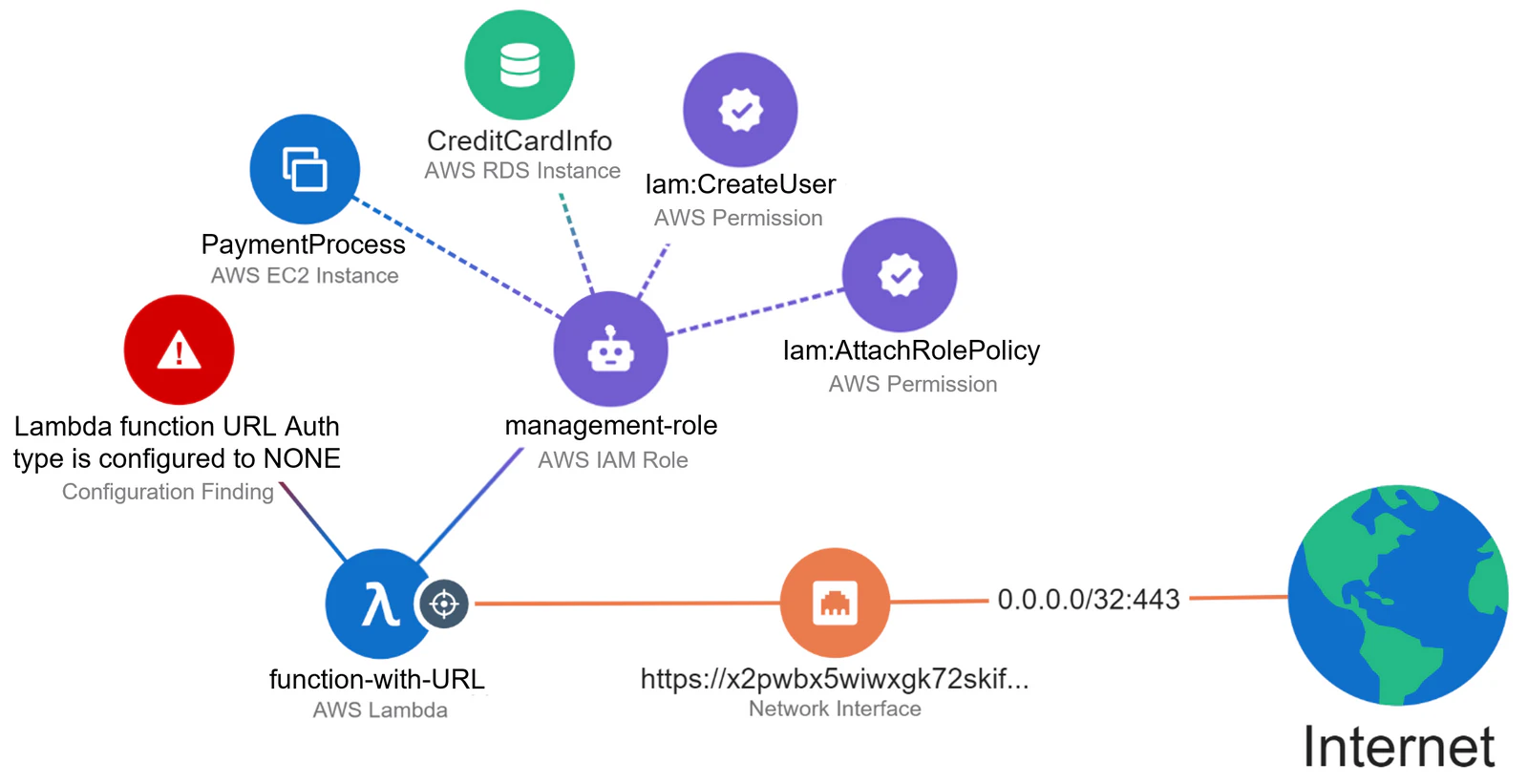
Securing AWS infrastructure at scale demands more than basic controls and native tooling. CNAPPs like Wiz unify security insights across cloud environments to deliver proactive, context-rich protection. Wiz correlates data across your infrastructure—identities, configurations, workloads, and vulnerabilities—to surface the most critical risks. Wiz capabilities include:
Unified visibility across accounts, workloads, and regions
Wiz provides complete visibility across all AWS accounts, services, and workloads, including complex multi-account and multi-region environments challenging central security teams. While native tools typically stop at the API and configuration layer, Wiz uses SideScanning to analyze the workload itself—inspecting EC2 instances and containers to identify vulnerabilities, exposed secrets, and malware without deploying agents.
Wiz delivers:
Automated, agentless discovery of all cloud assets and configurations across accounts
A single view that bridges development, security, and operations stakeholders
Continuous inventory updates that reveal real-time infrastructure changes
For instance, Fox uses Wiz to gain unified visibility across its complex cloud environments. This allows its security team to monitor risks across accounts and workloads without manual effort, driving faster resolution and better collaboration.
Contextual risk mapping and prioritization
Wiz enriches every security finding with business and infrastructure context, making it easier to prioritize what matters most.
Wiz adds context to your risks through:
Correlation of identity, configuration, network exposure, and vulnerability data to identify toxic combinations that represent real risk
Attack path mapping so teams understand how attackers could exploit an issue across services
Identification of minimal actions required to eliminate multiple risks simultaneously
Prioritizing findings by context reduces alert fatigue, enabling teams to focus their resources on high-impact problems.
Continuous monitoring, compliance automation, and scaled mitigation
Wiz continuously monitors cloud environments and automates policy enforcement. Set once and applied across accounts, these rules empower security and platform teams to maintain a consistent posture.
Wiz delivers these capabilities through:
Automated compliance checks against frameworks like CIS, NIST, and ISO
Real-time detection of drift and unauthorized changes
Rapid response through workflow automation and integrations with SIEM and ticketing platforms
Wiz also integrates with infrastructure as code pipelines to catch misconfigurations before deployment, making security part of the development lifecycle.
CNAPPs: The business value for security and platform managers
Wiz empowers both security leaders and platform teams through a shared operating model. The platform eliminates silos and delivers measurable improvements in risk reduction and operational efficiency.
Wiz provides the following key benefits:
The CNAPP aggregates identity, configuration, workload, and vulnerability data into one prioritized view to reduce mean time to detect and remediate.
Wiz enables consistent security enforcement across cloud accounts without slowing developer velocity, providing clear, contextual guidance that developers can act on quickly.
The solution provides reporting and metrics that align security outcomes with business objectives, which helps leaders measure performance and communicate progress to executives and stakeholders.
The CNAPP strengthens resource efficiency by unifying siloed tools into one platform that scales across multi-cloud environments and reduces operational overhead for security and platform teams.
Wiz improves collaboration across security, development, and cloud operations by enabling everyone to work from a shared, real-time understanding of exposure and ownership.
The platform supports governance and compliance efforts by continuously validating controls and automatically generating audit and regulatory evidence.
To learn how Wiz can help you secure your AWS environment, request a demo today and take the first step toward reducing risk, improving visibility, and scaling securely. You can also evaluate your AWS security now by checking out our free AWS security assessment.
Agentless full stack coverage of your AWS Workloads in minutes
Learn why CISOs at the fastest growing companies choose Wiz to help secure their AWS environments.

FAQ
Below are common questions about AWS security risks: