
What exactly is product security?
Product security is the practice of securing a software product as a complete system, not just the application code but everything that determines whether that code is actually safe in production.
Note: The term "product security" is also used in hardware and IoT contexts to describe securing physical devices, firmware, and embedded systems. This article focuses on cloud-native software products, where the "product" is a combination of code, cloud infrastructure, and services.
In cloud-native environments, a product includes:
Application code: The first-party services and logic your team writes.
Cloud infrastructure: The compute, storage, and networking that hosts your workloads.
APIs: The interfaces connecting your services to each other and to external consumers.
Identities and permissions: The service accounts, IAM roles, and policies controlling what each component can access.
Data: The sensitive information your product stores, processes, and transmits.
Runtime behavior: How your application actually executes in production, including what it connects to and what processes it spawns.
Product security focuses on how these layers interact. A vulnerability in code might be harmless on its own. But combine it with a public-facing endpoint and an over-privileged service account, and you have an exploitable attack path. The goal is to understand which issues create real risk in your specific environment, and that requires continuous visibility rather than point-in-time audits.
Get the Application Security Best Practices [Cheat Sheet]
A quick-reference framework covering vulnerability scanning, developer remediation workflows, and code-to-cloud risk prioritization.

Product Security vs Application Security
Application security focuses on risks in and around code. AppSec teams use SAST, DAST, SCA, secrets detection, and IaC scanning to find vulnerabilities, insecure patterns, and misconfigurations before deployment. These practices have been essential in shifting security left and embedding feedback directly into developer workflows.
Product security includes AppSec but adds the deployment context needed to assess real-world impact. Where AppSec evaluates a codebase, product security evaluates the running system: the application plus the cloud infrastructure, identities, data stores, and APIs it depends on.
This distinction matters because AppSec tooling is typically scoped to a single codebase or service. It can tell you a dependency has a critical CVE. It cannot tell you whether that service is reachable from the internet, whether it runs with excessive permissions, or whether exploitation would expose customer data. Product security connects those dots.
How product security functions organize varies by company. Some teams grow out of AppSec. Others emerge from cloud security or DevSecOps. As programs mature, they often specialize: one group owns supply chain and CI/CD risk, another handles cloud posture, another focuses on runtime detection or red teaming. The scope differs, but the objective is the same: secure the product as a deployed, operating system.
Prioritization also differs. AppSec typically relies on severity scores and point-in-time assessments. Product security prioritizes by correlating multiple signals (exposure, permissions, reachability, data sensitivity) to identify which combinations create actual attack paths.
The two disciplines are complementary. AppSec provides early detection and developer feedback. Product security provides the system-level context to focus remediation on what matters in production.
The Core Components of Product Security
Product security is not a single capability or team. It is the result of multiple signals working together to describe how a product can be attacked and what happens if it is. Most programs include the same core components. What matters is not that each component exists, but that they are connected.
Secure Development Signals
These signals come from the development lifecycle. They surface weaknesses before code reaches production.
This includes vulnerabilities in application code, risky dependencies, hardcoded secrets, and insecure infrastructure definitions. On their own, these findings describe potential weaknesses. They do not describe risk on their own. Risk emerges when these signals are evaluated against where the code runs and how it is used.
Secure development signals are most valuable when they are traceable to deployed services and ownership is clear. Without that connection, they tend to accumulate faster than teams can act on them.
Cloud and Infrastructure Context
Infrastructure defines where a product runs and how it is exposed.
Cloud configuration determines whether a service is reachable, whether network paths exist between components, and whether security controls are enforced consistently. Misconfigurations in this layer often turn otherwise contained issues into exploitable paths.
Product security depends on continuous visibility into infrastructure state. Static snapshots are not enough in environments where resources are created and destroyed frequently. Understanding infrastructure context is what allows teams to determine which findings actually affect production systems.
Identity and Access Relationships
Identity defines blast radius.
Permissions determine what a compromised service or user could do after initial access. Overly broad roles, shared identities, and permission drift expand the impact of otherwise limited issues. Effective product security requires understanding not just which permissions are granted, but which permissions are actually usable in practice.
Mapping identity relationships across services is critical for understanding lateral movement and privilege escalation paths inside a product.
API and Service Relationships
APIs define how components trust and communicate with each other.
Service relationships often create indirect exposure paths that are easy to miss. An internal service may not be internet-facing, but if it trusts an exposed API or shares credentials, it can still become reachable. Product security relies on understanding these relationships to identify paths that cross intended boundaries.
This is especially important in microservice architectures, where trust is often implicit and distributed.
Data Access and Sensitivity
Data defines impact.
Access to sensitive data changes the severity of every other issue. A vulnerability in a service with no data access may be low impact. The same vulnerability in a service that can read customer records or credentials is not.
Product security requires visibility into where sensitive data lives, how it is classified, and which identities can reach it. Without this context, teams cannot accurately assess the consequences of exploitation.
Runtime Behavior and Signals
Runtime signals show what is actually happening.
They validate whether a theoretical issue is being exercised and whether a configuration or permission is being abused. Unexpected network connections, unusual identity use, or abnormal process behavior can confirm risk that static signals only suggest.
Runtime visibility does not replace earlier signals. It completes them. Product security uses runtime behavior to confirm priorities and guide response.
Correlation Is What Makes Product Security Work
Each of these components produces useful information on its own. Product security emerges when these signals are correlated into a single view of how the product behaves as a system. That correlation is what turns findings into decisions and decisions into risk reduction.
This is why product security platforms are built around a unified data model rather than a collection of point tools. The value is in the connections.
Common product security failures and why teams miss real risk
Most product security failures do not happen because teams lack tools or effort. They happen because teams are looking at the right signals in isolation, but not seeing how those signals combine.
One of the most common failures is treating findings as independent issues. Vulnerabilities, misconfigurations, identity risks, and runtime alerts are reviewed in separate queues, owned by different teams, and prioritized using different criteria. Each signal may look manageable on its own. The real risk emerges only when those signals intersect, which often goes unnoticed.
Another failure is overreliance on severity scores. CVSS and similar metrics describe properties of a vulnerability, not its impact in a specific environment. When teams prioritize work based on severity alone, they often fix issues that are unreachable while leaving exploitable paths open. This creates a false sense of progress while real risk remains.
Teams also miss risk when they lack visibility into effective permissions. Granted permissions rarely reflect what a service or user can actually do in practice. Permission chains, role assumptions, and inherited access can dramatically expand blast radius. Without understanding effective permissions, teams underestimate the consequences of compromise.
Tool sprawl contributes to this problem. Application security, cloud posture, identity, data security, and runtime detection tools each provide partial views. When these views are not connected, teams are forced to mentally correlate findings across systems. This does not scale and leads to missed attack paths, especially in large environments.
Another common failure is focusing too heavily on prevention without validating behavior in production. Shift left controls reduce risk, but they do not eliminate it. Code changes, configuration drift, and new dependencies introduce gaps over time. Without runtime context, teams cannot tell whether a theoretical issue is being exercised or whether a control is actually effective.
Ownership boundaries also obscure risk. Engineering teams own services. Platform teams own infrastructure. Security teams own policies and alerts. When responsibility is fragmented, no single group sees the full picture. Issues fall through the cracks because each team assumes another team has context or accountability.
Finally, many teams underestimate how quickly risk changes. Cloud environments evolve continuously. Services are redeployed. Permissions drift. APIs are added. Data moves. Reviews that were accurate last month may be misleading today. When product security is treated as a periodic activity, teams are always reacting to an outdated picture of risk.
These failures share a common root cause. Teams are managing signals instead of managing systems.
Product security exists to close that gap. By connecting development findings, cloud configuration, identity relationships, data access, and runtime behavior into a single model, teams can identify which conditions combine into real attack paths. That is how product security shifts focus from fixing everything to fixing what actually matters.
What is a product security engineer?
Product Security Engineer is a security professional who embeds security into software design, development, and operations throughout product lifecycle.
もっと読む

Product security best practices
Product security is effective only when tools, ownership, and operating practices are aligned. Teams that succeed treat product security as a continuous discipline with clear accountability, shared context, and prioritization based on real exposure.
Prioritize risk based on exploitability and impact
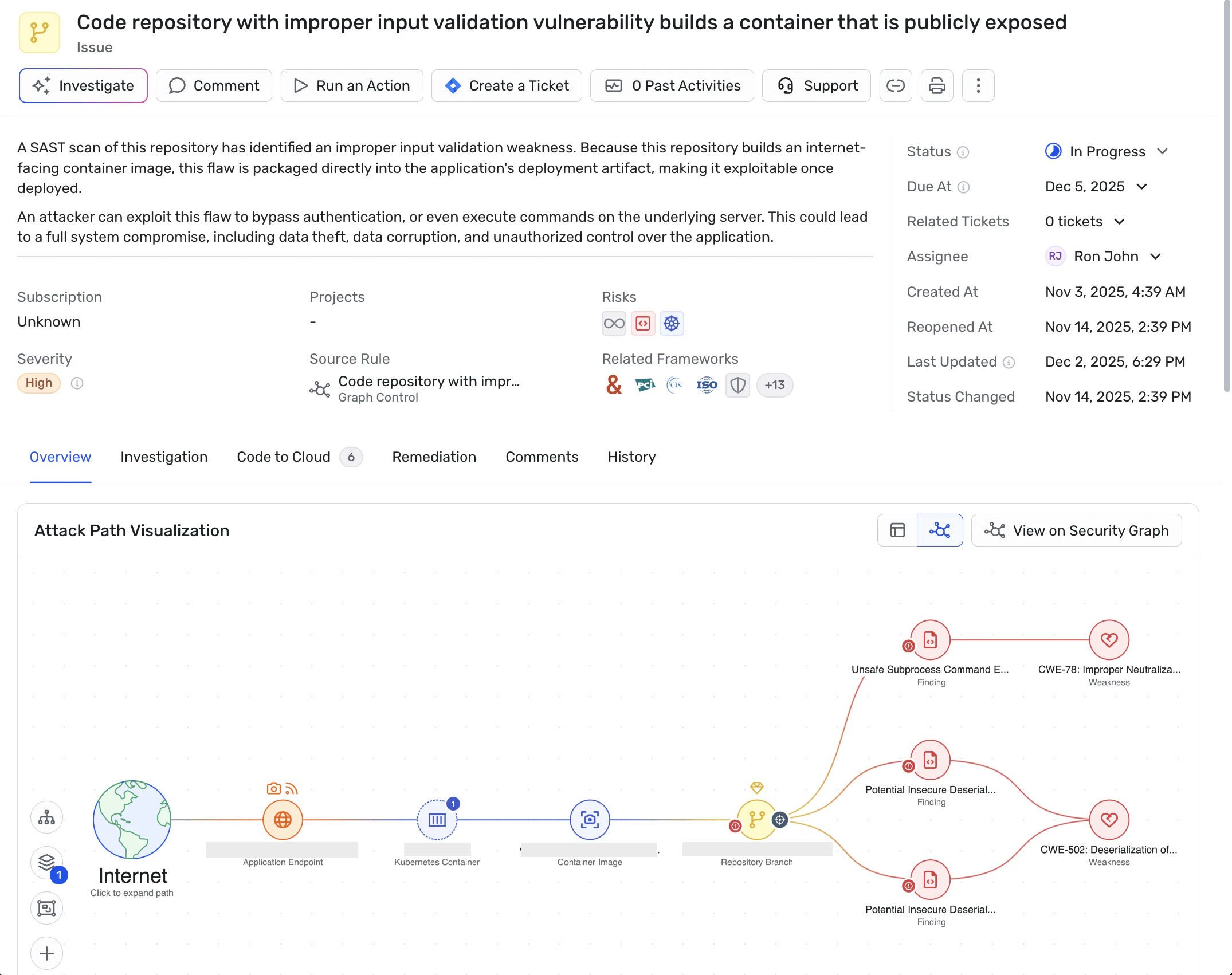
Product security programs should prioritize issues based on whether they can realistically be exploited and what the impact would be if they were. Severity scores alone do not capture this. Teams need to consider reachability, effective permissions, and access to sensitive data when deciding what to fix first.
This approach reduces noise and ensures effort is focused on risks that affect real products in production.
Watch 5-minute demo
Watch the demo to learn how Wiz Code scans infrastructure as code, container images, and CI/CD pipelines to catch risks early—before they reach the cloud.
Watch now
Maintain continuous visibility across the product lifecycle
Product security requires continuous visibility from development through runtime. Cloud environments change constantly as services are redeployed, permissions drift, and data moves. Periodic reviews quickly become outdated.
Teams should maintain up to date visibility across code, infrastructure, identities, APIs, and runtime behavior to ensure risk assessments reflect how the product actually operates.
Establish clear ownership for every risk
Every product security finding must have an owner.
Effective programs make ownership explicit by connecting issues to the teams and services responsible for remediation. Application risks should map to code owners. Infrastructure and configuration issues should map to platform or cloud teams. Identity and access issues should map to the teams that manage permissions and policies.
When ownership is unclear, issues stall. When ownership is explicit, remediation becomes predictable and scalable.
Shift left without losing production context
Preventive controls in development reduce risk, but they are not sufficient on their own. Product security programs should connect shift left findings to production context to validate whether issues were actually resolved and whether new risk has been introduced over time.
This ensures that development time security decisions continue to protect the product after deployment.
Reduce tool silos and unify risk context
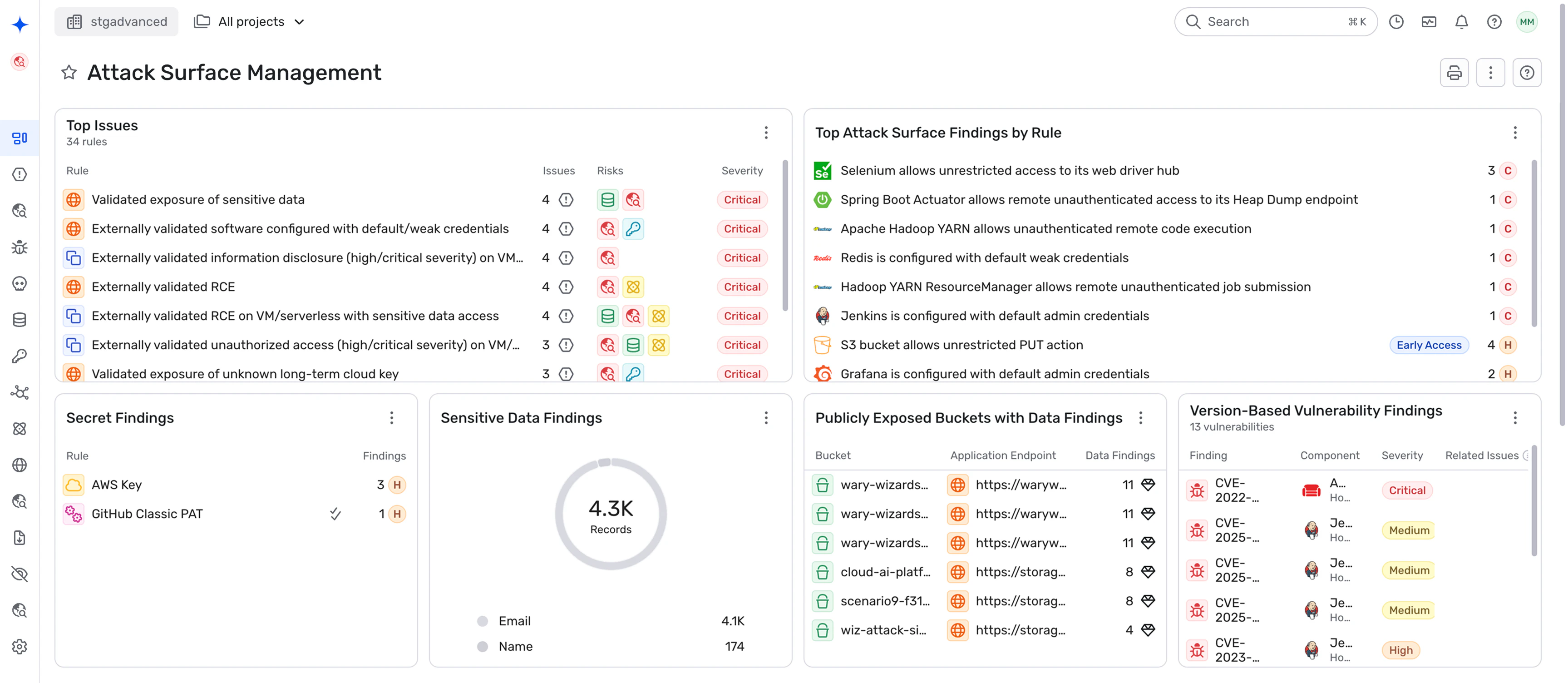
Siloed tools create fragmented views of risk and increase alert fatigue. Product security works best when signals from application security, cloud configuration, identity, data, and runtime behavior are evaluated together.
Unifying context across domains allows teams to see how issues interact and which combinations create real attack paths.
Measure outcomes, not activity
Product security success should be measured by reduced exposure, faster remediation of exploitable paths, and fewer security incidents. Metrics such as raw finding counts or scan coverage are secondary.
Outcome based metrics help teams focus on improving real security posture rather than optimizing for tool output.
Product security tools
Product security tools provide context-driven prioritization across the full product lifecycle, helping teams focus on issues that are actually exposed, reachable, and impactful. No single category of tools solves product security on its own. Effective programs combine multiple capabilities based on organizational needs and risk model.
Application security tools
Application security tools are foundational inputs to product security because they identify weaknesses early in development and testing. Findings from static analysis, dependency scanning, secret detection, and infrastructure-as-code analysis help teams catch issues before they reach production. However, without cloud and runtime context, these findings describe potential flaws, not real risk.
Examples include:
Dependency and software composition analysis
Secret and credential scanning
Infrastructure-as-code validation
Cloud and infrastructure security tools
Cloud and infrastructure security tools help teams understand how software is deployed and operated across cloud environments. They surface misconfigurations, identity and permission risks, and infrastructure weaknesses that influence exposure and reachability once code is running.
Examples include:
Misconfiguration detection
Effective permission analysis
Workload inventory and drift detection
Runtime detection and response tools
Runtime detection and response tools observe activity in production environments to detect active threats, abnormal behavior, and exploitation attempts. These signals validate whether theoretical issues are being exercised in practice and help teams confirm priorities and respond to active incidents.
Examples include:
Behavioral anomaly detection
Threat detection across running workloads
Runtime process and network monitoring
Correlation and prioritization platforms
Platforms that correlate signals across application, cloud, identity, and runtime domains provide the shared context needed for product security. By mapping how these signals relate to one another in a deployed environment, they help teams understand which combinations of conditions create exploitable attack paths.
Capabilities in this category include:
Unified risk scoring based on reachability and impact
Cross-domain correlation of findings
Prioritization based on real-world exploitability
Wiz's approach to product security
Wiz is a product security tool that helps teams understand, prioritize, and reduce risk across the full product system, from code and build artifacts to cloud infrastructure, identities, APIs, data, and runtime behavior.
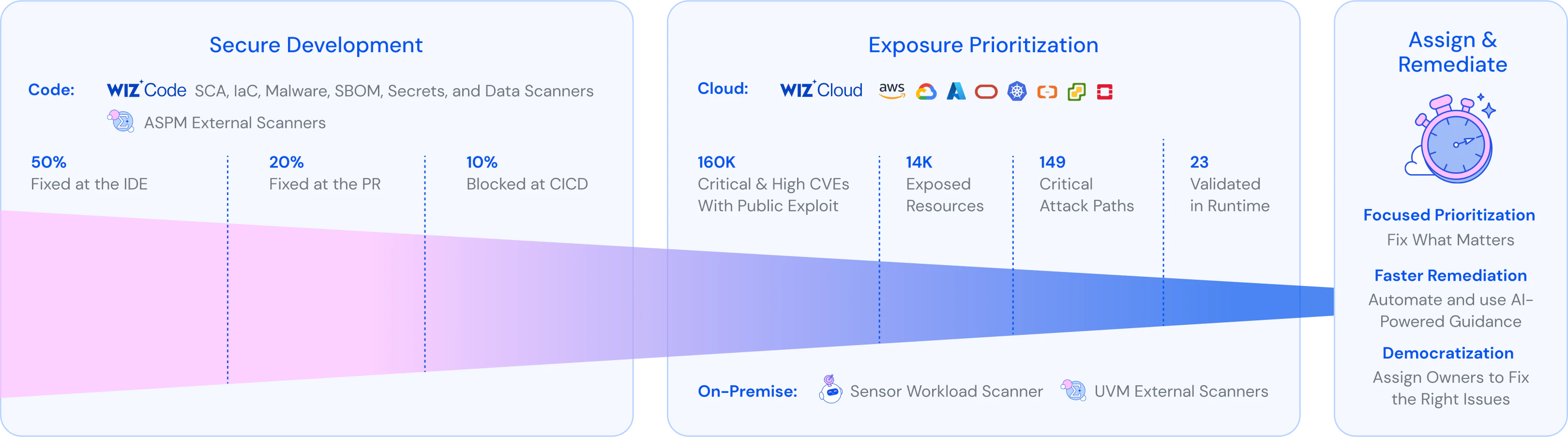
Wiz supports product security by unifying capabilities that are often treated as separate disciplines. This includes application security posture management, unified vulnerability management, and attack surface management, all evaluated together in production context rather than in isolation.
At the application layer, Wiz provides ASPM by connecting findings from code, dependencies, secrets, and infrastructure definitions to the services that actually run in the cloud. Application risks are not treated as abstract issues in a repository. They are evaluated based on where the code is deployed, how it is exposed, and what it can access in production. This allows teams to prioritize application security issues based on real impact rather than development-time severity alone.
For vulnerabilities in runtime environments, Wiz delivers Unified Vulnerability Management (UVM). Instead of managing CVEs as standalone findings, UVM evaluates vulnerabilities alongside cloud configuration, identity permissions, service relationships, and data access. A vulnerability becomes urgent only when it meaningfully increases risk in a specific environment. This shifts vulnerability management away from volume and toward exploitability and blast radius.
Wiz also provides Attack Surface Management (ASM) by continuously identifying which workloads, services, and APIs are externally reachable. ASM answers a critical product security question. Which parts of the product can be reached by an attacker without prior access. This external reachability context is essential for understanding which risks matter first.
When ASM and UVM are combined, Wiz enables Exposure Management. Exposure management identifies where vulnerabilities, misconfigurations, and identity risks intersect with external access to create real attack paths into a product. Rather than prioritizing based on severity or category, exposure management prioritizes based on whether an attacker can actually reach a vulnerable condition and what they could do next.
All of these capabilities are connected through the Wiz Security Graph. The graph models relationships between workloads, identities, network paths, APIs, data, and findings. This system-level view allows teams to see how individual issues combine into compound risk and to understand the full path from initial access to potential impact.
Because Wiz operates without agents, this visibility is continuous and low overhead, even as products change. Development-time signals, runtime behavior, identity changes, and exposure paths are evaluated together as the product evolves.
Most importantly, Wiz supports product security by giving teams a shared understanding of risk. Application security teams see how code findings translate to production exposure. Cloud and platform teams see how configuration and identity decisions affect blast radius. Security teams can prioritize based on exploitability and impact rather than raw finding counts. This shared context is what allows organizations to move from managing tools and alerts to actually reducing product risk.
Catch code risks before you deploy
Learn how Wiz Code scans IaC, containers, and pipelines to stop misconfigurations and vulnerabilities before they hit your cloud.
