

AI for security vs. security for AI
AI security solutions are divided into two distinct groups: tools that use AI to enhance defense (AI4Sec) and tools that secure AI infrastructure (Sec4AI). This distinction defines your selection strategy because a platform built to scale defense uses different controls than a platform built to protect model integrity.
AI Security Starter Pack
Build a practical foundation for securing AI systems across models, data, identities, and cloud infrastructure.

AI for security (AI4Sec)
This category focuses on applying AI, ML, and LLMs to the massive amount of telemetry security teams already collect, with the goal of reducing mean time to detect (MTTD) and mean time to respond (MTTR).
Core capabilities in this domain include:
Natural-language investigations: Natural-language capabilities let analysts issue queries like, "Show me all internet-facing VMs that have exposed high-severity CVEs and access to S3 buckets with sensitive PII," rather than writing complex SQL or KQL queries.
Automated event correlation: ML stitches together disparate signals, such as a suspicious login followed by a configuration change, into a single narrative.
Noise reduction: Filtering low-signal alerts lets SOC teams spend less time on false positives and more time on real threats.
For a closer look at how AI improves detection speed, correlates signals, and reduces alert fatigue, check out our articles on AI security.
Security for AI (Sec4AI)
This category covers controls that protect AI models, training data, pipelines, vector stores, and inference endpoints. AI workloads introduce unique risks, from deserialization vulnerabilities in model files (like Pickle) to runaway GPU compute costs and overly permissive access to sensitive training data.
Sec4AI capabilities to look for include:
Prompt injection guardrails: LLM firewalls inspect inputs and prevent attackers from overriding model constraints.
Model access governance: Controls determine which identities (human and machine) can invoke specific models or access vector stores.
Training & inference environment security: Security measures ensure training data stores are not publicly exposed and that containers running inference are patched, isolated, and locked down.
Learn more about the framework for protecting AI assets in our overview of AI-SPM.
Key capabilities in modern AI defense
These are the capability areas your AI security tooling needs to cover to handle a production AI environment.
Complete AI visibility across every deployment model. AI adoption spans managed cloud services, SaaS platforms, and custom-built applications. Most organizations don't have a full inventory of what's running. Your platform needs to discover AI systems across all three deployment models automatically, including shadow AI that teams spun up without security review. Discovery also means understanding how AI applications are actually built: which models, agents, tools, and data flows are connected, even when they aren't explicitly defined in configuration.
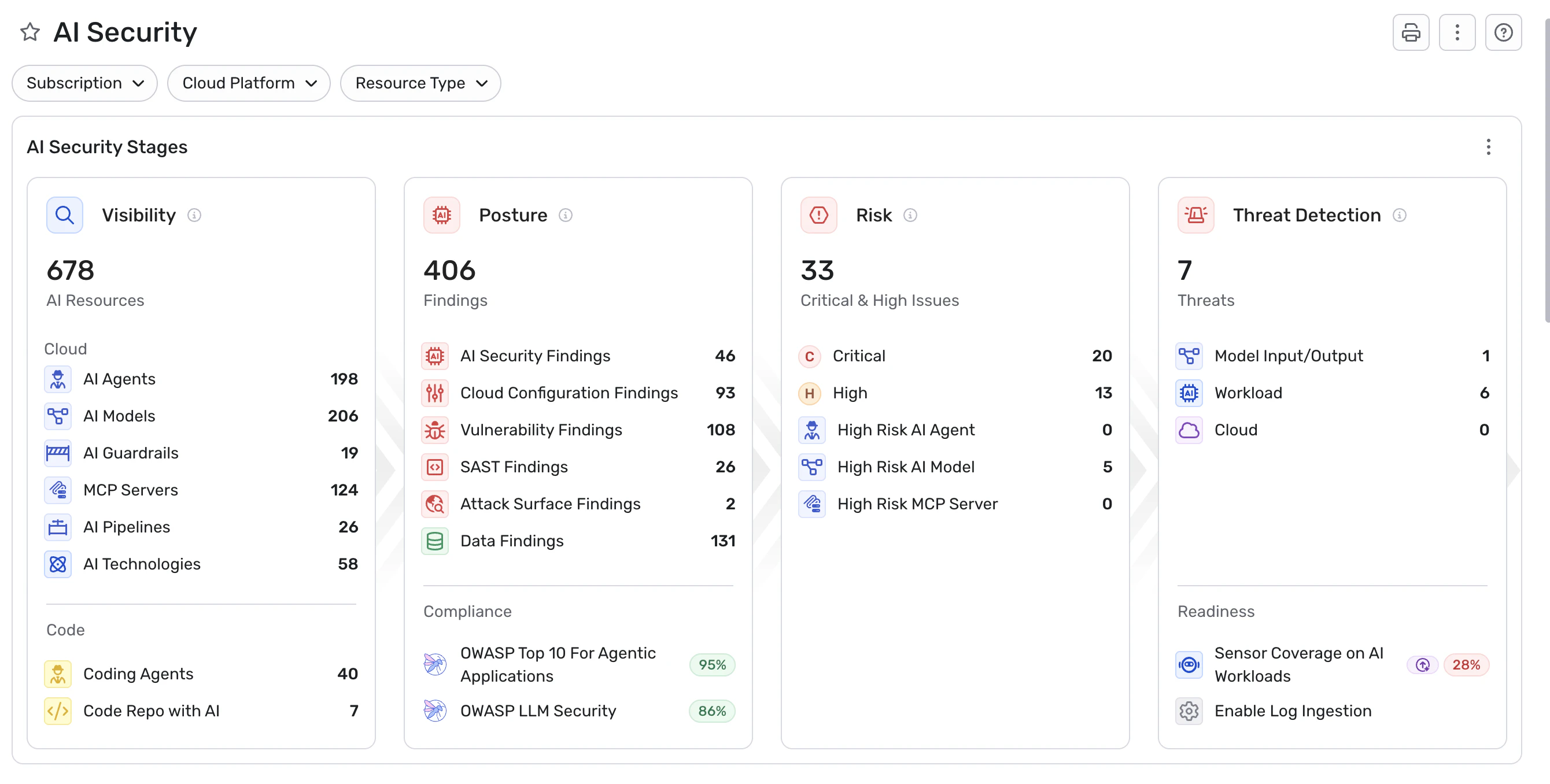
Cross-layer risk analysis. AI risk doesn't live in a single layer. A misconfigured model endpoint is one finding. That endpoint connected to an agent with code execution capabilities, accessing sensitive data through an overprivileged identity, exposed through a public API with an authentication bypass is a completely different risk. Your tooling must connect signals across infrastructure, access, model configuration, data sensitivity, and application behavior to surface attack paths that appear benign when viewed in isolation. Platforms that analyze each layer independently will miss the combinations that create real, exploitable risk.
AI supply chain validation. Models pull in dependencies just like standard software. You need to scan external models from Hugging Face or other registries for malicious code, unsafe serialization formats (like Pickle), and provenance gaps before they enter your pipeline.
Data security convergence. You can't secure AI without securing the data that feeds it. Your tooling must detect when AI systems have access to sensitive data stores and whether that access is necessary, scoped, and protected. If your security tool sees the model but not the data connection, you're missing the full risk path.
Identity and access hardening. AI workloads often run with high-privilege IAM roles to fetch large datasets. AI agents introduce another layer: autonomous systems that can execute code, call APIs, and access infrastructure on behalf of users. Reducing the privilege scope across models, agents, GPUs, and training data stores is critical to limiting the blast radius if any component is compromised.
Runtime threat detection across AI-specific layers. Static posture scanning catches misconfigurations. It doesn't catch an attacker actively exploiting a model endpoint, injecting prompts to manipulate an agent, or exfiltrating training data. Runtime detection for AI applications needs to monitor three layers simultaneously: model activity (inputs, outputs, prompt behavior), workload execution (agent activity, tool usage, system calls), and cloud activity (identity usage, API calls, infrastructure changes). Individual activity across these layers can appear normal. Connecting them is what reveals when an AI system is being exploited.
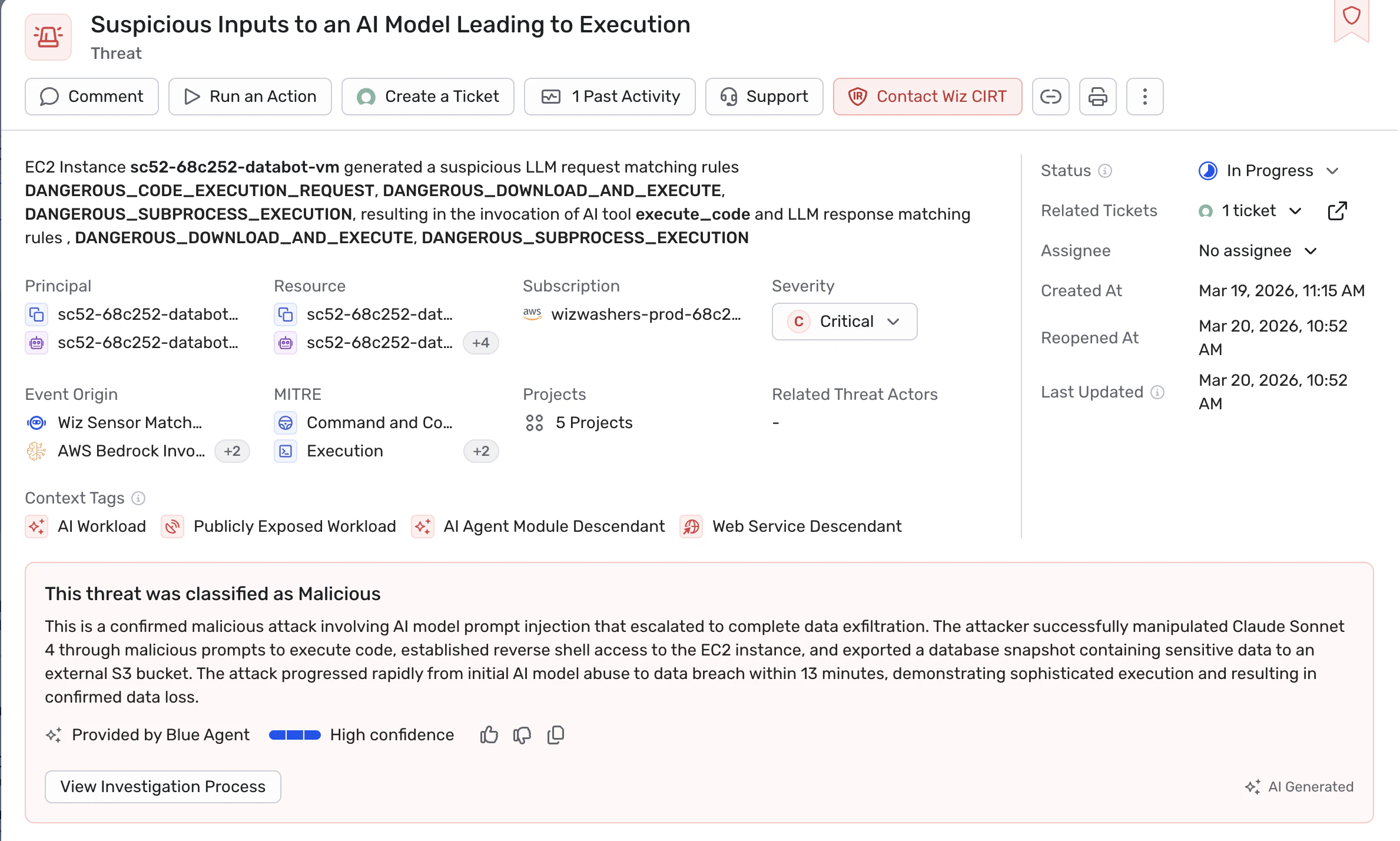
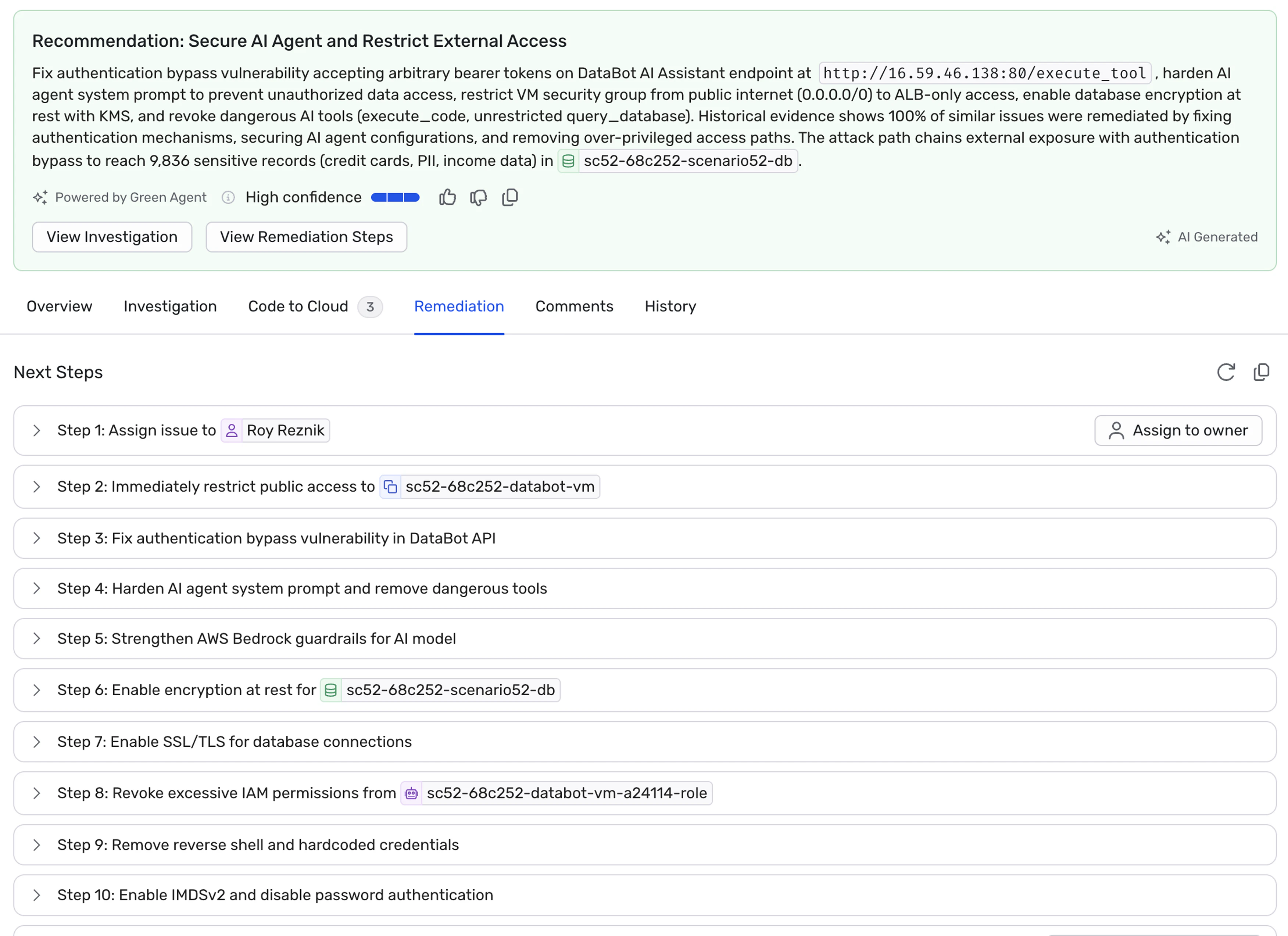
Automated investigation and response. When a threat targets your AI infrastructure, manual investigation doesn't scale. Your platform should automatically investigate threats against model endpoints, agents, and inference services, gathering context across all layers and producing a verdict with full reasoning. Response capabilities should include containing compromised AI workloads, revoking exposed API tokens, and isolating affected endpoints, with clear governance over what executes automatically and what requires human approval.
Choosing the right AI security approach for your organization
AI security is still a young category, and no single platform covers every need equally well. The right choice depends less on which vendor is "best" and more on which approach aligns with where your organization sits on the AI maturity curve and how AI shows up in your environment.
If you're early in AI adoption, your biggest risk is shadow AI and ungoverned data flowing into third-party models. You need discovery and data security first. Start with a platform that can build a complete AI inventory across managed services, SaaS platforms, and any custom deployments your engineering teams have stood up without security review. Visibility comes before governance.
If you're running AI in production, your risk shifts to cross-layer attack paths. A model endpoint, an agent with tool access, a data store with sensitive content, and an overprivileged identity can each look fine on their own. Connected together, they form an exploitable path. You need a platform that analyzes risk across these layers simultaneously, not one that scans each in isolation and leaves your team to correlate findings manually.
If your teams are building AI agents with real-world capabilities, the risk profile changes again. Agents that can execute code, call APIs, read data, and modify infrastructure introduce autonomous attack surface that traditional security tooling wasn't designed to handle. Your platform needs to understand what agents can actually do, classify their capabilities, and monitor their runtime behavior for manipulation.
Inside MCP Security: A Field Guide
Examine how MCP connects agents, tools, data, and cloud resources—and where security controls need shared context.

If you're scaling across multiple AI deployment models (managed services, SaaS AI, and custom-built applications), you need a platform that covers all three without requiring separate tools for each. Fragmented tooling recreates the same visibility gaps that drove cloud security consolidation five years ago.
If you're in a regulated industry, governance alignment matters immediately. The EU AI Act high-risk obligations take effect August 2, 2026. The NIST AI RMF provides the US scaffold. Your tooling needs to map AI risk findings to compliance controls and frameworks like the OWASP Top 10 for LLM Applications, and generate evidence that auditors accept.
Across all of these scenarios, two selection criteria stay constant.
First, noise reduction: if a tool generates alerts for each layer independently without connecting them, it creates the same alert fatigue problem that plagues traditional security. Look for platforms that surface connected attack paths, not isolated findings.
Second, integration depth: AI security doesn't live in a silo. The platform must connect into your CI/CD pipelines, container registries, identity providers, and existing SIEM/SOAR workflows.
Leading AI security companies
The AI cybersecurity software market is crowded, but only a handful of platforms are meaningfully addressing both sides of the problem: using AI to improve security and securing AI systems in production. Here’s a breakdown of the AI security vendors leading the pack.
Wiz
Wiz AI-APP secures AI applications end-to-end across three connected layers: visibility into where AI runs, risk analysis across how layers interact, and runtime detection and response for active threats. AI risk emerges when systems interact across models, agents, tools, infrastructure, and data. Individual signals can appear expected on their own. Wiz connects them to reveal when they combine into real, exploitable attack paths.
Focus: Cross-layer AI application protection from code to runtime, covering managed platforms (Bedrock, Azure AI, Vertex AI), SaaS AI (OpenAI, Copilot Studio), and custom-built applications
Features and benefits:
Complete AI inventory: Automatically discovers AI systems across all deployment models. The Wiz Workload Explainer uses AI to translate custom implementations into clear components that deterministic scanning alone cannot identify, mapping models, agents, tools, and data flows regardless of architecture
Cross-layer risk analysis: Connects signals across infrastructure, access, model configuration, data sensitivity, and application behavior to surface attack paths that appear benign when viewed in isolation. Maps findings to frameworks like OWASP Top 10 for LLM Applications
Runtime threat detection: Monitors across three layers simultaneously: model activity (inputs, outputs, prompt behavior), workload execution (agent activity, tool usage, system calls), and cloud activity (identity usage, API calls, infrastructure changes)
Insight to action with Wiz Agents: Red Agent identifies complex exploitable risk by reasoning like an attacker. Green Agent determines what to fix and who owns it. Blue Agent investigates threats and validates real impact. Wiz Workflows define when agents act autonomously and when humans approve
Get a sample AI security assessment report to get a better idea of Wiz’s AI-SPM capabilities.
Prisma Cloud by Palo Alto Networks
Prisma Cloud uses Palo Alto’s strength in network security, including firewall telemetry and traffic inspection, to fortify its cloud security capabilities. Their "Precision AI" initiative focuses on high-fidelity alerts to block attacks in real time.
Focus: Network + cloud depth, expanding AI posture coverage
Features and benefits:
Native connections: Suits environments that are already wall-to-wall Palo Alto, connecting firewall data with cloud posture
Asset discovery: Features strong capabilities for discovering AI assets across multi-cloud environments
Runtime protection: Features container runtime security via their Twistlock heritage, making them a solid choice for protecting the underlying compute of AI models
Falcon Cloud Security by CrowdStrike
CrowdStrike’s strength lies in endpoint security. For AI security, CrowdStrike focuses on protecting the compute and identity layer that runs models, bringing its endpoint security depth to AI workloads.
Focus: SOC reinforcement, unified EDR + cloud telemetry
Features and benefits:
Charlotte AI: Helps interpret detections and automate repetitive SOC tasks via a GenAI security analyst
Breach prevention: Excels at stopping lateral movement; if an attacker compromises a Jupyter notebook and tries to move to the host, Falcon intercepts
Visibility: Offers strong visibility into hybrid environments, bridging on-prem GPU clusters and cloud instances
Microsoft Defender for Cloud
If you are heavily invested in the Azure ecosystem (Azure OpenAI, Azure ML), Defender is the native choice.
Focus: Azure-native AI protection, identity-centric controls
Features and benefits:
Security Copilot: Uses OpenAI models; Copilot is deeply embedded into the workflow, summarizing incidents and suggesting script fixes
Identity-first: Effectively governs access to AI resources, aided by Microsoft Entra ID’s IAM capabilities
Threat intel: Uses Microsoft’s global threat intelligence to continuously update detections against nation-state actors targeting AI IP
SentinelOne
SentinelOne focuses on speed and autonomy and quickly contains compromised AI workloads at runtime. Their "Purple AI" acts as a force multiplier for threat hunters.
Focus: Autonomous containment + Purple AI hunting
Features and benefits:
Natural language hunting: Converts plain English into structured queries to hunt for threats across the estate
Autonomous response: Terminates suspicious activity and isolates compromised AI workloads to prevent lateral movement and limit the blast radius of incidents
Behavioral detection: Features AI-driven detection of "unknown" threats, relying on behavior rather than signatures
Darktrace
Darktrace approaches security from a network traffic and behavioral baseline perspective.
Focus: Anomaly detection & autonomous containment
Features and benefits:
Self-learning: Builds a "pattern of life" for your AI services and detects deviations (for example, a model suddenly exporting terabytes of data)
Cyber AI analyst: Autonomously stitches together disparate events to present a coherent incident report
Antigena: Autonomously interrupts abnormal connections, effectively containing a hijacked model or data exfiltration attempt without human intervention
Vectra AI
Vectra AI approaches security from a network detection and response (NDR) foundation, using behavioral AI to detect attacker activity across hybrid and multi-cloud environments. Their Attack Signal Intelligence analyzes behavior in real time across network, identity, cloud, and SaaS layers to surface compromises that signature-based tools miss.
Focus: AI-driven behavioral detection across the hybrid attack surface, with strength in lateral movement and identity-based threats
Features and benefits:
Attack Signal Intelligence: Behavioral AI that correlates attacker activity across network traffic, identity behavior, and cloud control plane activity, distinguishing real threats from benign anomalies even inside encrypted traffic
Hybrid coverage: Unified detection across on-premises data centers, cloud workloads, SaaS applications, and identity providers without requiring separate tools per environment
Autonomous triage: AI agents automate alert correlation and prioritization, reducing the volume of findings analysts need to review and cutting investigation times from days to minutes.
Want to see how Wiz connects signals across AI models, agents, infrastructure, and data to surface the attack paths that matter? Get a demo and explore cross-layer AI security in your own environment. Request a demo to explore how Wiz can secure your cloud environment.
See connected AI risk in context
Explore how Wiz connects models, agents, identities, infrastructure, and data from code to runtime.
