


API security testing is the process of validating that APIs are protected against abuse, misconfiguration, and sensitive data exposure. Unlike functional testing—which checks whether an API works—security testing looks for ways an API can be misused. This includes testing:
Authentication and authorization logic
Data exposure patterns
Schema enforcement
Input validation and error handling
In practice, this means probing inputs to surface bugs, edge cases, and undefined behavior, mirroring the tactics and attack paths of real adversaries. For example, altering API requests to simulate attack scenarios is an effective way to test for authorization and access control abuse, such as broken object-level authorization (BOLA), broken function level authorization (BFLA), and broken object property level authorization (BOPLA).
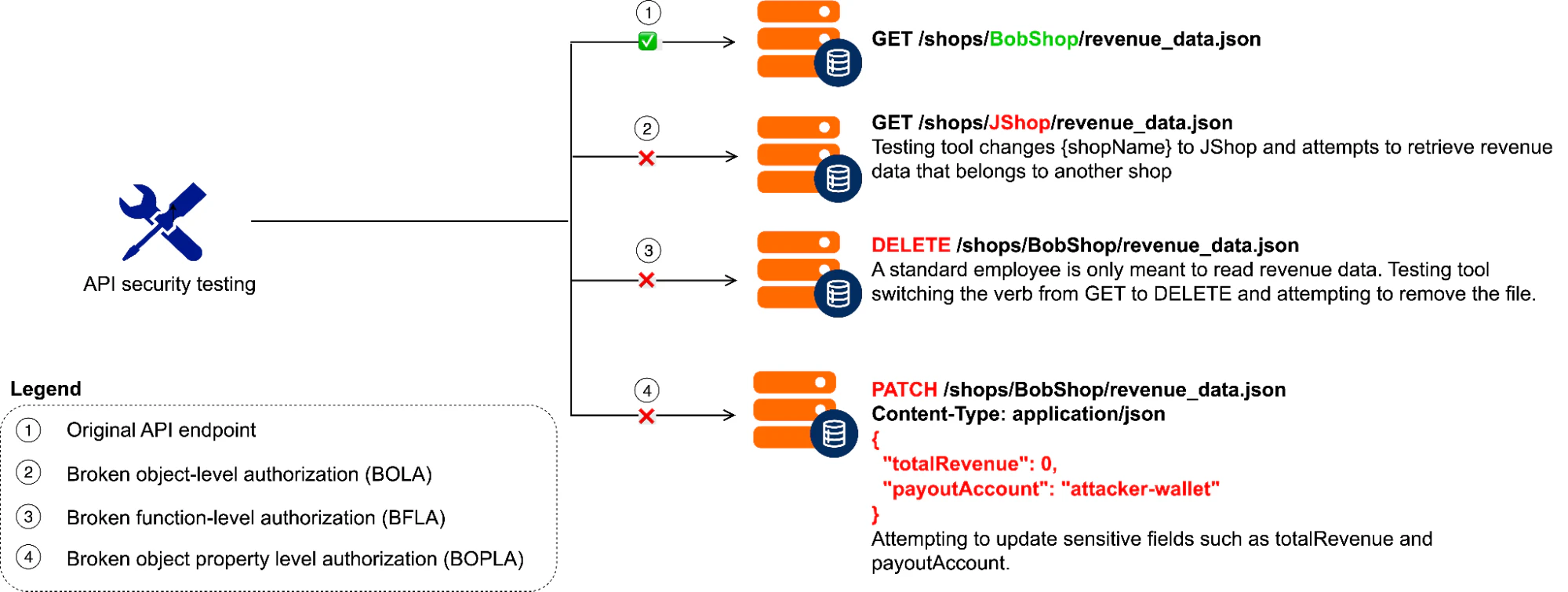
In this article, we’ll explore the ins and outs of API security testing, including top API security risks to test for and the key types of testing you’ll need to keep your APIs safe. We’ll also take a look at why contextual prioritization is required for teams to deliver faster, smarter fixes.
Advanced API Security Best Practices [Cheat Sheet]
Download the Wiz API Security Best Practices Cheat Sheet and fortify your API infrastructure with proven, advanced techniques tailored for secure, high-performance API management.

Automated API security testing for shift-left security
There is no closed, exhaustive test suite for APIs, and developers can’t track every attack path by hand. The solution? Automated API security testing.
Automated API security testing shifts security left by integrating it early in the SDLC, reducing the blast radius, lowering cost, and shortening time to recovery.

Types of API security testing
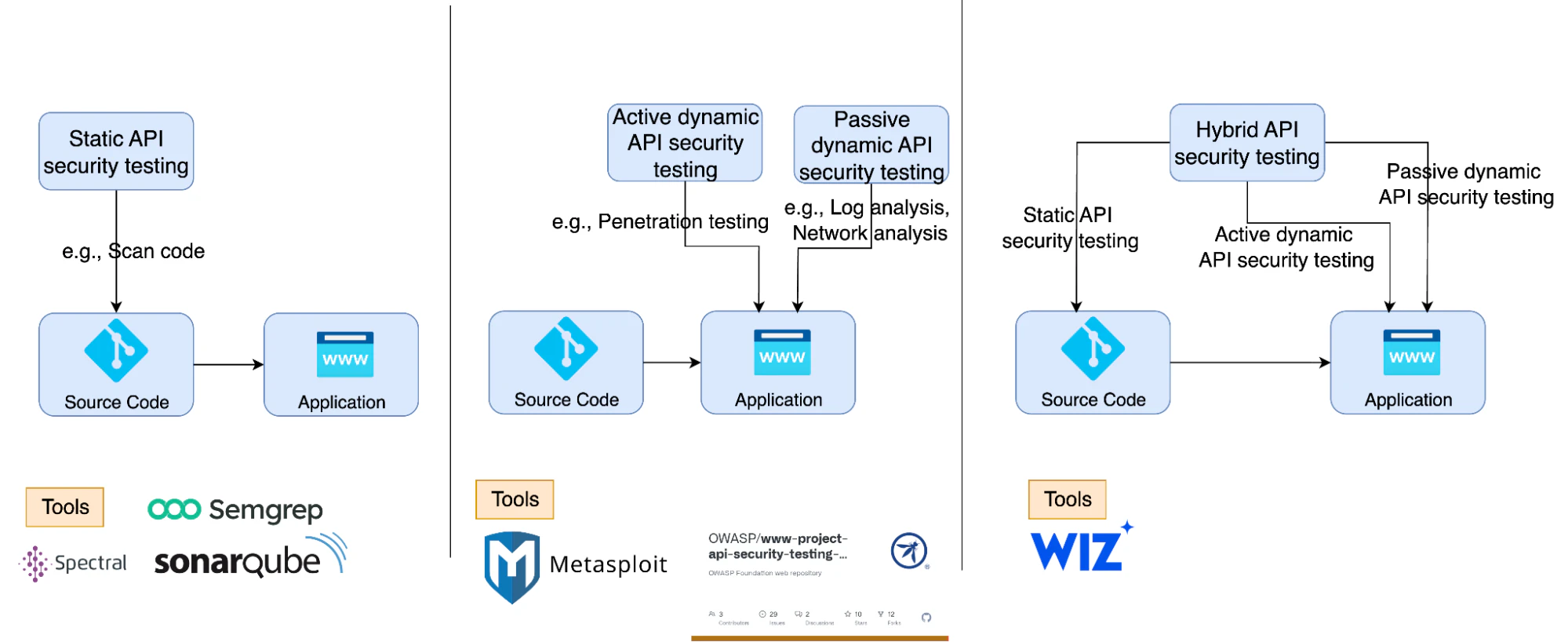
API security testing methods can be categorized based on how much each technique relies on code execution. This boils down to three types: static API security testing (the least dependent on code execution), dynamic API security testing (the most dependent on code execution), and hybrid API security testing (a blend of static and dynamic testing, so somewhere between the two).
1. Static API security testing
Static API security testing is a type of white-box testing, which means that it looks at code and configurations without running the application. Static testing tools spot misuses of APIs before runtime by inspecting source, bytecode, or intermediate representations. The big wins? Speed, coverage, and easy integration into developer workflows.
Here’s how it works: Static API security testing tools analyze source code, API specifications (OpenAPI/AsyncAPI), and infrastructure-as-code files to detect insecure patterns, unsafe defaults, and missing security controls. They match code against known vulnerability classes—such as hardcoded credentials, missing authentication checks, or overly permissive CORS policies—without executing the application.
Static API security testing tools rely on threat intel from a wide variety of sources. For example, in 2023, the Open Worldwide Application Security Project (OWASP) published a list of the 10 most common API security vulnerabilities, and this has become an industry-wide security benchmark. But that’s just the start: Thousands of CVE records reference APIs in the CVE Database, covering everything from authentication bypasses to injection flaws. This growing catalog underscores why automated testing against known vulnerability patterns is essential.
Static API security testing tools also include tools that do linting. Open-source linters such as Spectral validate OpenAPI/AsyncAPI files with customizable rules to catch missing authentication, weak schemas, and style violations.
Static application security testing (SAST) tools are also great for static API security checks.
Something to keep in mind: While SAST is important, it comes with some downsides. Static analysis can flag issues that never happen at runtime, so false alarms are common. Also, large projects can strain memory and time budgets unless you use on-demand slicing, which removes parts of the code that are irrelevant to a specific analysis.

The biggest drawback? SAST can't validate runtime behavior such as environment-specific configurations (staging vs. production secrets), live authentication flows (OAuth token exchange), network reachability (internet-exposed endpoints), or cloud IAM policies that control actual access at runtime.
Watch 12-minute Demo
Learn about the full power of the Wiz cloud security platform. Built to protect your cloud environment from code to runtime.
Watch now
2. Dynamic API security testing
Dynamic testing runs an API and watches how it behaves at runtime. Because it interacts with endpoints and observes external behavior rather than analyzing code, it’s often called black-box testing. The upside? Dynamic testing sees real responses, state changes, and authorization effects, so false positives are uncommon.
Dynamic API security testing tools can either be active or passive. Active dynamic API testing involves attempting to exploit vulnerabilities against a running API service to validate that a suspected weakness is truly an issue (e.g., penetration testing). On the other hand, passive dynamic API testing collects data and observes behavior without trying to cause harm (e.g., log analysis, network analysis). In practice, teams mix both. Start passively to map behaviors and data flows without adding load. When you move to active testing, implement rate limits (e.g., 10 requests per second), use dedicated test credentials, schedule tests during maintenance windows, and coordinate with SRE teams to monitor latency and error rates during test execution.
You can use the OWASP API security testing framework as a starting point—it’s a great automated dynamic testing framework for detecting API security vulnerabilities, covering everything on the OWASP Top 10 API Security Risks list:
Broken object-level authorization (BOLA): Users can access objects they don’t own by changing identifiers (e.g., IDs) in requests.
Broken authentication: Flaws in login or token handling let attackers impersonate users or keep sessions alive.
Broken object property level authorization (BOPLA): Users can read or modify fields within an allowed object that should be restricted.
Unrestricted resource consumption: Endpoints allow excessive use of CPU, memory, bandwidth, storage, or third-party calls without limits.
Broken function level authorization (BFLA): Lower-privilege users can invoke admin or high-risk functions due to missing role checks.
Unrestricted access to sensitive business flows: Critical workflows (e.g., checkout, password reset) can be abused or executed out of sequence.
Server-side request forgery (SSRF): The API fetches attacker-supplied URLs and is tricked into calling internal or metadata services.
Security misconfiguration: Unsafe defaults, verbose errors, open consoles, or weak TLS/CORS expose the API to attacks.
Improper inventory management: Unknown, outdated, or undocumented APIs and versions can result in exposure.
Unsafe consumption of APIs: The service trusts upstream APIs without strict validation, leading to injection, data leaks, or logic errors.
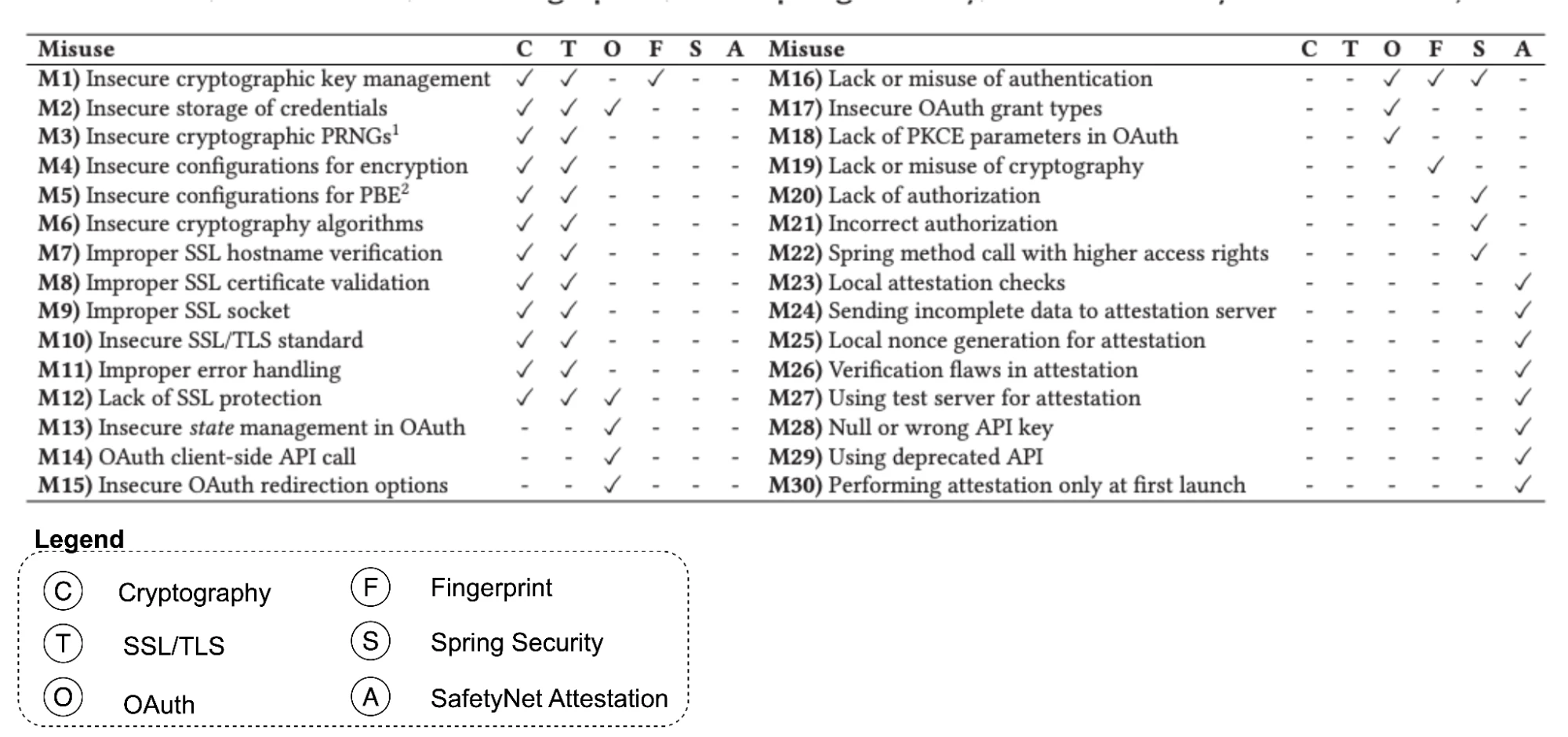
Remember: OWASP’s list doesn’t cover every API risk. Technologies evolve quickly, and new risks emerge all the time. For example, a July 2025 report by cybersecurity researchers included a 30-item taxonomy of security API misuses.
3. Hybrid API security testing
Hybrid API security testing combines static and dynamic techniques to get the best of both worlds. Unified solutions such as Wiz deliver faster triage, fewer false alarms, and higher confidence that fixes address both code-level flaws and real runtime behavior.
Hybrid API security testing in action: A real-world example
In 2017, University of Birmingham researchers discovered and disclosed a vulnerability in the mobile apps of several major banks, including HSBC, Meezan Bank, and Bank of America. The vulnerability allowed certificate pinning without hostname verification, meaning the mobile apps validated the certificate's cryptographic signature but didn't check whether the certificate's Common Name (CN) or Subject Alternative Name (SAN) matched the API's domain. This enabled network-adjacent attackers to present valid certificates for different domains and perform man-in-the-middle (MitM) attacks.
With hybrid API security testing, you can catch hostname verification flaws early and prove fixes end to end:

“Start left” with static checks in code and configs: Flag permissive
HostnameVerifierimplementations,trust-allTrustManager patterns,verify=Falseorcurl -k.Add unit tests that connect to a TLS server with a mismatched CN/SAN and expect the handshake to fail.
Enforce these rules in continuous integration (CI) so insecure flags and debug shortcuts never ship.
Hybrid testing is key here: Static testing alone can’t confirm real runtime behavior. Build paths, feature flags, proxy termination, certificate pin rotation, OS updates, and fail-open error handling only show up when the client actually runs. Dynamic tests close this gap by verifying that the client validates the server's hostname against the certificate's CN/SAN fields and refuses to send application data when hostname verification fails, terminating the TLS handshake with an error.
API risk assessment: Tools & techniques
An API risk assessment is a systematic process for evaluating the APIs used across an organization.
Read more
Prioritizing API risks with context
Your tests are complete, and your results are in. What now? You need context to decide what to fix first. A practical approach is to score each finding across three dimensions:
| What to score | Context provided | Example risks |
|---|---|---|
| Exposure | How reachable the API is in the real world | Public IPsInternet-facing load balancersMissing mutual TLS (mTLS) authenticationPermissive CORS |
| Exploitability | How easy it is to abuse the control gaps | Weak auth Overbroad scopesPredictable IDsRate limits that allow enumeration |
| Business impact | What the endpoint does and returns | PIIPHIPCI data (and whether it supports core transactions or regulated workflows) |
Now layer in automation to apply this scoring at scale. Context-driven risk prioritization ranks API findings by real impact using signals from cloud inventories, identities, data classification, and network paths. Tools like Wiz discover APIs, identify context to map attack paths, and surface what’s truly exploitable so teams can fix the highest-risk issues first.
Unmanaged API security: What cloud teams need to know
Unmanaged APIs are undocumented interfaces that operate outside standardized security and governance frameworks.
Read more
uAPI security testing with Wiz: Discovery to prioritization
API security testing only succeeds when it reflects how modern systems are built and attacked. The goal isn’t to run more checks but to validate real behavior, map exposure, and focus on what could actually cause harm. As we’ve seen, that means combining static and dynamic techniques with runtime evidence, then judging each finding by reachability, exploitability, and business impact. Teams that leverage the right tools to follow these steps reduce noise, fix faster, and lower breach risk.
Enter Wiz.
Wiz API Security Posture Management (API SPM) automatically discovers known and shadow APIs across AWS, Azure, GCP, and Kubernetes environments; validates internet exposure and broken authentication with dynamic tests; and enriches findings with cloud context—identities, network paths, data classification, and hosting metadata—to enable risk-based prioritization that focuses remediation on exploitable attack paths.

Ready to focus your efforts where they matter most? Start by running automated API security testing and risk mapping in a staging environment with Wiz, or book a demo to see how Wiz can help you secure your APIs and your entire cloud attack surface.
Agentless, contextual API discovery
Wiz helps teams quickly uncover every API in their cloud environment, known and unknown, and see their exposure with full execution context.
