

What does a DevOps engineer do?
At a high level, DevOps is the practice of reducing friction between software development and operations through automation, shared ownership, and faster delivery. In recent years, the role has expanded into platform design, reliability, and security.
DevOps engineers often shape the “paved road” developers use every day: a standardized, self-service path developers rely on to build, test, deploy, and operate software with less friction and fewer risky one-off decisions (think CI/CD pipelines, container platforms, IaC modules, secrets handling, deployment workflows, and observability).
That’s why security is now central to DevOps. If you’re provisioning IAM roles, deploying Helm Charts, managing GitHub Actions, or defining Terraform modules, you’re responsible for the attack surface whether security is in your title or not.
DevOps Security Best Practices [Cheat Sheet]
Explore best practices across secure coding, infrastructure security, and monitoring and response in DevOps.

From pipeline automation to platform ownership
A few years ago, you could stand out by building Jenkins pipelines, scripting deployments, and cleaning up environment drift. Those skills still matter, but they’re table stakes. Managed services, reusable modules, and AI-assisted tooling have lowered the value of basic setup work.
As we’ve seen, DevOps is increasingly about platform ownership: building and maintaining the internal systems, standards, and self-service workflows that developers depend on. Engineers help teams ship software quickly and keep systems stable. That means reducing build times, improving deployment quality, controlling cloud waste, and adding guardrails that validate changes before they reach production.
DevOps vs. DevSecOps vs. SecDevOps
These terms overlap, but the emphasis is slightly different:
DevOps focuses on automation and operational reliability. DevSecOps adds security checks like dependency scanning and secrets detection into the delivery workflow. SecDevOps prioritizes a security-first posture where teams design engineering choices around risk reduction from the start.
Here’s a quick summary:
DevOps focuses on automation, release flow, infrastructure consistency, and operational reliability.
DevSecOps brings security directly into the delivery workflow, including dependency scanning, IaC scanning, secrets detection, and policy checks in CI/CD.
SecDevOps usually implies a stronger emphasis on security, where engineering choices are intentionally designed to reduce risk.
In practice, real teams integrate these responsibilities based on their specific delivery goals. The important point is that security fluency is no longer optional if you want to keep growing in DevOps.
DevSecOps vs DevOps: Key differences & Comparison
DevOps is a way of working that breaks down walls between development and operations teams. This means developers and IT operations work together instead of in separate silos, which helps companies build and release software faster.
Read more

Essential technical skills for modern DevOps engineers
If you’re mapping the career path for DevOps, focus on durable skills that apply to real environments:
1. Cloud architecture
Select one major cloud provider and master its core architecture. Learn IAM, networking, compute, storage, logging, and managed Kubernetes. Early on, you don’t need deep expertise in AWS, Azure, and GCP at the same time. One strong foundation is far more useful than shallow familiarity across all three.
You should understand how workloads are deployed, how identities gain access, how traffic flows, and where cloud misconfigurations usually happen.
2. Infrastructure as code (IaC) and GitOps
Terraform remains a core skill, while Pulumi is increasingly useful for teams that prefer general-purpose languages. But writing resources is only part of the job. You also need to understand module design, state handling, review practices, drift management, and reusable secure defaults.
GitOps reinforces security goals by making Git the source of truth for environments, using tools like Argo CD and Flux. GitOps practices improve consistency and make unauthorized manual changes easier to detect and reverse.
3. Secure CI/CD design
A good pipeline isn’t just fast. It catches risky changes early while maintaining high deployment velocity.
You should know how to integrate:
SAST for custom code vulnerabilities
SCA for open-source dependency risk
IaC scanning for misconfigurations
Secrets detection for leaked credentials
Image and artifact validation before deployment
This is where DevOps engineer requirements overlap heavily with security expectations. You don’t need to become an application security specialist, but you do need to design systems that fail safely.
4. Observability and incident response
You need to know whether a system is healthy and what to do when it isn’t. That means expertise in metrics, logs, traces, dashboards, alerts, SLOs, rollback strategies, and basic incident response. Strong observability helps teams detect problems earlier, understand where failures are happening, and reduce time to resolution during incidents. It also gives DevOps engineers the context they need to improve reliability over time, instead of just reacting when something breaks.
5. Security fundamentals
Security literacy enables you to build resilient systems. Understanding vulnerability management and software supply chain risk empowers you to strengthen security posture during development. For DevOps engineers, some of the highest-value areas to build expertise in are identity risk, least privilege, and runtime security.
Building a security-first DevOps mindset
The best DevOps engineers don’t bolt security on at the end. They build systems where secure behavior is the default:
Embed security without slowing down velocity
A large set of blocking checks can slow builds down and interrupt momentum. A better model is layered. Start with visibility, reduce noisy findings, and enforce the controls that matter most. Secrets, critical IaC mistakes, obvious policy violations, and exploitable exposure paths should be dealt with early. Lower-risk issues should be triaged with context rather than blocking every release.
Shift left, but keep context
Shifting left works when developers get feedback in their normal workflow. Scanning IaC in pull requests, validating policies before merge, and using hardened modules with secure defaults all reduce rework. Context is what makes those controls useful. For example, an alert about an overly permissive IAM role is much more actionable when a developer can see which workload it affects, whether it’s exposed to the internet, and how it could increase real risk in production.
Identity is the new perimeter
In cloud-native environments, identity often matters more than the network edge. Least privilege, secrets management, and CIEM-style thinking matter for DevOps engineers because permissions directly shape blast radius.
Prioritize real risk
Good security programs help teams answer the question, “What should we fix first?” Mature teams focus on toxic combinations, not just raw alert volume.
Security KPIs in real DevOps work
Successful teams keep close tabs on mean time to remediate, rollback rates, and how quickly risky configuration drift is fixed. These metrics matter because DevOps is about shipping faster while also shipping reliably and safely. If you can improve delivery speed while also improving security posture, you become far more valuable than someone who only knows how to keep the pipeline green.
Watch 5-minute demo
Watch the demo to learn how Wiz Code scans infrastructure as code, container images, and CI/CD pipelines to catch risks early—before they reach the cloud.

Career paths and specialization opportunities
One of the best things about DevOps is that it opens up multiple opportunities once you build your foundation:
Platform engineer
If you like automating manual developer tasks and building internal systems, platform engineering is a natural next step. Platform engineers create reusable infrastructure, self-service workflows, deployment guardrails, and the shared tools that make teams more productive.
Site reliability engineer
If you’re more interested in resilience, performance, and service health, SRE may be a better fit. You’ll spend more time on reliability engineering, incident response, operational quality, and service-level management.
Cloud security engineer or DevSecOps engineer
If security is the part of the role you keep gravitating toward, follow it. Experience with identity, cloud posture management, Kubernetes security, and secure CI/CD make that transition more natural. These skills build directly on the infrastructure and delivery expertise many DevOps engineers already have, while moving closer to a dedicated security role.
DevSecOps engineer roles and career progression
DevSecOps acts as a natural extension of traditional DevOps, weaving security into every phase of the software development lifecycle (SDLC). The main goal? To shift security left and make it a major consideration for everyone instead of an afterthought for a select few.
Read moreGetting started: Education, certs, and experience
There’s no single entry path into DevOps, but the strongest roadmaps combine foundational knowledge, hands-on practice, and proof that you can work across systems, delivery, and security.
Do you need a master’s degree in DevOps?
A master’s degree in DevOps is rarely a hard requirement. Most hiring managers care more about what you’ve built, operated, secured, and improved than about a specialized graduate credential.
That doesn’t mean advanced education has no value. It can help if it fits your goals. But for most people, real project experience, cloud fluency, and secure automation will do more for your career than another diploma.
Certifications
Certifications help most when they support hands-on skills. A solid path might be one cloud certification, then Certified Kubernetes Administrator (CKA) or Certified Kubernetes Application Developer (CKAD), then a security-focused cert if you lean toward DevSecOps or cloud security.
How to gain experience in DevOps
Learn Linux, networking, Git, and scripting: These fundamentals help you understand how systems run, how applications communicate, and how modern engineering teams manage changes reliably.
Build and deploy containerized apps: Working with containers helps you understand packaging, portability, and the deployment patterns that show up in modern cloud environments.
Learn one cloud platform deeply: As we’ve seen, strong DevOps practitioners master one cloud platform (AWS, Azure, or GCP) to understand how workloads deploy and identities gain access. Engineers must also identify where cloud misconfigurations happen across compute, storage, and networking layers to prevent data exposure.
Write Terraform for real environments: Infrastructure as code becomes much more valuable when you use it to provision realistic environments, manage changes safely, and create reusable patterns other teams can rely on.
Build CI/CD pipelines: Pipeline design teaches you how code moves from commit to production and how to improve speed, consistency, and release quality across that process.
Add observability and alerting: Metrics, logs, traces, and alerts help you detect issues earlier, troubleshoot faster, and build a stronger understanding of system health over time.
Add security scanning, secrets checks, and policy controls: These guardrails help teams catch risky changes earlier and make secure delivery part of the normal engineering workflow.
Practice remediation, rollback, and incident response: Recovery skills matter just as much as delivery skills because strong DevOps engineers need to respond calmly and effectively when something goes wrong.
DevOps engineer resume: Structure, skills, and examples
The best DevOps resumes show collaboration, not just automation. Top candidates demonstrate they can bridge development, operations, and security teams rather than working in isolation. Hiring managers look for evidence of cross-functional communication.
Read moreHow Wiz supports security-aware DevOps teams
For DevOps teams, the challenge is not just finding security risks. It’s getting enough context to know what matters, then fixing those issues without slowing down delivery.
That’s where Wiz comes in. Wiz connects development signals, cloud posture, and identities to secure environments from code to runtime.
Wiz Code starts the process by scanning code and IaC for secrets, vulnerabilities, and configuration issues before they move further downstream. From there, Wiz Cloud gives teams agentless visibility into the cloud environment, including workloads, Kubernetes, identities, and exposed resources.
Those findings connect in the Wiz Security Graph, which shows how a code issue, risky permission, or exposed asset can create a real attack path. That helps teams focus on the risks that can actually lead to impact instead of sorting through isolated alerts. Wiz Defend builds on that context at runtime by helping teams detect and respond to active threats in the cloud environment.
To effectively secure AI, DevOps teams should shift security left by integrating Wiz AI Security into their existing pipelines. This ensures that AI models, datasets, and agents are vetted before reaching production while maintaining continuous visibility into the cloud environment.
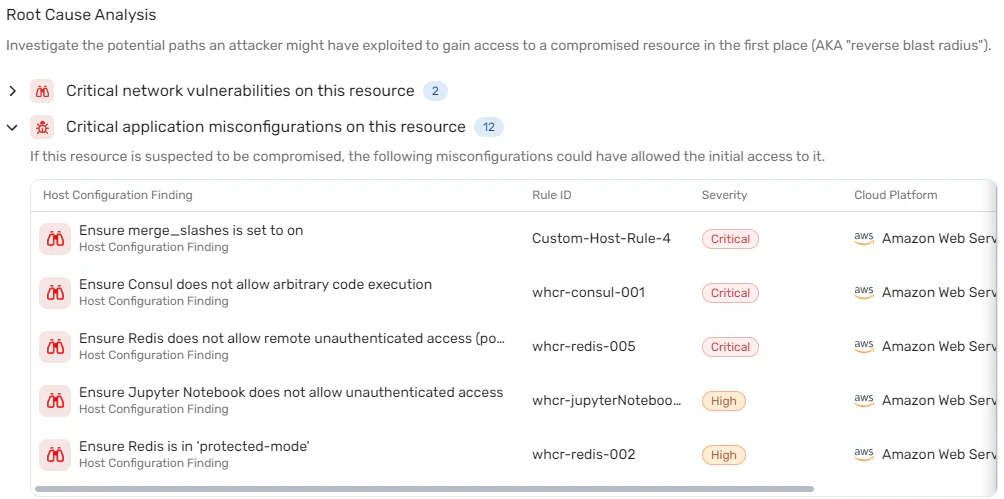
For DevOps and platform teams, the value is full coverage and a shared context. Developers, DevOps, and security teams can work from the same picture of risk, clarifying ownership, fostering collaboration, and slashing remediation times.
To see how Wiz can help your team prioritize risks and speed up remediation, book a demo now.
See for yourself...
Learn what makes Wiz the platform to enable your cloud security operation
