

What is a threat intelligence analyst?
A threat intelligence analyst is a specialized security practitioner who transforms fragmented information about threat actors, intent, and likely next moves into actionable intelligence to protect enterprise cyber assets.
The core distinction of this role is the evolution from raw data collection to actionable intelligence analysis. Rather than managing static perimeters, analysts use operational intelligence to accurately predict the when, where (by mapping specific attack paths), and how of incoming attacks. This predictive capability ensures security teams take the right mitigation steps at the right time.
To connect real-world threat data with business context, analysts build a comprehensive suite of technical skills and toolsets. This baseline includes proficiency with Threat Intelligence Platforms (TIPs), Open Source Intelligence (OSINT) methodologies, and attack surface visibility tools.
Above all, analysts master structured analytic techniques and standard intelligence frameworks. Applying this analytical rigor allows threat analysts to systematically eliminate cognitive bias and transform tactical threat data into accurate, defensible foresight.
2026 Cloud Threat Report
Get the latest cloud threat intelligence, attack trends, and defensive strategies from the Wiz Research team.

Essentially, threat intel analysts enrich indicators of compromise (IOCs) with context, map threat activity to frameworks like MITRE ATT&CK, and produce tactical guidance that sharpens detections and accelerates investigations. Their work spans:
Strategic intelligence: Analysts translate technical threat data into executive and enterprise risk trends and business impact.
Operational intelligence (or technical intelligence): Threat intelligence analysts examine adversary campaigns, infrastructure, timing, and intent to anticipate threats that are likely to affect the organization in the near term. This level of intelligence helps Security Operations Center (SOC), Incident Response (IR), and leadership teams understand who is targeting them, why the campaign matters, and where defenses should shift first.
Tactical intelligence: Analysts input the immediate threat horizon (including malicious IP addresses, domain names, and file hashes) into detection rules. Threat intel analysts translate raw intelligence into fewer blind alerts, faster containment, and more resilient, threat-informed defenses for SOC, IR, and detection teams.
Core responsibilities of threat intelligence analysts
The role focuses on refining threat information to identify which alerts require immediate action. Let’s break it down into six key daily tasks:
1. Monitoring and triage
As an analyst, you don’t wait for alerts, you go hunting. Analysts track adversary campaigns, infrastructure shifts, and dark web signals to separate relevant signals from the massive volume of daily security noise, identifying patterns that indicate a credible, impending threat to the enterprise.
2. Threat intel feed maintenance
Maintaining the fidelity of inbound threat data requires constant curation. Threat analysts stream live OSINT and closed sources, enrich and validate IOCs, and map activity to TTPs to separate durable signals from feed noise, before these signals are ingested by automated defensive controls.
3. Malware triage
When novel or suspected malicious files are discovered, analysts conduct rapid triage. They detonate malware samples in sandboxes to extract behavioral indicators, C2 callbacks, and persistence mechanisms. The goal is to quickly document IoCs and TTPs attackers could use to establish an initial foothold.
4. Analysis and production
Raw data becomes valuable only when contextualized. A significant portion of analysts' daily tasks is converting raw data into audience-specific intelligence: e.g. reports for Security Operations Center (SOC)/detection teams explaining how a new attack technique impacts the specific tech stack they use, or preparing risk narratives detailing the business implication of a newly discovered IoC to execs.
5. Threat trend monitoring
Adversary behaviors shift continuously, requiring analysts to monitor global cybercrime trends.
6. Cross-functional integration
Finished intelligence serves no purpose in a vacuum. Analysts actively feed contextualized intelligence into Detection Engineering (tuning rules) and Incident Response (accelerating triage). They also work with red teams to ensure they are testing against actual adversaries currently targeting the business, not just running generic simulations.
How to Make Your Incident Response Framework Actionable
An incident response framework is a blueprint that helps organizations deal with security incidents in a structured and efficient way. It outlines the steps to take before, during, and after an incident, and assigns roles and responsibilities to different team members.
Read more

Essential skills and qualifications of threat analysts
Once the core responsibilities are clear, the real question becomes: what qualifies someone to be a threat intel analyst? That tends to cluster across three dimensions: certifications (proof of your capabilities), technical skills (to signal your understanding of the battlefront), and analytical skills (to demonstrate how you think under uncertainty):
1. Certifications
Certifications like the GIAC Cyber Threat Intelligence (GCTI), EC-Council Certified Threat Intelligence Analyst (C|TIA), and CompTIA CySA+ are widely considered the gold standard for demonstrating proficiency in campaign analysis.
2. Technical skills
This includes surface-level security knowledge but also extends to OSINT gathering and threat modeling. Analysts must possess:
IT security knowledge: Strong analysts understand enterprise architecture and read network traffic like a book. They spot anomalies in cloud configurations, network protocols, TLS behavior, and endpoint activity. This knowledge allows them to interpret threat signals instantly, for example, why traffic over port 443 using a non-standard TLS cipher suite requires immediate investigation.
OSINT proficiency: Threat intel analysts are fluent in OSINT. They specialize in gathering and extracting the right insights from noisy, often deceptive OSINT sources.
Threat modeling: Modern threat intelligence analysts know how to map specific TTPs using MITRE ATT&CK. They can trace attack progression using Cyber Kill Chain and link adversary groups with victim infrastructure using the Diamond Model of Intrusion Analysis. Essentially, they understand adversary intent in various contexts.
3. Analytical skills
The job is pattern recognition and communication under pressure. Analysts must have:
Analytical thinking skills: Analysts use structured thinking to turn thousands of indicators into defense signals. This includes correlating datasets, testing hypotheses, and avoiding bias. Methods like Analysis of Competing Hypotheses (ACH) help to test their findings and challenge assumptions to identify the intent behind an attack. Analysts use structured thinking to move from identifying an isolated artifact like an IP address, to uncovering an active phishing campaign targeting specific internal departments.
Communication skills: Threat intelligence fails if its consumers cannot understand it. Analysts must be capable of translating technical findings into audience-specific reports that SOC, IR, and leadership can act on without friction.
4. Portfolio building
While certifications establish a baseline, recruiters prioritize original work and technical demonstrations.Such as demonstrating effective use of YARA rules, published breach analysis, and other documented hunts. These serve as tangible proof of your technical acumen and communication prowess.
Threat Intelligence: Types, Lifecycle, and Use Cases
Threat intelligence is the systematic collection and analysis of data about current and emerging cyber threats that helps organizations make informed security decisions.
Read more

Salary expectations and market demand
The market for cybersecurity threat intelligence jobs has expanded beyond traditional cybersecurity vendors into sectors aggressively targeted by threat actors: finance, healthcare, and government, where disruption carries immediate operational and regulatory consequences.
This demand is being accelerated by a structural shift toward proactive risk assessment. Regulations like the US SEC disclosure rules (which legislates a four-day incident reporting window) and Europe’s NIS2 directive (which mandates proactive cyber risk management and incident reporting) are forcing organizations to continuously assess threat exposure and articulate it in business terms.
This has created a demand for analysts who can translate adversary activity into proactive prevention and executive-relevant risk reports. And compensation reflects that pressure: ~$95,000–$135,000 for entry-level, $135,000–$190,000 for mid-level, and $175,000–$280,000 for senior analysts, with experience and job roles varying across board.
Beyond core experience, there are usually premiums for analysts with Top Secret/Sensitive Compartmented Information (TS/SCI) security clearances and specialized foreign language skills relevant to tracking geopolitical threat actors. Plus, the trajectory doesn’t stall. Many analysts move into threat intelligence leadership or CISO advisory roles, where intelligence directly shapes strategy.
Watch 5-min demo
See how Wiz Defend brings real-time detection, investigation, and automated response to your cloud environment.

Tools and technologies every analyst should know
Tools don’t exactly make the analyst; but they do shape how effectively analysts gather OSINT, correlate it with internal telemetry, and transform it into organizational resilience. Top tools for threat intel analysts include:
1. Threat Intelligence Platforms (TIPs)
Analysts use TIPs to aggregate and normalize threat feeds, turning scattered adversary information into usable intelligence. But analysts must still understand adversary behavior, filter out irrelevant intelligence, and automatically distribute high-fidelity telemetry directly to security controls, without triggering false positives.
2. OSINT and dark web
Before active intrusion, adversary activities can leave public footprints that require specific skills and technology to unearth. OSINT search engines, plus controlled dark web access, enable targeted collection and adversary tracking, surfacing early signals that inform preemptive defense.
3. SIEM and EDR
External intelligence holds little value if it cannot be verified against the organization's internal reality. Essential solutions to have in your arsenal as an analyst include and Wiz. Querying logs in Elastic Search (ELK), correlating endpoint vulnerabilities with Wazuh, and validating cloud risk signals in Wiz ensures intelligence gathered truly delivers proactive defense.
Breaking into threat intelligence: A practical roadmap
Build a security foundation: Complete a relevant cybersecurity course. Prioritize detection fundamentals in cloud, networks, operating systems, over general breadth.
Internalize core frameworks: Master MITRE ATT&CK, the Diamond Model, and the Cyber Kill Chain. These frameworks serve as your analytical baseline for structured investigation.
Get hands-on experience: Build a home lab, analyze malware samples, and simulate investigations to transition from theory to technical pattern recognition.
Practice writing reports: Publish concise reports or OSINT analyses tailored to both technical and executive audiences to demonstrate your ability to synthesize data.
Pursue relevant certifications: Earn foundational certifications such as CompTIA Security+ or CySA+, then pursue intelligence-focused credentials such as GIAC Cyber Threat Intelligence (GCTI) or EC-Council Certified Threat Intelligence Analyst (C|TIA). This sequence helps hiring managers see both baseline security knowledge and specialized threat intelligence capability.
Enter through adjacent roles: Use SOC or junior analyst positions to build your career trajectory and develop technical intuition for threat gathering.
Specialize deliberately: Progress into OSINT, threat hunting, or intelligence production based on where your analytical strengths provide the most value.
Context-Driven Threat Intelligence with Wiz
The pattern is hard to miss: TTPs shift, IoCs change, new threat actors emerge, threat feeds evolve. But analysts who combine the right tools with essential certifications and analytical thinking tend to rise fastest. This is where using a comprehensive security platform, like Wiz, that natively ingests threat data, current TTPs and IoCs, comes into play.
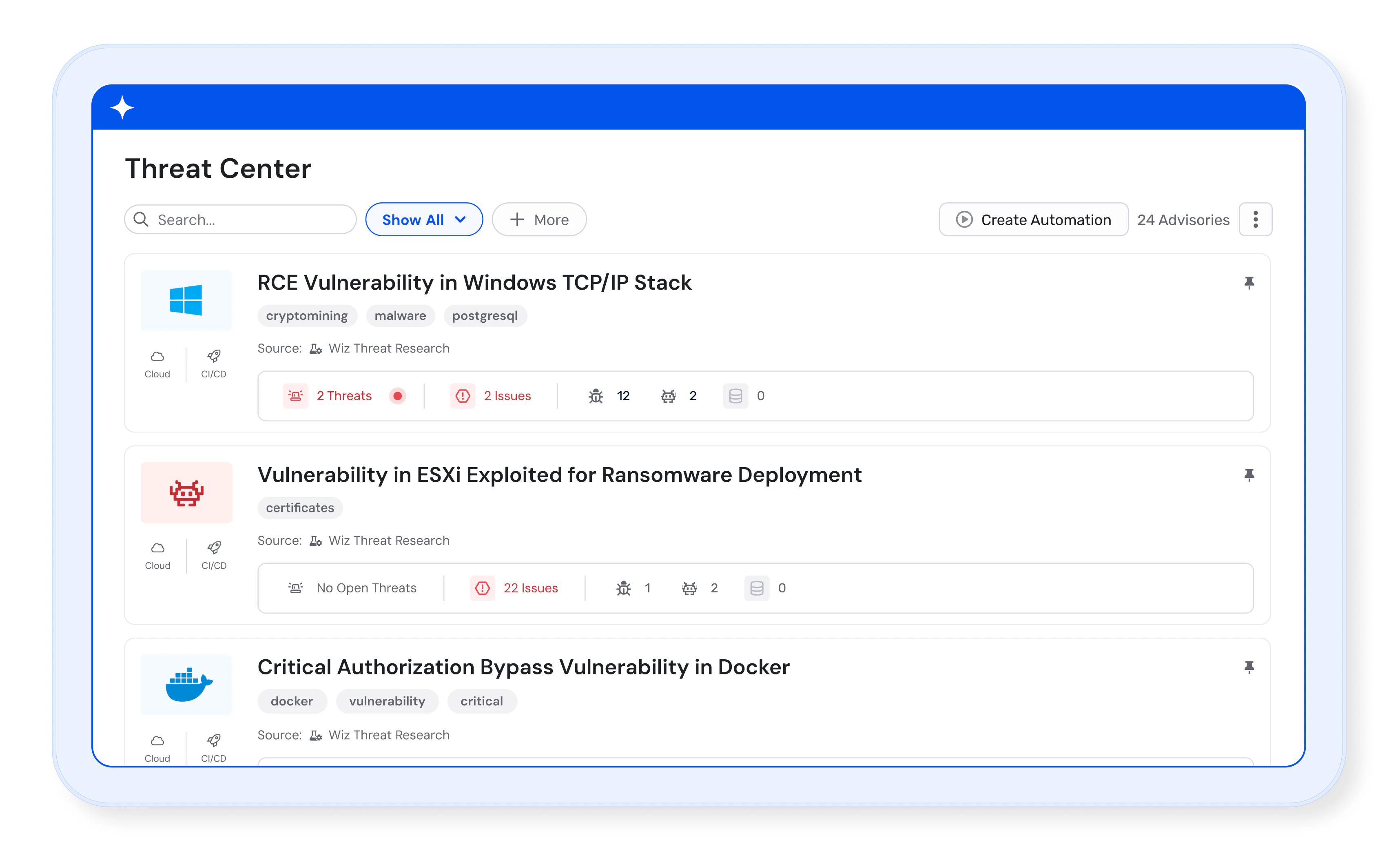
Wiz bridges the gap between raw threat intelligence and actual cloud risk, equipping analysts with the visibility necessary to elevate their strategic value:
Wiz Threat Center: Instantly assess whether a newly disclosed vulnerability or active exploit campaign affects your specific environment. This feature slashes the time from external alert to exposure validation from hours to minutes.
AI Threat Readiness: Reduce risk across modern cloud and AI-native environments using the Wiz Security Graph and purpose-built AI agents. Wiz gives teams continuous visibility across code, cloud, and runtime to validate exposure, prioritize real operational risk, and accelerate remediation.
Wiz Security Graph: Move beyond isolated vulnerabilities by visualizing the "toxic combinations" of risk that matter most to your business.
Attack Path Analysis: Map exactly how vulnerabilities chain together to reach critical assets, allowing you to model lateral movement before an adversary attempts it.
Wiz Defend: Use the Investigation Graph to access complete attack timelines and blast radius data, providing the structured narratives required to profile complex adversary behaviors.
AI Graph Query: Leverage the Blue Agent to automate triage and investigate sprawling cloud environments using simple, natural language queries.
Wiz Code: Extend your influence into the development lifecycle by using code-to-cloud visibility to lead proactive shift-left security initiatives.
Wiz ASM: Gain an "outside-in" perspective through external scanning to validate exploitability from a true attacker’s point of view.
Ready to see it in action? Schedule a demo today to see how Wiz transforms threat data into cloud-wide protection.
See for yourself...
Learn what makes Wiz the platform to enable your cloud security operation
