What is vulnerability management?
Vulnerability management is a continuous, risk‑driven practice to discover, assess, prioritize, and fix weaknesses across source code, pipelines, cloud infrastructure, workloads, and applications—plus your external attack surface—before they’re exploited. The objective isn’t just to find every issue; it’s to reduce exploitable risk and shrink blast radius where it matters to the business.
Vulnerability management isn’t a checklist – it’s a way of understanding your environment end to end.
Context is the signal: who can reach what, which identities have standing or toxic permissions, what’s internet‑exposed, where sensitive data lives, which code paths make a vulnerability reachable, and whether exploits exist.
A unified, agentless, full‑stack view – augmented by external attack surface management and code insights – becomes the common source of truth across code, cloud, and edge.
Automation keeps that picture current and turns findings into fixes through pull requests, playbooks, and tickets. The goal isn’t zero findings; it’s a learning system that continuously reduces exploitable pathways, preserves availability, and upholds compliance – without slowing the business. Discovery drives understanding, understanding guides change, and each iteration feeds insights back to owners and developers so the organization grows safer over time.
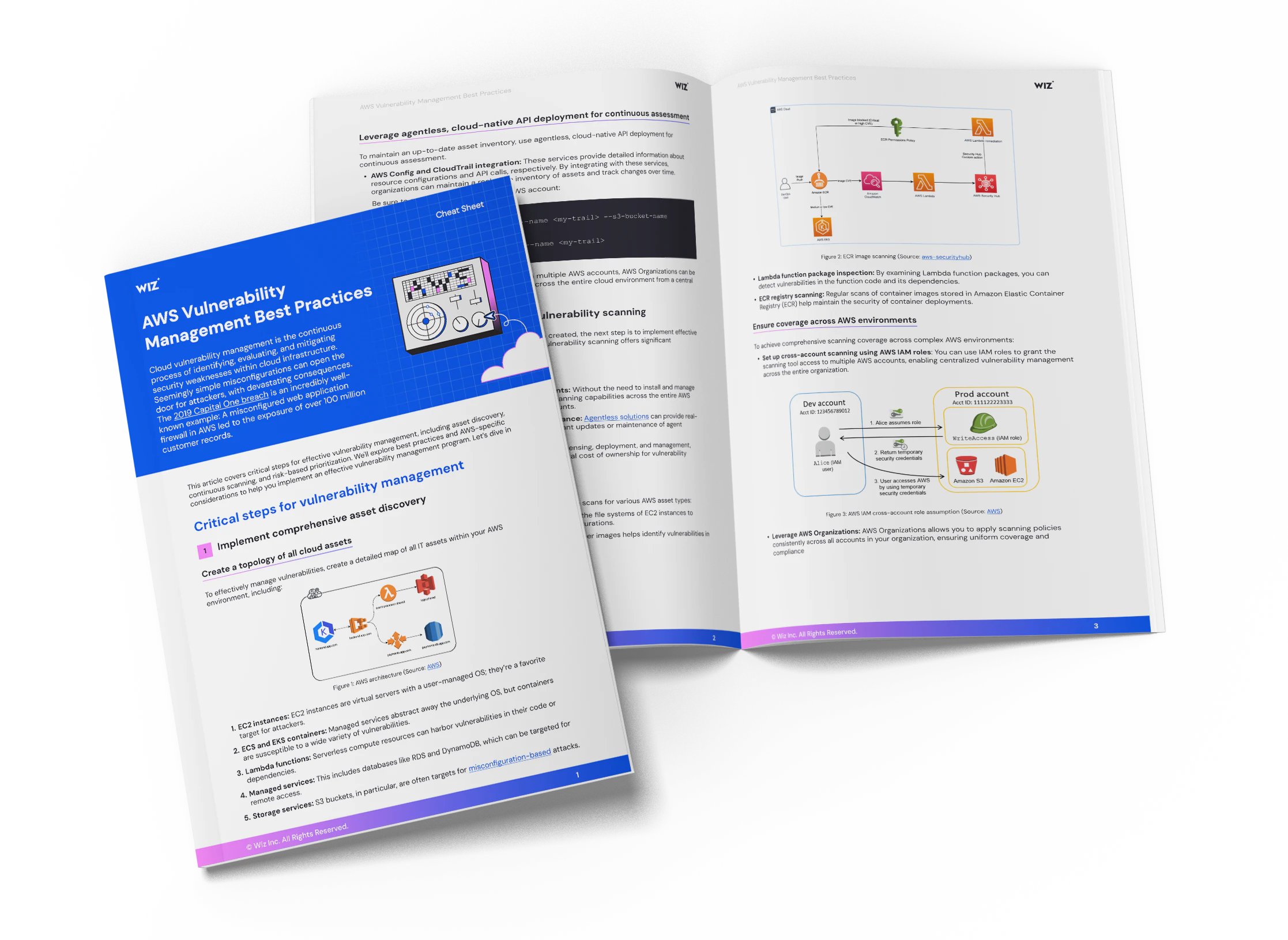
The Ultimate Vulnerability Management Playbook
Actionable steps to identify, assess, and mitigate AWS vulnerabilities, ensuring your cloud infrastructure is protected.
Get Cheat Sheet
Why is vulnerability management necessary?
Business risks from weak vulnerability management extend far beyond technical problems. Organizations face direct financial and operational consequences when attackers exploit unpatched systems or exposed assets, with government agencies sometimes issuing emergency directives to protect against ongoing exploitation by nation‑state threat actors.
Modern attack vectors now span code and cloud: misconfigured IAM roles that grant excessive permissions, exposed APIs without authentication, over‑permissive containers, leaked secrets in repos, vulnerable open-source packages, and overlooked internet‑facing assets discovered via attack surface reconnaissance.These weaknesses open doors to data breaches, compliance violations, and operational disruption.
Consequences of weak vulnerability management
Below are some common results of weak vulnerability management:
Costly data breaches: Exposing sensitive information leads to financial loss and reputational damage.
Compliance violations: Failing to meet regulations results in penalties and legal ramifications.
Operational inefficiencies: Threats disrupt workflows, drain resources, and erode customer trust.
As a result, businesses are investing heavily in solutions. For instance, experts estimate that the global vulnerability management market will reach $18.7 billion by 2026 at a 6.3% annual growth rate.
The benefits of strong vulnerability management
Below are some positive attributes of effective vulnerability management:
Stronger security posture: Proactively identify and remediate security risks to reduce exposure.
Streamlined operations: Integrate security seamlessly into daily workflows.
Enhanced visibility: Gain a clear, real-time view of vulnerabilities across environments.
Team empowerment: Equip employees with the tools they need to take ownership of security.
Improved compliance: Meet industry security standards with strong policies and access controls.
Vulnerability management vs vulnerability assessment
Vulnerability assessment and vulnerability management are related, but they're not the same thing.
Vulnerability assessment is a point‑in‑time activity—a scan or review that identifies potential weaknesses. It’s a snapshot.
Vulnerability management is an ongoing, code‑to‑cloud process. It includes continuous discovery (including your external attack surface), prioritization with context, remediation, validation, and reporting to reduce exploitable risk over time.
The vulnerability management process in 5 steps
Effective vulnerability management follows a structured 5‑step cycle that transforms risks into actionable remediation plans:
Discover - Identify all assets and vulnerabilities across code, cloud, and internet‑facing surface.
Prioritize - Focus on the most critical, exploitable paths using contextual analysis.
Remediate - Apply fixes and controls via PRs, automation, and least‑privilege changes.
Validate - Confirm fixes, enforce gates, and detect drift continuously.
Report - Track outcomes and communicate results to stakeholders.
This systematic approach ensures comprehensive coverage while optimizing resource allocation.
Dive into further detail on each below:
The vulnerability management process in 5 steps
Effective vulnerability management follows a structured 5‑step cycle that transforms risks into actionable remediation plans:
Discover - Identify all assets and vulnerabilities across code, cloud, and internet‑facing surface.
Prioritize - Focus on the most critical, exploitable paths using contextual analysis.
Remediate - Apply fixes and controls via PRs, automation, and least‑privilege changes.
Validate - Confirm fixes, enforce gates, and detect drift continuously.
Report - Track outcomes and communicate results to stakeholders.
This systematic approach ensures comprehensive coverage while optimizing resource allocation.
Dive into further detail on each below:
1.Discover
Discovery is the foundation—a living inventory that spans code repositories and pipelines, cloud accounts and subscriptions, and the internet‑facing edge. It goes beyond a static list to model how everything connects: VMs, containers and registries, serverlessfunctions, virtual appliances, ephemeral resources, managed services, identitiesand permissions, data stores, and external assets like domains, subdomains, certificates, and exposed services.
Continuous, agentless collection gathers signals from everywhere—SCM‑native code scanning (SAST, SCA, secrets, IaC), cloud configuration and runtime metadata, container and base images, SBOMs, and network exposure—and correlates them into a topology that shows reachability: who can talk to what, which identities have standing access, and where sensitive data lives.
Outside‑in discovery complements the inside‑out view with attack surface management to uncover unmanaged or unknown assets, dangling DNS, misissued or expired certificates, shadow subdomains, and internet‑exposed services, then map them back to owners so nothing falls through the cracks.
Because some risks evade scanners, targeted, context‑informed validation confirms what’s truly exploitable – open permissions, exposed APIs, and control plane misconfigurations – closing blind spots.
The result is a single, always‑current discovery graph: what you own, how it’s connected, what’s exposed, and where attackers could begin – setting up prioritization and fast, focused fixes.
2. Prioritize
CVSS scores standardize severity from 0 (none) to 10 (critical), using base, temporal, and environmentalmetrics.
However, CVSS alone doesn’t identify what’s exploitable. A critical issue on an isolated dev host may be lower risk than a medium in an internet‑facing service with access to sensitive data.
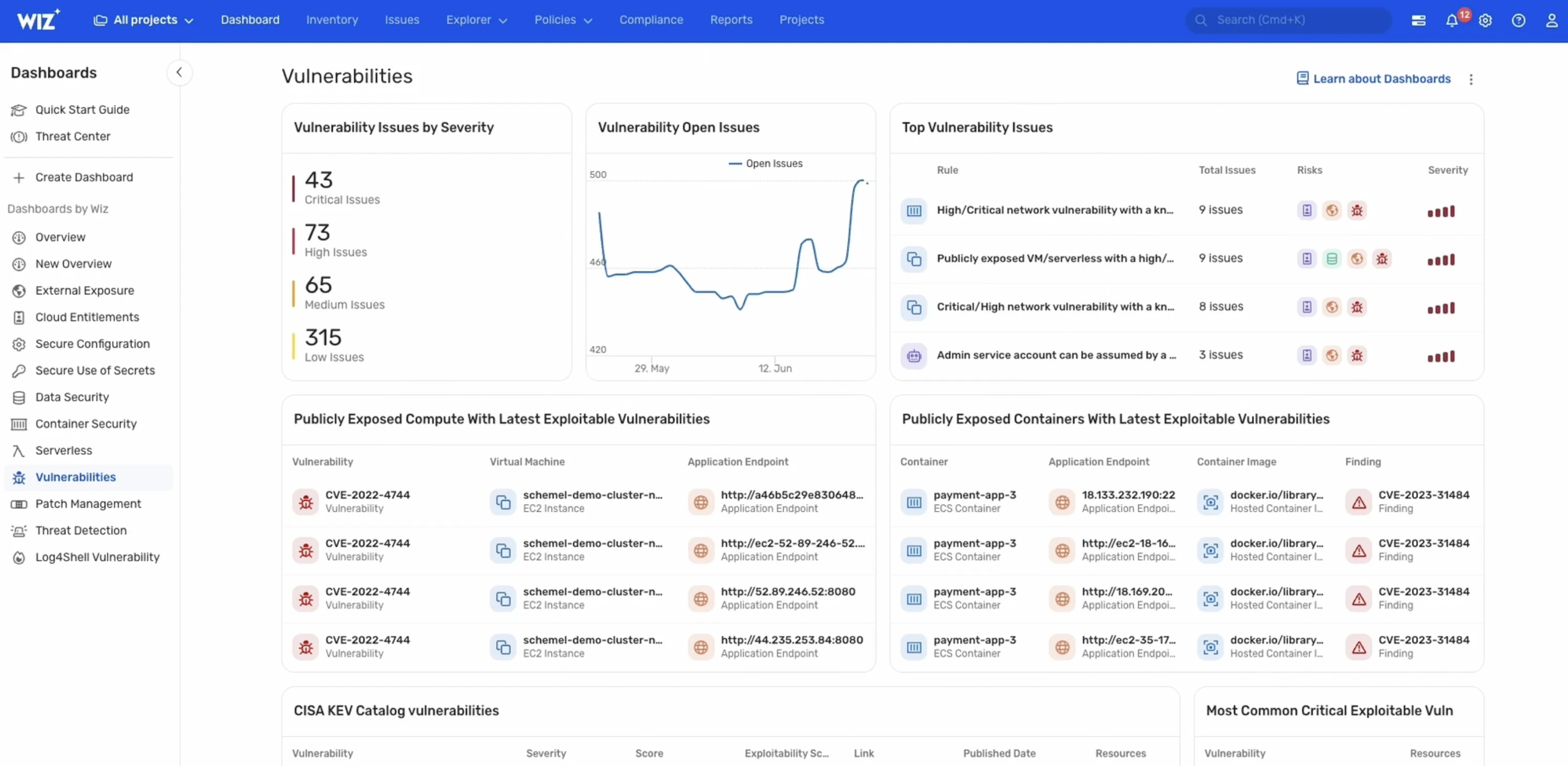
Context‑aware prioritization layers in exposure (internet‑facing, publicly reachable), identity paths and permissions, data sensitivity, runtime signals, known exploited status (KEV), and code reachability to focus on vulnerabilities that create real business risk.
Vulnerabilities always outnumber resources. Legacy approaches often treat dev/test and production equally. Organizations need context to elevate the few issues that meaningfully reduce blast radius.
By combining vulnerability data with threat intelligence and attack path analysis, teams can rank issues by business impact—what’s exposed, what it can reach, and what could break if exploited. Wiz automatically highlights critical toxic combinations and exploitable paths across code and cloud so your team can act first where it matters most.
3. Remediate
Remediation spans patching software, decommissioning dormant assets, right‑sizing identity entitlements, fixing misconfigurations, rotating secrets, and accepting low‑risk findings with compensating controls. Start with the issues that close exploitable paths.
Maximize impact by integrating remediation into CI/CD with pull‑request fixes and policy checks, automated patch orchestration, ITSM workflows, and canary deployments to reduce production risk.
The most effective way to scale remediation is with a unified, cloud‑native platform that brings code and cloud together – combining agentless cloud context with SAST/SCA/secrets/IaC, guided fix suggestions, PR generation, guardrails, and response playbooks – so teams get continuous scanning, prioritized risk, and real‑time visibility in one place.
4. Validate
Validation is the proof phase—the point where you demonstrate that risk was actually removed and will stay removed. The goal is simple: break the attack path, preserve availability, and prevent regression across code, cloud, and the internet‑facing edge.
In practice, validation confirms four things: the vulnerability is no longer reachable or exploitable; the exposure or identity path that made it risky is closed; the fix didn’t introduce new issues; and the control will hold as the environment changes.
Do this continuously with re‑scans and reachability checks, safe exploit simulation, CI policy gates, IaC drift detection, post‑deployment health checks, and external attack surface verification. Tie results back to owners, attach evidence to PRs and tickets, and trigger incident workflows if a fix fails or drift re‑opens the path.
When validation is working, closed issues stay closed, mean time to remediate shrinks, and teams gain confidence that changes reduce exploitable risk without slowing the business.
5. Report
Reporting turns work into outcomes. The goal of this phase is to prove risk is dropping, demonstrate control effectiveness and compliance, and give owners clear direction for the next iteration.
Deliver scheduled, role‑based reports for executives, product/platform owners, and auditors—plus on‑demand dashboards for day‑to‑day operations.
Show context and trends across code and cloud: exploitable‑risk reduction, mean time to remediate (MTTR), recurrence rate, SLA adherence, coverage across repos and cloud accounts, and external exposure MTTR. Highlight closed attack paths, remaining blast radius, and bottlenecks caused by ownership or policy gaps.
Make evidence audit‑ready with control mappings, policy attestations, and artifacts tied to PRs, tickets, and deployments. Integrate with SIEM, SOAR, GRC/ITSM, and BI to enrich correlation and speed response.
Use these insights to recalibrate priorities, tighten guardrails, and set goals for the next cycle—so reporting closes the loop and your program gets measurably safer over time.
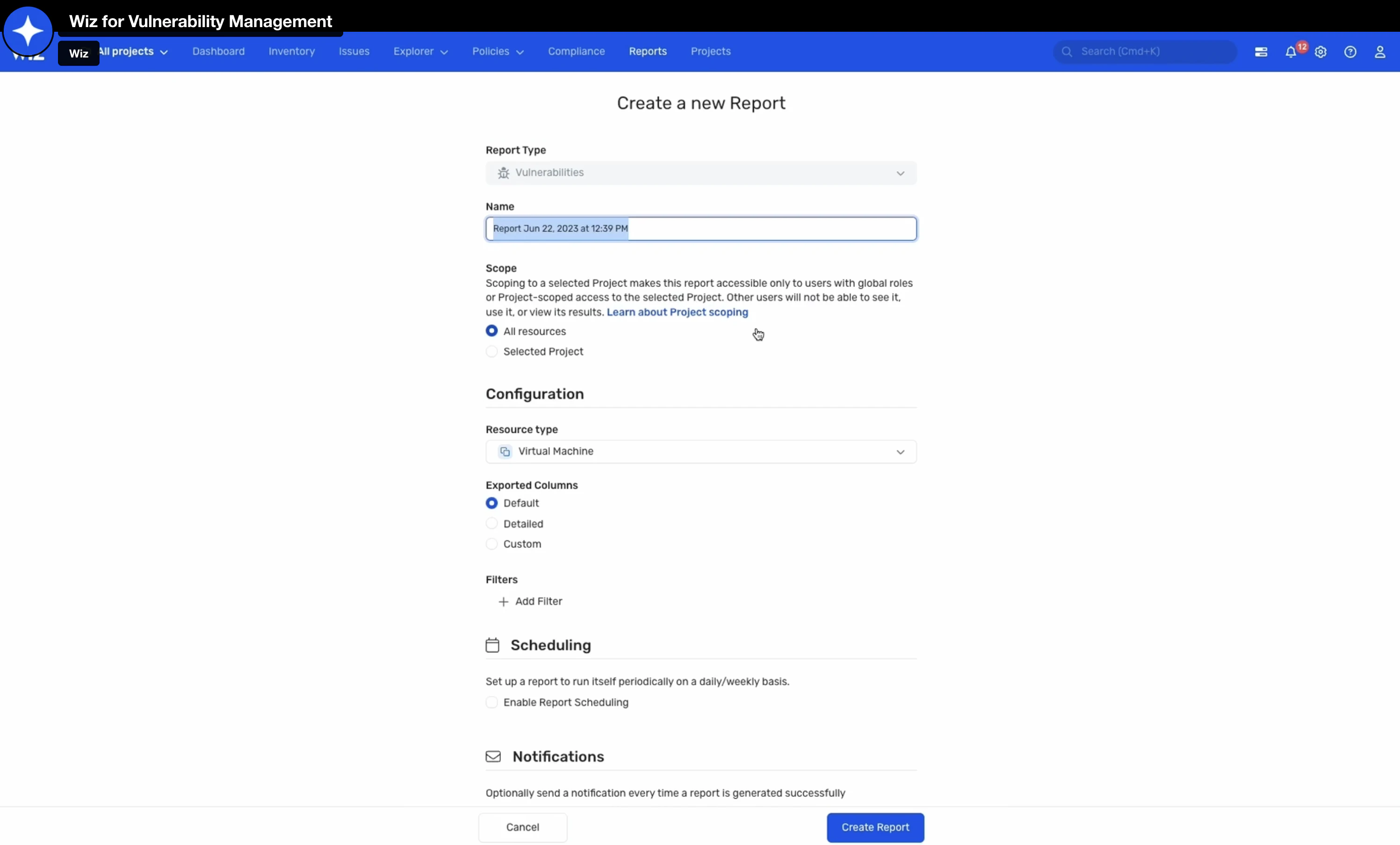
AI and vulnerability management
AI is transforming vulnerability management in two major ways: it’s creating new types of risk, and it’s helping security teams manage those risks more intelligently.
On the risk side, organizations are adopting generative AI and large language models across cloud environments, introducing new code paths, dependencies, and data exposures. These AI workloads often rely on open-source models, third-party APIs, and dynamically generated code—all of which expand the attack surface. Traditional scanners can’t easily identify or contextualize these risks, especially when they span across AI pipelines, storage, and inference environments.
On the opportunity side, AI is reshaping how vulnerability management works. Machine learning models can now correlate massive volumes of security signals—linking vulnerabilities to identity paths, data sensitivity, and runtime behavior—to surface what’s actually exploitable. AI-driven analysis can also predict which findings are likely to be targeted next, accelerate triage, and even recommend remediations tailored to code owners and business impact.
Modern Unified Vulnerability Management (UVM) solutions are beginning to embed these AI capabilities directly into their workflows. The result: teams can reduce noise, automate prioritization, and make smarter, faster remediation decisions, all while staying ahead of emerging AI-specific threats.
The CVE Database: Curated Vulnerability Intelligence by Wiz
Wiz's CVE Database curates CVE data to create easy-to-navigate profiles that cover the entire vulnerability timeline, exploit scenarios, and mitigation steps.
Explore database
How to implement an effective vulnerability management program
Effective vulnerability management programs require a structured approach and dedicated resources. Here’s how to create the foundation you need for success:
Prioritize coverage first
Strong vulnerability management begins with knowing what you’re protecting. Start by creating a comprehensive inventory of all assets, including devices, applications, cloud resources, and connections.
An up-to-date asset baseline ensures that you account for and assess every component in your environment. This visibility not only helps you identify gaps in coverage but also provides essential context when you’re prioritizing and remediating vulnerabilities.
Don’t overlook shadow IT—unapproved systems or applications that operate outside official oversight—since they often introduce hidden vulnerabilities.
Shift risk ownership left
Fostering collaboration and shifting left by embedding security from development through deployment enables teams to address vulnerabilities quickly and efficiently without slowing innovation.
Integrating vulnerability management into the development lifecycle ensures that teams address security from the start. By embedding security practices into CI/CD pipelines, developers can identify and remediate vulnerabilities as they write code, which reduces the likelihood that issues will make it to production. This proactive approach saves time, lowers costs, and enhances overall security.
Build a dedicated vulnerability management team
Assign ownership of your vulnerability management program to a specialized team to ensure consistent oversight and accountability. This team should coordinate efforts across departments, maintain asset inventories, prioritize risks, and drive remediation activities.
Clear roles and responsibilities are also essential for success. As such, teams should include experts in security operations, compliance, and DevOps, as well as defined tasks like vulnerability scanning, risk assessment, and strategy implementation.
Align with risk
Not all vulnerabilities pose the same level of risk, so a one-size-fits-all approach won’t cut it. Instead, develop a risk-based framework to help you prioritize vulnerabilities based on their potential impact on business operations, exploitability, and the sensitivity of affected systems.
This ensures that your team focuses on the most critical issues first and minimizes risk to essential functions and sensitive data.
Automate and integrate for scale
The right vulnerability management tool can make or break your program (popular tools include OpenVAS, OpenSCAP, and Nmap). When you choose solutions, find tools that offer comprehensive scanning across cloud, on-prem, and hybrid environments. Look for tools that provide contextual prioritization too so your team can focus on the most critical risks first.
Tools that streamline remediation processes through automation, such as patch management, configuration changes, or compensating controls, also save time and reduce the potential for human error.
Track what matters
Implement continuous monitoring to detect vulnerabilities as they emerge across your environments. Tools that provide real-time insights and threat intelligence can help you stay ahead of attackers by identifying vulnerabilities before they escalate.
Equally important is adapting your strategies based on these insights. Start by reviewing and refining your vulnerability management processes to account for new attack vectors, updated compliance requirements, and lessons you learn from past security incidents. You should also skip vanity metrics like vulnerability count and instead focus on time to triage, time to patch, and the exploitable risk percentage of criticals your team resolved in production.
Key features to look for in a modern vulnerability management solution
Modern vulnerability management isn’t about chasing every CVE. It’s about understanding which vulnerabilities actually create exploitable risk—and fixing those efficiently. The most effective programs combine context, automation, and continuous visibility from development to runtime.
Here’s what to look for:
1. Context-driven, risk-based prioritization
Traditional severity scores only tell part of the story. Leading solutions combine multiple layers of context – whether an asset is internet-exposed or reachable through identity paths, which permissions could be abused, what data is at risk, and whether an exploit is active in the wild.
By mapping these signals into clear attack paths, teams can focus on fixing the few issues that meaningfully reduce exposure instead of spreading effort across hundreds of low-impact findings.
2. Continuous, agentless coverage from code to cloud
Coverage should span the full lifecycle, from code commit to production. Look for platforms that pair agentless cloud discovery with source-aware scanning of repositories and pipelines, identifying risks in source code, dependencies, secrets, and infrastructure-as-code before deployment.
Continuous, frictionless discovery ensures new assets and exposures are automatically attributed, monitored, and prioritized as environments evolve.
3. Outside-in visibility of the attack surface
Your external footprint changes constantly. Modern vulnerability management extends beyond the internal cloud view to include real-time discovery of internet-facing assets, misconfigurations, and data exposures.
Connecting these “outside-in” findings with internal context—ownership, sensitivity, and exposure—helps teams understand how external risks link to exploitable attack paths inside the environment.
4. Unified context across every layer
Vulnerabilities don’t exist in isolation. The right solution unifies visibility across workloads, identities, configurations, data, and network layers, tying them together through context-rich graphs or attack-path analysis.
This approach clarifies what’s exploitable, why it matters, and how to fix it, helping teams make risk-based decisions that align with business impact.
5. Integrated workflows and automation
Vulnerability management should fit seamlessly into existing workflows. Look for integrations with issue tracking, CI/CD, ITSM, and communication tools to automate policy enforcement, ticketing, and remediation. Automation closes the loop from detection to resolution while reducing manual effort and alert fatigue.
6. Outcome-focused reporting
Finally, reporting should go beyond raw counts. Effective programs track tangible outcomes—mean time to remediate, SLA adherence, coverage across environments, and reduction in exploitable risk over time.
Audit-ready evidence, policy-as-code, and continuous assessment make compliance a natural outcome of good security hygiene rather than a separate project.
Manage vulnerabilities at the scale and speed of the cloud
As we scale and gain more customers, we are confident that we can tell them we are aware of all known vulnerabilities and that new vulnerabilities will be quickly visible to us, too.
Kashfun Nazir, Information Security Lead & Data Protection Officer, Atlan
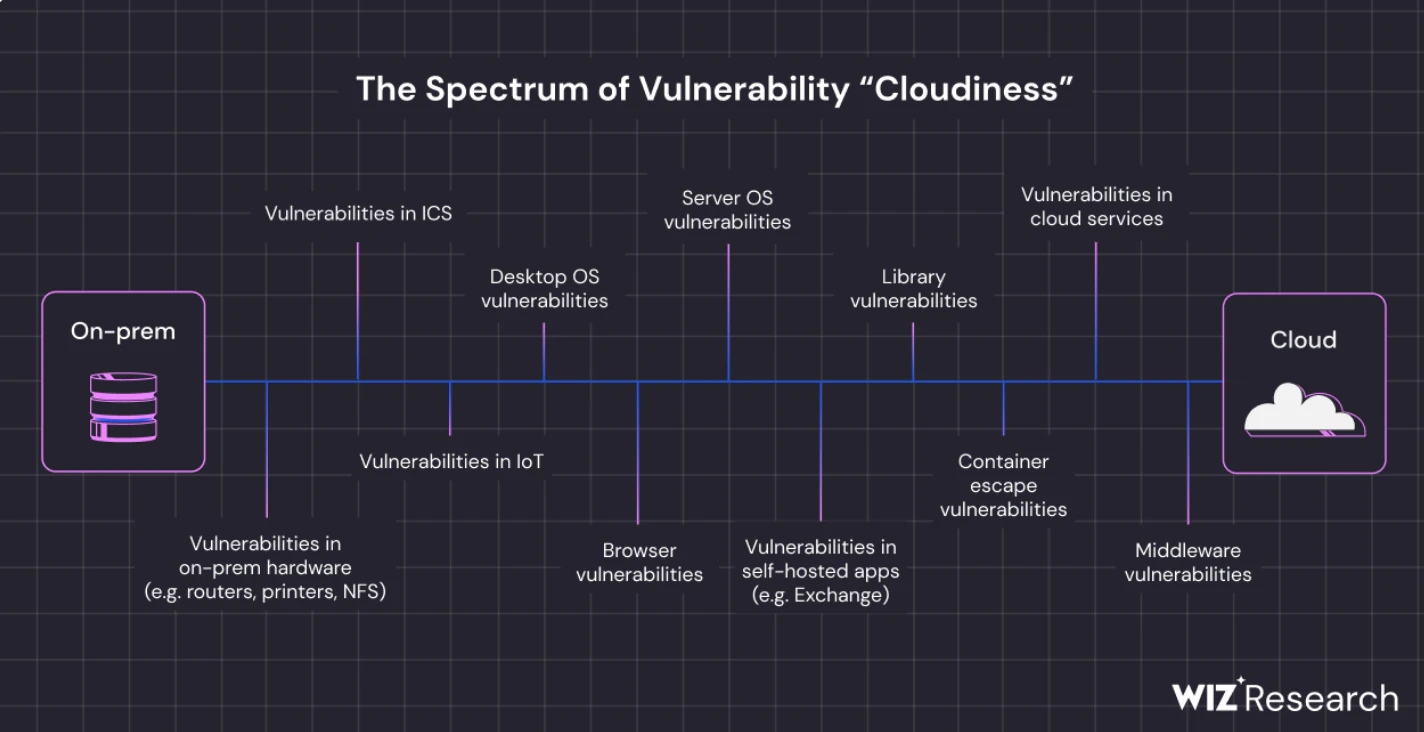
Cloud environments move fast, and so do their risks. Traditional vulnerability management tools—built for static, on-prem systems—can’t keep up with the dynamic, distributed nature of the cloud. That’s why organizations are shifting to Unified Vulnerability Management (UVM): a modern approach that brings together every signal from code to runtime into one, context-rich view of risk.
Wiz delivers this unified model. Its agentless platform continuously discovers vulnerabilities across your entire environment—code, cloud, and external attack surface—without slowing innovation. By combining findings with identity, data, and network context in the Wiz Security Graph, it reveals which exposures are actually exploitable and which fixes matter most.
With Wiz UVM, teams can prioritize and remediate faster, embed security earlier in development, and validate that risks stay closed – all from a single platform designed for cloud scale.
Want to cut through vulnerability noise and focus on what’s truly at risk? Check out Wiz’s free 1-on-1 vulnerability assessment.