



What is a vulnerability assessment?
A vulnerability assessment is a systematic process for identifying, analyzing, and prioritizing security vulnerabilities across your IT infrastructure. It produces a ranked list of weaknesses so security teams can focus remediation effort where it reduces the most risk. The process goes beyond detection to understand which security gaps pose genuine risk by evaluating the business impact and exploitability of discovered weaknesses.
Vulnerability assessments differ from vulnerability scanning in both scope and depth. Vulnerability scanning is an automated process that uses scanners to detect known vulnerabilities by checking systems against vulnerability databases like the NIST National Vulnerability Database (NVD) and CISA Known Exploited Vulnerabilities (KEV) catalog. A vulnerability assessment adds analysis, risk evaluation, and prioritization on top of that scan data. While scanning identifies potential issues, assessment determines which vulnerabilities actually threaten your organization based on context like exposure, exploitability, and business impact.
Get a vulnerability assessment
Uncover critical vulnerabilities across your clouds and workloads with business-prioritized remediation guidance from an agentless assessment of your environment.

Types of vulnerability assessments
Different parts of your infrastructure require different assessment approaches. Most organizations combine several types to achieve full coverage across their environment.
Network vulnerability assessment
Network assessments scan routers, switches, firewalls, and other network devices for misconfigurations, open ports, and known CVEs. They map your network topology to identify paths an attacker could use to move laterally between systems.
Web application vulnerability assessment
These assessments target web-facing applications for flaws like SQL injection, cross-site scripting (XSS), and authentication bypasses. They test both the application code and the server configurations that support it.
Host-based vulnerability assessment
Host-based assessments examine individual servers, workstations, and endpoints for missing patches, insecure configurations, and outdated software. Authenticated scans with local credentials provide deeper visibility than external-only approaches.
Cloud vulnerability assessment
Cloud assessments evaluate virtual machines, storage buckets, identity policies, and managed services across providers like AWS, Azure, and GCP. Ephemeral resources like containers and serverless functions require continuous scanning because they may exist for only minutes, processing sensitive data before disappearing from your inventory.
Database vulnerability assessment
Database assessments check for weak authentication, excessive privileges, unpatched database engines, and exposed sensitive data. They verify that access controls and encryption settings align with your data classification policies.
6 steps for conducting a modern vulnerability assessment
Here's a practical framework for implementing vulnerability assessments that cut through alert noise to identify business-critical risks:
The following six steps describe how to conduct a vulnerability assessment in modern environments, from asset discovery through validated remediation and continuous monitoring.
Step 1: Lay the groundwork
Successful vulnerability assessments start with clear objectives and stakeholder alignment. Define what you are trying to protect and establish success criteria before launching scans. This involves documenting your cloud architecture. For instance, map which cloud service providers you use, which services run in each environment, and how shared responsibility models divide security obligations. Understanding the boundaries between provider-managed and customer-managed infrastructure prevents gaps in coverage.
Once you have built your initial groundwork, do the following activities:
Review compliance requirements early: Frameworks like PCI DSS, HIPAA, and SOC 2 mandate specific vulnerability management controls. Your vulnerability assessment process must generate evidence for auditors, so build reporting requirements into your initial planning.
Identify crown jewel assets that store or process your most sensitive data: Customer PII, intellectual property, financial records, and authentication systems deserve prioritized attention in vulnerability assessments. Document these high-value targets so you can calibrate risk scoring accordingly.
Collaborate with development, operations, and business teams to establish remediation SLAs: Agree on realistic timeframes for patching critical, high, medium, and low-severity vulnerabilities based on your organization's risk tolerance and operational constraints. Clear expectations prevent friction when vulnerabilities require urgent remediation.
Step 2: Build a comprehensive asset inventory
You cannot discover vulnerabilities in assets that you do not know exist. Catalog every cloud resource across all environments and accounts: VMs, containers, Kubernetes clusters, serverless functions, databases, storage buckets, load balancers, and PaaS services.
Do not overlook supporting infrastructure like DNS records, SSL certificates, and CDN configurations. Each component represents a potential vulnerability that adversaries could exploit.
After you have categorized your assets, follow these actions:
Document all identities with access to your environment: This includes human users, service accounts, API keys, and machine identities. Map their permissions and access patterns because overprivileged identities turn minor vulnerabilities into major security incidents when attackers leverage stolen credentials for lateral movement.
Catalog application dependencies and third-party integrations: Modern applications rely on hundreds of open-source libraries, npm packages, and external APIs. Vulnerabilities in these dependencies often provide attackers with entry points, as the 2021 Log4Shell incident demonstrated when a widely used logging library exposed countless applications to remote code execution.
Automate asset discovery to maintain inventory accuracy: Cloud environments change constantly as developers deploy updates, scale services, and provision test environments. Manual inventory processes become outdated within hours, leaving blind spots in your vulnerability assessment coverage. Deploy tools that continuously monitor cloud APIs to detect new resources and configuration changes automatically.
Step 3: Scan vulnerabilities regularly and automate where possible
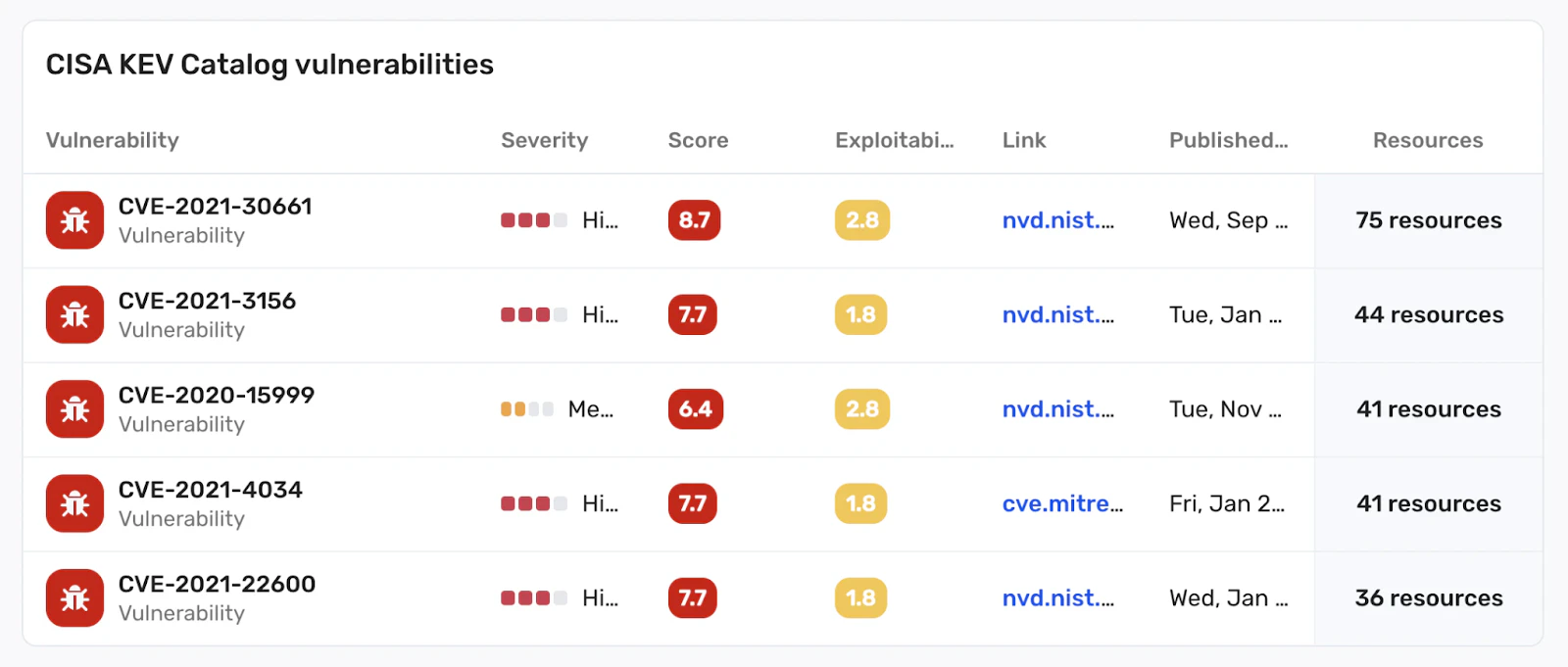
When you have complete visibility into your infrastructure, you can systematically identify security weaknesses across all assets.
Configure your scanning tools to match your environment's needs. Adjust scan parameters beyond default settings to account for your specific infrastructure. Authenticated scanning with read-only credentials provides deeper vulnerability visibility than unauthenticated external scans. Balance thoroughness against performance impact, especially for production systems. Then follow these steps:
Deploy multiple vulnerability scanning capabilities to achieve comprehensive coverage: Infrastructure scanning detects OS vulnerabilities and misconfigurations in VMs and cloud services, while container scanning identifies vulnerabilities in base images and application layers. Web application scanning discovers common vulnerabilities like SQL injection, cross-site scripting, and authentication bypasses, and API security testing finds authorization flaws and input validation issues.
Leverage multiple vulnerability databases for complete coverage: The CISA KEV catalog highlights actively exploited flaws, NIST's NVD provides comprehensive CVE coverage, and the MITRE ATT&CK knowledge base maps adversary techniques to help you prioritize defenses. Combining these sources ensures that you catch both emerging threats and established attack patterns.
Implement continuous scanning rather than periodic assessments: Weekly or monthly scans create windows where new vulnerabilities remain undetected. Continuous monitoring detects security issues as resources deploy and identifies new CVEs within hours of disclosure. For rapidly changing environments, real-time vulnerability detection is the only viable approach.
Consider targeted penetration testing to validate critical findings: While vulnerability scanners detect known weaknesses efficiently, skilled penetration testers also identify complex attack chains that automated tools miss. Periodic testing by security professionals helps you validate that your vulnerability assessment process catches the threats that matter most.
Watch 12-min demo
See Wiz in action across your cloud environment.

Step 4: Prioritize vulnerabilities
Vulnerability scans typically uncover thousands of potential issues. Effective prioritization reduces that list to the subset that poses genuine business risk, factoring in exploitability, asset sensitivity, network exposure, and whether a known exploit exists in the wild.
Start prioritization by filtering out false positives. Automated scanners frequently flag vulnerabilities in services that are not actually exposed or configurations that do not apply to your specific deployment. Verify your findings before escalating to development teams to maintain their trust in your security process.
After filtering out your false positives, implement these practices:
Add risk-based prioritization: Focus on vulnerabilities that meet criteria like high severity, active exploitation in the wild, network exposure, access to sensitive data, and potential for lateral movement. A vulnerable service isolated in a development environment with no Internet access or access to production data poses minimal risk compared to an Internet-facing application that processes customer PII.
Use the Exploit Prediction Scoring System (EPSS) to assess exploitation likelihood: EPSS provides data-driven predictions of whether attackers will exploit a vulnerability based on factors like availability, attacker interest, and technical complexity. The CVSS also provides severity scores from 0.0 to 10.0, with qualitative ratings of None (0), Low (0.1 to 3.9), Medium (4.0 to 6.9), High (7.0 to 8.9), and Critical (9.0 to 10.0). Combining EPSS with CVSS severity scores and your environment's specific context helps focus remediation on the vulnerabilities that adversaries actively target.
Prioritize based on asset criticality: Vulnerabilities in systems that support business-critical operations or store sensitive data warrant faster remediation than identical issues in low-value assets. Define asset tiers during your planning phase and weight vulnerability severity accordingly.
Account for compliance obligations: Regulatory frameworks often mandate specific remediation timeframes. PCI DSS, for instance, mandates specific remediation timeframes for identified vulnerabilities. Your vulnerability management program must track compliance deadlines and escalate issues that risk audit failures or regulatory penalties.
Step 5: Analyze vulnerabilities and develop remediation strategies
Understanding identified vulnerabilities enables effective remediation planning. Each vulnerability type requires different approaches and timelines.
Analyze the potential impact of each vulnerability on your specific environment. A remote code execution vulnerability in an Internet-facing web server presents immediate danger. The same vulnerability in an internal service behind multiple security controls might allow for scheduled patching. Evaluate the blast radius by mapping which resources an attacker could reach if they exploited each vulnerability. Then introduce these protocols:
Develop remediation strategies for each vulnerability class: Software vulnerabilities typically require patching affected systems or updating vulnerable dependencies. Misconfigurations need configuration changes through infrastructure-as-code updates, over-permissioned identities require access policy revisions, and exposed secrets demand rotation and implementation of proper secret management.
Provide clear, actionable remediation guidance to responsible teams: Generic advice like "Update to the latest version" frustrates developers who need specific version numbers, migration paths for breaking changes, and validation steps. Detailed guidance accelerates remediation and reduces back-and-forth between security and development teams.
Plan compensating controls for vulnerabilities you cannot immediately remediate: Not every vulnerability has a patch available. Legacy systems may not support security updates, and business-critical applications might require extensive testing before patching. In these cases, implement network segmentation, additional authentication requirements, or runtime protection to reduce risk while you work toward permanent fixes.
Validate remediation through subsequent scans: After teams deploy patches or configuration changes, verify that the vulnerability no longer appears in assessment results. Revalidation catches incomplete remediation, configuration drift that reintroduces vulnerabilities, and new vulnerabilities that appeared during patching. When done consistently, the results are significant: Datavant achieved a 51% reduction in vulnerabilities and prevented net-new critical and high issues.
Step 6: Report, evaluate, and improve
Vulnerability assessment programs require two ongoing practices to remain effective: structured documentation of findings, remediation actions, and exceptions for each scan cycle, and a regular review process that updates scope, tooling, and prioritization criteria as the environment and threat landscape change.
Generate reports that serve multiple audiences. Security teams need technical details and remediation status, executives require high-level risk summaries and trend analysis, and auditors demand evidence of compliance with vulnerability management requirements. Automated reporting tools should produce customized outputs for each stakeholder group.
Additionally, practice the following processes:
Track key metrics to measure program effectiveness: Mean time to remediation shows how quickly you address vulnerabilities after discovery. Vulnerability density (vulnerabilities per asset) indicates whether your security posture improves over time. Remediation rate by severity level reveals whether you are fixing high-risk issues faster than low-risk ones.
Conduct retrospective analysis after security incidents: When vulnerabilities lead to breaches, investigate whether your assessment process detected the exploited weakness. If not, identify the gaps in your coverage or prioritization that allowed the issue to persist and use these lessons to refine your strategy.
Iterate on your vulnerability assessment process continuously: Cloud security threats evolve constantly as attackers develop new techniques and researchers discover new vulnerability classes. Review and update your assessment methodology quarterly to account for emerging risks, new technologies in your environment, and lessons learned from remediation cycles.
Share vulnerability trends and remediation success with stakeholders: Regular communication about security improvements demonstrates the value of your vulnerability management program and maintains organizational support for security investments.
AWS VM Best Practices Cheat Sheet
Secure your AWS environment with this definitive guide to cloud defense. From agentless visibility to automated patching, get the essential blueprint for hardening your workloads and neutralizing risks before they scale.

Vulnerability assessment vs. penetration testing
Vulnerability assessments identify and rank security weaknesses across your environment, while penetration testing actively exploits specific targets to prove whether defenses hold under attack.
| Criteria | Vulnerability assessment | Penetration testing |
|---|---|---|
| Purpose | Identify and prioritize known weaknesses | Validate whether defenses can be exploited |
| Scope | Broad, covers the full environment | Narrow, targets specific systems or applications |
| Methodology | Automated scanning plus manual analysis | Manual exploitation simulating real attackers |
| Output | Prioritized list of vulnerabilities with remediation guidance | Proof-of-concept exploits and attack narratives |
| Frequency | Continuous or weekly | Quarterly or annually |
| Who performs it | Security teams using automated tools | Specialized pen testers or red teams |
Run vulnerability assessments continuously to maintain baseline coverage across your environment. Use penetration testing periodically to validate that your highest-risk systems resist real attack techniques. In practice, the two approaches complement each other: assessments find the weaknesses, and pen tests confirm which ones an attacker could actually exploit.
How Wiz supports vulnerability assessments
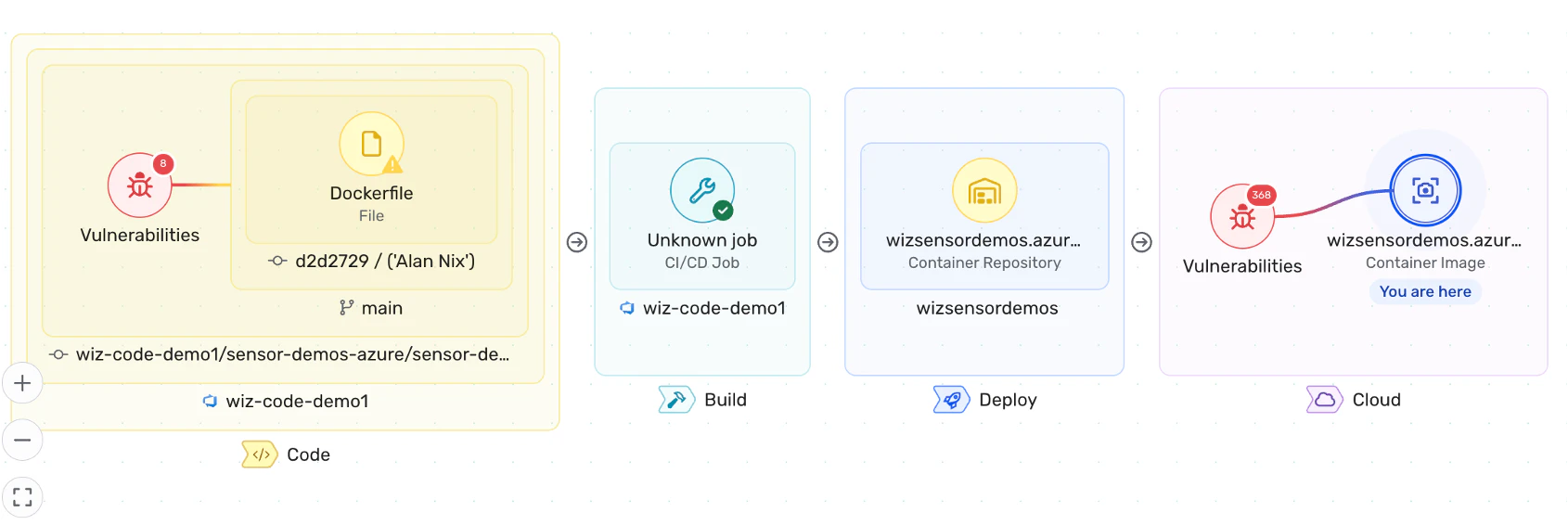
Modern cloud environments change faster than legacy vulnerability tools can scan them, and AI workloads add entirely new risk categories that traditional scanners were never designed to evaluate. Wiz's vulnerability management solution delivers agentless scanning across AWS, Azure, GCP, OCI, Alibaba Cloud, Kubernetes, and container environments. Without agents to deploy and maintain, you gain complete visibility within minutes while automatically protecting new workloads as your environment scales.
Context-aware prioritization cuts through alert noise by analyzing how vulnerabilities combine with other risk factors. Rather than simply ranking issues by CVSS scores, Wiz evaluates network exposure, identity permissions, data sensitivity, lateral movement paths, and exploit availability. The Wiz Security Graph models all resources and their relationships to identify toxic combinations where multiple security weaknesses create genuine business risk.
For organizations building AI systems, Wiz AI-APP extends vulnerability assessment to AI models, training pipelines, and inference endpoints, surfacing risks like exposed model APIs, misconfigured guardrails, and overprivileged AI service accounts that traditional scanners miss entirely.
Wiz cloud connects security, development, and operations teams around a shared view of risk. Developers receive visibility, risk prioritization, and remediation guidance to fix vulnerabilities in their own infrastructure and applications. CI/CD integration then prevents vulnerable resources from deploying to production in the first place.
Ready to see not just what vulnerabilities exist but which ones attackers can exploit based on identity, exposure, and runtime behavior? Get a demo today.
Get a demo
Take control of your vulnerability management program with context-aware prioritization.
