Recent advancements in AI now enable frontier models to autonomously discover zero-day vulnerabilities and chain exploits at machine speed. This means that more vulnerabilities will be discovered and disclosed, and that the time between discovery and exploitation will continue to shrink.
Now that exposure windows have shrunk from weeks to minutes, organizations face a gap where exploitation is done at AI speed, but remediation and patching lags behind. To keep up with the new AI threat landscape, organizations must shift their defense to machine-speed.
In our last blog post about AI Threat Readiness, we shared a framework to help organizations prepare for an era where AI can exploit vulnerabilities faster than ever before. The framework focuses on two foundational factors: speed of action and breadth of visibility.
As the exploitation window continues to shrink, speed is paramount. Security programs need to continuously reduce the time between identification, validation, and remediation across code, infrastructure, and runtime to keep up. Breadth of visibility is required to ensure defense covers your entire modern environment, including cloud, code, private infrastructure, SaaS, AI and the software supply chain.
To successfully operationalize these two factors, we have identified four core pillars:

In this blog, we’ll take a deeper look at how Wiz helps customers operationalize and scale this framework. We’ll explore how organizations can turn AI Threat Readiness into an actionable, automated defense strategy that keeps pace with the speed of AI-driven threats.
Wiz AI Threat Readiness in Action
How Wiz helps:
Pillar 1: Reduce critical exposures & scan with an AI pentester
As exploitation accelerates, reducing your attack surface is your first line of defense. The first step should be to reduce unnecessary exposure, validate what can actually be exploited, and make sure new risk does not depend on manual triage. Any exposed application, service, or technology should be prioritized based on reachability, exploitability, and business impact, with a clear and fast process to route the issue to the right owner and drive remediation. To stay ahead of adversaries, organizations must continuously use AI to identify exploitable exposures and remediate them before attackers can take advantage.
Reduce your attack surface with Wiz ASM
Traditional attack surface scanners only look at your environment from the outside. Wiz goes deeper by combining external scanning with internal analysis to map your entire footprint. This includes SaaS exposure, shadow APIs, and “vibe-coded” applications that anyone can rapidly spin up without standard security reviews and documentation. Wiz ASM detects exploitable risk such as misconfigurations, default credentials, and vulnerabilities and validates them from the outside in. Start by looking at your external attack surface and focusing your efforts exposed versioned technologies, and assets that are business critical. Start by reducing unnecessary exposure, prioritizing remediation of validated exploitable risk, and mapping remediation workflows even if the resources are patched today.
Remove logic-driven vulnerabilities with Red Agent, the AI-pentester
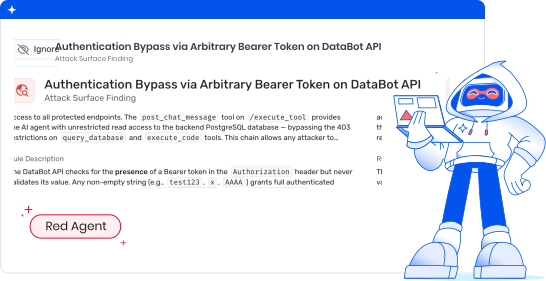
To stay ahead of attackers, you need to defend at machine speed. Leverage the Wiz Red Agent, an autonomous, continuous AI-pentester, to uncover complex logic-driven vulnerabilities at AI speed. Red Agent findings represent validated attack chains that attackers can actually exploit, and should be treated as critical alerts and remediated quickly.
Pillar 2: Accelerate fixes with the Wiz Green Agent & Workflows and Start secure
Finding critical risks at machine speed is a crucial first step, but to keep up with the new AI threat landscape we also need to be able to remediate at scale and at machine-speed. This requires having all the context you need in order to respond fast, and automate response where you can. Teams need to be able to easily map ownership and trace issues back to their source in code or configuration, get remediation guidance at AI-speed, and scale by establishing automated response workflows. Finally, teams should implement prevention controls as we can no longer knowingly deploy risks into production.
Fix fast with the Wiz Green Agent
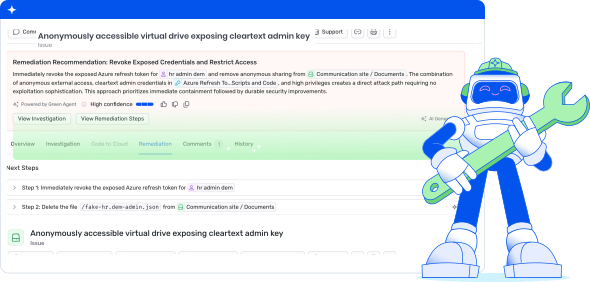
The Green Agent automatically analyzes the context of your environment to determine the fastest and safest remediation path. It leverages code-to-cloud mapping, ownership context, and historical remediation data to tell you where you need to fix at the source, who needs to fix it, and how. Once you identify the critical Wiz Issues and Red Agent findings to prioritize, leverage the AI-generated remediation steps and risk owner provided by the Green Agent to send to the right owner. You can even give your developers 1-click in-code fixes to open a PR or send the fix straight to their coding agent to remediate at machine-speed.
Scale and automate with Wiz Workflows and Posture Issues
Wiz Workflows help teams scale remediation through an easy drag-and-drop architecture for building repeatable response processes. Workflows can orchestrate actions across Wiz, external systems, and AI agents to standardize response and operate at AI speed. For example, teams can create a workflow that automatically investigates critical Wiz Issues with the Green Agent, identifies the appropriate fix in code, and sends the remediation steps directly to the developer. Once critical risk has been eliminated, every team should continue to optimize and improve the hygiene of the environment. Posture Issues give teams a structured way to tackle initiatives at scale that drive long-term progress.
Implement prevention with WizOS and guardrails
Burning down exposures is critical, but organizations also need to raise the bar on what can be deployed in the first place. Wiz guardrails enable teams to implement and enforce a unified policy framework across the software development lifecycle to prevent risks from reaching production. Wiz Code plugins extend guardrails to the agentic coding loop to enable coding agents to scan and rewrite AI-generated code with organizational baselines in mind. WizOS goes further to minimize the application attack surface from the start with hardened images that remove inherited vulnerabilities, preserve supply chain integrity, and SLAs for CVE remediation.
Pillar 3: Deep AI Code Analysis enriched on the Wiz Security Graph
The goal here is to analyze complex, customer-facing code using advanced AI models to identify logic flaws, chained vulnerabilities, and insecure application flows. Frontier AI models make finding complex security flaws simpler than ever, but understanding if they matter in your environment remains a challenge. Wiz helps bridge the gap between your code repositories and your runtime environment.
Context-aware AI-SAST
Wiz maps your entire code repository environment, showing you exactly which repositories map to critical production environments so you can prioritize your scanning efforts. Wiz then runs comprehensive security scans, including advanced AI-SAST, now in private preview. This allows teams to run a multi-layered defense combining continuous, radar-like scans with periodic, x-ray scans using the latest frontier models.
Because AI is exceptionally good at finding complex code flaws, it can sometimes create a deluge of findings. To prevent developer fatigue, Wiz pairs AI-SAST with the Red Agent to automatically triage and validate findings, proving whether a code flaw presents a real-world risk based on your live cloud architecture. Leverage Wiz SAST findings correlated to context on the Wiz Security Graph to focus your remediation efforts on code vulnerabilities that have true impact.
Enrich external AI scanners with context
Wiz is designed as an open ecosystem to help you prioritize risks regardless of how they were discovered. If your team uses other frontier models or AI SAST scanners such as Gemini, Mythos, or CodeMender, Wiz seamlessly ingests those external findings.
You can bring your preferred model’s code findings into the Security Graph to correlate them against your environment context to understand their true impact and prioritize with context. Wiz helps you manage and report on the entire lifecycle from scan coverage to detections to PRs opened. It also tracks issue age and SLA adherence to ensure your speed of action.
AI Threat Defense with Google
For customers looking for additional support, we're also teaming up with the Google Cloud team to add AI and Mandiant expertise to help organizations accelerate their AI threat readiness. Learn more here.
Pillar 4: Detect & Contain Runtime Threats with Wiz Defend & Blue Agent
Even with strong defense, active threats happen. When an attack occurs at AI speed, your response requires you to keep up to reduce business impact. This requires full context across code, cloud, runtime, identity, network, workload, and data. With this context, detection can become more precise, investigations can be automated, and response can be routed or triggered based on the actual risk and blast radius.
Detect and respond with Wiz Defend and Sensor
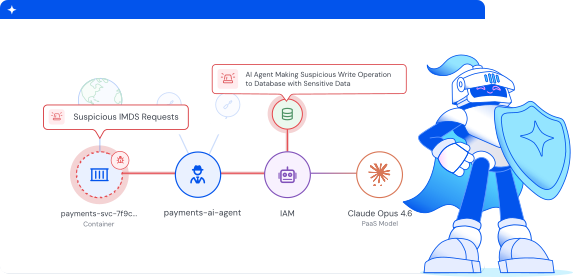
Wiz Defend provides real-time visibility and threat detection across cloud workloads, Kubernetes clusters, identities, and AI environments. With Defend, you can detect suspicious behavior across your environment to respond quickly. The Wiz Runtime Sensor provides runtime visibility to identify suspicious processes and correlates them back to the cloud-native telemetry to provide a unified timeline of the attack.
Machine-speed threat investigation with the Wiz Blue Agent
The Blue Agent helps SOC teams triage alerts and instantly investigate suspicious activity using the broader context of the environment and the Wiz Security Graph. It determines which risks are actively being exercised and delivers an accurate verdict in real time. This reduces investigation time, accelerates incident response, and helps teams focus on the threats that matter most.
Want to learn more about Wiz AI Threat Readiness?
Operationalizing AI threat readiness requires building a continuous loop of discovery, validation, and automated response. By combining the deep context of the Wiz Security Graph with specialized AI agents, Wiz enables your security and development teams to outpace modern threats. To learn more, watch the on-demand webinar or schedule a live demo with our team.
You can also learn more about how Wiz fits in the Google AI Threat Defense solution here.