



What is web application security?
Web application security is the practice of protecting against common web app vulnerabilities that can lead to unauthorized access, misuse, data exposure, and service interruption. This security discipline safeguards all the elements of a web application: the client side (user-facing components), the backend service, APIs, and the underlying infrastructure (cloud, on-premises, hybrid):
The front end / client side includes the forms, scripts, and client-side logic that a user interacts with.
The backend involves services that serve requests, process business logic, and access and modify data.
APIs connect microservice and application components to third-party systems.
The infrastructure layer (think containers, virtual machines, identities, and storage) enables everything to run.
In addition to this multi-layered approach, another key aspect of web app security is its emphasis on security by design. While designing features, workflows, and architectures, teams consider potential abuse cases so that security isn’t an add-on or afterthought—it’s an integral part of the development process.
AppSec Best Practices [Cheat Sheet]
This cheat sheet is for developers, AppSec engineers, DevSecOps practitioners, and security-conscious teams who already know the basics—but want practical, advanced strategies they can apply immediately.

Why web app security matters
Between their accessibility and the valuable data they store and send, web apps are high-value targets. Unlike traditional applications, web applications are…
Publicly accessible via the internet (though internal web apps face similar risks through VPN compromise or lateral movement)
Constantly changing and evolving (new features, enhancements, etc.)
Heavily dependent on third-party code
Commonly distributed across several cloud services
These differences mean that traditional perimeter security is no match for today’s attackers. To keep your systems safe, it’s essential to prioritize robust web app security.
In this blog post, we’ll look at how modern web application security works in practice, the most common threats teams face today, and the principles and testing approaches that help reduce real-world risk.
Understanding the modern web threat landscape
Web application attack surfaces have increased dramatically in the last few years with the rise of new technologies, including APIs, microservices, serverless functions, and cloud-native workflows.
While these technologies allow developers to deliver products quickly and easily, they’ve also increased the potential entry points into a system, the number of service-to-service interactions, and the number of configuration paths to exploit. Remember: The more services, endpoints, and identities you have in play, the greater the chances are that one or more will have a weakness in their access control mechanisms, input validation processes, or configuration options. And without complete visibility of the entire application environment, these weaknesses can be extremely difficult to identify.
When web app vulnerabilities are exploited, the impact can be severe. As the OWASP Top 10 Web Application Security Risks list shows, attackers may steal sensitive data, take over user accounts, disrupt business operations, or use compromised applications as a launch point to move deeper into cloud environments.
Some of the most common web application attacks include:
Broken access control: Users or services have the ability to access data or perform actions that are outside their permission boundaries (this is the most prevalent web app vulnerability)
Injection flaws: Flaws where untrusted input is processed in a way that allows it to run as code or system commands; includes SQL and NoSQL injection, OS command injection, unsafe deserialization, and template injection
Cross-site scripting (XSS): Injecting malicious scripts that execute in a user’s browser due to missing or incorrect output encoding
Server-side request forgery (SSRF): Tricking a server into sending outbound requests it should not make, often to access internal services or cloud metadata APIs
Security misconfigurations: Exposed admin interfaces, overly permissive cloud settings, default credentials, or unnecessary services
Cryptographic failures: Encryption that is missing, poorly configured, or used incorrectly can expose sensitive data during transmission or while it’s stored
Insecure design: Architectural weaknesses where security controls were never properly implemented or enforced
Broken authentication and session management: Flawed login flows, token handling, or session controls that lead to account takeover, often overlapping with request-based attacks such as cross-site request forgery (CSRF)
Vulnerable and outdated components: Risks introduced when applications rely on libraries, frameworks, and third-party packages that are no longer maintained or kept up to date with security fixes
API-specific weaknesses: Broken object-level authorization (BOLA), broken function-level authorization (BFLA), missing rate limiting, and unsafe authentication flows that expose backend functionality
Real-world web application attacks rarely rely on a single bug. Attackers chain multiple weaknesses, like an exposed API, an overly permissive role, and an unpatched dependency, to move laterally and reach sensitive data or production systems.
Application Security Frameworks: OWASP, NIST, ISO & CIS Guide
Application security frameworks are essential guidelines, best practices, and tools designed to help organizations stay consistent in their security practices, meet compliance requirements, and effectively manage risks associated with application security.
Read more

Best practices for web application security
Strong web application security starts with a few foundational principles that are applicable across stacks and frameworks. These practices help reduce common classes of risk and limit the impact of mistakes when they happen:
Input validation and output encoding: Assume all external input is untrusted, no matter where it originates from. Validate inputs as early as possible, enforce strict data types and formats, and encode output consistently to prevent injection attacks and XSS.
Strong authentication and authorization: Protect credentials, use modern authentication mechanisms, and enforce least privilege. Clearly separate who a user or service is from what actions they are allowed to perform.
Secure session management: Safely handle cookies, tokens, and session lifecycles by using secure flags, proper expiration, and protection against reuse or replay.
Error and exception handling: Handle failures securely by showing users simple, generic error messages while logging detailed diagnostics internally. Secure error- and exception-handling practices prevent stack traces, secrets, and system details from leaking.
Data encryption in transit and at rest: Use proven cryptographic standards to protect sensitive data as it moves between services and while it’s stored, reducing exposure due to interception or misconfigurations.
These principles reinforce secure coding best practices and are more effective when applied early and consistently. A shift-left approach brings them into design reviews, code reviews, and build pipelines, resulting in a secure SDLC where issues are easier to fix, cost less to address, and are less likely to reach production.
Web application security testing and validation
The work of securing web applications doesn’t stop once you’ve implemented best practices. Because web applications are always changing, continuous testing is also crucial.
Effective testing relies on layered application security controls. A practical web application security checklist helps teams ensure that testing, configuration, and runtime controls are applied consistently as applications evolve and new features, dependencies, and configurations introduce risks every release.
Common web application security testing approaches include SAST, DAST, IAST, and SCA (often complemented by manual penetration testing and fuzzing for high-risk authorization logic and API endpoints):
Static application security testing (SAST): Reviews source code to flag insecure patterns early in the development process, before the application is built or deployed
Dynamic application security testing (DAST): Identifies vulnerabilities in running applications by simulating real attack techniques
Interactive application security testing (IAST): Observes application behavior during execution and links findings back to the code paths involved, helping reduce false positives
Software composition analysis (SCA): Tracks open-source libraries and dependencies to surface known vulnerabilities and licensing risks
A word of caution: API security testing often lags behind traditional web testing, even though APIs now handle most application logic. Incomplete coverage, limited visibility into runtime behavior, and slow patch cycles leave gaps that attackers can exploit. That’s why testing alone is not enough. Runtime validation and consistent patch management help close the loop between detection and remediation.
Watch 5-min demo
Learn about the full power of the Wiz cloud security platform. Built to protect your cloud environment from code to runtime.

Runtime protection and threat detection
After deployment, web applications still need active defenses. Runtime protection focuses on detecting and blocking attacks as they happen, especially when preventive controls fail or new vulnerabilities emerge after release.
Key strategies include:
Web application firewalls (WAFs) and runtime application self-protection (RASP) to intercept malicious requests, block known exploit techniques, and stop attacks close to the application logic
eBPF-based monitoring to observe kernel-level behavior, container activity, and unexpected process execution with lightweight sensors—without relying on intrusive agents
Behavioral analytics and application detection and response (ADR) to identify abnormal behavior, such as lateral movement, privilege abuse, and suspicious API usage patterns
Collectively, these strategies help detect and reduce the impact of exploits that bypass static defense, including command injection attempts, container escapes, credential theft, and suspicious API usage patterns.
Embedding security in DevSecOps workflows
DevSecOps integrates security into every stage of CI/CD, rather than treating it as a final gate at the end of delivery. The goal is to catch risk as code is written, built, and deployed—when fixes are faster and less disruptive. Automation is a key part of this approach:
Scanning code, APIs, and open-source dependencies on every build and pull request catches issues before they reach shared environments.
Automatically managing secrets, enforcing policy, and running compliance checks reduces manual errors and drift.
Applying secure configuration baselines for containers and cloud services, such as by using infrastructure as code (IaC) and policy as code (PaC), ensures new environments start from a safe state.
Pro-tip: Developer enablement is just as important as these automated workflows. When tools provide clear context and practical fixes, security transforms from an obstacle to a frictionless part of the development culture.
IaC Scanning: Concepts, Process, and Tools
IaC scanning catches misconfigurations before deployment. Learn the process, top tools, and how to embed IaC security into your DevSecOps cloud.
Read more

Wiz’s unified approach to web application security
As we’ve seen, web app security requires a layered, multi-pronged approach. Your best bet for success? Partnering with an all-in-one platform that provides end-to-end protection.
Enter Wiz.
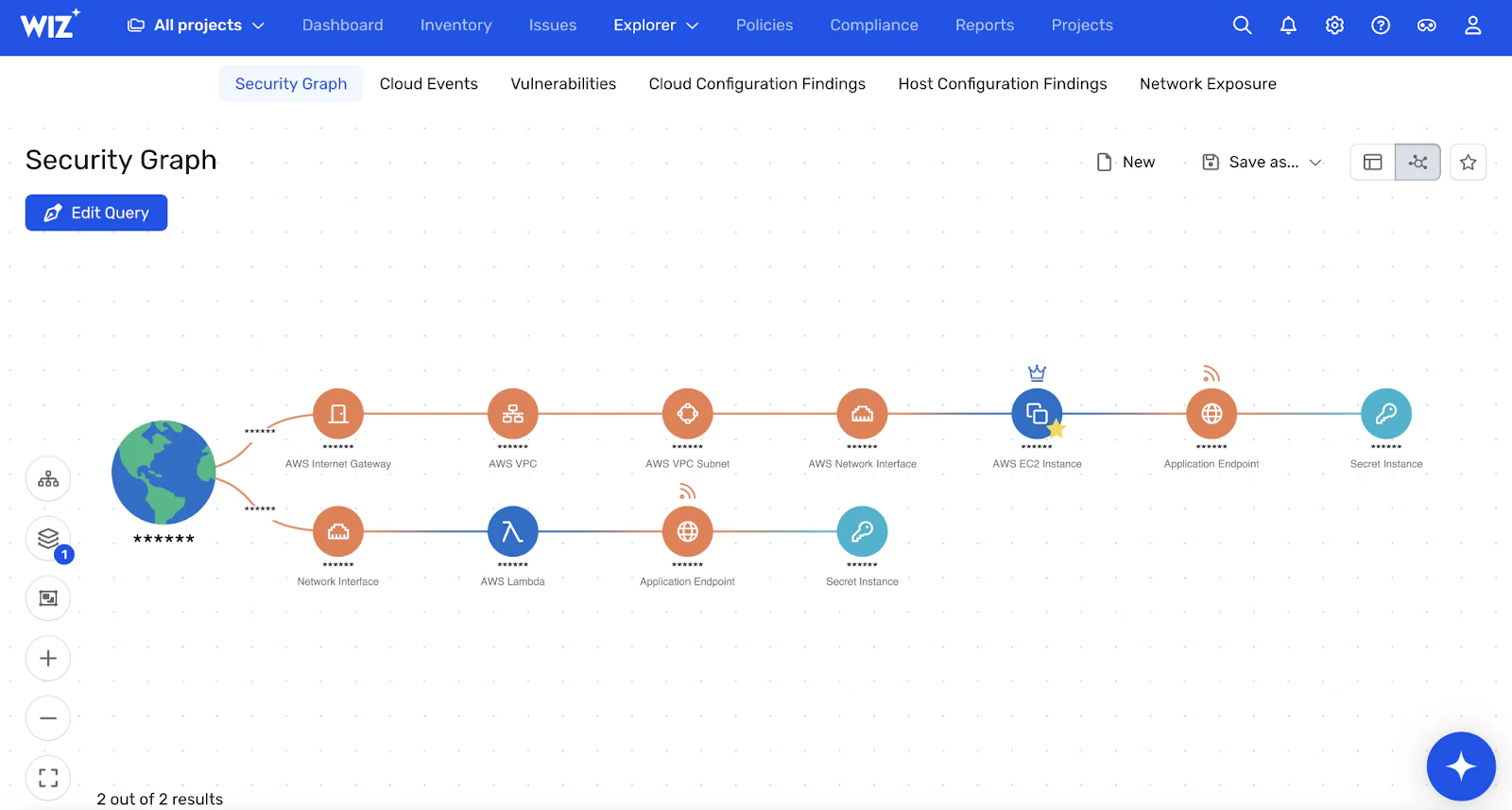
Wiz takes a unified, code-to-cloud approach to web application security, covering the entire lifecycle with a suite of integrated solutions:
Wiz Code scans repositories for open-source dependency risks (SCA), exposed secrets, malware, sensitive data, and infrastructure-as-code misconfigurations. It evaluates CI/CD posture and can ingest third-party SAST findings for added context, then correlates these signals with cloud and runtime insights to help teams fix issues at the source.
Wiz Cloud brings together cloud security posture management (CSPM), cloud infrastructure entitlement management (CIEM), data security posture management (DSPM), and vulnerability management in a single platform. API security is also part of Wiz Cloud, and resources across multi-cloud environments are normalized and analyzed to prioritize exploitable risk.
The Wiz Security Graph connects risks across code, cloud, and runtime to show real attack paths instead of isolated alerts.
Wiz Defend uses optional eBPF sensors for runtime visibility and protection, detecting threats such as remote code execution, container escapes, and suspicious API usage patterns.
Wiz CIEM maps effective permissions and lateral movement paths, helping teams right-size access and break identity-driven attack chains.
Together, these capabilities streamline application security, providing continuous visibility, meaningful prioritization, and clear remediation guidance from development through production.
Ready to see how Wiz can protect everything you build and run in the cloud? Schedule a demo today.
Catch code risks before you deploy
Learn how Wiz Code scans IaC, containers, and pipelines to stop misconfigurations and vulnerabilities before they hit your cloud.
