

What do we mean by “AI CNAPP”?
AI CNAPP is a cloud-native application protection platform that uses AI to accelerate security workflows, and secures your AI workloads. It’s not a new category as much as the natural evolution of CNAPP as AI becomes part of how teams build software.
A modern CNAPP already connects cloud configuration, workloads, identities, data pathways, and runtime behavior into a single graph. AI adds a reasoning layer on top of that graph: summarizing risk, explaining attack paths, suggesting the likely root cause, and helping teams land the fix faster.
The same platform extends that model to AI workloads: models, training data, inference endpoints, vector stores, and agents become first-class assets in the graph. You see how AI services are connected to sensitive data, which identities can call them, and what happens if they’re exposed to the internet.
Gartner® Market Guide for CNAPP
The Gartner® Market Guide for CNAPP explores this shift and outlines what security leaders should consider as the market matures.

Why this framing matters now
CNAPP solved the hard structural problem: cloud security requires a unified view of configuration, workloads, identities, data, and runtime behavior. Instead of chasing isolated alerts, teams reason about actual attack paths – the combination of issues that make exploitation possible.
AI doesn’t replace that foundation. It changes the tempo of both risk and response.
Cloud and AI environments now move faster than human workflows can. Teams ship new services, models, and pipelines daily. Access patterns shift based on model usage, not just application logic. And when something goes wrong, it unfolds across multiple layers at once – infrastructure, identity, data, and code.
The result is an operations gap: security teams still need the same context they always did, but they need it immediately, without assembling it by hand.
Instead of reading dozens of findings and dashboards, teams can ask questions in natural language, see the full path of an issue, and receive guided remediation in real time. Investigation shifts from “gather context” to “validate impact and apply a fix.”
At the same time, AI workloads themselves become part of the attack surface:
public inference endpoints
vector databases containing sensitive data
AI agents executing real actions with credentials
pipelines that modify models continuously
identity scopes attached to training jobs or orchestrators
Those assets don’t live in a separate universe – they sit inside the same cloud accounts, networks, and identity systems a CNAPP already maps. That’s why “AI CNAPP” matters: the platform must understand AI resources, not just cloud infrastructure.
How CNAPP solved the fundamentals (before AI)
Before anyone talked about “AI in security,” cloud-native security had already shifted from point tools to a unified model. Traditional security stacks produced fragmented views – CSPM findings lived in one console, workload signals in another, identity risks in a third. Teams spent more time stitching context together than fixing anything.
CNAPP changed that by creating a single platform with shared context, built around three core ideas:
1. One model of your environment, not separate tools
CSPM, CWPP, CIEM, IaC scanning, and data security all feed the same graph – so a misconfiguration isn’t just an object, it’s part of a path:
which identity can reach it
what data sits behind it
whether the workload is exposed
who owns the code that deployed it
This made cloud security about risk, not volume.
2. Attack-path thinking replaced severity thinking
Severity used to be decimal scores and patch queues. CNAPP introduced toxic combinations – issues that don’t matter alone, but matter together:
a public workload
with a known exploit
holding an over-permitted role
connected to a sensitive database
CNAPP became the mechanism for seeing how attackers would move, not just where vulnerabilities exist.
3. Code-to-cloud traceability closed the loop
Risk doesn’t start in production – it starts in code. CNAPP platforms trace a runtime issue back to:
the IaC module
the image tag
the pipeline run
the owning repository
This let security fix the cause, not the symptoms – and prevent the next deployment from re-introducing the issue.
4. Teams aligned around one source of truth
Instead of security and engineering debating screenshots, a CNAPP provides a shared view:
one graph
one incident
one owner
That operational alignment matters more than any AI feature. It’s the reason CNAPP adoption accelerated: it turned cloud security into a system, not a tool chain.

How AI evolves CNAPP
AI doesn’t redefine CNAPP – it removes the operational friction between finding a problem and fixing it. The core platform already understands relationships across code, cloud resources, identities, data, and runtime signals. AI builds on that understanding to guide teams forward: what matters, why it matters, and how to resolve it efficiently.
Rather than navigating multiple dashboards, stitching context together, and debating priority, teams can start with an answer – an evaluated path to resolution backed by the graph. The result isn’t just faster triage; it’s a shift in posture. Work moves from investigation loops to resolution loops, with ownership, context, and sequence clarified from the start.
Below are four ways AI changes how teams use CNAPP in practice:
1. Intelligent detection and prioritization
The hardest part of cloud security isn’t detecting issues – it’s deciding which one to fix first. AI helps by evaluating findings through the full context of your environment: how exposed a resource is, which identities can reach it, what data is connected, and whether recent changes introduced new risk.
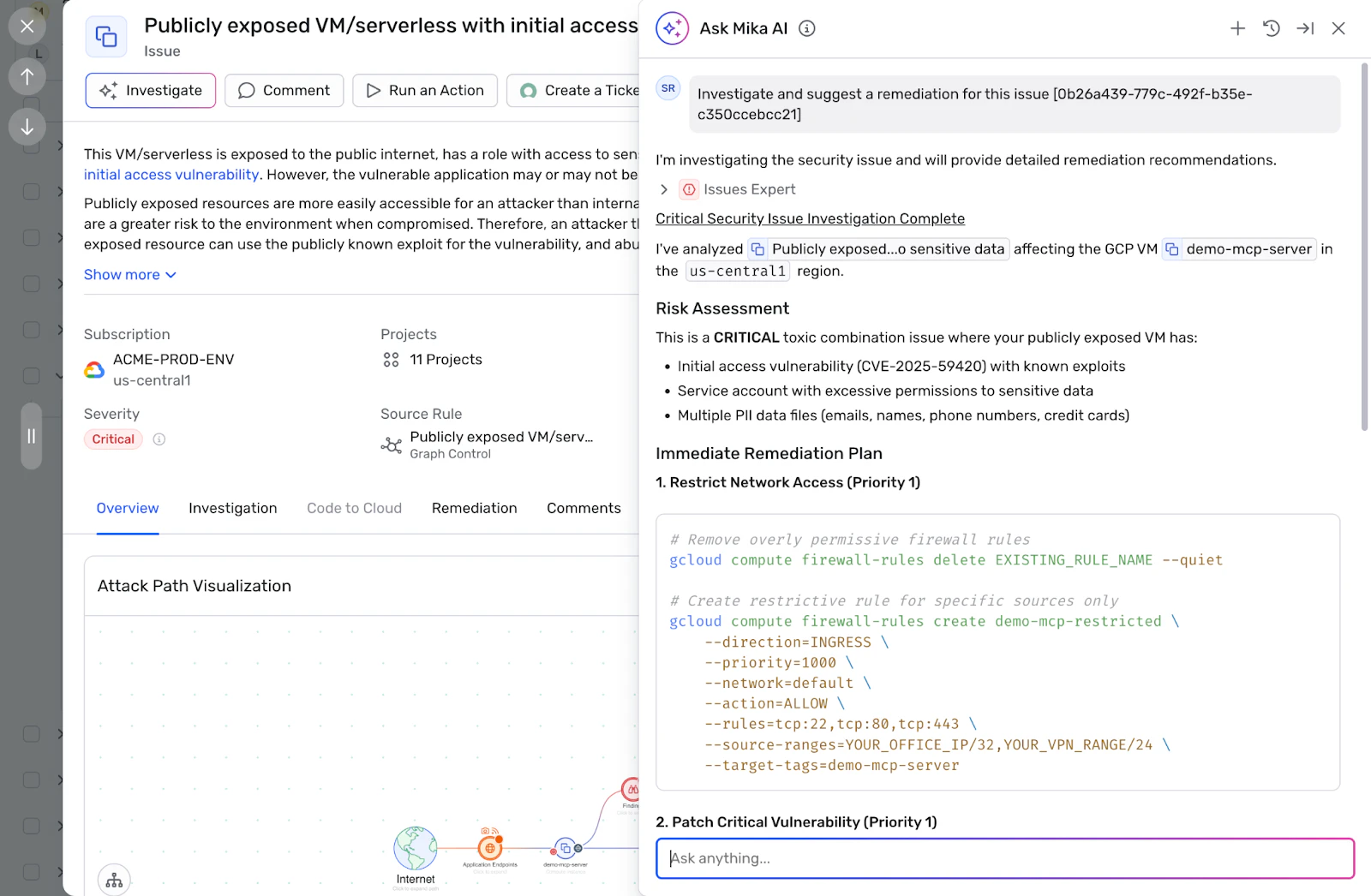
Instead of handing teams a long list of “critical” items, the platform highlights true attack paths: the combinations that matter. Not “another high-severity CVE,” but: an internet-facing service + over-permissive role + access to sensitive data.
AI here acts as a context engine, not a scoring engine. It reasons over the graph, collapses noise, and lets you start with the few issues that actually move risk. This directly reflects the idea behind the Issues Agent: the fastest path to impact is clarity.
2. Automated investigation with a clear storyline
Investigations require hunting across logs, assets, identity graphs, and dashboards to assemble context. With AI, investigation becomes compressed into a narrative: what happened, why it matters, which resources are involved, and what changed.
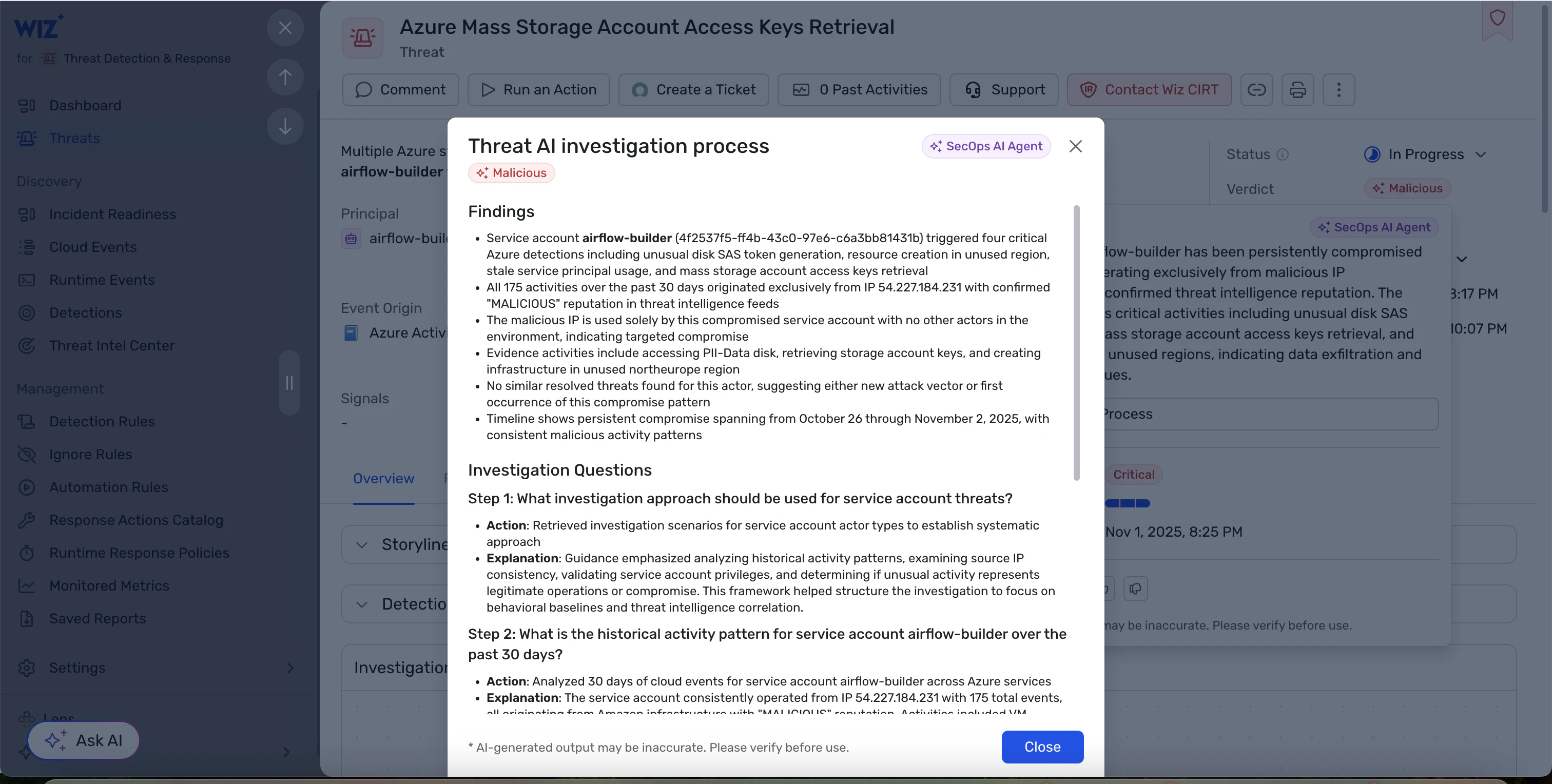
Instead of a raw event stream, teams get a storyline:
the triggering event
the related resources and roles
the lateral paths available
the relevant configuration or code change
the risk of impact
It’s not abstract summarization – it’s graph-grounded reasoning: “Here’s the context we see. Here’s the logical sequence. Here’s the likely root cause.” Analysts can expand nodes, ask follow-ups, or dive deeper – but the platform delivers a coherent starting point, not a blank page.
3. Guided remediation with ownership and sequence
This is where the Issues Agent philosophy really shows up: AI evaluates the most efficient path to a fix, not just recommends one action.
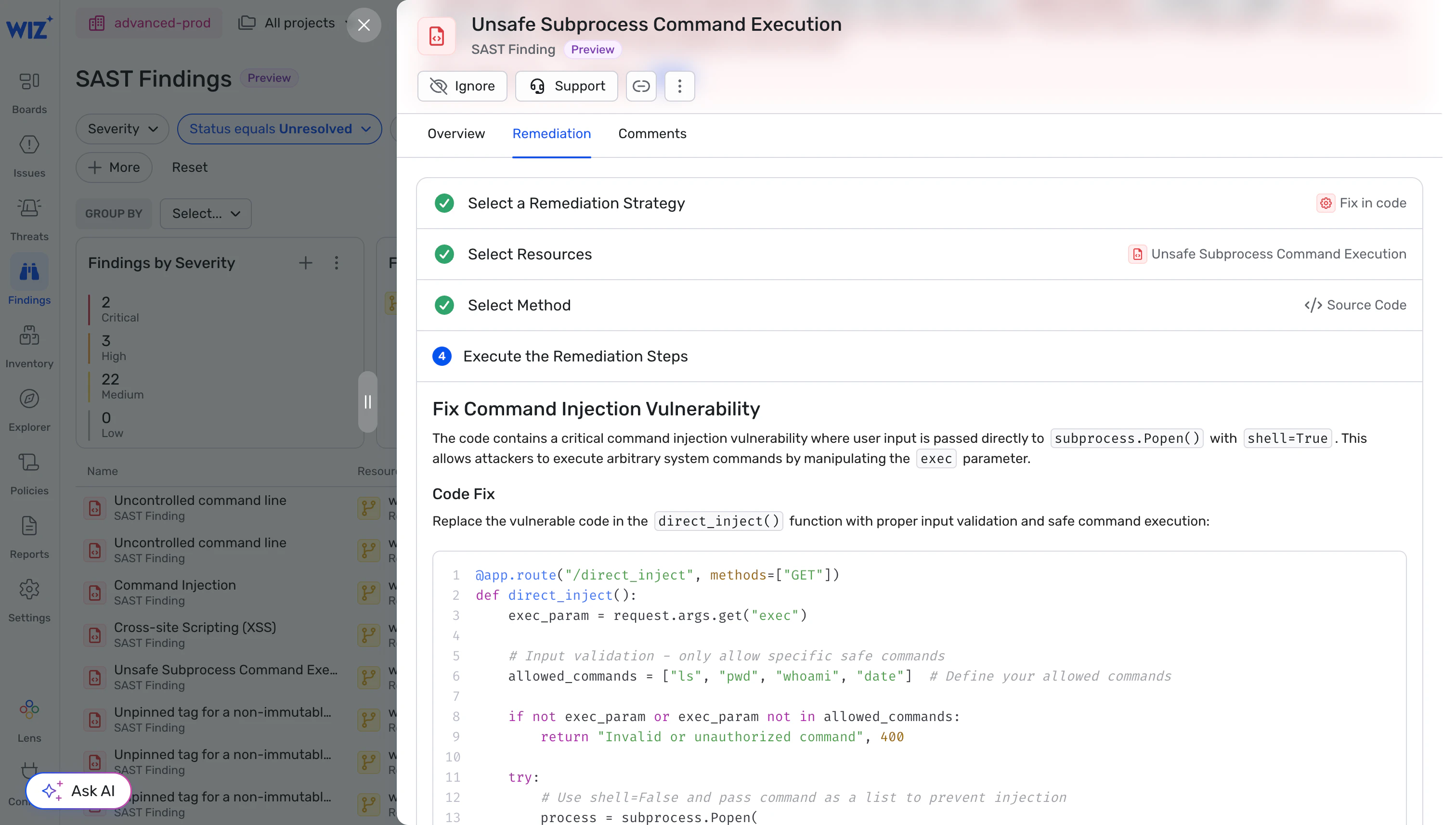
Teams don’t get a generic suggestion like “tighten the IAM policy.” They get a guided sequence grounded in the graph:
the owner of the resource
the relevant code or IaC source
the exact change required
what depends on it
the steps in order that avoid breaking dependencies
The model prioritizes least-effort, high-impact remediation paths – and shows why. If the shortest path is opening a PR on the IaC module instead of patching in production, it surfaces that route.
The point isn’t automation for automation’s sake – it’s removing ambiguity so teams spend their time executing, not debating.
4. Graph-native reasoning through natural language
The platform becomes interactive. Instead of learning a query language, teams can ask:
“Show me issues on internet-exposed services with access to customer data, ordered by blast radius.”
The system responds with an evaluated answer, not just a filtered list.
It can explain why something is critical, show the context that makes it exploitable, and propose next steps – all grounded in the graph.
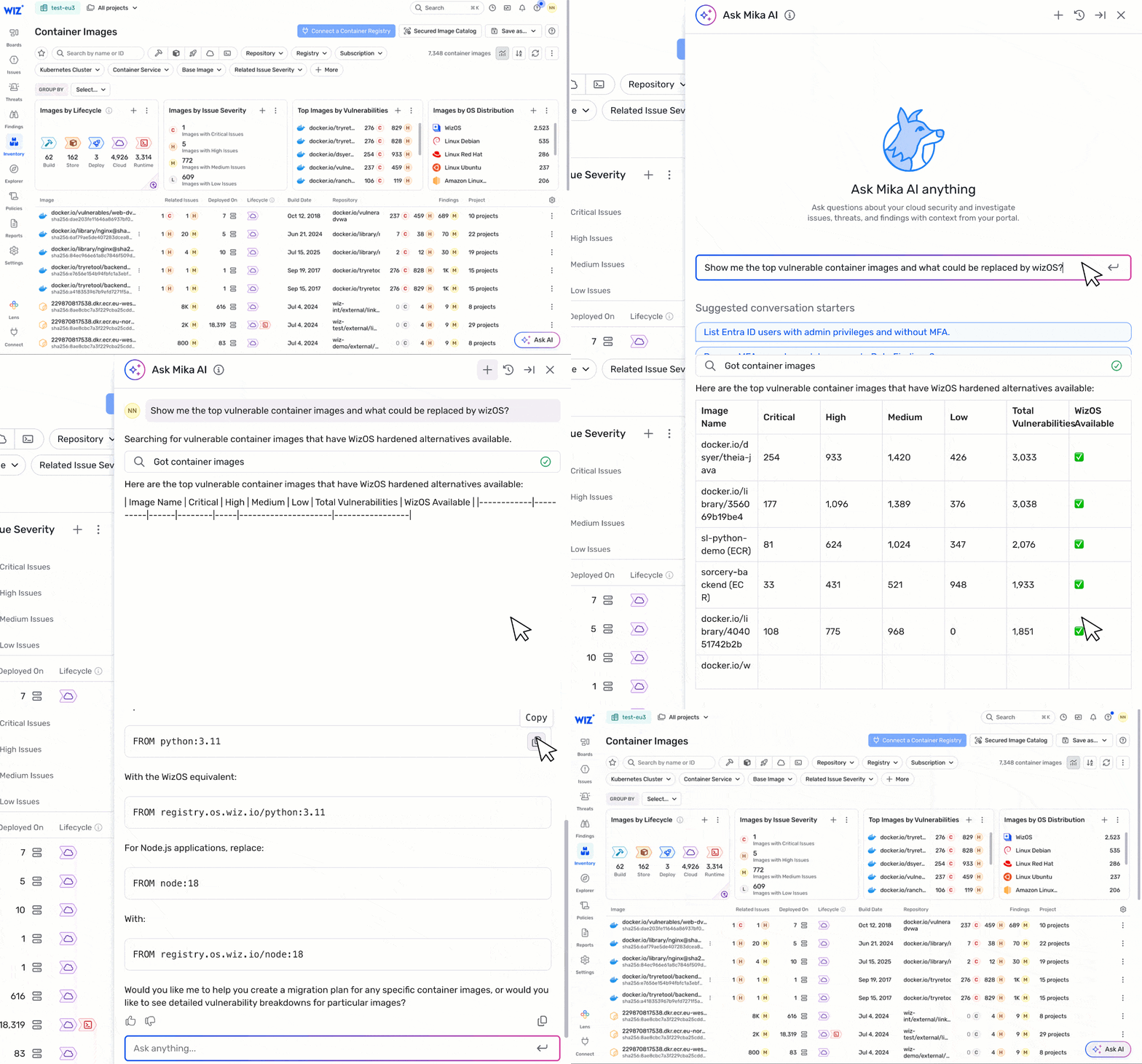
This matters because it reflects a deeper shift: AI isn’t a chatbot sitting on top of CNAPP.
It’s a reasoning layer embedded in the graph model that understands resources, relationships, and ownership – so answers are truly contextual and immediately actionable.
Securing AI workloads is now part of CNAPP’s core scope
As organizations adopt AI to power products and internal workflows, the workloads behind those systems start to look like everything else CNAPP already protects – just with different building blocks. A modern AI deployment isn’t “a model in isolation,” it’s a chain of cloud resources: fine-tuning jobs running on GPUs, managed model endpoints, vector stores holding embeddings, and orchestration layers connecting models to production services. That entire surface is exposed and governed through the cloud – which means it belongs inside the CNAPP model rather than in a separate tool.
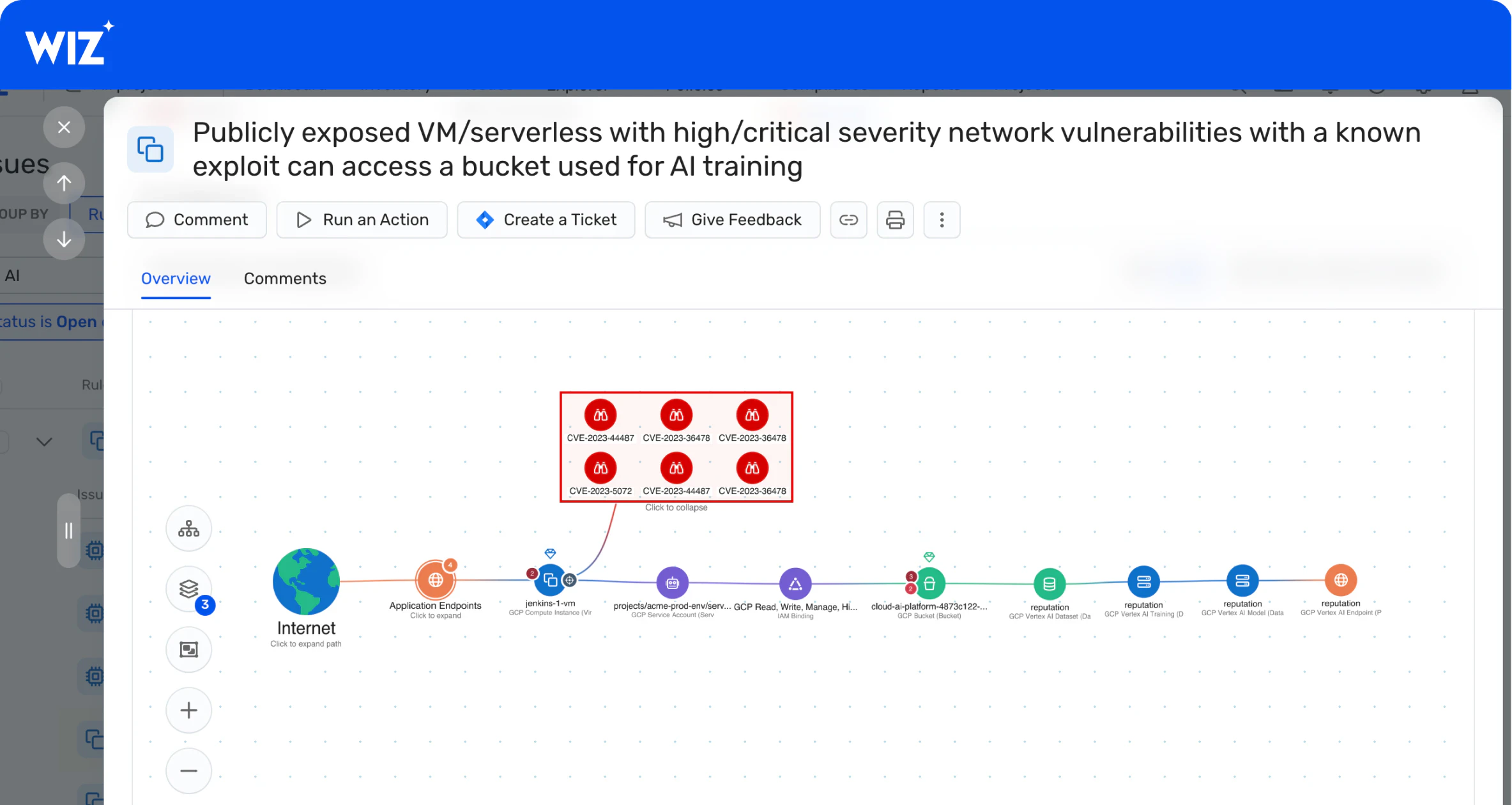
The shift is subtle but important: CNAPP doesn’t bolt on “AI coverage” – it absorbs AI into its existing understanding of cloud posture, identity, data, and code. The same graph that surfaces a misconfigured storage bucket can show when a public inference endpoint has reach into sensitive training data. The same identity model that calculates effective permissions for workloads can tell you whether a model-serving service account has access far beyond what its usage requires. AI becomes another first-class application pattern, not a parallel category.
This is where AI-SPM fits naturally. Instead of reinventing controls, AI-SPM extends the existing posture model to include AI-specific risks: model endpoints exposed on the internet, over-permissive service roles, unsafe connections between AI services and data stores, or agent flows that can be driven off course by untrusted input. It views these risks through the same lens as everything else in the environment – exposure, identity reach, data sensitivity, and blast radius. The benefit is consistency: you don’t create side rules for AI, you apply your existing cloud policy engine to a new class of assets.
How Wiz supports this evolution
Wiz approaches AI in CNAPP the same way it approached cloud security from the beginning: by connecting everything into one graph and letting context drive action. The platform wasn’t rebuilt around AI trends; it already used a shared model of resources, identities, data, and code. AI now sits on top of that foundation to help teams move through detection, investigation, and remediation with less manual stitching.
From a product perspective, Wiz isn’t trying to reposition itself as an “AI CNAPP” or replace operations tooling. Instead, AI is used where the graph already has leverage: turning risk into stories, clarifying ownership, and helping teams fix the things that matter. The CNAPP remains the core; AI is the acceleration layer.
Wiz’s AI agents express this in practice. Features like Mika AI give teams a conversational interface to the graph so they can ask real questions instead of jumping between dashboards. The Blue Agent investigates cloud threats automatically using environment context rather than signatures, showing each step it took. The Issues Agent helps teams move from finding to resolution by evaluating the cleanest remediation path and showing which team owns it. And AI SAST applies the same graph thinking to code, connecting vulnerabilities in repositories to the infrastructure they can impact at runtime.
All of these follow the same pattern: graph context first, AI assistance second. The result is not a new category, but a faster way to work within the one customers already trust. Wiz is still a CNAPP at its core, now with AI helping teams extract value from that context with far less effort.
This is where the market is moving: unified cloud and AI security, driven by a shared context model, with AI turning that model into usable guidance. A CNAPP built on a graph can support both cloud and AI workloads without creating separate tools or pipelines. Wiz focuses on that design: one model of your environment, one view of risk, and a set of AI capabilities that help teams move faster toward a healthier posture.
Ready to bridge the gap between cloud context and AI-driven resolution? Request a Wiz demo to get started!
See AI-CNAPP in Action
Discover how leading security teams secure AI workloads, pipelines, and LLM deployments.
