

What is attack surface reduction?
Attackers don’t start with what you think is exposed, they start with whatever they can reach. Attack surface reduction (ASR) is about shrinking the real-world set of entry points that attackers could use to get to your cloud resources, identities, and APIs—before they can be exploited.
To reflect how attackers actually see your environment and exploit risk, attack surface reduction strategies…
Continuously discover externally reachable assets—including those outside DNS or inventory systems
Cut down on privilege and resource sprawl
Limit attack paths by removing unnecessary services, tightening access, and eliminating misconfigurations that create exposure
As cloud environments expand, traditional asset tracking and perimeter-based security fall short. Understanding why is the first step toward building a cloud attack surface reduction program that delivers measurable, meaningful results.
2025 Gartner® Market Guide for CNAPP
Security teams are consolidating tools, aligning workflows, and prioritizing platforms that offer end-to-end context. The 2025 Gartner® Market Guide for Cloud-Native Application Protection Platforms (CNAPP) explores this shift and outlines what security leaders should consider as the market matures.

Why attack surface reduction matters in cloud environments
In the cloud, services are continuously created, scaled, and removed. The sheer size and speed of cloud environments tend to overwhelm traditional attack surface review methods, like manual configuration checks, spreadsheet-based inventories, static architecture diagrams, and scheduled audits.
Public storage, APIs, and serverless functions introduce far more entry points than perimeter-based security can handle, while highly distributed deployments mean identity, storage, and network misconfigurations are easier to introduce and harder to find. Other cloud risks include shadow assets, rotating addresses, and short-lived resources, making external reachability difficult to track.
Validating exposure from an attacker's perspective cuts noise and highlights what's truly exploitable, especially as attackers search for lateral movement opportunities inside your cloud estate.
Attack surface monitoring: Your first line of cloud defense
Attack surface monitoring involves continuously identifying and tracking internet-reachable assets. In cloud-native environments, where endpoints, identities, and services
Read more

Core components of attack surface reduction
The core components of attack surface reduction are the required pillars of a complete ASR program—the what, not the tools. They represent foundational building blocks that apply regardless of cloud provider, architecture, or maturity level.
These core components should include:
Continuous discovery of all public-facing cloud, SaaS, AI, and on-prem assets
External scanning paired with internal context to understand what each exposure connects to—unified graph context connects external exposures to internal misconfigurations, identities, sensitive data, and downstream services, enabling risk-based prioritization over isolated findings.
Validation of which exposures are exploitable in real-world conditions
Clear ownership mapping so teams know who must fix each exposure and why
Automated guardrails in CI/CD to prevent new exposures from being introduced
Routine removal of unused services, stale identities, and orphaned public addresses
Classification of exposures based on reachable data, privilege impact, data-layer access paths, and attack paths
Attack surface mapping: Complete visibility guide
Attack surface mapping identifies externally reachable entry points and shows what those entry points expose inside your environment, including internal resources, identities, and data.
Read more

Attack surface reduction strategies for cloud-native architectures
Strategies are the how of attack surface reduction. They translate the core pillars into concrete, repeatable actions that fit modern deployment models and operational realities.
Identity and access controls
Use least-privilege access across IAM roles, service accounts, and workloads.
Remove unused IAM roles, access keys, and permissions by analyzing CloudTrail/Azure Activity Logs for last-used timestamps. Right-size policies based on effective permissions and access analytics from CIEM tools to limit privilege sprawl and reduce lateral movement risk.
Use short-lived, federated credentials—for example, AWS STS AssumeRole with ExternalId parameter, Azure Managed Identities, GCP Workload Identity, or OIDC federation. For AWS cross-account access, enforce ExternalId on trust policies to prevent confused deputy attacks. Scope delegation with IAM conditions based on source IP ranges (for example, corporate VPN CIDR), time windows (for example, business hours only), or resource tags (for example, environment=production).
Network and exposure controls
Restrict network reachability using cloud-native segmentation controls: VPCs/VNets with isolated subnets and route tables in AWS/Azure/GCP, security groups and network security groups (NSGs) with tightly scoped inbound rules, and Kubernetes NetworkPolicies to limit pod-to-pod communication.
Enforce secure defaults for storage, API endpoints, certificates, and serverless functions.
Validate reachable assets with outside-in scanning and correlate them with internal context.
Assess exposure paths across containers and Kubernetes clusters by identifying Services of type LoadBalancer or NodePort, internet-facing ingress controllers, pods using hostNetwork, publicly accessible control plane/API endpoints, nodes with public IPs, and overly permissive security groups or firewalls that expose nodePort ranges (typically 30000-32767). These configurations often create unintended external reachability.
Configuration and code hygiene
Apply code-level checks to prevent insecure configurations from reaching production.
Ensure infrastructure templates enforce restricted access and secure service settings.
Automate cleanup of unused public addresses and outdated endpoints, keys, and roles.
Risk-based prioritization
Begin prioritization with attack path analysis to reveal exposures that lead to sensitive data, privilege escalation, or lateral movement.
Prioritize externally reachable issues that are verified as exploitable.
Address patterns that repeatedly appear across workloads or engineering teams.
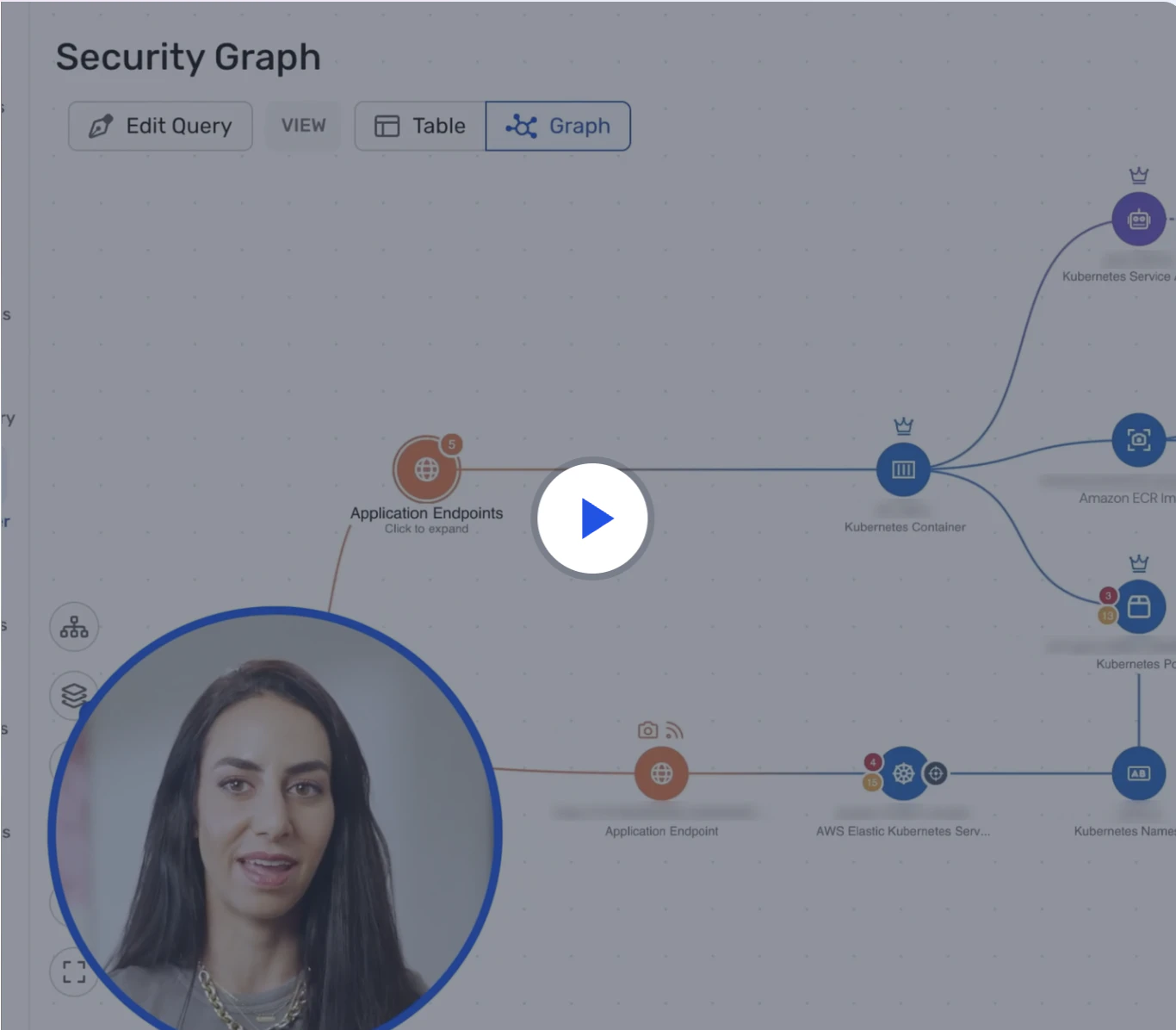
Watch 12-minute demo
Learn about the full power of the Wiz cloud security platform. Built to protect your cloud environment from code to runtime.
Watch now
Implementing an effective attack surface reduction program
This section outlines a practical roadmap for turning attack surface reduction principles into day-to-day operational practice. It also highlights some of the tools you’ll need to help you get there.
1. Establish visibility and discovery
Start by understanding what’s exposed. You’ll need a complete, continuously updated view of all externally reachable assets and what they connect to.
Build a unified inventory that combines external discovery with internal cloud context.
Identify all public-facing cloud, SaaS, AI, and on-prem assets.
Detect shadow assets and correlate them with the services and data they reach.
Typical tools: External attack surface management (EASM) platforms, CSPM tools, cloud asset inventory platforms, IAM governance tools
2. Classify and validate exposures
Not every exposure carries the same risk. Save time and effort by validating exploitability and ranking exposures based on real impact.
Validate which exposures are exploitable by safely simulating real-world attacker interactions from the public internet: Test for weak or default credentials, directory listing, open indexes, exposed admin panels, and misconfigured CORS policies without performing intrusive exploitation.
Rank exposures by reachable data, privilege impact, or attack path value.
Highlight risks tied to sensitive data or impactful service roles.
Typical tools: Vulnerability management platforms, CSPM/CNAPP tools, attack path analysis solutions, data discovery and classification tools
3. Assign ownership and streamline workflows
Start cutting exposures by establishing clear responsibility and remediation workflows, ideally using your teams' existing tool stack.
Map exposures to owners across infrastructure, application, and business groups. Code-to-cloud correlation helps identify the owning repository, team, and even the specific commit that introduced each exposure, enabling precise ownership assignment and faster remediation.
Integrate assignment into existing engineering workflows through ITSM platforms (Jira, ServiceNow) and collaboration tools (Slack, Microsoft Teams).
Use actionable guidance to shorten remediation time—provide specific remediation steps, IaC template fixes, and policy recommendations rather than generic vulnerability descriptions.
Typical tools: ITSM/ticketing platforms, CMDB platforms, service catalog tools, engineering project management tools
4. Embed prevention into engineering processes
Shift left on ASR by stopping new exposures at the code and infrastructure level before they reach production environments.
Add guardrails in CI/CD to block insecure configurations from merging.
Implement security constraints like least-privilege identity policies and automated secret scanning into development workflows to block insecure configurations before they reach production.
Enforce policies for public access, key usage, and network reachability.
Embed ASR controls directly into DevOps workflows so exposure prevention becomes part of normal development activity.
Typical tools: CI/CD security gate tools, IaC security scanners, SAST tools, policy-as-code platforms
5. Review and improve continuously
Attack surface reduction demands constant reassessment as your services, attack paths, and external exposure all evolve.
Analyze exposure patterns and trends to refine policies and guardrails.
Expand coverage to new services, workloads, and external assets.
Reevaluate attack paths as the environment evolves.
Typical tools: CNAPP reporting dashboards, SIEM platforms, GRC/IRM platforms, business intelligence reporting tools
Measuring attack surface reduction success
| Metric | Success direction | What it measures | Why it matters |
|---|---|---|---|
| Verified exploitable exposures | ↓ | Count of exposures you’ve confirmed attackers can reach and exploit (should go down) | Shows reduction of real attacker opportunities |
| Total number of internet-facing assets | ↓ | Size of externally reachable footprint, including shadow assets (should go down) | Indicates whether the overall attack surface is shrinking |
| Critical and high-severity vulnerabilities on reachable assets | ↓ | Severe issues on assets exposed to attackers (should go down) | Keeps focus on the most dangerous weaknesses |
| Mean Time To Remediate (MTTR) | ↓ | Time from detection to fix for exposure-linked issues (should go down) | Reflects how quickly teams close exploitable exposures |
| Ownership mapping rate | ↑ | Percentage of exposures linked to a clear owner (should go up) | Ensures accountability and reduces stalled remediation |
| Attack paths removed or shortened | ↑ | Number of high-impact paths eliminated or reduced in length (should go up) | Tracks whether meaningful lateral-movement risks are shrinking |
| Inventory gap ratio | ↓ | Externally discovered assets minus inventoried assets (should go down) | Measures reduction of shadow IT and blind spots |
Metrics like 'Attack paths removed or shortened' and 'Ownership mapping rate' require platforms that correlate external exposures with internal cloud context. Tools that maintain a security graph—representing cloud resources, identities, data, and their relationships as nodes and edges—can automatically calculate attack path metrics by analyzing how many high-risk paths (for example, internet → vulnerable service → privileged identity → sensitive data) have been eliminated through remediation. Similarly, code-to-cloud correlation enables automated ownership mapping by tracing resources back to source repositories and teams, making the 'Ownership mapping rate' metric trackable without manual spreadsheet maintenance.


Wiz's approach to cloud attack surface reduction
The right security platform can make the difference between theory and execution, leaping the gap between knowing what it takes to implement attack surface reduction and being able to do it continuously amid today’s multi-cloud challenges.
Wiz is a modern CNAPP solution that brings together agentless scanning, attack path analysis, and attack surface management (ASM) to support continuous attack surface visibility and reduction across AWS, Azure, GCP, SaaS, and custom domains.
Wiz ASM continuously discovers external-facing assets—domains, IPs, APIs, and application endpoints—validates public exposure and exploitability through safe, non-intrusive testing, then correlates findings with internal cloud context to reveal true business impact and ownership. This means you see not just that an API endpoint is exposed, but also which team owns it, what sensitive data it can reach, what privileges it holds, and which specific code repository introduced the exposure—enabling same-day remediation instead of weeks of investigation.
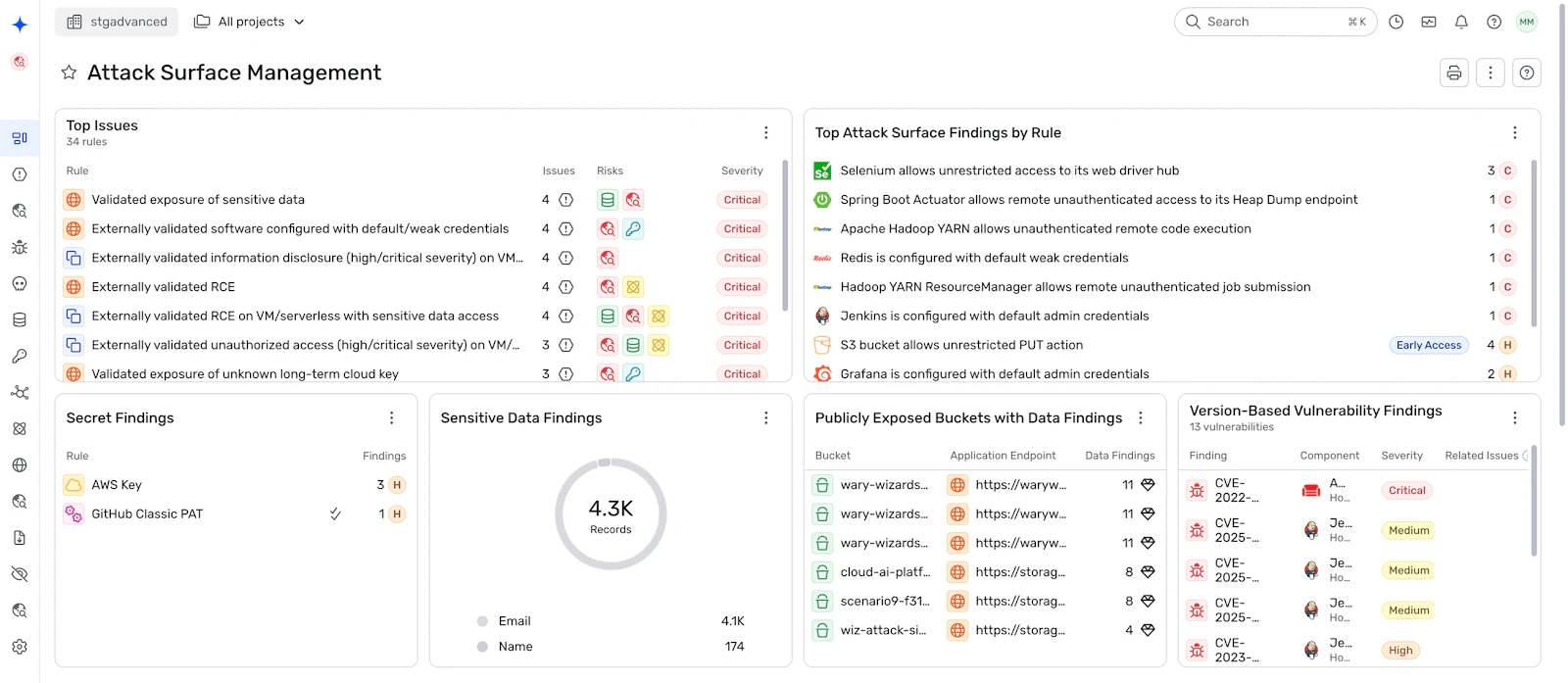
You’ll see at a glance exactly how each exposure connects to real privileges, services, and reachable data, with:
ASM findings embedded in the Wiz Security Graph for instant visibility into external exposures and how they connect to internal misconfigurations, vulnerabilities, and sensitive data risks
Dynamic scanning and DNS resolution to validate true internet exposure and identify common adversary tactics by applying rules that simulate real-world threats (like weak credentials, misconfigurations, and open directories). Wiz ASM detects these exploitable conditions so teams can remediate them before attackers exploit them.
API-specific risk assessments mapped to the OWASP API Top 10, PCI DSS reporting alignment and enrichment with CISA Known Exploited Vulnerabilities (KEV) data at the Wiz platform level, and near-real-time asset discovery across cloud, SaaS, and on-premises environments
Instead of having to stitch together results from disconnected tools, Wiz gives you a unified view of external and internal risk. You’ll know exactly why each exposure matters, how it could be abused, and what downstream impact it creates before it turns into lateral movement or data access.
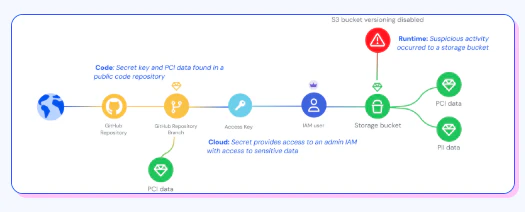
For example, when Wiz ASM discovers an externally reachable Jenkins instance with default credentials, the Security Graph immediately reveals the connected IAM role with admin permissions to production databases. Code-to-cloud correlation identifies the repository and team responsible, enabling same-day remediation and CI/CD hardening to prevent recurrence, turning what could have been a critical breach into a closed exposure within hours.
With agentless coverage, deep cloud context, and a unique zero-noise approach, Wiz lets you manage cloud attack surface risk at scale based on real exposure, validated impact, and clear paths to remediation.
See how Wiz can help you reduce your attack surface: Book a demo today.
Surface the exposures that matter most
Detect critical exposures that span across your cloud, code, SaaS, APIs and more.
