
What is an attack surface management (ASM) vendor?
An attack surface management vendor is a security provider that helps organizations continuously discover, analyze, and reduce external exposures across their internet-facing footprint. Your real-world risk comes from the gap between what you think is exposed and what attackers can actually reach and exploit. ASM vendors close that gap by finding assets you did not know existed, validating whether those assets are truly vulnerable, and helping you fix the exposures that matter most.
The attack surface has expanded far beyond traditional domains and IP addresses. Today it includes cloud endpoints, APIs, SaaS integrations, and AI services. Cloud providers assign public addresses that never appear in your DNS records, and development teams spin up test environments that quietly become production-connected. Without an ASM tool that understands this reality, you will have blind spots that attackers can see clearly.
Expose the Risks That Matter Most
Learn how Wiz Cloud surfaces toxic combinations across misconfigurations, identities, vulnerabilities, and data—so you can take action fast.

What counts as "attack surface" in 2026?
Modern attack surfaces span multiple categories that legacy tools were never designed to track:
Cloud endpoints: Public buckets, managed databases, Kubernetes ingress controllers, serverless URLs, and PaaS consoles
Web and API surfaces: REST and GraphQL endpoints, admin panels, and partner portals, often a major source of real-world security incidents due to authentication gaps, misconfigured access controls, and exposed sensitive data.
SaaS and identity spillover: OAuth apps, SSO misconfigurations, and leaked tokens
AI surfaces: Exposed model endpoints, training data stores, inference services, and notebooks
Why is choosing the right ASM vendor matters
Cloud and AI have made exposure more dynamic than DNS-based scanning can keep up with, especially as multi-cloud adoption becomes the norm across enterprises. Organizations running workloads across AWS, Azure, and GCP face attack surfaces that span multiple provider-assigned address spaces, none of which appear in traditional DNS records. Assets appear and disappear quickly, and "temporary" test endpoints often end up connected to production permissions or sensitive data. A developer spins up a Jupyter notebook to prototype an AI model, connects it to a production database for realistic testing, and forgets to tear it down. That notebook now sits on a cloud-assigned IP that no one is monitoring.
The shift in the market is from "inventory" to "validated exposure management." Security teams do not lose because they lacked a list. They lose because they could not prove which exposures were truly reachable, exploitable, and high-impact fast enough to drive remediation. Industry reporting consistently links unknown or poorly managed internet-facing assets to real-world breaches, assets that existed outside the security team's visibility until attackers found them first. When you hand engineering a list of 500 "potentially vulnerable" assets with no proof and no ownership mapping, nothing gets fixed.
The pace of cloud deployment and AI adoption outstrips traditional security review cycles. By the time a quarterly scan completes, the environment has already changed. Continuous ASM is no longer optional if you want to keep up with how your organization actually builds and deploys.
Legacy vs modern ASM: what changed (and what to demand from vendors)?
Understanding what has shifted in the ASM market helps you ask better questions during vendor evaluations. Legacy ASM is mostly outside-in discovery plus a risk list. Modern ASM is discovery plus validation plus context that shows blast radius.
Legacy ASM patterns (and their limits)
Legacy tools have real limitations that create gaps in coverage and actionability:
Finds domains and IPs, but struggles with cloud-native ephemeral endpoints: Cloud-assigned hostnames and dynamic IPs slip through DNS-based discovery. If your tool only knows about assets registered in your domain space, it misses the majority of cloud exposure.
Prioritizes by CVSS and port severity, not business impact: High-severity findings may not matter if they lack a path to sensitive data or privilege. A "critical" vulnerability on an isolated test box is less urgent than a "medium" finding on a service with admin credentials, a key principle of cloud vulnerability management.
Produces findings that are hard to route because ownership is unclear: Security teams waste time chasing down who can fix an issue. Without ownership mapping, findings sit in a queue until someone manually investigates.
Modern ASM expectations
Buyers should demand capabilities that go beyond discovery:
Inside-out meets outside-in: External scanning enriched with cloud configuration, identity, and data sensitivity context. You need to know not just that an asset is exposed, but what it can access if compromised.
Exploitability validation: Tests what an attacker can actually do, not just what might be vulnerable. Safe, automated checks for default credentials, unauthenticated endpoints, and common RCE paths.
Attack-path thinking: Shows how exposure leads to privilege escalation or sensitive data access. A graph that connects the internet-facing service to the admin role to the production database.
Modern ASM should unify findings across cloud, SaaS, on-prem, and AI surfaces in a single view. If you need three different tools to see your full exposure, you will never prioritize correctly.
Attack surface monitoring: Your first line of cloud defense
Attack surface monitoring involves continuously identifying and tracking internet-reachable assets. In cloud-native environments, where endpoints, identities, and services
Read more

What to look for in an attack surface management vendor (buyer's guide)
This section provides a practical checklist for evaluating ASM vendors during POC and procurement. Each criterion maps to a real capability gap you might encounter.
1. Discovery that works for cloud attack surface management
Buyers should look for vendors that can find cloud provider public endpoints that do not sit under your domains, public PaaS services and managed resources, and internet-facing Kubernetes and API gateways.
Pressure-test questions to ask:
Can you find assets with cloud-assigned hostnames that are not in our DNS?
How do you handle fast-changing IPs and ephemeral services?
2. Shadow cloud discovery (the "unknown unknowns" problem)
A modern vendor should detect cloud resources with public addresses that are not tied to your known domain space. Attackers do not need your DNS to find them. They scan cloud IP ranges directly and fingerprint what they find.
Shadow cloud assets are a leading cause of breaches in cloud-native environments, making attack surface discovery critical. A forgotten test instance, an S3 bucket with a predictable name, or a misconfigured load balancer can all become entry points. If your ASM vendor cannot find these, you have a critical blind spot.
3. Exploitability validation (prove it safely)
Buyers should ask how the vendor validates default credentials, unauthenticated admin consoles, common RCE paths, and sensitive data exposure or secret leakage.
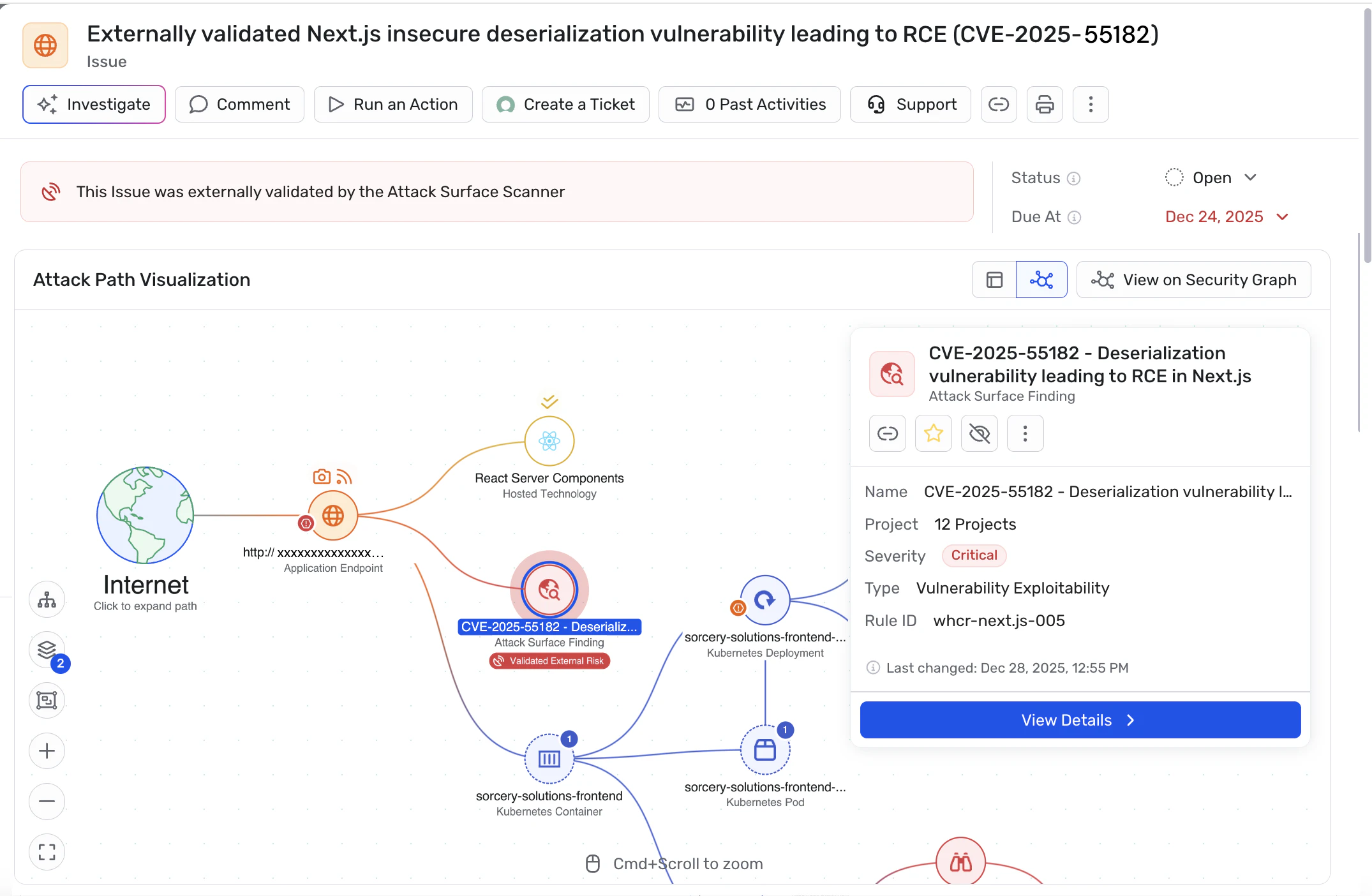
Good validation looks like evidence such as safe screenshots, clear reproduction steps, and controlled testing that avoids production impact. If a vendor says "potentially vulnerable" without proof, that is a red flag. You need findings that engineering will trust and act on.
Watch 12-min demo
Watch how Wiz automatically discovers external-facing assets, validates real exploitability, and connects exposures to internal cloud context

4. Prioritization based on attack paths to high-value targets
Buyers want to see paths like: Internet exposed service leads to weak auth or known exploit, which leads to privileged identity, which leads to sensitive data store. This chain shows real business impact.
Pressure-test questions to ask:
Can you show the path from exposure to data or admin?
Do you incorporate identity permissions and data sensitivity, or only external signals?
5. Ownership mapping that actually routes fixes
Buyers should look for mapping to the application or business service, infra owner and cloud account, repo and developer when relevant, and CMDB and ticket routing rules.
Integrations that determine whether findings get fixed
Ownership mapping only works if findings flow into the tools teams already use:
Ticketing systems: Jira, ServiceNow, Azure DevOps for creating actionable work items with context
Messaging platforms: Slack, Microsoft Teams for real-time alerts to owning teams
CI/CD pipelines: GitHub Actions, GitLab CI, Jenkins for shift-left remediation and PR-level feedback
CMDB and service catalogs: ServiceNow CMDB, Backstage for mapping assets to business services and owners
Cloud providers: AWS, Azure, GCP APIs for enriching findings with cloud-native context
SIEM and SOAR: Splunk, Microsoft Sentinel, Palo Alto XSOAR for correlation and automated response
During your POC, test the actual integration flow, not just that an integration exists, but that tickets arrive with the right context and routing.
Ownership mapping is what separates an "alert generator" from a "risk-reduction engine." If every finding routes to "security team" by default, you will spend more time triaging than remediating.
6. Multi-environment coverage (cloud, SaaS, on-prem, AI)
If the vendor only covers one slice well, you will end up with parallel programs and inconsistent prioritization. A critical exposure in your SaaS environment should compete for attention with a critical exposure in your cloud environment.
Minimum expectation: Cloud and SaaS coverage, plus a path to on-prem and partner-owned surfaces. AI surfaces should be included as part of the modern external footprint, not treated as a future roadmap item.
7. Operational fit and "day 2" realities
Buyers should evaluate deployment time to first value, ongoing tuning requirements, API limits and scan cadence, data retention and evidence storage, access controls, and guardrails to avoid disruptive scanning.
A tool that takes six months to deploy or requires constant tuning will not deliver value. Ask about day-2 operations during your POC, not after you have signed.
Attack surface reduction in the cloud
Attack surface reduction strategies help you keep up with fast-changing cloud environments by continuously identifying, validating, and shrinking the set of externally reachable assets and misconfigurations attackers can target.
Read more

Questions to ask attack surface management vendors (shortlist interview)
Use these questions during vendor demos and shortlist interviews to differentiate capabilities.
Discovery and attribution
Can you explain how you decide an asset belongs to us?
How do you handle subsidiaries and acquisitions?
What is your false positive dispute workflow?
Validation and safety
What exactly do you test to validate exploitability?
How do you avoid breaking production systems during validation?
Prioritization and reporting
What inputs feed your risk ranking?
Can you explain why one exposure is above another in plain terms?
Ownership and remediation
How do you map issues to teams and apps?
Do you trace exposures back to code changes when relevant?
Coverage for AI and emerging tech
How do you discover exposed AI endpoints and connected training data?
Do you treat AI services as distinct asset types with their own risk signals?
Attack surface management tools: 2026 comparison guide
Facing the attack surface head-on requires investing in top-tier solutions. Platforms that combine agentless discovery, context-based risk prioritization, and seamless developer workflow integration are your best bet.
Read more

Wiz's approach to attack surface management (ASM)
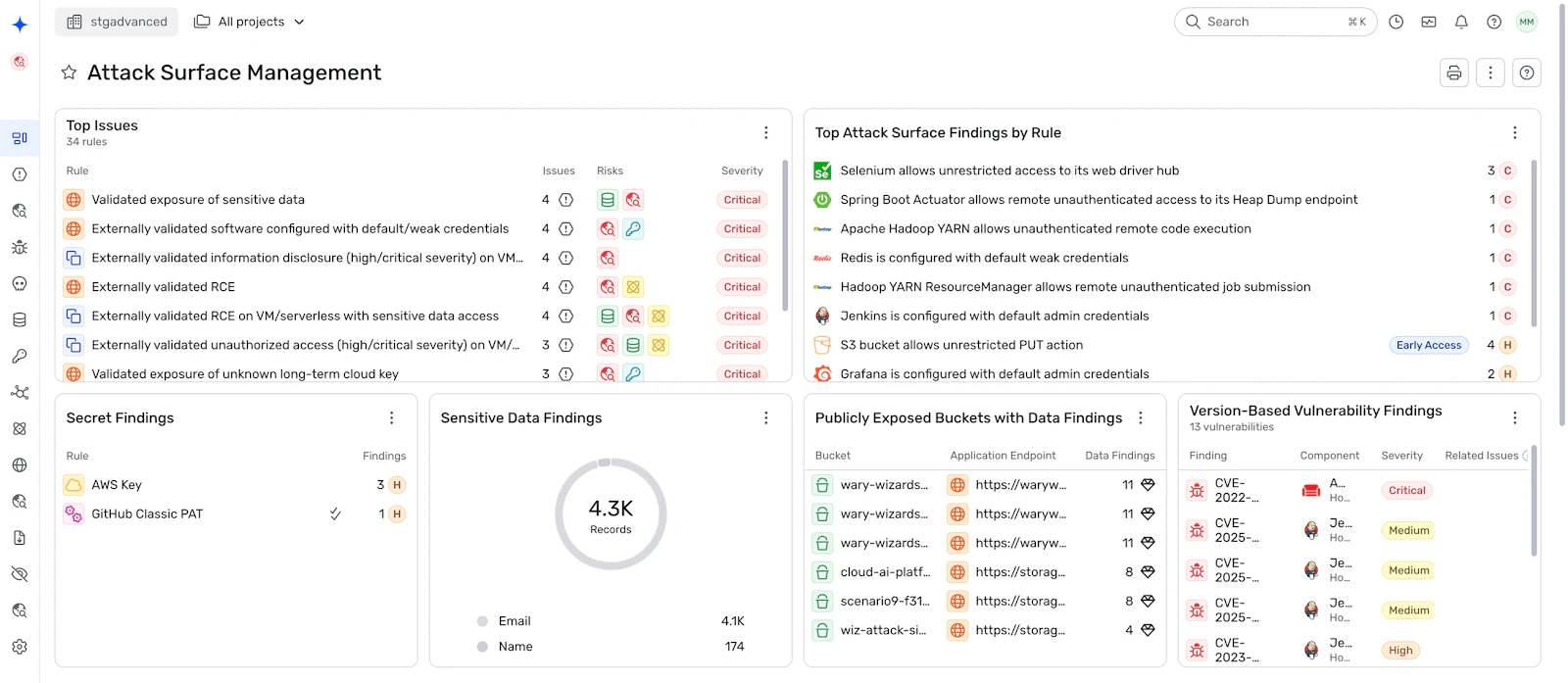
Wiz implements an "inside-out meets outside-in" approach that modern ASM requires, combining external scanning with deep cloud context to show not just what is exposed, but what that exposure means for your business. Wiz ASM performs outside-in scanning to discover internet-facing assets, while the Wiz Security Graph ties that exposure to what matters inside your environment: identity permissions, reachable resources, and sensitive data. This combination lets teams see not just "this is exposed" but "this exposure leads to admin credentials and production data." When you can show engineering the full attack path, they understand why the fix is urgent.
Wiz identifies public-facing cloud assets that are not linked to your known DNS, reducing blind spots created by cloud-assigned addresses. It combines external discovery with internal cloud context, using cloud API access to identify resources with public exposure, so you can validate ownership and impact rather than relying solely on DNS enumeration. This is critical for organizations with fast-moving cloud teams and multi-cloud environments. When developers can provision resources without going through a central process, shadow assets accumulate quickly.
Beyond discovery, Wiz validates exposures and visualizes attack paths, so teams can see chains like: internet exposure leads to vulnerable service, which leads to admin permissions, which leads to sensitive data. The graph makes these relationships clear and actionable. Wiz Sensor adds runtime signals that help validate whether vulnerable components are actually present and active in real execution paths. This increases confidence that an exposure is truly actionable by showing whether the vulnerable code is loaded in memory, not just present in the filesystem.
Wiz maps exposures to the owning team, app, business unit, and when available, back to code and the developer who introduced the change. Tickets go to the right people with the context they need to act. This shortens the handoff cycle and reduces time-to-fix. Instead of security triaging every finding and manually researching ownership, the platform does that work automatically.
Wiz includes AI security posture management (AI-SPM) to surface exposed AI models and connected data. AI endpoints, training data stores, and inference services are treated as first-class asset types with their own risk signals. Wiz supports broader exposure management by unifying inputs across cloud, on-prem, SaaS, and imported scanner findings. This gives teams a single view of exposure across their entire environment.
Wiz ASM enabled us to gain clear visibility into our external attack surface, mapping all exposed assets and highlighting those that could potentially affect our corporate reputation. With this context, we were able to prioritize exploitable risks and take timely action against emerging threats.
Organizations like Schibsted have used Wiz to centralize visibility across dozens of business units and reduce critical exposure faster by combining agentless scanning with graph-based ownership mapping and prioritization.
Want to see how Wiz connects external exposure to cloud context and ownership? Get a demo to see the platform in action.
Expose the Risks That Matter Most
Learn how Wiz Cloud surfaces toxic combinations across misconfigurations, identities, vulnerabilities, and data—so you can take action fast.