

What are vulnerability management tools
Opensource vulnerability management tools are community-built, automated security solutions that continuously discover, assess, prioritize, and help remediate vulnerabilities across your applications, infrastructure, and software supply chain. These are open source tools used for vulnerability management—not tools limited to scanning open source components—and they can cover networks, hosts, web apps, containers, and dependencies.
Most environments blend proprietary and open source code, so effective programs must address both. Visibility into third-party libraries and transitive dependencies is especially critical—research shows that 95% of vulnerabilities exist in transitive dependencies. Proactive, continuous scanning with open source tools can help reduce your attack surface and surface issues early.
Uncover Vulnerabilities Across Your Clouds and Workloads
Learn why CISOs at the fastest growing companies choose Wiz to secure their cloud environments.

Features to look for in open source vulnerability management tools
Based on Wiz’s experience partnering with security and engineering teams, the most effective programs evaluate open source options against a consistent set of capabilities. Our goal is to help you choose the right fit for your environment—not to favor any particular toolset. Many OSS projects already deliver several of these strengths; the checklist below is intended to help you compare them fairly and combine them effectively.
Dynamic asset discovery
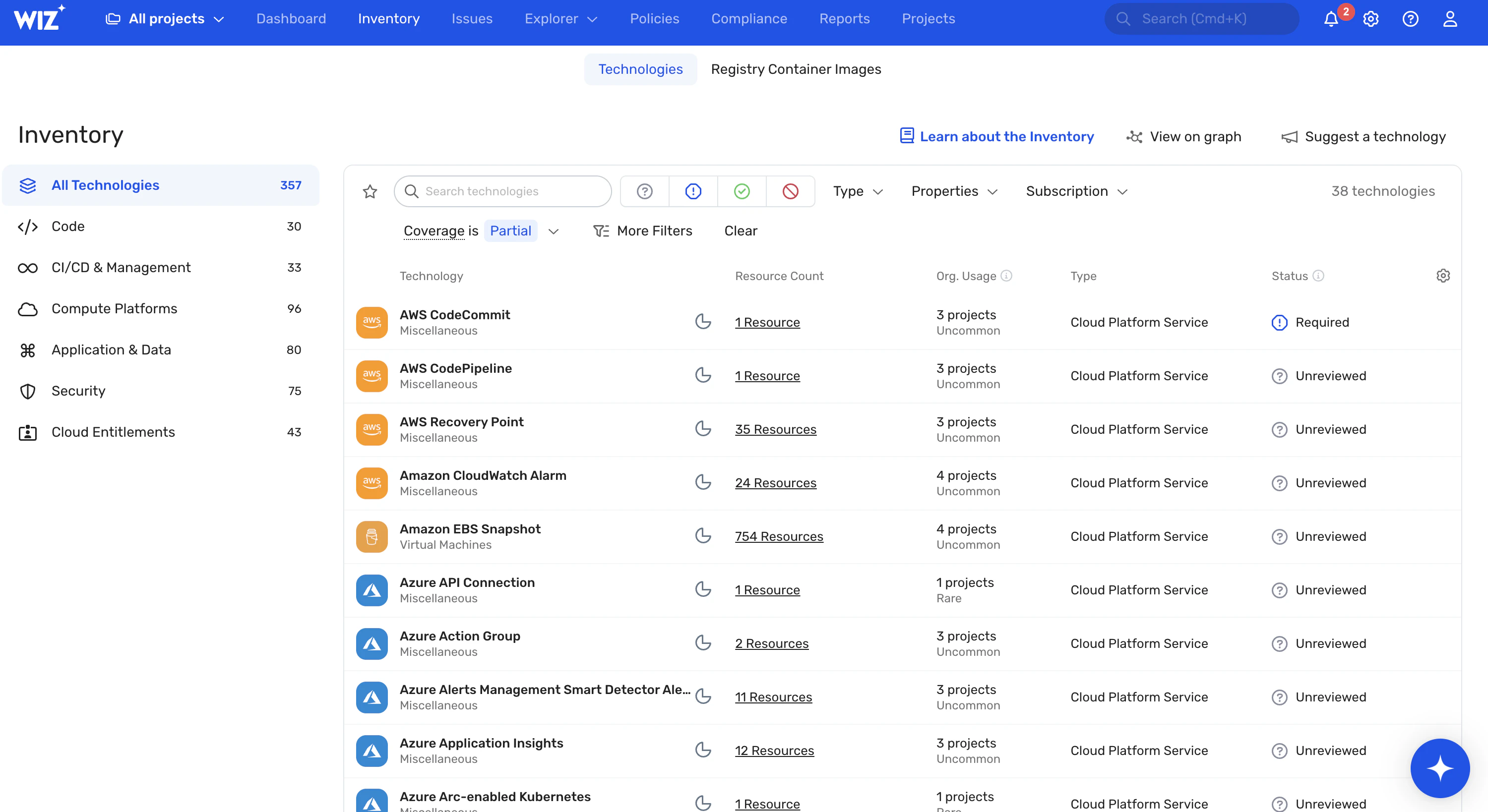
Consider tools with automatic, continuous discovery of all software assets and their components as your environment evolves. The tool should inventory apps, VMs, containers, container images, databases, and embedded open source libraries to help reduce blind spots – especially for ephemeral resources in cloud and containerized environments. Agentless discovery (or lightweight agents where needed) can improve speed and coverage, and versioned inventories help you track drift over time.
SCA and SBOM integration
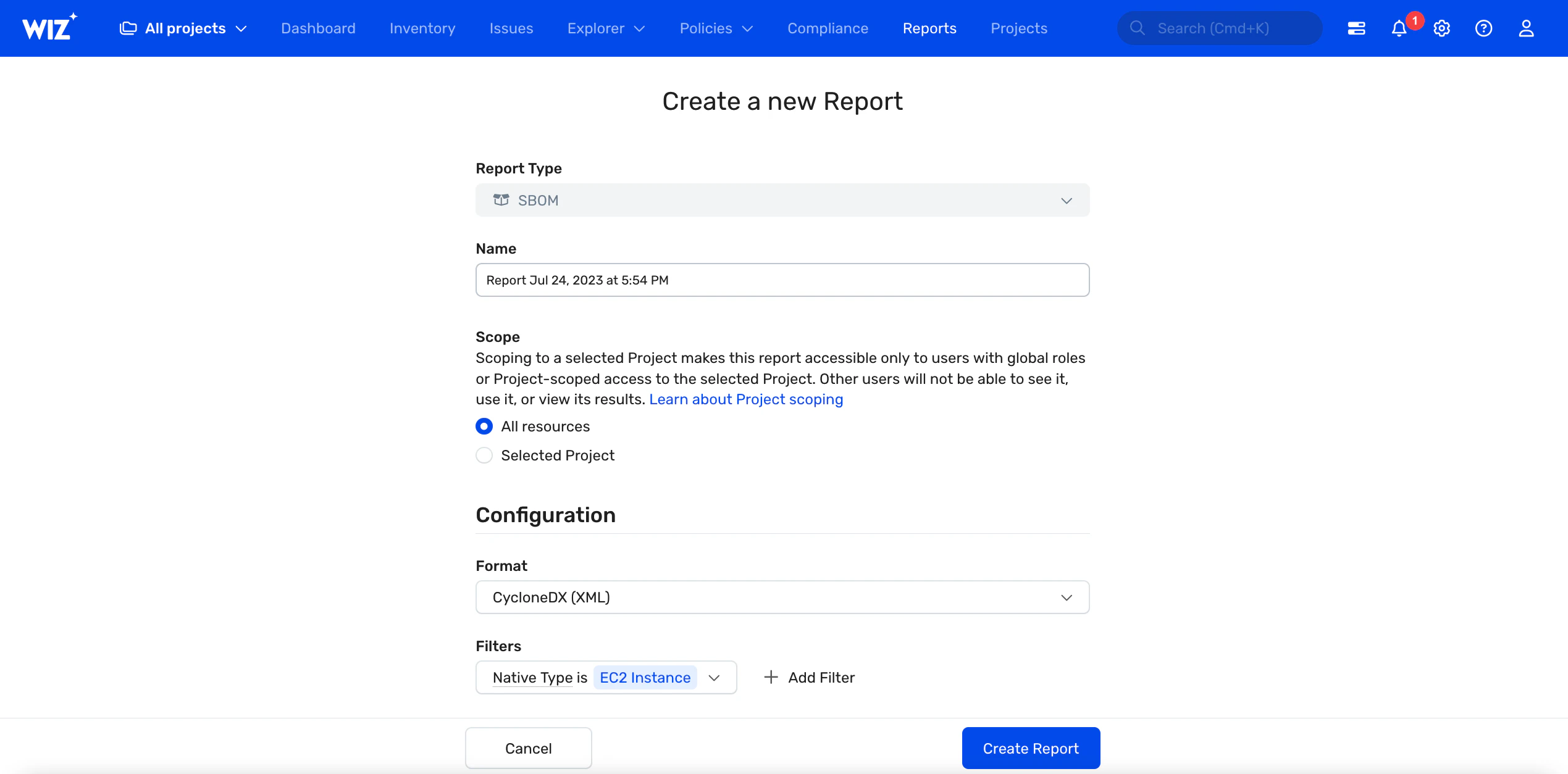
Prioritize tight integration with SCA and SBOM tooling to surface issues early in development. Software composition analysis should flag known vulnerabilities and license risks, while a software bill of materials should track third‑party dependencies, versions, and release data. Look for support to both generate and ingest SBOMs (e.g., SPDX, CycloneDX), schedule reports across multiple services, and maintain visibility into transitive dependencies and vulnerabilities in source code and binaries. Integration with build systems and container registries helps catch issues before deployment.
Accurate vulnerability detection
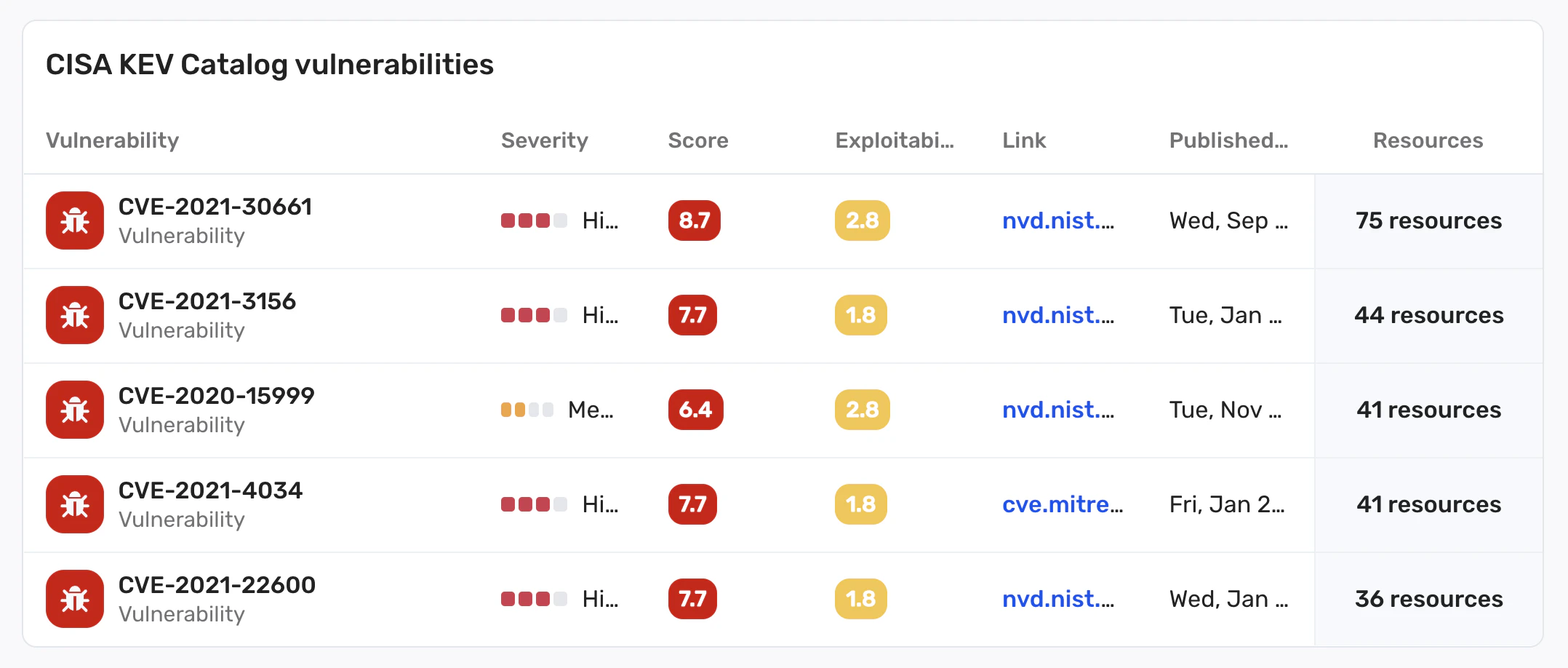
Favor rapid, low‑impact scanning with high signal. Continuous monitoring can help detect emerging threats without disrupting operations, and agentless options can reduce operational overhead. Accuracy matters – tools ideally minimize false positives and negatives and align with authoritative sources such as CISA’s Known Exploited Vulnerabilities. Support for techniques like differential scans, authenticated checks (where appropriate), and configurable policies helps teams tune fidelity to their environments.
Risk-based prioritization
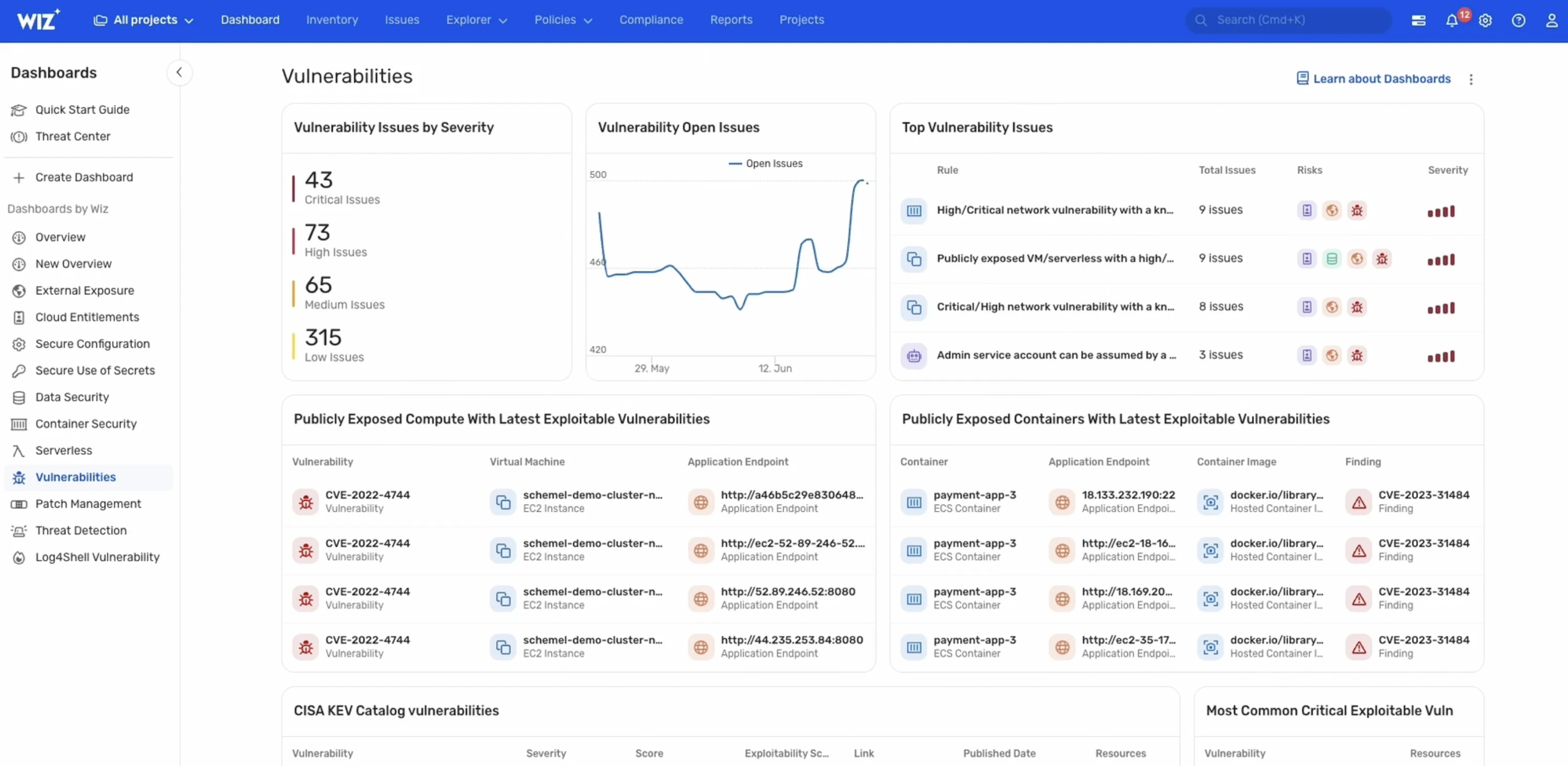
Ensure the tool ranks issues by contextual risk so teams focus on what matters. Effective prioritization considers exploitability, external exposure, asset criticality, and potential business impact, then groups and deduplicates findings into actionable work items rather than long raw lists. Mapping findings to business services, environments (prod vs. dev), and ownership improves triage and accelerates time to fix.
Remediation and alerting
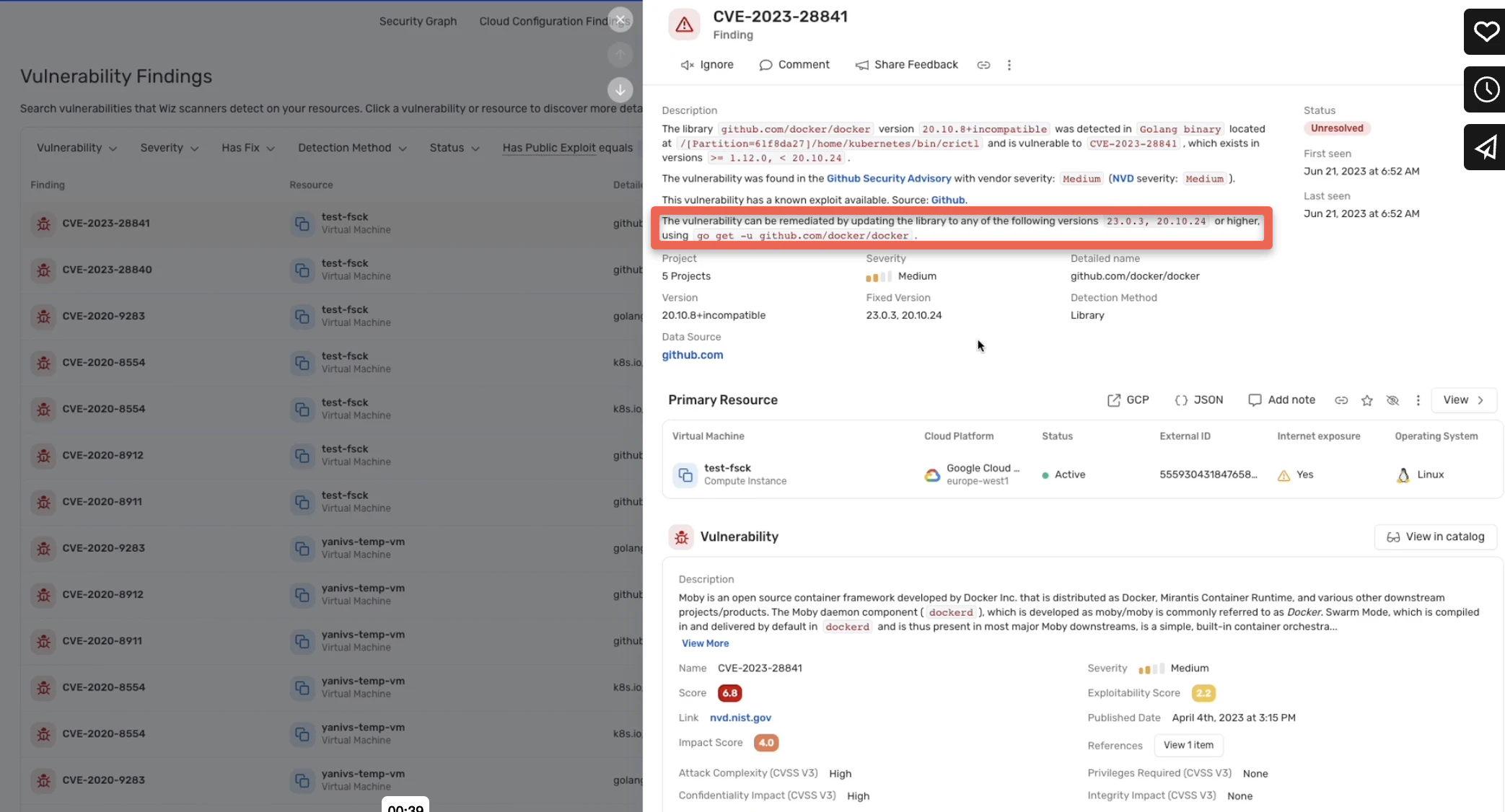
Ensure the tool ranks issues by contextual risk so teams focus on what matters. Effective prioritization considers exploitability, external exposure, asset criticality, and potential business impact, then groups and deduplicates findings into actionable work items rather than long raw lists. Mapping findings to business services, environments (prod vs. dev), and ownership improves triage and accelerates time to fix.
Compatibility
Verify broad environment support. Many OSS scanners target specific languages or OSes (for example, Govulncheck for Go, Vuls and Lynis for Linux).Confirm compatibility with your operating systems, container runtimes, orchestrators (e.g., Kubernetes), package managers, SCMs, and CI/CD systems—and ensure the tool offers APIs, headless modes, and extensibility to fit your workflows.
Scale and performance
Evaluate how the tool scales with your footprint. Look for parallelization options, tunable concurrency, and efficient resource use to support large codebases and distributed environments. Clear guidance on scan sizing and safe defaults helps teams maintain performance as coverage grows.
Governance, reporting, and usability
Seek clear reporting and manageable operations. Dashboards, trend reports, and exportable evidence support audits and stakeholder updates. Role-based access, project scoping, and good documentation can simplify daily operations for both security and engineering teams.
These criteria reflect Wiz’s viewpoint on what helps teams get reliable coverage with minimal friction. Open source tools can excel in many of these areas; selecting the right combination—and aligning it with your processes – goes a long way toward an effective vulnerability management program.


Benefits of open source vulnerability management tools
Cost-effective: Open source tools are free to use, making them accessible for teams with limited budgets.
Transparency: You can review and modify the source code to fit your needs or to verify how the tool works.
Community support: Many open source projects have active communities that contribute updates, plugins, and troubleshooting help.
Flexibility: You can integrate open source tools into your existing workflows and automate scans as part of your CI/CD pipeline.
No vendor lock-in: You are not tied to a single provider and can switch or combine tools as your needs change.
Top OSS vulnerability management tools
There are various open-source vulnerability management solutions on the market, each offering a range of capabilities across detection, testing, and integration workflows. We cover common open-source tools (in no particular order) and their capabilities, separated into their respective categories.
Infrastructure scanners
OpenVAS
Open Vulnerability Assessment Software (OpenVAS) is a network and endpoint vulnerability scanner made up of several testing modules and two central components: a scanner and a manager. Its extensive up-to-date vulnerability database helps with accurate network vulnerability detection.
OpenVAS has a free and a paid version, with the major differences being the capabilities offered and network vulnerability test (NVT) feeds used; the paid version comes with the Greenbone Enterprise Feed, while the free version has the Greenbone Community Feed.
Features (of the free version)
Automatic asset discovery, inventorying, and tagging
Local or cloud-based installation
Risk prioritization
Flagging of outdated software, web server vulnerabilities, and misconfigurations
Graphical, interactive web interface
OpenSCAP
Open Security Content Automation Protocol (OpenSCAP) is a Linux-based platform managed by the U.S. National Institute of Standards and Technology (NIST) to implement the SCAP standard. It comprises a suite of modules, including OpenSCAP Base, Workbench, and Daemon, targeted at vulnerability scanning and compliance enforcement.
Its vulnerability scanner – OpenSCAP Base – detects vulnerabilities by comparing Common Platform Enumeration (CPE) tags with those retrieved from vulnerability databases. More recent versions of OpenSCAP also support Windows.
Features
Security misconfiguration detection
Compliance assessment
Severity ranking
Command-line scanning
Graphical web interface
Nmap
Network Mapper (Nmap) is a command-line network and port vulnerability scanner for Windows, Linux, macOS, and FreeBSD systems. Nmap sends various packet types to target networks to discover online/offline hosts, open/closed ports, firewalls, etc., as well as any associated vulnerabilities.
Features
Automatic host address, service, and OS discovery
Host and service scanning with IP packets
Advanced vulnerability assessment with 500+ scripts
Version detection
TCP/IP/OS fingerprinting
DNS querying
Nikto
Nikto is a web server scanner with a command-line interface for running vulnerability checks. It uncovers software version vulnerabilities and malicious programs in various server types and automatically updates outdated software.
It also checks for server misconfigurations and captures cookies to detect cookie poisoning. The latest version, Nikto 2.5, offers IPv6 support.
Features
Tests for 7,000+ dangerous files/CGIs
Detects 1250+ outdated server versions and 270+ version-specific vulnerabilities
Supports SSL with Perl/NetSSL for Windows and OpenSSL for Unix systems
Subdomain and credential guessing
Reports in plain text, XML, SQL, JSON, etc. formats
Multiple web server support, including Nginx, Apache, Lighttpd, and LiteSpeed
Website and web app scanners
While these tools are top web app scanners, they cannot detect network and infrastructure vulnerabilities.
Wapiti
Wapiti is an app/website vulnerability scanner and penetration tester. It supports GET and POST HTTP penetration attack methods.
Rather than examining app codebases to uncover vulnerabilities, Wapiti uses a fuzzing technique to discover vulnerable scripts. It also allows users to set anomaly thresholds and will send alerts accordingly.
Features
Web app fingerprinting
Discovery of multiple SQL injection techniques
HTTP header security
Cross-site request forgery (CSRF), server-side request forgery (SSRF), carriage return line feed (CRLF) injection, and brute force login detection
Man-in-the-middle (MITM) proxy support
sqlmap
sqlmap is a vulnerability scanning and penetration testing tool primarily for databases. Its powerful penetration tester minimizes noise during scans and detects various database vulnerability types.
Using DBMS credentials, database name, IP address, etc., it bypasses SQL injection when connecting to databases, designed to help reduce false positives.
Features
Covers various SQL injection techniques, including stacked queries
Support for several database services, including PostgreSQL, MySQL, and Oracle
Password hash format detection
OWASP ZAP
OWASP ZAP is a well-known, fully open-source web application security scanner and testing platform. It supports both automated scanning and manual testing workflows, making it suitable for developers and AppSec teams. ZAP can be integrated into CI/CD pipelines to help teams detect issues early and prevent vulnerable code from reaching production.
Features
Automated active and passive scanning of web applications and APIs
Built-in intercepting proxy for traffic inspection and manipulation
CI/CD integrations and headless automation options
API scanning support (including OpenAPI/Swagger import)
Extensible add-on marketplace and scripting for custom checks
Nuclei (ProjectDiscovery)
Nuclei is an open-source, template-driven scanner used to identify exposures and misconfigurations across web apps, APIs, and internet-facing assets. It relies on a large community-maintained template ecosystem, enabling rapid coverage for common vulnerabilities and emerging threats. Nuclei fits developer and AppSec workflows and can be run in CI/CD to prevent risky changes from shipping.
Features
Template-based scanning covering CVEs, misconfigurations, and common exposures
Parallel scanning suitable for large attack surfaces
Extensive community template ecosystem and custom template authoring
CI/CD friendly with machine-readable outputs for automation
Supports scanning of URLs, domains, IPs, and API endpoints
The CVE Database: Curated Vulnerability Intelligence by Wiz
Wiz's CVE Database curates CVE data to create easy-to-navigate profiles that cover the entire vulnerability timeline, exploit scenarios, and mitigation steps.
Explore database
Choosing a best-fit tool
Open source vulnerability management tools are mature, widely adopted, and effective across networks, hosts, web apps, containers, and code. The best fit depends on your environment, risk model, business needs, and workflows—map your requirements to each tool’s strengths and start with the capabilities that deliver the quickest wins.
As organizations grow, an open source stack can scale successfully when it’s paired with sound engineering practices: automate scans in CI/CD, standardize SBOM/SCA processes, leverage APIs for ticketing and SIEM, and centralize results for shared visibility. Active communities ship updates quickly, and many projects offer extensibility so you can tailor checks, policies, and reporting to your needs.
Many teams use a combination of open source tools for broad coverage and, when helpful, add a unifying layer for consolidated dashboards, risk-based prioritization, or compliance reporting. The goal is a complementary approach—use open source where it excels and add consolidation only where it simplifies operations for your organization.
Wiz + open source: a better‑together approach to vulnerability management
As part of its cloud-native application protection platform, Wiz can act as the control plane that unifies your open source scanners and augments them with agentless cloud context, prioritization, and workflow automation. Keep the tools you know—Wiz helps them scale and delivers the context needed to drive action.
Ingest and enrich OSS findings: Normalize and deduplicate results from your tools. Wiz correlates these with cloud configuration, network exposure, identities, and data to add the context scanners alone can’t provide.
Agentless discovery for complete coverage: Continuous, API-based inventory across clouds and workloads attaches OSS findings to real assets and uncovers blind spots – ephemeral resources, unmanaged hosts, and internet-facing services.
Contextual, risk-based prioritization: Cut noise by ranking issues using exploitability signals (including CISA KEV), external exposure, asset criticality, and potential blast radius. Wiz groups related findings into fix-ready tasks instead of long raw lists.
Orchestrated workflows: Trigger and gate scans in CI/CD, and route prioritized work to Jira, GitHub/GitLab, or ServiceNow. Use policies to auto-assign owners, enforce SLAs, and verify closure on subsequent scans.
Deeper assessment when it matters: Detect hidden risks—like nested Log4j dependencies—across VMs, containers, registries, and serverless, then map a clear path to remediation.
Compliance and reporting: Convert heterogeneous OSS outputs into audit-ready reports aligned to frameworks (e.g., CIS, NIST, PCI) and share progress with security and engineering stakeholders.
Uncover Vulnerabilities Across Your Clouds and Workloads
Learn why CISOs at the fastest growing companies choose Wiz to secure their cloud environments.
Related tool roundups