
What is a SOC analyst?
A security operations center (SOC) analyst is the human link between threat detection, prevention, and incident response. Tooling generates alerts and logs, and a SOC analyst provides interpretation and decision-making that determines whether something is harmless or dangerous.
Being a SOC analyst was once about fixed parameters in on-premises networks, but now the job centers on analyzing hybrid and multi-cloud environments with dynamic assets. That means more time spent mapping IAM relationships, analyzing cross-cloud attack paths, and maintaining visibility across APIs and services that constantly spin up and down.
MCP Prompt Playbook for SOC
Accelerate your SOC investigations with ready-to-use MCP prompts built for cloud threat analysis.

Core SOC analyst responsibilities in modern environments
For a cybersecurity SOC analyst in cloud environments, core responsibilities are monitoring signals, validating alerts, investigating suspicious behavior, and recommending or executing containment. Daily responsibilities depend on how advanced the SOC is and the size of the organization’s cloud environment, but will usually revolve around:
Continuous monitoring of multi-cloud logs and infrastructure signals
Separating meaningful alerts from low-risk noise
Investigating unusual patterns or access attempts
Conducting root cause analysis
Recommending containment and/or remediation of active threats
Documenting incidents and sharing findings for improvement
SOC analysts are also part of a larger security team where:
SOC managers and leads provide strategic direction and coordinate ongoing response efforts
Security engineers maintain log pipelines, detection rules, and monitoring systems
Threat hunters search for novel attack techniques
Forensic specialists conduct deep analysis of complex incidents
AI is reshaping how analysts execute these responsibilities day to day. AI investigation agents now serve as a force multiplier for SOC analysts, automatically investigating each new threat by correlating cloud events, runtime signals, and identity context.
Instead of spending 30–45 minutes manually gathering context across multiple tools, analysts receive a complete, structured investigation they can validate in minutes. This shifts the analyst's role from context gathering to judgment and decision-making: reviewing the agent's verdict, confirming impact, and choosing the right response action.
SOC analyst tiers
Tier 1
With AI agents handling initial investigation, the traditional tier model evolves. Tier 1 analysts shift from manual alert triage to reviewing and validating AI-generated investigations. This raises the effective skill level of the entire SOC: every analyst, regardless of experience, starts from the same complete, context-rich view of each incident.
Tier 2
Analysts uncover how events connect across identity, network, workload, and data layers in order to map possible attack paths and determine business impact.
Tier 3
Tier 3 analysts typically focus on advanced threat hunting, reverse engineering, malware behavior, and complex incident response. They write detection rules, design playbooks, reverse-engineer payloads, and systematically remove attacker access.
Essential skills for cloud-native SOC operations
The cloud changes how infrastructure behaves, which means analysts must learn to interpret new types of signals and relationships using cloud security posture management (CSPM) tools. This requires deep experience in cloud architectures, how applications behave in cloud environments, network communication processes, and how identity access management (IAM) affects them all.
Beyond cloud IR basics, a SOC analyst should have a solid understanding of…
Cloud provider architectures (AWS, Azure, and GCP)
Encryption boundaries, workload execution models, and API-driven infrastructure
MITRE ATT&CK techniques, which have recognizable cloud intrusion behavior patterns
How to correlate data across systems by determining context, which is the difference between alert fatigue and meaningful detection
Scripting and automation to reduce manual tasks using Python and PowerShell
Cloud threat hunting to locate threats that bypass security automation in multi-cloud settings
How to extract and interpret artifacts from short-lived resources (containers, managed compute services, serverless functions, and orchestration frameworks), where evidence might disappear if not captured quickly
Analysts must also identify privilege escalation paths, cross-account access routes, and hidden trust chains. This means mastering…
Identity access management (IAM)
Privileged access management (PAM)
Cloud infrastructure entitlement management (CIEM)
SOC analyst tools for effective threat detection
Most teams rely on some combination of:
Security information and event management (SIEM) platforms to centralize logs and apply detection logic
Security orchestration, automation, and response (SOAR) systems to automate repeatable response workflows
Threat intelligence to understand attacker techniques
Forensic and timeline tools to reconstruct incidents
Log aggregation, alert correlation, and threat modeling are cloud-contextual tasks, meaning it’s crucial to use:
Cloud security posture management (CSPM) tools to identify cloud misconfigurations and compliance and policy violations while reducing risk through automation workflows
Cloud workload protection platforms (CWPPs) to protect compute workloads—virtual machines, containers, and serverless functions—at runtime. CWPPs monitor process behavior, file integrity, and network connections within running workloads to detect malware, unauthorized access, and anomalous activity.
Extended detection and response (XDR) to correlate and automate detection and response across endpoints, identities, cloud infrastructure, and networks—providing unified visibility into how threats move laterally through your environment. Pair XDR with cloud detection and response (CDR) to strengthen cloud control-plane coverage, as many XDR platforms require additional integration to fully interpret AWS CloudTrail, Azure Activity Logs, and GCP Cloud Audit Logs.
Cloud detection and response (CDR) to detect threats using cloud control-plane logs (AWS CloudTrail, Azure activity logs, GCP Cloud Audit Logs), identity activity, configuration state changes, and runtime telemetry from workloads
Cloud-native application protection (CNAPP) to unify cloud posture management, identity analysis (CIEM), workload and container risks (CWPP), data sensitivity (DSPM), and configuration risk—correlating findings into attack-path context
Automation and orchestration tools help SOC analysts and the IR team speed containment by shrinking mean time to detect (MTTD). But to truly improve security, these tools need to be integrated so they provide a connected, contextual view.
A SIEM may identify an anomalous login, but you need deeper cloud context to determine whether it grants access to high-value data or internal lateral movement paths. For example, prioritize an anomalous login to an IAM user only when that identity has effective permissions to internet-exposed EC2 instances that can access RDS databases containing customer PII. Without this attack-path context, the login might appear as a low-priority event, when it actually represents a critical risk chain.
Watch 5-min demo
See how Wiz Defend correlates cloud context with runtime signals to surface the threats that actually matter.

SOC analyst career progression and specialization paths
A security operations center analyst job description changes over the course of a career:
SOC analysts’ advancement from Tiers 1 and 2
As you gain experience in alert triage and incident management in Tiers 1 and 2, you’ll develop stronger log analysis skills. Foundational certifications will be part of the mix, like CompTIA Security+, or Cisco CCNA. As you shift from reactive to proactive work, you’ll learn how to:
Anticipate attacker behavior
Design detection rules
Improve workflows
Specialization in Tiers 2 and 3
Your advancing technical expertise will position you for threat hunting, digital forensics, malware analysis, and reverse engineering tasks, which require:
Proficiency in advanced tools and frameworks like MITRE ATT&CK, threat intelligence platforms, and SOAR tools for automation
Detection rule development and tuning for SIEM, CSPM, CIEM, CNAPP, and data security posture management (DSPM)
As you progress, your leadership skills will grow: You’ll manage larger workloads, lead IR efforts, and train junior analysts. SOC analyst certification paths like Security+, GCIH, and CySA+ are common at this stage of your career.
Contributing strategically (Tier 3)
Working in Tier 3 means you’ve proven you can research new threats, vulnerabilities, and attack methods to inform security strategy. You’ll lead complex incident responses and mentor lower-tier analysts while contributing to the organization’s SOC strategy.
At higher tiers, people typically pursue GCIA, OSCP, CISM, or CISSP, along with specialized IR or cloud-focused certifications. Pursuing any of these depends on your time in the field and your cybersecurity goals. Specialization paths include:
Security engineering
Threat hunting and adversary detection
Managed detection and response (MDR) or forensic and digital evidence handling
SOC lead or CISO tracks
Governance, risk, and compliance (GRC)
At every stage and in every SOC environment, you’ll need to unify workflows, tools, and platforms for effective cloud security.
How Wiz empowers modern SOC analyst workflows
Many SOC teams have lots of data but little usable context. Alerts arrive from every direction, yet analysts still have to answer the same hard question: Does this actually matter? Without a way to connect identity, exposure, configuration, and behavior, even experienced teams waste time validating signals that lead nowhere.
Wiz solves this by unifying cloud security operations around a shared context model. Identity permissions, workload posture, network reachability, data sensitivity, and runtime signals are all connected in a single graph. Analysts can immediately see how a signal fits into the environment, while SOC managers gain a clear view of risk that aligns with real exposure.
Detection driven by cloud context, not alert volume
Wiz Defend detects threats by correlating multiple risk factors rather than relying on isolated indicators. Teams can evaluate identity privileges, public exposure, misconfigurations, and runtime behavior together to identify conditions that enable real attack paths.
This approach replaces volume-based triage with prioritization rooted in environmental reality. Analysts know why something matters, and leaders can trust that response resources are being applied where they have the greatest impact.
Automated investigation and attack path visualization
SOC automation is only useful if it reduces thinking along with keyboard time. Wiz embeds automation directly into the investigative workflow, showing teams how an identity, service, or process could move laterally or escalate privileges.
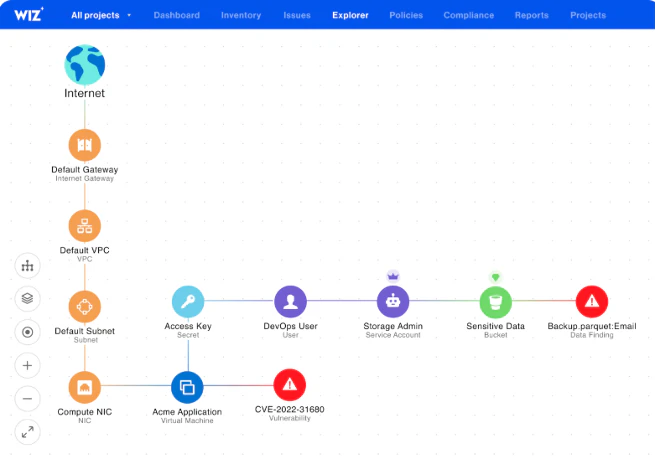
When a threat surfaces, Wiz automatically assembles the relevant context into a visual attack path. Analysts can trace how an identity or workload could move through the environment without manually querying multiple systems.
Wiz integrates security from development (Wiz Code) to runtime (Wiz Defend), enabling SOC analysts to:
Trace cloud risks back to their code origins
Get precise remediation guidance, including AI-generated suggestions and one-click fixes
Significantly shorten the mean time to resolution (MTTR)
The Wiz Security Graph provides the structural foundation, while the SecOps AI-Agent adds interpretive support by analyzing threats and offering conclusions with confidence levels. Investigations move faster because SOC teams get the understanding they need up front.
Cloud-native response workflows that scale
Wiz enables response actions that align with how cloud infrastructure actually works. Analysts can isolate workloads, revoke permissions, rotate secrets, or block access using cloud-native controls. These actions are consistent, repeatable, and suited to dynamic environments.
SOC managers benefit from standardized response patterns, while analysts avoid the overhead of custom scripts or brittle processes during incidents.
Strengthening SIEM and SOAR with actionable context
Wiz integrates with SIEM and SOAR platforms such as Google Security Operations and Microsoft Sentinel to enrich alerts with cloud context. SIEM continues to collect and alert. SOAR continues to orchestrate. Wiz provides the intelligence that makes automation safe to trust.
This integration allows teams to improve outcomes without discarding existing tools or retraining staff from scratch.
Focusing analysts on analysis instead of noise
By identifying risk based on exploitability, Wiz reduces alert fatigue and frees analysts to focus on deeper investigation and response. They get exactly what they need to do their jobs by spending less time filtering false positives and more time understanding attacker behavior.
The result is a SOC that operates with clarity, confidence, and sustained effectiveness. Ready to see how Wiz brings clarity and context to your SOC workflows? Get a demo to experience unified cloud security operations firsthand.
See Wiz in Action
Experience how Wiz unifies posture, identity, and runtime context to give your SOC the clarity it needs.

What’s different about SOC analysis in cloud environments?
Cloud environments are dynamic, identity-driven, and interconnected, which means SOC analysts must evaluate behavior in context rather than relying on static configuration baselines.
How much can a SOC analyst expect to earn?
Entry-level salaries for SOC analysts often range from $60k–$80k; senior analysts commonly exceed $120k, depending on geography, industry sector, and scope—including 24x7 coverage responsibilities and incident leadership roles.
What certifications are most valuable for SOC analysts?
Security+, Cisco CCNA, CySA+, and GCIH are valuable certifications for entry-level SOC analysts; CISSP, GCIA, OSCP, and CISM certifications are valuable for advanced leadership and senior roles.
How do SOC analysts handle multi-cloud security incidents?
Centralized logging, unified playbooks, and automation tools streamline detection and response across AWS, Azure, and GCP. Different platforms expose different logs, identity models, and control surfaces. As a result, analysts must normalize concepts across providers.
What are some career advancement opportunities for SOC analysts?
Some career advancement opportunities are progression into threat hunting, forensics, IR leadership, MDR/CDR specialization, or SOC management.
Do SOC analysts need coding skills?
Coding skills aren’t mandatory, but scripting skills in Python, PowerShell, or Bash help automate investigations and IR workflows. These basic scripting skills improve efficiency but aren’t required initially—most analysts learn over time.
How is AI changing the SOC analyst role?
While AI speeds up triage and investigation, human analysts remain essential for context, judgment, and final decision-making across detection tuning, incident scoping, and response execution.