

What is continuous pen testing?
Continuous penetration testing is an always-on, adversarial security testing approach that persistently discovers, exploits, and validates vulnerabilities across your environment rather than testing at a single point in time. Instead of a snapshot of risk that goes stale within weeks, you get ongoing proof of what attackers can actually exploit as your environment changes around you.
What makes it "continuous" is not just frequency. Running the same penetration test quarterly is still point-in-time. Continuous pen testing is an adaptive methodology that responds to new deployments, configuration drift, identity changes, and newly disclosed vulnerabilities as they happen. It stays in sync with your environment rather than catching up to it once a year.
This approach sits within a broader landscape of security validation practices. Continuous Threat Exposure Management (CTEM) is the strategic framework, Penetration Testing as a Service (PTaaS) is the delivery model, and automated security validation is the tooling layer. Continuous pen testing is the adversarial validation component that proves what is actually exploitable in your real environment, not just what could theoretically be a problem.
Vulnerability Management Buyer's Guide
This guide helps your security and dev teams finally start speaking the same language while giving you everything you need to objectively choose or replace your VM solution.

Traditional vs. continuous pen testing
The shift from traditional to continuous pen testing is not just about cadence. It changes the cost model, the remediation workflow, and the types of risk you can actually validate.
| Dimension | Traditional (annual/biannual) | Continuous pen testing |
|---|---|---|
| Cadence | Point-in-time (1-2 weeks per year) | Always-on, persistent testing |
| Scope | Fixed scope defined before engagement | Dynamic scope that adapts as the environment changes |
| Asset coverage | Known assets at time of scoping | Continuous discovery including shadow assets |
| Findings delivery | Static report weeks after engagement | Real-time findings as they are validated |
| Remediation tracking | Manual follow-up at next engagement | Closed-loop retesting and SLA monitoring |
| Cloud-native coverage | Limited (network and web app focus) | Includes identity, entitlements, cloud configs, APIs |
| Cost model | High fee + repeat ramp-up | Subscription or platform-based, predictable spend |
| Time to value | Weeks to months | Continuous from day one |
The cost model shift matters. Traditional pen tests carry a high per-engagement fee, and the "ramp-up" cost repeats every time. Continuous testing spreads that cost across ongoing validation, and the per-finding cost drops as automation handles breadth.
Penetration Testing vs Vulnerability Scanning: What's the Difference?
Penetration Testing vs Vulnerability Scanning: Penetration testing simulates attacks to exploit flaws while vulnerability scanning identifies known risks.
En savoir plus

How does continuous pen testing work?
Unlike traditional pen tests with a defined start and end date, continuous testing operates as a persistent loop. It cycles through discovery, exploitation, validation, remediation, and retesting without ever stopping.
Continuous discovery and reconnaissance
Everything starts with persistent attack surface discovery. New assets, endpoints, APIs, and cloud resources are detected as they appear, not inventoried once at the start of an engagement. This includes shadow cloud resources like storage buckets with dynamically assigned public addresses, undocumented API endpoints, and forgotten test environments that traditional scoping would miss entirely.
Cloud resources often receive dynamic addresses from the provider that are not part of your known DNS entries. Without continuous discovery, these resources remain invisible to external scanning and untested.
Automated and AI-powered exploitation
Modern continuous pen testing uses AI-powered agents that reason about application logic, adapt attack patterns based on observed responses, and chain multi-step exploitation sequences. This is fundamentally different from traditional DAST scanners that follow fixed test patterns.
Targets include web applications, APIs (including undocumented or shadow APIs discovered through client-side code analysis), cloud services, and inference endpoints for AI workloads. Safe testing constraints, including blocking destructive actions, rate-limiting requests, and restricting write operations to approved non-production targets, allow continuous validation without disrupting live systems.
Expert-driven validation and depth testing
Automated testing handles breadth and persistence across the full attack surface. Human pen testers focus on complex logic flaws, creative attack chaining, and scenarios requiring judgment that AI cannot yet replicate. The combination of AI breadth and human depth is what separates continuous pen testing from pure automation tools.
Contextual risk analysis
Exploitation proof alone does not drive remediation. Validated findings must connect to cloud context to determine actual business impact. An exploitable RCE on an internet-facing service is high priority, but the real business risk depends on cloud context. Security teams need to know whether the compromised workload has an overprivileged IAM role, whether it can reach sensitive data governed by data security posture management (DSPM), and whether cloud security posture management (CSPM) issues such as permissive network rules or public exposure expand the blast radius.
This is the step where continuous pen testing becomes a prioritized map of real business risk. It reveals toxic combinations: findings that look moderate in isolation but become critical when identity permissions, network exposure, and sensitive data access combine into a single exploitable path.
Remediation and retesting
Findings route to the right owner with specific fix guidance. Once remediated, the system automatically retests to confirm the fix worked. This is the part most programs get wrong: they generate findings continuously but never close the loop. Without ownership routing, remediation guidance, and automated retesting, continuous testing just produces a faster stream of stale reports.
| Traditional Pen Test Phase | Continuous Pen Testing Equivalent |
|---|---|
| Scoping and asset inventory | Continuous attack surface discovery |
| Vulnerability scanning | Persistent automated scanning and AI-powered exploitation |
| Manual exploitation | AI-adaptive exploitation + expert depth testing |
| Post-exploitation and lateral movement | Attack path analysis with identity and data context |
| Report delivery | Real-time findings with ownership routing |
| Remediation follow-up (next engagement) | Automated retesting and SLA tracking |
What are the benefits of continuous pen testing?
The real value of continuous pen testing goes beyond "more testing." It changes what happens operationally when adversarial validation becomes persistent.
Closes the exposure window between assessments
The primary risk of annual testing is the months-long gap where new vulnerabilities, misconfigurations, and attack paths go unvalidated. A new cloud service deployed in March creates an exploitable path. With annual testing scheduled for November, that path can remain open for months. Continuous testing catches it within days.
Proves exploitability, not just theoretical risk
Continuous pen testing validates that a vulnerability can actually be exploited in the real environment, with concrete proof like a screenshot of an exposed service or a validated RCE. A proven exploit path to sensitive data gets fixed immediately; a theoretical CVE on an isolated resource gets deprioritized.
Drives faster remediation through ownership and context
The bottleneck in most security programs is not detection but remediation. When findings arrive with clear ownership mapping, specific fix guidance, and context about blast radius, teams fix things faster. Continuous pen testing done right routes findings to the person who can actually fix them, not just into a security team's queue.
Supports compliance with continuous assurance
Continuous pen testing produces ongoing evidence of security validation rather than annual compliance snapshots. PCI DSS 4.0, SOC 2, and similar frameworks are moving toward continuous assurance models, and auditors increasingly prefer persistent testing evidence over a single annual report.
Reduces cost per validated finding
Traditional pen tests carry diminishing returns because the ramp-up cost repeats every engagement. Continuous testing spreads cost across ongoing validation, and the per-finding cost drops as automated testing handles breadth while humans focus on depth.
Watch 12-min demo
Learn how Wiz connects the dots across your entire cloud, enabling teams to own the vulnerability management life cycle together through a single, unified lens.

Common pitfalls in continuous pen testing programs
These are the mistakes organizations make when implementing continuous pen testing, based on patterns seen across real-world deployments:
Treating it as "just more scanning": The most common failure is deploying automated scanning tools and calling it continuous pen testing. Discovery alone creates noise. Exploitation proof creates action. Without exploitation validation, adaptive testing, and human expertise for depth, organizations get more noise without more insight.
Ignoring the remediation workflow: Generating a continuous stream of findings without a clear path to remediation creates fatigue. If findings do not route to the right team with fix guidance and SLA tracking, continuous testing actively harms the security program by overwhelming teams with an ever-growing backlog.
Scoping only for known assets: Traditional pen test scoping assumes you know what you have. In cloud environments, shadow resources, dynamically provisioned infrastructure, and third-party SaaS integrations constantly expand the attack surface. Continuous pen testing must include continuous discovery, or it will miss the resources most likely to be misconfigured and exposed.
Missing identity and data context: Exploiting a vulnerability is only half the story. An exploitable RCE on a resource with no permissions and no data access is low priority. The same RCE on a resource with admin-level cloud permissions and access to PII is an emergency. Organizations need a unified risk model that correlates exploitation proof with identity permissions, data classification, network topology, and lateral movement potential. Without that unified view, teams cannot distinguish an isolated issue from an attack path that leads directly to sensitive business data.
DAST vs pen testing: Key differences explained
Traditional pen testing was purely manual and periodic. Modern approaches increasingly incorporate automation, AI-assisted tooling, and penetration testing as a service (PTaaS) models that offer more frequent engagements.
En savoir plus

Wiz's approach to continuous pen testing
Wiz approaches continuous pen testing as part of a broader continuous exposure management strategy, combining outside-in adversarial validation with deep cloud-native context to prove what is truly exploitable and drive faster remediation.
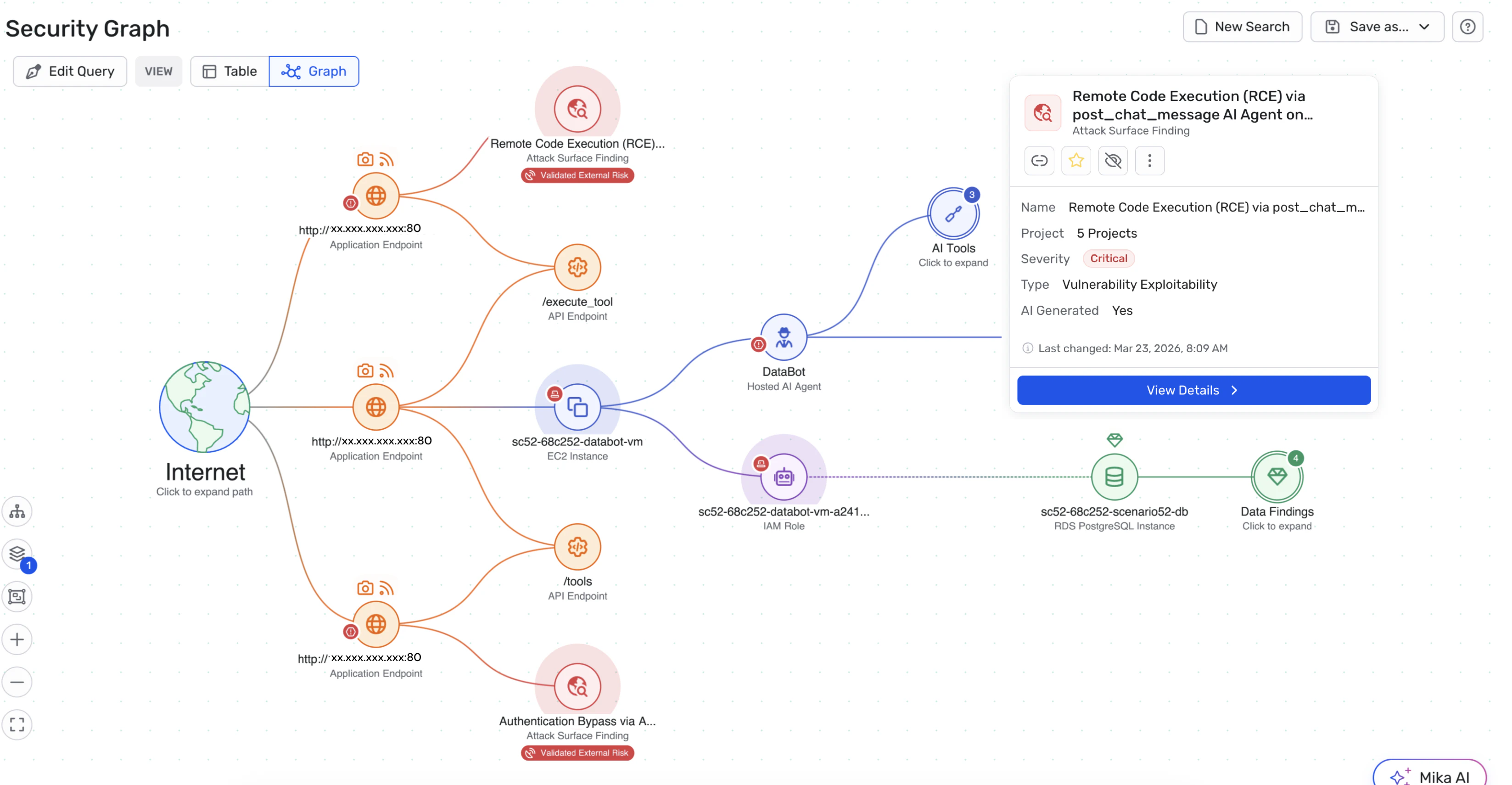
The Wiz Red Agent is an AI-powered penetration testing agent that performs adaptive exploitation against web applications and APIs. It analyzes application logic, adapts attack patterns based on responses, and chains multi-step exploitation sequences. Its AI-powered web crawler discovers shadow APIs by analyzing client-side code, finding undocumented endpoints that traditional scanning misses.
Red Agent finds what humans miss. It caught critical authorization flaws across services where traditional testing and our bug bounty program came up short. We had continuous AI-powered attack surface testing on our roadmap. Wiz got there first, and did it better than we would have.
Emil Vaagland, Head of Product Security, Vend
The ASM Scanner continuously discovers and validates external exposures across cloud, AI, on-prem, and SaaS environments, producing concrete proof of exploitability including screenshots of exposed services and validated remote code execution.
When either component validates an exploitable finding, the Wiz Security Graph correlates it with identity permissions, data sensitivity, network topology, and potential lateral movement paths. This transforms "we found an exploitable vulnerability" into "this vulnerability gives an attacker a path to sensitive PII through an overprivileged service account."
The Green Agent closes the loop by generating AI-powered remediation guidance and routing findings to the right owner through Wiz Code's cloud-to-code correlation. Automated retesting confirms fixes, closing the gap between "finding reported" and "finding fixed."
Get a demo to see how Wiz combines continuous adversarial validation with deep cloud-native context to prove what is truly exploitable and accelerate remediation.
Complete Visibility Into Vulnerabilities
Learn why CISOs at the fastest growing companies choose Wiz to identify and remediate vulnerabilities in their cloud environments.
