In the past two posts on AI Threat Readiness, we covered how to reduce critical exposures by validating what attackers can exploit in your environment and how to accelerate patching and response by closing the loop from detection to remediation.
Both pillars start with code that's already been written. AI is changing that, accelerating how fast code is produced and how exploitable it can become. The next move is closing the loop at the source.
Today, we are diving deep into Pillar 3: Perform AI Code Analysis. We will explore why traditional scanning must evolve, how to prioritize your most critical repositories, and how Wiz leverages native AI Code Scans, frontier models, and agentic workflows to ensure that fixing vulnerabilities is finally as fast as breaking the applications they were found in.
Why AI Code Scans Matter for AI Threat Readiness
Traditional code security wasn’t built for AI-driven development.
As highlighted in our recent State of SDLC Security 2026 report, AI’s primary impact isn't necessarily introducing entirely new risks. It's the amplification of existing ones through faster code generation, contributing to a wider attack surface area with less time for human review.
Meanwhile, frontier models have collapsed the window between vulnerability discovery and exploitation. Because they can reason about application logic, they’re highly adept at uncovering complex flaws traditional Application Security solutions miss.
For security teams, this shift surfaces three persistent challenges that existing tools weren't designed to solve:
Inconsistent coverage: Traditional SAST relies on predefined patterns and struggles to reason about application intent, data flows, and trust boundaries, allowing business logic flaws and authorization issues to slip through.
Alert fatigue: Code security findings often lack the runtime context needed to determine exploitability, leaving developers overwhelmed by alerts that may not matter in production.
Manual remediation workflows: Even when vulnerabilities are identified, assigning ownership, prioritizing fixes, and driving remediation remains heavily manual and difficult to scale.
How Wiz Supports Pillar 3: Perform AI Code Analysis
Knowing Where and When to Scan with AI
The first step is to understand where to deploy AI analysis across your environment. Since AI models can reason deeply about application logic, they’re highly resource intensive. For an enterprise managing hundreds or thousands of repositories, running AI code scans against every single file is slow, expensive, and complex to scale.
We need a systematic strategy to determine when and where to deploy AI analysis. The deepest, model-driven analysis must be focused exactly where the potential business impact is highest. But how do you pinpoint your most critical repositories?
Start from your cloud, before your code. Rather than looking at code repositories in a vacuum, organizations must understand their real-world runtime architecture. Using the Wiz Service Catalog and Code-to-Cloud mapping, teams can connect deployed resources directly to their source code.
This context makes scanning priorities clear. Repositories supporting customer-facing applications, internet-exposed APIs, and sensitive authentication services can be prioritized for advanced AI analysis, while lower-risk projects continue to benefit from cost-effective baseline scanning.
By combining runtime context with code analysis, organizations can focus AI resources where they deliver the greatest security impact.

A Layered Approach Using Traditional and AI Scans
A common misconception is that frontier models will replace traditional scanners. In practice, running heavy AI analysis on every code commit across an enterprise is financially and operationally unsustainable.
Instead, the future of code security relies on highly efficient, lightweight models that deliver outsized value by operating continuously in the background. The effectiveness of this approach is already being validated across our industry.
To balance speed, cost, and depth, organizations need a layered approach to application security. One that balances
Ongoing, Rules Based SAST (Pattern Matching): Traditional SAST is highly adept at catching well-known, syntax-based flaws like SQL injections and Cross-Site Scripting (XSS). It remains a critical, fast, and cost-effective approach for all codebases and should be used as a form of ongoing security hygiene. Wiz’s Unified Policy Engine lets teams define security policies across IDEs, pull requests, CI/CD pipelines, and cloud environments as a continuous, low-cost baseline that catches common errors before they reach production.
Continuous, AI Code Scans (Semantic Reasoning): AI Code Scans employ commercially available AI models to reason about application code the way a security researcher would. Run these on every major update to identify intent-dependent vulnerabilities like IDOR, business logic errors and broken function-level authorization. In Wiz, our native AI scans are developed around a purpose-built model harness that we’re constantly improving based on research, evolving cloud risks, and learnings from scans across our environment.
Periodic, Deep "X-Ray" Analysis (Frontier Models): For mission-critical applications, highly intensive architectural scans using advanced frontier models act as the ultimate validation layer to uncover multi-step, complex zero-days. These scans should run on a risk-based cadence, guided by application criticality and the organization’s tolerance for cost and review time.
Together, this approach delivers the best of every world: the speed and cost-efficiency of traditional SAST, the semantic depth of AI reasoning, and the thoroughness of frontier-grade analysis. Because this layered model is natively built and managed for you directly within the Wiz platform, it eliminates the complex infrastructure overhead usually required to spin up and maintain disconnected tools.
Across all three layers, Wiz operates as an open platform. We offer native static and AI scanning capabilities, but also ingest findings from frontier models or external scanners your teams already use. Every finding, regardless of source, is enriched on the Wiz Security Graph so teams can operationalize AI Threat Readiness under a consistent workflow.
Context is Queen in Application Security
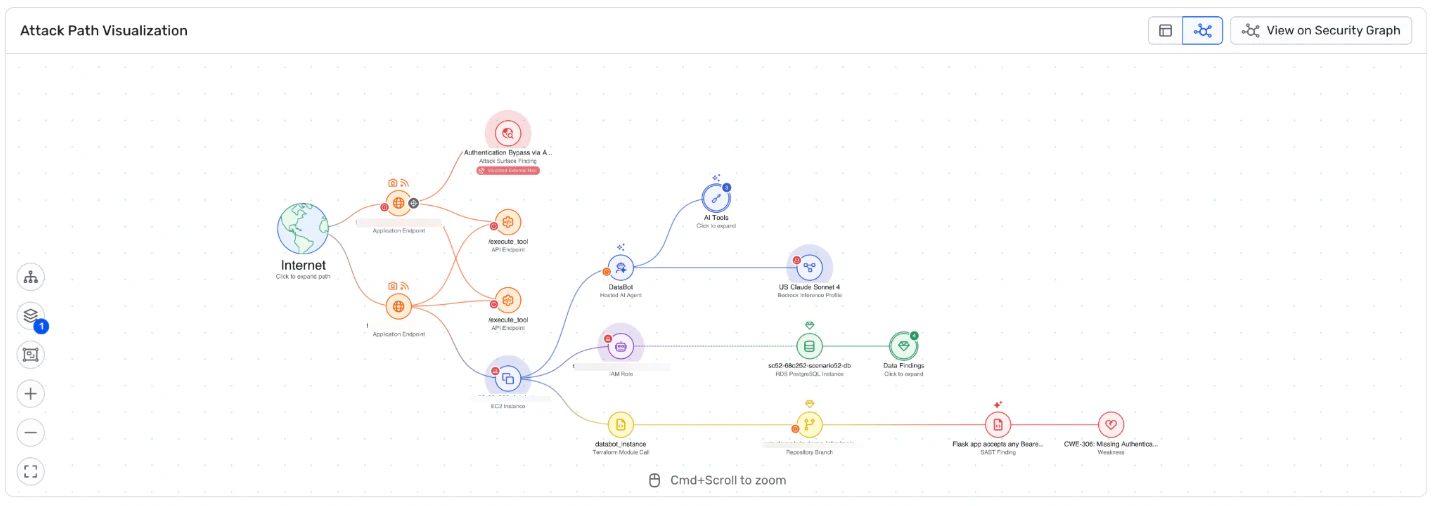
Once we have a list of findings, the next step is to enrich, correlate, and prioritize. Most exploitable vulnerabilities don't exist in isolation. They emerge when multiple weaknesses combine across code, identities, cloud resources, and external exposure.
This is where standalone scanners reach their limits. A code scanner can identify a vulnerability, but it cannot determine how that finding interacts with the rest of the environment or whether it contributes to a viable attack path.
The Wiz Security Graph connects relationships across code, cloud resources, identities, runtime activity, and external exposure to provide that missing context. But now, with AI we can go one step further and use adversarial validation to confirm whether or not a finding is truly exploitable.
The Wiz Red Agent uses the context of AI Code Scans and autonomously tests them end-to-end against your live environment, so teams can not only identify vulnerabilities in code but also confirm their exploitability.
Machine-Speed Remediation at Scale
Finding and validating a zero-day at machine speed provides limited value if it still takes human engineers weeks to patch it. In a post-AI world, fixing must be as fast as detecting.
When the Red Agent validates a critical attack path, the Wiz Green Agent immediately takes over to automate the remediation lifecycle. Using the full context of your code, pipeline, cloud, and runtime environment, the Green Agent creates a tailored remediation plan to address the root cause which goes beyond generic LLM guidance. It instantly identifies the exact ownership, down to the specific infrastructure, application, or individual developer, and formulates an optimal, step-by-step remediation strategy. It even provides mitigating controls while the code fix is being developed and best practices that improve the overall posture of your application.
It can also work alongside AI coding agents such as Claude Code and CodeMender to help automate the path from validated finding to implemented fix in a truly agentic workflow.

This outcome is a continuous loop. One where discovery, validation, and remediation work together to help teams move faster without sacrificing security.
Governing the Full Lifecycle
Not every finding may map to an attack path. But, lower-severity findings still represent real risk if left unaddressed. Organizations need a way to track and govern these Posture Issues as ongoing security debt, with consistent ownership and remediation expectations over time.
Wiz helps assess coverage, define remediation SLAs, and measure speed of action and progress. Wiz orchestrates the entire program across environments so organizations can demonstrate risk reduction over time, maintain accountability across teams, and easily report progress to their board.
The result is a single platform that manages the full lifecycle of a vulnerability, from discovery through governance.

Practical Steps to Implement Today
Wiz customers looking to operationalize Pillar 3 of the AI Threat Readiness Framework can start building a layered defense today:
Establish the Baseline Radar: Deploy continuous deterministic scanning across all repositories via Wiz Code and the unified policy engine to catch pattern-based vulnerabilities at scale.
Start from Your Cloud, Not Your Code: Use the Wiz Service Catalog and Code-to-Cloud mapping to identify which repositories power your most exposed, sensitive, or privileged live services. Let runtime context drive your scanning priorities.
Activate AI Code Scans on High-Value Repositories: Target customer-facing applications, internet-exposed APIs, and sensitive data flows for deep semantic analysis to surface intent-dependent flaws traditional SAST misses.
Prioritize Risk Issues: Focus remediation efforts on findings that contribute to Red Agent validated attack paths.
Remediate at Machine Speed: Enable the Green Agent to generate pull requests and route fixes directly to code owners and their coding agents, closing the loop without manual bottlenecks.
Securing Applications at Machine Speed
As AI accelerates both software development and vulnerability discovery, the gap between exposure and exploitation will only continue to shrink. Security teams need a continuous risk elimination loop and an operating model where AI-powered defense runs natively across code, cloud, and runtime.
The answer is a layered approach. Pattern matching for baseline hygiene, AI Code Scans for the intent-dependent flaws, and frontier-grade x-ray analysis for the most critical applications. Combined with context and our agents, security teams can operationalize AI Threat Readiness at enterprise scale.
A core part of this is our native AI Code Scans. Now in private preview, AI Code Scans use agentic analysis to reason about code like a human security researcher, surfacing complex vulnerabilities that traditional pattern-matching engines miss. We designed it as a lightweight, high-value engine that is easy to operationalize, folding into the classic AppSec workflows your team already relies on. AI Code Scans will be included with Wiz Code Advanced, extending the value of the existing subscription with contextual code analysis for defenders.
Talk to a Wiz expert to learn how to operationalize the AI Threat Readiness Framework in your environment. And if you're already a Wiz Code Advanced customer, reach out to your account team to get started with AI Code Scans.
Check out our next blog in this series to learn about Pillar 4: Detect and contain threats in real-time.