So far in this series, we’ve covered how to reduce critical exposure, accelerate patching, and analyze code before attackers do with Wiz to help you get your systems ready for AI threats. But prevention can only take you so far.
Even with a hardened posture, some risk will still materialize into an active threat at runtime. And in the AI era, detection and response face two compounding challenges: the speed of exploitation is accelerating, and the threat landscape itself has fundamentally changed. AI-powered attacks, prompt injection, supply chain risks as coding agents gain broader access to codebases and pipelines, and abuse of cloud-native AI services are creating new attack surfaces that traditional detection tools were never built to cover.
The old model - alert fires, analyst reviews, investigation starts from scratch - won’t hold up when the window between initial access and impact shrinks to minutes. What’s needed is a fundamentally different approach: one where telemetry is comprehensive across all layers, investigation is automated, and containment doesn’t wait for a human to start the clock.
Today, we are diving into Pillar 4: Detect and contain threats in real time. We will explore why manual investigation can no longer keep pace with AI-driven threats, how to achieve full-context visibility into threats across your environment, and how Wiz uses AI-driven investigation and automated containment playbooks to ensure that responding to threats is finally as fast as they arrive.
Why detecting and containing threats in real time is crucial for AI Threat Readiness
Traditional detection and response wasn’t built for today’s AI threat landscape. Alert volumes are growing, attack surfaces have expanded across cloud infrastructure, workloads, identities, APIs, and AI services - and when a threat does materialize, investigation still depends on analysts manually correlating signals across disconnected tools.
In the AI era, that model breaks down. Attackers operating with AI assistance are compressing the time between initial access and lateral movement - leaving defenders a shrinking window to detect, investigate, and contain before the blast radius grows. The security perimeter has expanded too. As coding agents gain broader access to codebases and pipelines, a single compromise can become a path across the entire environment - from codebase to production infrastructure, turning supply chain risk into a runtime detection problem.
AI workloads also introduce an entirely new threat landscape that existing detection tools weren’t built to cover. Unlike traditional workloads, AI agents and models behave non-deterministically - harder to baseline, harder to monitor, and harder to detect when compromised. This creates three new requirements for detection and response:
New context - Understanding what your AI workloads actually do at runtime requires attributing activity to specific agents, MCPs, tools, and models. Without that attribution, anomalous behavior is invisible.
New telemetry - AI workloads generate inputs and outputs that must be monitored specifically for prompt injection, data leakage, and model misuse - signals that don’t appear in cloud logs or workload telemetry alone.
New resources - Cloud-native AI services like Amazon Bedrock, Azure AI, Vertex AI are now first-class attack surfaces that require the same security monitoring as any other cloud resources.
Together, these forces surface five interconnected challenges that existing tools and processes weren’t designed to solve:
Incomplete visibility: Without broad telemetry spanning workload, cloud, identity, network, and data layers - including AI invocation logs - gaps in coverage mean threats go undetected entirely. Teams can only investigate what they can see.
False positive fatigue: High alert volumes with low signal-to-noise ratios erode analyst trust in the tooling. Without AI-established behavioral baselines and continuous tuning, teams spend more time chasing noise than investigating real threats.
Manual triage with no context: When a threat fires, investigation typically starts from scratch - pulling logs, correlating events, and reconstructing timelines manually. Without environment specific memory of previous investigations and behavioral patterns, analysts repeat the same work even for threats they’ve seen before.
Response without blast radius context: Containing a threat effectively requires understanding what was affected, how it was accessed, and what else is at risk - across code, cloud, runtime, identity, workload, and data. Without that full-context picture, response actions are guesswork.
Slow and manual containment: Even when a threat is understood, containment still requires human approval at every step - isolating a workload, revoking access, blocking a process. By the time those approvals happen, lateral movement to crown jewels has already occurred.
How Wiz Supports Pillar 4: Detect and Contain threats in real time
The goals of this pillar are to solve the current challenges Security Operations teams face by:
Achieving comprehensive real-time visibility across all environments and telemetry sources, including AI workload behavior and supply chain activity
Leveraging AI to automatically investigate every threat and render a clear, defensible verdict
Reducing false positives through behavioral baselines and continuous fine-tuning
Enabling automated containment playbooks that act on high-fidelity threats at machine speed
Ensuring human oversight is preserved for sensitive actions, without making it the bottleneck
Never Miss a Critical Detection
Effective detection starts with telemetry breadth. Most security tools cover one or two layers of the environment - but in the AI era, AI-driven attacks move through all of them. An attacker who compromises an AI workload will move across model inputs, workload processes, and cloud infrastructure in a single connected attack chain. If you’re missing any one of those layers, you’re blind to part of the attack story.
Wiz Defend ingests telemetry across multiple layers to ensure full coverage:
Cloud Control Plane - Cloud audit logs from AWS, Azure, GCP, and other providers capture high-risk actions taken by identities in your environment: deleting logging configurations, exporting databases to external buckets, and modifying IAM permissions. These are the signals that show what an attacker did once they had access.
AI Workloads - The Wiz Runtime Sensor deploys on your workloads to capture what’s happening at the process level in real time: a Python process spawning an interactive shell, a DNS query to a known malicious domain, a reverse shell being executed - all attributed to the specific AI agent that triggered them. Crucially, the Sensor also enables you to understand how your AI workloads actually behave at runtime, attributing activity to specific agents, MCPs, and models so that anomalous behavior can be detected against a known baseline - essential given the non-deterministic nature of AI workloads.
Model Input & Output - AI invocation logs capture what’s being sent to and received from your models: prompt injection attempts, PII in model outputs, harmful content categories. These signals show where an attacker first gained a foothold - before anything else fires.
To understand why each layer matters, consider a real example: Suspicious Prompt Input Leading to Remote Code Execution.
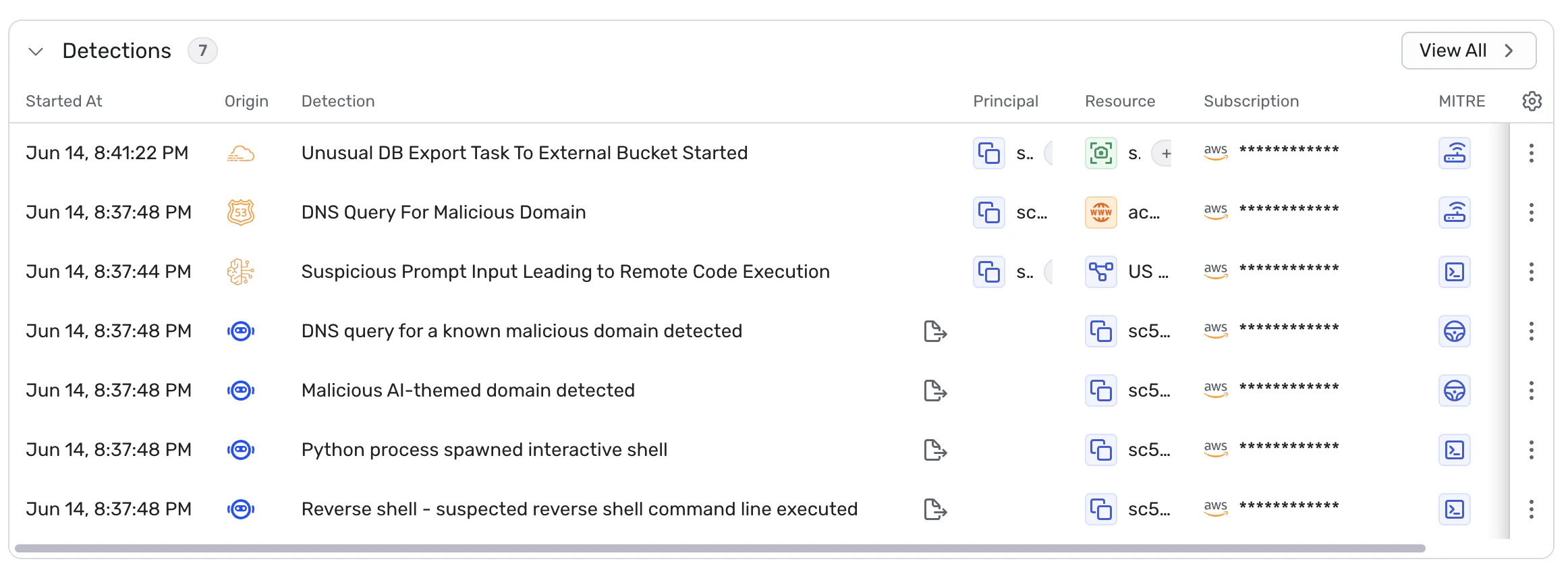
Looking at the detections grouped under this threat, the attack chain becomes clear across each layer:
Model Input & Output fired first - a suspicious prompt input was detected targeting a Claude Sonnet model, flagging a potential prompt injection attempt
AI workload sensor detections fired next - within seconds, the workload showed a Python process spawning an interactive shell, DNS queries to a known malicious domain, a malicious AI-themed domain lookup, and a suspected reverse shell command executing
Cloud Control Plane fired last - the attacker used that access to initiate an unusual database export to an external bucket, attempting to exfiltrate data
No single layer tells the full story. The invocation logs show the entry point but not the damage. The workload sensors show the execution but not the trigger. The cloud logs show the exfiltration but not how access was obtained. Only when all layers are correlated together does the complete attack chain become visible - and actionable.
Accelerate Investigation with AI-Driven Threat Analysis
Even with the right detections firing, investigation remains the bottleneck. Answering the fundamental questions like: “is this legitimate activity, a security test, or a malicious attack? What’s the blast radius? Who needs to respond?” - all take hours of manual work. Analysts have to stitch together signals across cloud logs, workload telemetry, and other sources by manually correlating detections across disconnected tools to reconstruct what actually happened. By the time a clear picture emerges, the window to contain the threat has already narrowed.
The Wiz Blue Agent was built to close that gap. As soon as a threat is triggered, the Blue Agent automatically initiates an investigation - pulling detections, cloud events, resource metadata, and risk findings, then correlating them the way a trained incident responder would. The investigation is transparent at every step: analysts who get the alert can see the questions the agent asked, the data it retrieved, and how each signal shaped the final verdict.

Using the same example as before of a Suspicious Prompt Input Leading to a Remote Code Execution - the Blue Agent classified the threat as Malicious with high confidence and reconstructed the full attack chain automatically. What would have taken an analyst hours to piece together manually was delivered in minutes - ready and waiting when the analyst opens the alert, with a clear verdict and confidence level for validation and action.
The Blue Agent analysis also includes an automated review of the forensics packages captured by the Runtime Sensor at detection time and analyzed before an analyst has finished reading the alert.

This is the difference between metadata - a process name, a parent process, a timestamp - and actual evidence that can help accelerate the investigation process. Forensics transforms what would have otherwise been an inconclusive alert into a high-confidence, defensible verdict, with a full picture of what happened on the workload layer.
Reduce your MTTR with Automated Response and Workflows
A verdict from the Blue Agent is only valuable if it leads to fast action. Historically, even after an investigation is complete, containment still requires an analyst to manually initiate each response step - isolating a workload, revoking an identity, blocking a process, and often waiting on approvals across multiple teams. That handoff gap is where the attackers move laterally.
Wiz Workflows closes that gap by turning a Blue Agent verdict directly into action. Built on a drag-and-drop orchestration platform with full Security Graph context, Workflows can automatically trigger multi-step response chains the moment a high-fidelity threat is confirmed. Ownership is automatically assigned based on Wiz’s code-to-cloud context, so the right team is notified with the right information from the first moment.

For sensitive containment actions, Wiz also generates an AI-powered response playbook directly from the threat’s involved entities, timeline, and detection details. In the prompt injection example above, Wiz’s Recommendation surfaced immediately: isolate the compromised EC2 instance from all networks by modifying its security group to block all inbound and outbound traffic, and create a forensic snapshot before taking further action. A single click executes the action.

Workflows supports fully automated execution for high-confidence threats, human-in-the-loop approval for sensitive actions, and agent-led orchestration for complex multi-step scenarios. The result is a measurable shift in how security operations teams work - from hours spent manually correlating and escalating, to minutes from detection to containment.
Practical Steps to Implement Today
Achieve telemetry breadth across all layers - Ingest cloud audit logs (CloudTrail, Azure Activity Logs, GCP Cloud Audit Logs), identity provider logs (Entra, Okta, Google Workspace), and deploy the Wiz Runtime Sensor to capture workload and AI invocation telemetry. Coverage gaps are detection gaps.
Enable the Blue Agent for every threat - Turn on the Blue Agent so that every new and updated threat is automatically investigated, correlated, and assigned a verdict before an analyst opens the alert.
Deploy the Runtime Sensor for AI Workload visibility - The Runtime Sensor is what enables Wiz to understand how your AI workloads behave at runtime - attributing activity to specific agents, MCPs, tools, models, and detecting when that behavior deviates from baseline. It also enables forensics collection at detection time, enabling higher confidence verdicts based on forensic package analysis
Build your first automated response Workflow - Start with a high-fidelity threat type and define a containment playbook: isolate the workload, notify the owner, open an incident. Use the Blue Agent verdict and confidence level as the trigger so human approval is only required where the action warrants it.
Measure what matters in Wiz - Track Threat MTTR, agentic triage coverage (percentage of alerts investigated by the Blue Agent with clear verdict), and analyst agreement rate with the Blue Agent’s verdicts in Wiz dashboards.
Stopping Threats at Machine Speed
Prevention reduces the surface. But in the AI era, the organizations that will be most resilient are the ones that can detect, investigate, and contain threats as fast as they arrive - without depending on manual processes that can't scale.
Pillar 4 closes the loop. With comprehensive telemetry across cloud, workload, and AI model layers, the Blue Agent's automated investigation and verdict, and Workflows-driven containment playbooks, security teams can finally operate at the speed the threat landscape demands - letting AI absorb the volume and repetition, so human judgment is reserved for the decisions that actually require it.
This concludes the AI Threat Readiness series. Across all four pillars - reduce critical exposure, accelerate patching, analyze code before attackers do, and detect and respond in real time, the goal is the same: build a continuous, AI-powered loop that closes the gap between risk and resolution before attackers can exploit it.
Talk to a Wiz expert to learn how to operationalize the AI Threat Readiness Framework in your environment.