Recently, we introduced the Wiz AI Application Protection Platform (AI-APP) to secure AI-native applications end-to-end and provide the context needed to understand real risks across models, agents, data, and infrastructure. Today, we’re extending that logic directly to the source: the code itself.
AI-accelerated development has fundamentally changed the volume and velocity of code reaching production, expanding the attack surface faster than security teams can keep up. As teams build AI-native applications, they need to consider a new threat model, one that accounts for how AI components interact with sensitive data, external tools, and user inputs.
To help organizations cover this challenge end-to-end, Wiz is tackling emerging risks associated with native AI apps with a unified approach that spans from the IDE to production. By detecting AI-specific risks in code, validating exploitability at runtime, and remediating with agents that understand your codebase, Wiz Code serves as the security fabric for AI-native development, securing the entire lifecycle from prompt to production so developers can address risks from their inception and code with confidence.
A Unified Approach To Uncover Risks From Code To Cloud
Securing AI-native applications is not about shifting left or shielding the controls right; it's about connecting the two into a single, unified workflow. Wiz provides a unified policy engine that spans the code, cloud, and runtime layers, unlocking simplified policy management and ensuring consistent scans across the entire AI application development lifecycle.

Because this policy engine is unified, it ensures that the exact same AI risks detected in running cloud workloads are also identified during early development via Wiz SAST. To standardize this continuous detection, our rules engine leverages emerging industry benchmarks, providing SAST coverage mapped directly to both the OWASP Top 10 for LLM Applications 2025 and the OWASP Top 10 for Agentic Applications 2026.
For example, a rule such as "Unsanitized User Input in AI Agent Prompts" catches prompt injection vectors at the code level before they reach production where they can be exploited by a threat actor. In this way, organizations are protected whether the application is still in design or already live in production.

Inception: Securing AI Apps as they are Designed
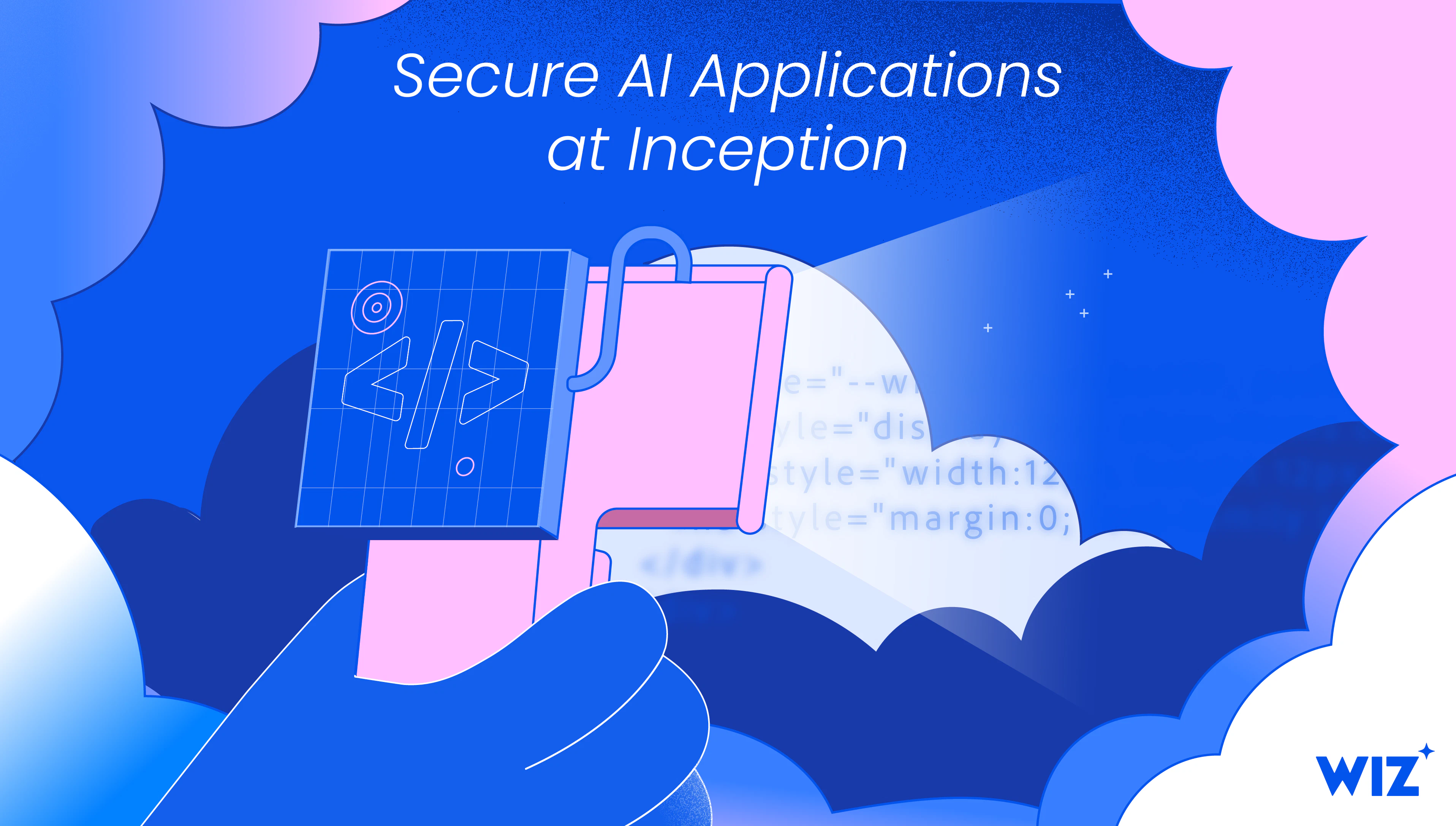
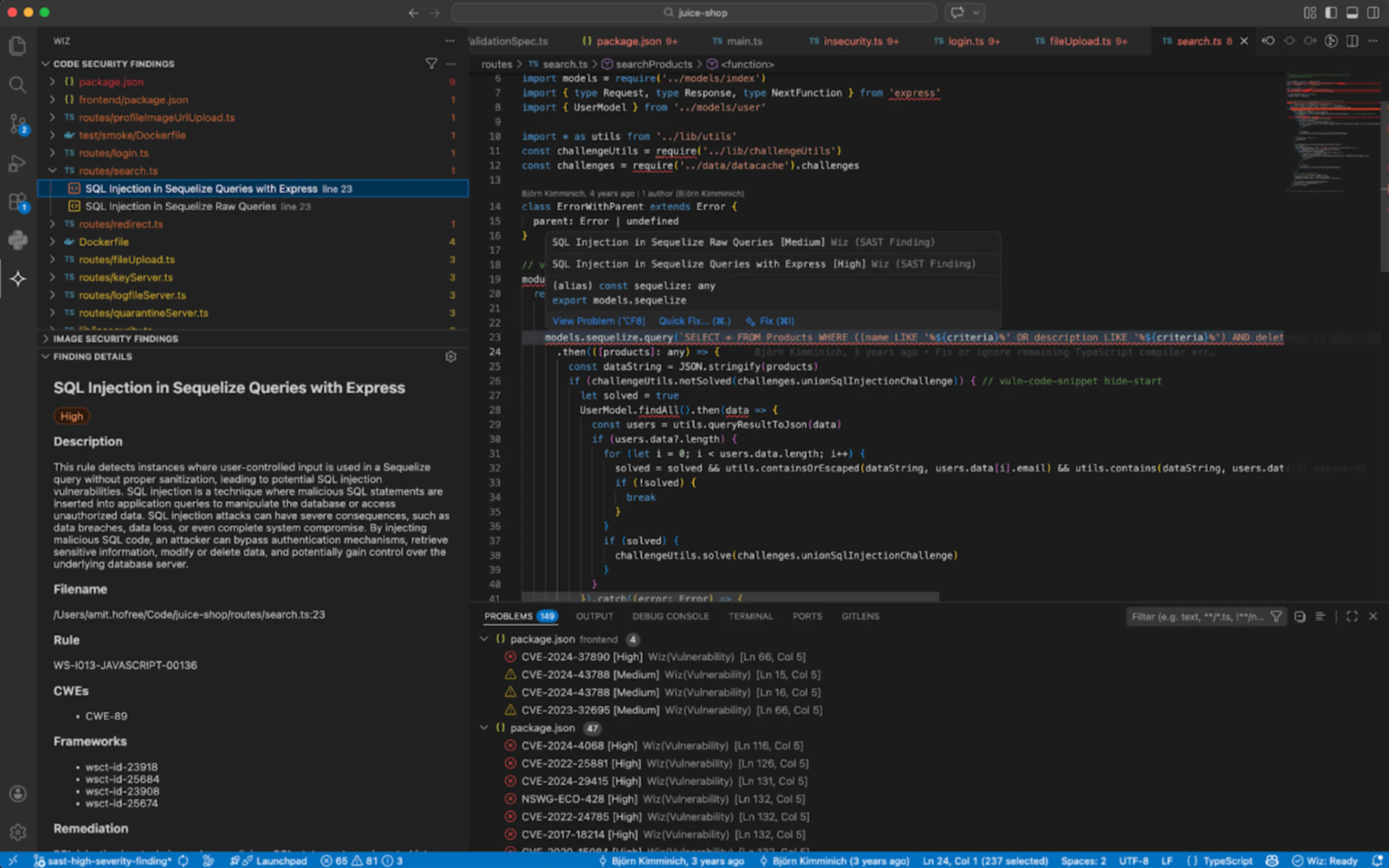
Modern development teams, now augmented with agentic AI, are now shipping code at an unprecedented speed while away from the keyboard. This shift demands that security be embedded at the very moment of code inception. To secure this AI-accelerated lifecycle, Wiz Code extends its reach across every developer workflow, utilizing the Wiz CLI, native IDE extensions for industry-leading environments like JetBrains, VS Code, Cursor, and Antigravity, with more integrations soon to follow.
This continuous security spans multiple domains, including SAST, SCA, IaC scanning, and secrets scanning. Developers receive immediate, inline guidance with deep context, helping them catch a wide spectrum of weaknesses before the code ever leaves their machine.
From Findings to Exploitable Attack Paths
Catching risks early is critical, but findings alone don’t tell the full story. The key challenge for Application Security has always been prioritizing based on exploitability, not just alerts.
Wiz closes that gap by connecting code-level risks to how applications actually run. Instead of stopping at detection, we follow each risk through the deployment stack, from code to cloud to runtime, to understand if it can be exploited.
A key component of our approach to AI involves Red Agent, our AI-powered attacker that actively probes endpoints the way a threat actor would. For example, a SQL injection detected in code is mapped to the virtual machine serving the application, and connected to the public API endpoint exposing it to the internet. The Red Agent can validate exploitability by probing the endpoint in the way a threat actor would. In this way, Wiz can provide security teams not only an inside-out risk assessment, but also validate it from the outside-in.
But knowing a vulnerability is reachable is only half the battle. When the Red Agent detects an exploitable vulnerability in a live AI application, SAST ties that runtime finding directly back to its code-level root cause. What started as a confirmed runtime risk is mapped back through the deployment layer to the exact line of code that introduced it.

Solving AI Risks at AI Speed
Finding a weakness is step one, but getting it fixed is where most AppSec programs stall. When you pair the exploitable findings proven by Red Agent with the precise root cause analysis delivered by SAST, organizations can close the security loop faster than ever.
Wiz automates this path to remediation using the Green Agent, solving AI risks at AI speed. Because the Green Agent understands exactly where the exploitable vulnerability stems from in the codebase, it generates a precise fix grounded in actual code context and delivers a tailored fix directly into the developer's workflow. AppSec assigns it. The developer accepts it. Zero friction.

For teams leveraging coding agents in their pull request workflows, Wiz Code can delegate the remediation task directly to the agent. Wiz's Green Agent provides the full code-to-cloud investigation context and recommended remediation strategies. This allows the organization's own coding agent to autonomously generate the tailored fixes in a new PR.

To accelerate agent-driven remediation at every boundary, we will soon equip coding agents and AI-native IDEs with dedicated Wiz Skills and plugins, empowering developers to continuously fix right where they build. By integrating directly into AI coding assistants, the security context travels with the task, meaning the agent understands not just what to fix, but how and why it matters.
Looking Ahead
AI is changing how software is built. Code is no longer written, reviewed, and fixed in isolation. It’s increasingly handled by a team of agents working alongside developers. From the first line of code to live deployment in production, Wiz gives security and development teams a unified approach to AI application security built on exploitability, not alerts. It detects risks as code is written, validates them in runtime, and routes remediation directly into the workflows and tools developers already use.
The result is a closed loop, where risks are identified, proven, and resolved in the same flow the code was created.
Stay tuned for more exciting updates on Wiz Code Week and if you’re curious how this works in practice, we’d love to show you.
Request a demo to see how Wiz helps teams detect, validate, and fix AI risks, all in one flow.