


What is AI-DLC (AI-Driven Development Lifecycle)?
AI-DLC is an AI-centric approach to software development that positions AI as the primary executor across every phase of the lifecycle, from planning through operations, while humans provide strategic direction, approval, and oversight.
AI Security Starter Pack
Build practical controls for AI-driven development across code, cloud, identity, and runtime.

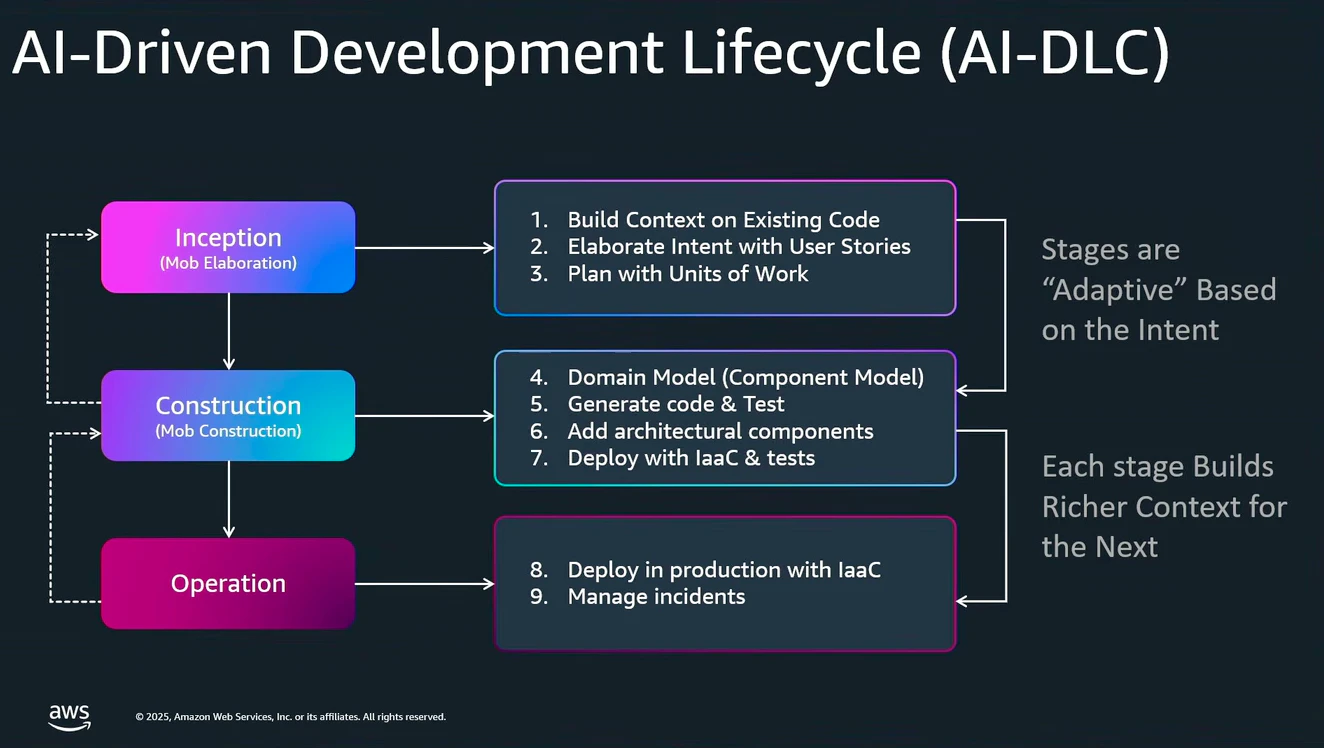
Introduced by AWS and now adopted industry-wide, it marks the shift from AI-assisted coding to AI-driven engineering.
Key characteristics:
It is built for velocity: Organizations shipping AI-generated code at 10x the previous velocity need a lifecycle purpose-built for that speed. Bolting AI onto old models causes security and quality to collapse.
It is a structured methodology: AI-DLC goes beyond vibe coding. It grounds the power of LLMs in rigidly defined flow structures (Inception, Construction, Operations) and prescribed rituals (Mob Elaboration, Mob Construction).
It is not a tool. Think of it as a way of organizing how teams plan, build, test, deploy, and operate software when AI handles most of the execution.
Why traditional SDLC falls short in an AI-first world
The conventional SDLC was designed for human-driven, sequential workflows where a developer writes code, a reviewer reads it, a tester validates it, and an ops team deploys it. Every handoff assumes human authorship and human-speed iteration. When you bolt AI coding assistants onto this model, the process starts to buckle.
To understand why, it helps to look at the spectrum of AI involvement:
AI-Assisted: Copilots suggest code completions within existing SDLC stages (too narrow).
AI-Autonomous: AI builds systems hands-off with minimal human governance (too risky).
AI-DLC (The middle path): Reimagines the lifecycle itself to support AI execution with strict human oversight.
Consider a standard two-week sprint: AI agents can now generate code, tests, and IaC in hours instead of days. Writing code is no longer the time consuming bottleneck. Review queues and security gates are. Traditional SDLC fails here because:
Sprint planning calibrates velocity to human capacity instead of AI throughput.
Security gates designed for periodic, manual scans cannot keep pace with continuous AI output.
Legacy test strategies, built for human error patterns, miss AI-specific vulnerability classes.
The old model assumes code velocity is limited by human typing speed. The new reality is that velocity is limited only by review, security, and governance capacity.
How does AI-DLC work?
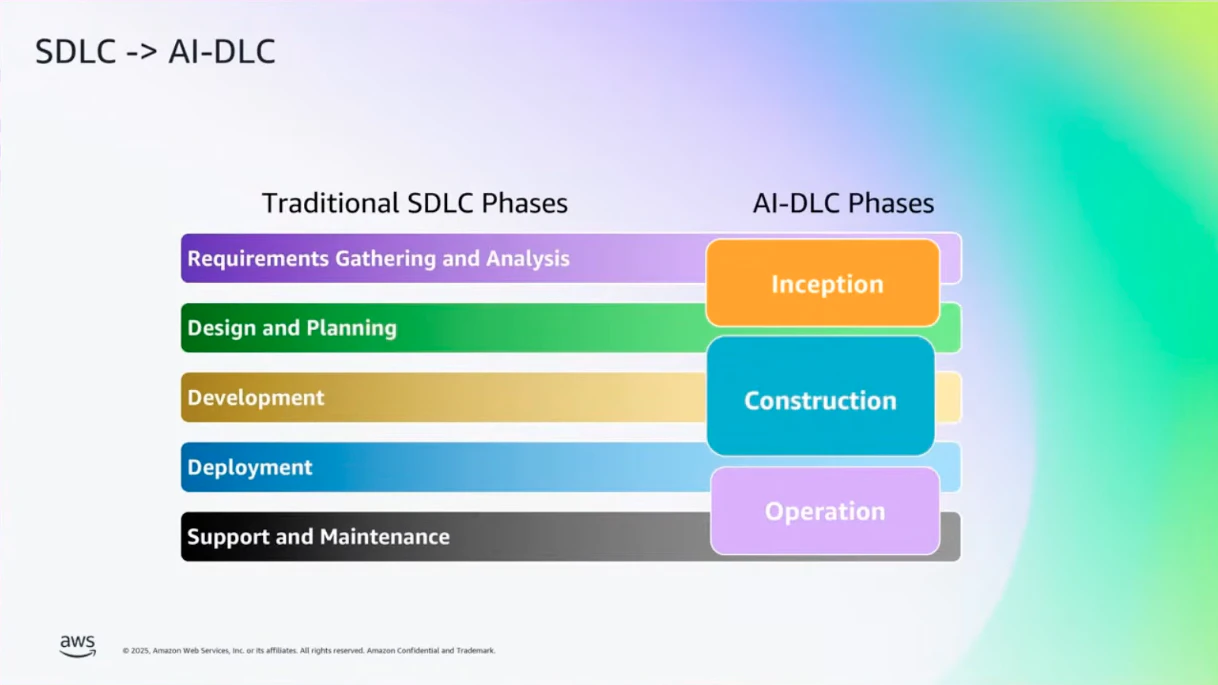
The methodology operates in three phases (Inception, Construction, and Operations) where AI initiates workflows while maintaining persistent context across all stages. These form a continuous loop rather than a linear waterfall.
| Phase | AI role | Human role | Key artifacts | Security checkpoint |
|---|---|---|---|---|
| Inception | Generates plans, architecture proposals, user stories, clarifying questions | Validates direction, resolves ambiguities, approves plan | Specs, context documents, intent definitions | Review which services, data, and permissions the plan assumes |
| Construction | Writes code, generates tests, creates IaC templates, builds CI/CD configs | Reviews, steers, approves at defined checkpoints | Source code, test suites, IaC manifests, container images | Automated SAST, SCA, secrets, IaC scanning at every commit |
| Operations | Handles deployment orchestration, monitors runtime, detects anomalies | Approves production changes, escalates incidents | Deployment configs, monitoring dashboards, runbooks | Runtime validation that code behavior matches what was scanned |
Inception
AI-DLC introduces practices like mob elaboration, where AI agents generate project plans, architecture proposals, user stories, and clarifying questions based on high-level human intent. Humans validate direction, resolve ambiguities, and approve the plan before any code is written.
This phase produces structured specifications and context documents that persist into Construction, giving AI agents the memory and guardrails they need to build correctly. The security implication is significant: decisions made at Inception (which cloud services to use, what data to access, which identity model to follow) define the attack surface downstream. Security review at this stage prevents entire classes of risk from ever reaching code.
Construction
Traditional sprints are replaced by "bolts," (shorter, more intense work cycles) measured in hours or days rather than weeks. This shift underscores the method's emphasis on speed and continuous delivery. During mob construction, AI agents write code, generate tests, create IaC templates, and build CI/CD configurations while humans review, steer, and approve at defined checkpoints.
Persistent context flows between Inception and Construction so the AI does not lose track of architectural decisions, security requirements, or business constraints. The security implication here is straightforward: AI-generated code, dependencies, and IaC templates all need automated scanning at this stage because the volume and velocity make manual line-by-line review impractical. When an AI agent produces dozens of pull requests in a single day, you need SAST, SCA (software composition analysis), secrets detection, and IaC scanning running continuously.
Operations
AI-DLC extends into deployment and monitoring. AI agents handle deployment orchestration, observe runtime behavior, detect anomalies, and propose remediations. Humans maintain governance through approval gates for production changes and incident escalation decisions.
The operations phase feeds learnings back into Inception, creating a closed loop where production insights inform future planning. AI agents operating in production environments need tightly scoped permissions, and runtime monitoring must validate that what was scanned in code actually matches what is running in the cloud. A vulnerability that looked benign in the repository might become critical when the deployed workload is internet-exposed, runs with a high-privilege identity, and can reach a database that stores PII. This is why security platforms that connect code findings to runtime cloud context, mapping workloads to their actual identities, network exposure, and data access, are essential for AI-DLC operations.
AI-DLC vs. SDLC: key differences
| Column A | Column B | New Column |
|---|---|---|
| Lifecycle model | Waterfall or agile stages | Continuous three-phase loop (Inception, Construction, Operations) |
| Code authorship | Human-written | AI-generated with human approval |
| Cycle time | Weeks (sprints) | Hours or days (bolts) |
| Roles | Developers write code | Developers review and steer AI output |
| Governance model | Periodic reviews and gates | Continuous automated checks with human approval gates |
| Security checkpoints | Periodic scans and gates | Embedded scanning at every phase plus runtime validation |
| Documentation | Human-authored specs | AI-generated specs validated by humans |
| Feedback loop | Retrospectives at sprint end | Continuous closed-loop from operations back to inception |
For security teams, the most important difference is this: AI-DLC assumes code is generated faster than any human can review it. That means security controls must be automated, contextual, and connected to runtime behavior. Relying on periodic manual review alone will not work.
Benefits of AI-DLC
AI-driven development delivers tangible outcomes when teams pair the methodology with automated scanning, approval workflows, and cloud runtime visibility. Without those controls, faster generation can simply move risk through the pipeline faster.
Compresses delivery cycles from weeks to hours: AI handles the execution-heavy work (coding, test generation, IaC authoring), so teams ship faster without cutting corners on planning or review.
Elevates developer work from routine coding to creative problem-solving: Developers spend time on architecture, design decisions, and approval rather than writing boilerplate, which increases output quality and job satisfaction.
Improves consistency through AI-enforced patterns: AI agents apply the same coding standards, security policies, and architectural patterns every time, reducing the drift that occurs when different developers interpret guidelines differently.
Enables rapid market responsiveness: When a zero-day vulnerability is disclosed, AI-DLC teams can regenerate, re-scan, and redeploy affected components in hours rather than scheduling a fix into the next sprint.
Creates built-in traceability from intent to deployment: Because AI-DLC produces structured artifacts at every phase (specs, plans, code, test results, deployment configs), teams get an audit trail by default rather than reconstructing it after the fact.
Security risks and challenges of AI-DLC
AI-DLC’s greatest asset (its speed) is also its biggest security vulnerability. When code ships in hours instead of weeks, misconfigurations and exposed secrets reach production much faster. Wiz found that 4 of the 5 most common validated secrets found in public repos were AI-related, highlighting how quickly prompts and API keys can leak into source control.
This sheer volume easily exceeds human review capacity, compounding several specific categories of risk:
Subtle code vulnerabilities: AI often produces code that is syntactically correct and passes basic linting, but contains hidden logic flaws or insecure defaults. (One study identified 4,241 CWE instances across AI-generated files). Catching these requires AI-powered SAST and runtime context.
Supply chain attacks via package hallucination: AI agents autonomously select dependencies, skipping human vetting. With roughly 20% of AI package recommendations referencing non-existent dependencies, attackers can exploit this via "slopsquatting" to compromise the software supply chain.
Scaled infrastructure misconfigurations: When AI generates IaC (like Terraform or Kubernetes manifests), a single error, such as a public S3 bucket or an overprivileged IAM role, can be replicated across dozens of deployments before anyone notices.
Wider blast radius from CI/CD permissions: AI agents need elevated pipeline credentials to build, test, and deploy. If these permissions are too broad, a hallucinating or compromised agent can cause widespread environmental damage.
Plausible but flawed security configs: AI hallucinations can generate security rules (e.g., IAM policies, encryption settings) that look entirely correct but contain subtle, critical errors, such as allowing unauthorized network ingress.
Inside MCP Security: A Field Guide
Understand how MCP-connected agents introduce identity, tool, and data access paths that teams need to govern.

Here is what this looks like in practice: an AI agent generates a containerized microservice, selects a base image with known CVEs, provisions a public-facing load balancer, attaches an overprivileged service account with access to a sensitive data store, and deploys it all through an automated pipeline. Each individual artifact might pass a narrow scan, but the combination creates a critical attack path that only becomes visible when you connect code, cloud, identity, and data context together.
Beyond pure security, shifting to AI-DLC introduces broader organizational hurdles:
Operational readiness: Teams must develop new skills and workflows to effectively manage and govern AI executors.
Code-to-cloud traceability: NIST AI Risk Management Framework, EU AI Act, and SOC 2 Type II are starting to enforce strict provenance tracking. Regulators now require clear audit trails to prove exactly what was authored by a machine versus approved by a human.
Securing the AI-driven development lifecycle
If your scanning runs on a nightly cron job but your AI agent ships code every hour, you have a gap. Security controls must operate at the same velocity as AI-driven development.
Automated scanning at every phase, not just pre-deploy: SAST, SCA, secrets detection, IaC scanning, and sensitive data scanning must run in the IDE, at PR time, in CI/CD, and continuously in production. This is the only way to match the pace of AI-generated output.
Runtime validation that connects code findings to actual deployment exposure: A vulnerability in a code repository is theoretical until you know whether that code is deployed, whether the workload is internet-exposed, what identity permissions it has, and what data it can reach. Security platforms need to map code findings to their real-world cloud context.
AI-powered triage that scales investigation to match code volume: When AI generates hundreds of findings per day, human reviewers cannot triage them all. AI-assisted triage that explains why a finding is exploitable (or marks it as a likely false positive) becomes essential.
Code-to-cloud traceability for governance and compliance: Regulators and auditors need to trace a deployed artifact back to its source repository, the AI agent that generated it, the human who approved it, and the policy that governed it. Unified platforms that maintain this chain automatically are critical for AI-DLC governance.
Least-privilege enforcement for AI agents themselves: AI agents operating in CI/CD pipelines and cloud environments need tightly scoped credentials, and security teams need visibility into what permissions those agents hold and what they are actually doing.
The architecture that AI-DLC demands is a unified platform that correlates code, cloud, identity, and data context into a single risk model. Without that correlation, security teams are triaging findings in a vacuum, unable to distinguish a critical production exposure from a benign dev-branch artifact.
Consider this scenario: a security team receives a SAST finding for an SQL injection in AI-generated code. Without cloud context, they do not know if the code is deployed, if the workload is internet-facing, or if it has access to a database with PII. With a platform that maps code to cloud, they can immediately see that the vulnerable code runs in a public-facing container with access to a production database, making it a critical priority, or that it exists only in a dev branch with no deployment, making it low priority.
Wiz's approach to securing AI-DLC
When AI agents generate code, pull dependencies, provision infrastructure, and deploy to production in hours, you need security that follows the same path end-to-end.
Wiz secures the entire AI development lifecycle through the AI Application Protection Platform (AI-APP).
This Code-to-Cloud approach integrates Wiz Code (application and supply chain security ), AI-SPM (posture/inventory), and Wiz Defend (runtime protection) to provide unified visibility and risk prioritization across the entire AI pipeline.
Wiz's zero-configuration code-to-cloud mapping traces source code through CI pipelines to container registries to running workloads automatically. Every code finding gets enriched with cloud context: is this code deployed? Is the workload internet-exposed? What identity permissions does it have? What data can it access?
The Wiz Security Graph connects these signals into a unified risk model. Instead of triaging isolated findings, security teams see toxic combinations, like an AI-generated container with a known CVE, a public endpoint, an overprivileged service account, and access to sensitive data. That is the difference between a list of thousands of alerts and a short queue of issues that actually matter.
For the high volume of code-level findings that AI-DLC produces, Wiz's AI-powered SAST triage agent explains why a finding is exploitable or marks it as a likely false positive. This cuts the manual effort of reviewing hundreds of AI-generated findings per day down to a manageable number.
Wiz also helps teams prevent vulnerable code from ever reaching production, with plugins for AI coding agents. These plugins orchestrate SCA, SAST, secrets, and IaC scans once code is generated, so teams catch issues pre-commit when they’re easiest to fix.
Leveraging the Green Agent, Wiz injects vulnerability remediation directly into the agentic workflow. For issues that already exist, security teams can direct the Green Agent to send remediation commands to AI coding agents. From the development side, dev teams can pull existing issues directly into their IDEs and CLIs using WIz Skills, get a full rundown of critical issues, and automatically apply fixes based on Green Agent suggestions.
Wiz AI SPM extends this protection to AI applications by providing visibility into models, pipelines, and inference services with the cloud context needed to understand real risk, which helped Konverso achieve zero criticals for its GenAI platform.
Ready to secure your AI-driven development lifecycle from code to cloud? Get a demo to see how Wiz connects code, cloud, and runtime context into a unified risk model, so your team can focus on the exposures that actually matter in production. Request a demo to explore how Wiz can secure your cloud environment.
See AI-DLC security in context
See how Wiz correlates AI-generated code findings with cloud exposure, identity, data, and runtime context.
