

What is API security posture management?
API security posture management, or API-SPM, is a security discipline that focuses on maintaining and proactively improving the security health of enterprise APIs. APIs and their many risks proliferate fast in federated microservices cloud architectures—much faster than legacy tools can handle. And that’s exactly why businesses need to dial in their API security posture management strategy ASAP.
Some basic Q&As to get us started: Whose domain does API security posture management fall under? Ideally, it should be a collaboration between security, development, and infrastructure teams. And what exactly does API security posture management include? Everything from API discovery and mapping to risk prioritization and issue remediation.
Let’s break down a few core components of API security posture management and how they help:
Continuous API discovery: Strong API security begins with knowing what APIs exist in your cloud environments. And since today's cloud environments are so fast-paced, detection and inventorying capabilities have to be automated. With continuous and automated API discovery, you'll achieve complete visibility of the API attack surface, without blind spots.
Risk assessments: Evaluating the security posture of every single API endpoint in the cloud helps teams identify, prioritize, and remediate critical API security and compliance risks like poor authentication and sensitive data exposure.
Policy enforcement: The best way to curb API configuration and policy drift? Automated policy checks across every phase of a CI/CD pipeline. And remember: Automated guardrails also reduce human errors, further strengthening the overall API security posture.
Runtime protection: Comprehensive API security hinges on runtime coverage. This means monitoring runtime environments to see how API code issues show up down the line. Runtime coverage also helps teams map API issues back to their source, giving them a complete understanding of where API risks stem from and how they can be mitigated.
Code‑to‑cloud context: Effective API‑SPM correlates API endpoints with cloud resources, identities, data sensitivity, and runtime behavior to prioritize real attack paths and reduce risk.
Advanced API Security Best Practices [Cheat Sheet]
Download the Wiz API Security Best Practices Cheat Sheet and fortify your API infrastructure with proven, advanced techniques tailored for secure, high-performance API management.

Why traditional API security approaches fall short
Why does API security need a radical overhaul? Salt Security's State of API Security Q1 2023 report reveals that 94% of companies faced API-related security events in the year preceding the survey. And in early 2025, Gartner reported that data breaches involving APIs leak ten times more data than those that do not. The plain and simple truth is that API security issues are more sophisticated than we've ever seen. (The OWASP Top 10 API Security Risks list is a leading resource to understand key risks in greater detail.)
Businesses are struggling with the following API security challenges:
Most legacy API security tools and strategies were built for environments very different from the cloud—environments with monolithic architectures, fewer ephemeral resources, and much clearer perimeters. When environments were static and had traditional perimeters, solutions like API gateways and web application firewalls did the job. But the cloud shakes everything up: APIs are spun up in minutes across disparate multi-vendor environments. When the API attack surface is constantly evolving, static tools offer no help. The consequence? Weak API security posture management.
Legacy tools weren’t designed to deal with the new techniques adversaries are employing. For instance, consider broken object-level authorization (BOLA), broken function-level authorization (BFLA), mass assignment attacks, sensitive data exposure, and GraphQL complexity attacks. These are all exploitations of logic flaws, and preventing them requires a contextual and deep understanding of how APIs interact with the rest of your IT environment. Since legacy tools lack context-awareness, there’s no way for traditional solutions to mitigate these attacks.
Teams are under pressure to drive agile software development practices. Sometimes, developers spin up APIs so quickly that many slip past centralized governance programs. The result? Shadow, orphaned, and zombie APIs—enticing vectors for threat actors.
Listing API vulnerabilities and risks without context hinders development and poses a security issue in itself. Unfortunately, this is exactly what legacy API security tools do.
For fast, multi-vendor IT environments, businesses need a whole new approach to API security posture management and a cutting-edge API security platform.
Top API Vulnerabilities: How to Detect, Prioritize, and Prevent Real-World Risk
Application programming interfaces (APIs) enable communication between services, applications, and data systems—powering everything from mobile apps to large-scale enterprise platforms.
Read more

Must-haves for strong API security posture management
Below are four non-negotiable features that you should look for in an API security solution.
1. Comprehensive API discovery and inventory management
API discovery in cloud environments is challenging due to unmanaged gateways, multi-cloud sprawl, ephemeral workloads, shadow and zombie APIs, and third-party services. Effective discovery combines runtime telemetry, gateway logs, OpenAPI specs, infrastructure as code (IaC), code repositories, and external attack surface scanning. Each method has strengths and limits: runtime telemetry catches active traffic, gateway logs reveal managed endpoints, and code/IaC analysis finds APIs before deployment. Buyers should evaluate tools that integrate multiple sources to reduce blind spots. And remember: Complex installation is a major no-no in the cloud. Agentless‑first approaches with optional lightweight runtime sensors scale best.
What else should you look for in an API discovery solution? The ability to correlate diverse cloud and business-specific risk factors to prioritize mission-critical issues is crucial. Your best bet? A tool that can classify APIs based on exposure level, data sensitivity, business criticality, and authentication requirements.
2. Risk-based vulnerability assessment and prioritization
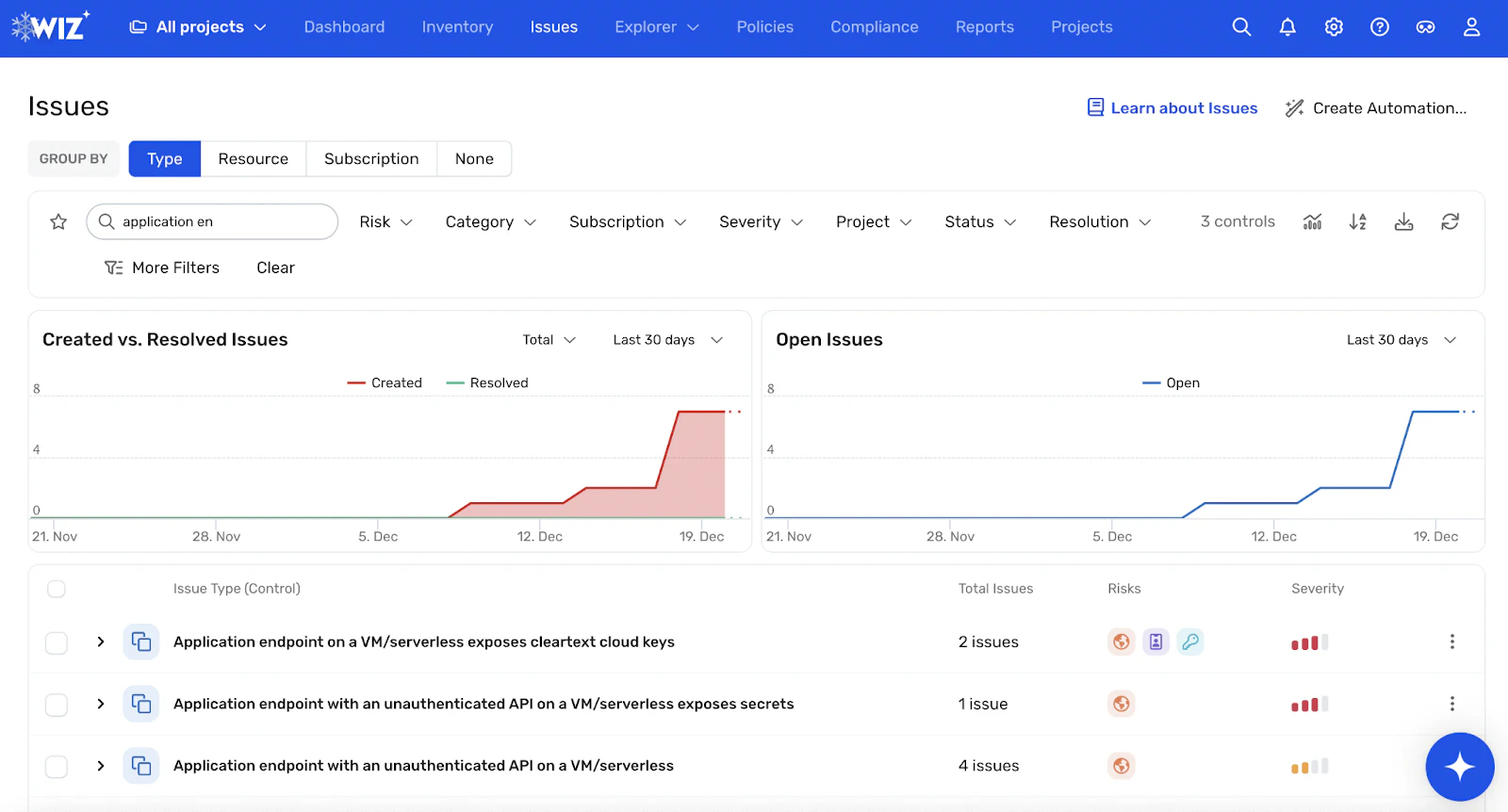
Ironically, a tool that treats all API risks equally is a security vulnerability. What you need is a tool that goes beyond rudimentary risk scores or vulnerability severity ratings. As we’ve seen, the ideal tool will understand and map how various API risks connect with business-critical data and processes. A misconfigured API linked to an S3 bucket with PHI hanging in the balance? Critical. A misconfigured API with no actual exposure? Deprioritize.
The best API security tools have full runtime coverage. Being able to detect runtime security issues is important because it allows security teams to see how API code issues eventually manifest in runtime. And remember that tools that weave in trusted threat intelligence feeds perform significantly better against API threats.
3. Behavioral monitoring and anomaly detection
Strong tools allow you to establish API security baselines to root out threats before they escalate. In other words, once your API security tool knows what safe API activity looks like, it will flag anything that deviates from that. Signature-based tools can be useful, but they focus on known attack patterns and may miss novel or low-and-slow credential abuse patterns like credential stuffing.
Think of it this way: The more advanced an API security tool’s ML capabilities are, the more effectively it can correlate and contextualize risks. So if you want to separate true API threats from a wall of low-risk noise, you need a tool with cutting-edge ML abilities.
Another game-changer? A security solution that can connect API flaws to IAM gaps—this is critical to detecting privilege escalation and lateral movement in the cloud.
4. Policy enforcement and automated remediation
Achieving complete coverage across the API lifecycle requires a tool with:
Strong policy engines: Policy engines support authorization patterns like RBAC and ABAC, enforce mTLS for service-to-service authentication, manage token rotation and expiry, set request size and rate limits, and validate inputs against OpenAPI schemas. Integrate policy as code into CI/CD pipelines with break/fix gates, and provide developer-friendly exceptions, PR comments, and policy waivers with expiry to avoid friction.
Automated remediation capabilities: Find out whether the tool can block malicious requests without human intervention. Can it activate incident response runbooks? If the answer is no, then that tool isn’t a good fit for fast-paced cloud setups.
CI/CD unification: Tools that easily unify with CI/CD pipelines ensure that policy-driven controls are embedded across the development lifecycle, empowering DevOps teams to catch issues early.
As you’re making your selection, remember that any tool that kills productivity is counterproductive. API security should always support development, not hinder it.
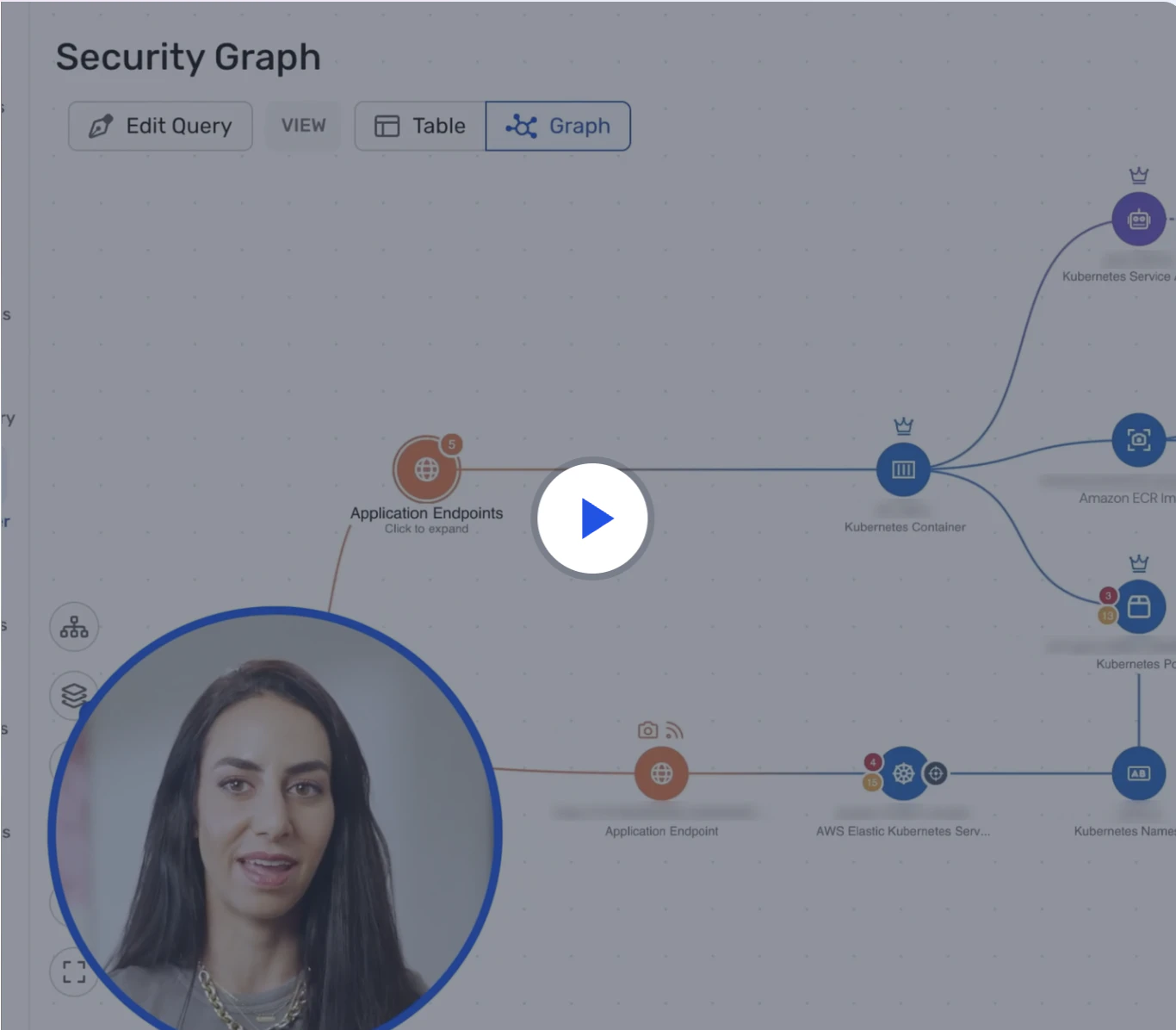
Watch 12-minute Demo
Learn about the full power of the Wiz cloud security platform. Built to protect your cloud environment from code to runtime.
Watch now
API security posture management best practices
Foster cross-team API security collaboration
Successful API security posture management requires cross-functional cooperation and shared ownership across security, compliance, development, and infrastructure teams.
Your next moves:
Set up leadership positions and outline roles and responsibilities so that APIs are secured and accounted for across every stage of the pipeline.
Embed API security into CI/CD workflows to ensure that developers are responsible for the APIs they spin up.
Schedule high-level meetings with C-suite executives and security leaders to make sure that you’re investing in the right API security tools and that the ROI is healthy.
Automate and enforce API security policies
Adopt a policy-driven strategy to introduce controls like authentication, authorization, rate throttling, and token management. To introduce these controls at scale, employ service meshes and API gateways.
Remember: Manual API policy design and enforcement will lead to drift in the cloud, so automate wherever possible.
Continuously scan and inventory cloud APIs
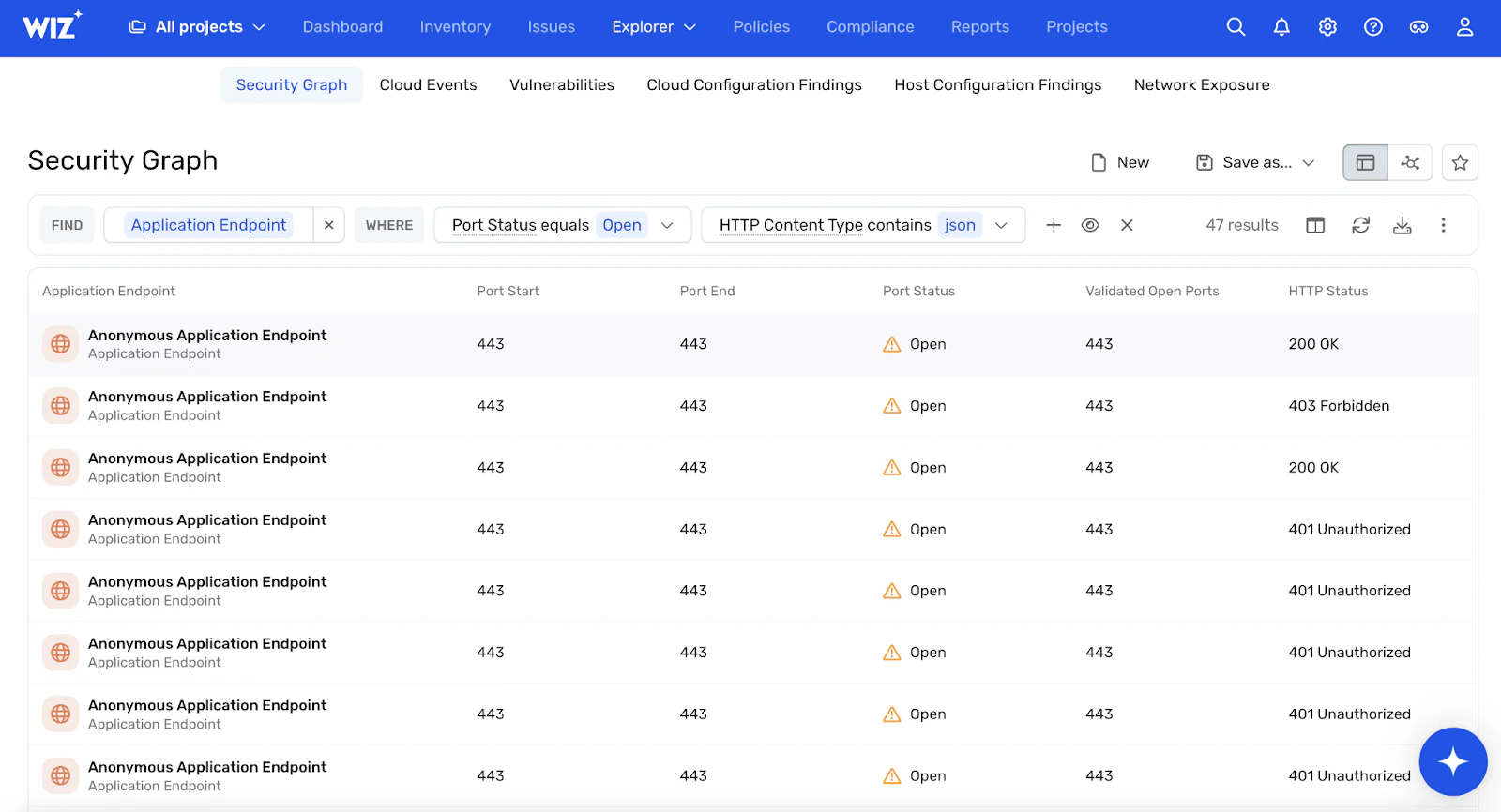
Another key to strong API security posture management: continuous scanning and comprehensive inventorying of API endpoints (including active, dormant, orphaned, and shadow APIs).
Once you identify all API endpoints in your setup, map them to other resources and risks across the cloud environment: Inventorying shouldn’t just be making a long list of API endpoints; make sure you classify APIs and associated risks based on sensitivity and criticality.
Consolidate API-SPM into your existing cloud security stack
Holistic API security in federated cloud environments is only possible if your API security tool can connect with the rest of your tech stack. For accurate API risk prioritization, it’s also crucial to connect to other cloud security tools. Start with the fundamentals:
Keep in mind that the strength of your API security posture management program largely depends on the quality of the threat data that it uses. So make sure that your tools are enriched with the best and most up-to-date cloud threat intelligence feeds.
Use the right API security metrics
Having measurable and actionable API security posture management insights is crucial for iterative improvements. Monitor metrics like…
MTTD
MTTR
Vulnerability resolution time
Overall API coverage
Volume of false positives
And don't settle for middling numbers. Design the strongest API security posture management program possible, and use the right metrics to know you're on track.
API management: Fundamentals for cloud security teams
API management is about how you actually govern and protect your cloud app's biggest attack surface—your APIs—from day one.
Read more
How Wiz enables comprehensive API security posture management
API security posture management in the cloud isn’t straightforward, which is why it helps to use a cloud-native capability like Wiz API Security Posture Management (API SPM), built to discover, assess, and prioritize API risk in dynamic cloud environments.
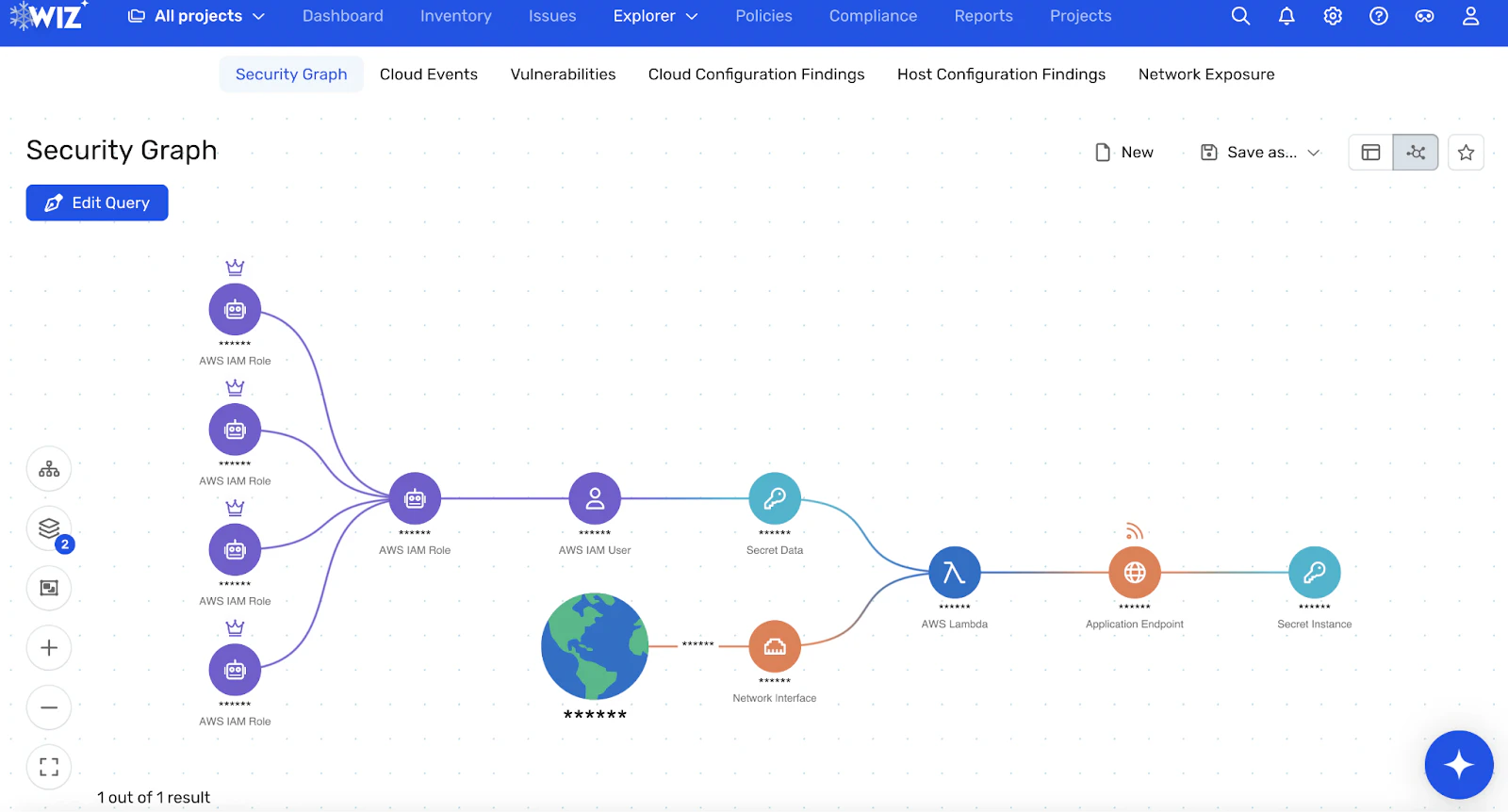
Wiz API SPM, part of Wiz Cloud, gives teams comprehensive API visibility, proactive API risk management, precise API issue triage, and self-service workflows that help developers secure the APIs they build and run.
Wiz Cloud’s API security approach involves multiple layers:
Discovery: Wiz inventories every single API in your cloud.
Risk assessment: Wiz’s Dynamic Scanner proactively scans API endpoints to discover public exposure and risks.
Toxic combinations: Wiz contextualizes cloud risks with API characteristics, such as sensitive data and external exposure, authorization flow, and hosting resources, to identify the most critical API issues to tackle.
Exposure validation: Wiz Attack Surface Management verifies whether an API is actually exposed and reachable from the internet, helping teams focus on exploitable paths instead of a long list of theoretical findings.
Code-to-runtime mapping: Wiz traces API runtime issues all the way back to their source, which significantly expedites remediation workflows.
And this is just skimming the surface. Wiz API SPM also supports discovery, API modeling, and risk analysis with features like API endpoint inventory, external exposure analysis, schema analysis, sensitive data scanning, authorization header scanning, authorization misconfiguration detection, API metrics, and hosting resource context. All of these capabilities are presented in a unified API security dashboard.
With Wiz API SPM, the path is simple: Discover your APIs. Validate and triage the risks that matter. Remediate issues before they escalate.
Ready to see for yourself? Get a demo to learn more about how Wiz can boost your API security posture management.
Secure your APIs with Wiz
Learn how Wiz gives security teams instant visibility into API exposure, misconfigurations, and attack paths — all in one platform.
