



Tracking where sensitive data lives in cloud environments is one of modern security teams’ most persistent challenges. You may believe you have complete visibility into critical data stores, only to discover an S3 bucket or Snowflake schema that contains exposed PII during a breach or audit. This explains why data security posture management (DSPM) solutions have become mission-critical for cloud data security.
Below are seven leading DSPM solutions for 2026 and their capabilities across cloud native coverage, classification accuracy, risk prioritization, and integration with broader security workflows.
Top 7 DSPM solutions for 2026
This comparison focuses on solutions that excel in cloud native architectures, deliver strong data coverage, and demonstrate proven customer success through verified reviews. Where relevant, we’ll highlight capabilities for AI and GenAI scenarios, including detecting sensitive data in model training or AI application pipelines.
Here’s a quick comparison table:
| Tool | Key strengths | Best for | G2 rating |
|---|---|---|---|
| Wiz | Security Graph correlation, agentless discovery, and toxic combination detection | Unified cloud security with graph-based risk prioritization | 4.7/5 |
| Microsoft Defender for Cloud | Native Azure integration and Entra ID correlation | Microsoft-centric environments | 4.4/5 |
| Cyera | AI-native discovery and automated remediation | Complex, multi-cloud data classification | 4.6/5 |
| Palo Alto Networks Cortex Cloud | Multi-cloud coverage and DevSecOps integration | Large enterprise cloud footprints | 4.1/5 |
| Securiti | Knowledge graph, AI governance, and data flow mapping | Organizations that leverage data for AI | 4.7/5 |
| BigID | Hundreds of data sources and privacy compliance | Unified data governance needs | 4.3/5 |
| SentinelOne Singularity Cloud | XDR integration and automated response | Threat detection and response focus | 4.9/5 |
Below is a more detailed breakdown of each solution and its capabilities:
1. Wiz
G2 rating: 4.7 out of 5 ⭐ (754 reviews)
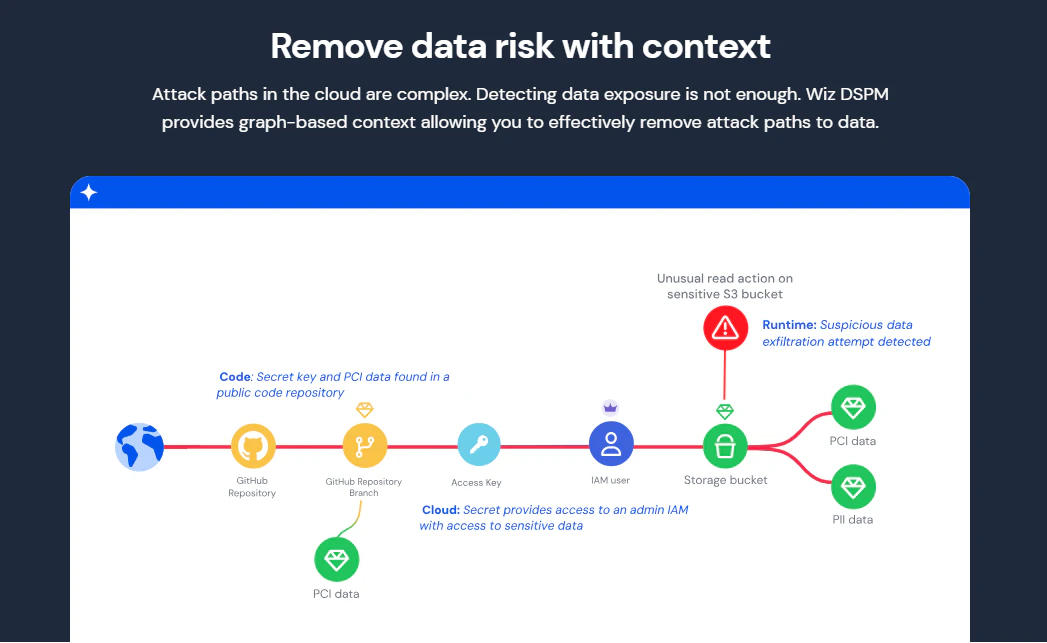
Wiz is a cloud native, agentless cloud native application protection platform (CNAPP) with integrated DSPM capabilities and a unified Security Graph. The platform correlates data stores with identities, misconfigurations, vulnerabilities, and network paths to provide complete context and eliminate noise. This graph-based approach helps security teams focus on real attack paths rather than isolated findings.
Key features:
AI-powered data classification combines RegEx with machine learning to accurately identify sensitive data types across structured and semi-structured cloud stores, with custom classifiers that support specialized use cases like PHI, source code, or telemetry data.
Agentless data discovery across AWS, Azure, GCP, and SaaS environments enables immediate visibility without deployment overhead or inline proxies.
Toxic combination detection highlights real attack paths by identifying scenarios like sensitive data exposed via public access, exploitable identities, or vulnerable workloads.
Code-to-data tracing links data exposure risks back to commits, misconfigured CI/CD pipelines, or infrastructure drift.
Developer-ready remediation workflows include issue previews, policy suggestions, and enforcement guardrails directly in pull requests or CI/CD pipelines.
Best for: Cloud-first organizations that want unified security with graph-based risk correlation that cuts through noise or that are looking to consolidate their security tools and improve their cross-team collaboration
Considerations: Wiz stands apart as the only DSPM solution that uses a cloud native security graph to connect data risk to identity, misconfigurations, workload posture, and real attack paths. This approach is ideal for security teams that need fast, contextual insights and developers who want to fix issues where they work.
2. Microsoft Defender for Cloud
G2 rating: 4.4 out of 5 ⭐ (303 reviews)
Microsoft Defender for Cloud delivers integrated cloud security with growing DSPM capabilities. It also provides strong visibility into data risks by combining native Azure integrations with expanding support across multi-cloud environments. With it, organizations gain enhanced protection, especially in Microsoft-heavy or hybrid setups
Key features:
Native Azure integration leverages Entra ID access logs and Purview Unified Catalog to deliver enhanced data security visibility across your environment.
Automatic data classification scans sensitive SharePoint content and maps access risks directly to specific Azure AD service principals.
Multi-cloud support extends its robust capabilities beyond Azure to include full AWS and GCP environments.
Best for: Microsoft-centric environments and hybrid cloud deployments
Considerations: Its capabilities vary across cloud providers, but it provides the strongest support for Azure environments. As a result, organizations that have heavily invested in the Microsoft ecosystem will find the tightest integration here.
3. Cyera
G2 rating: 4.6 out of 5 ⭐ (20 reviews)
Cyera is a cloud native, AI-powered DSPM platform that pioneered security across SaaS, PaaS, and IaaS environments. The platform’s AI-native discovery engine autonomously classifies data by learning your organization’s unique data patterns.
Key features:
Automated remediation workflows apply encryption, correct logging configurations, and implement proper cloud tags without requiring manual intervention.
Agentless architecture connects to datastores using a single IAM role, which dramatically simplifies deployment across even the most complex environments.
Best for: Organizations with complex multi-cloud environments that want high-accuracy data classification and automated remediation
Considerations: Cyera is most valuable when teams integrate it into existing security workflows and define clear remediation policies upfront. The tool also brings strong capabilities in data discovery and classification that complement broader security strategies.
4. Palo Alto Networks Cortex Cloud
G2 rating: 4.1 out of 5 ⭐ (111 reviews)
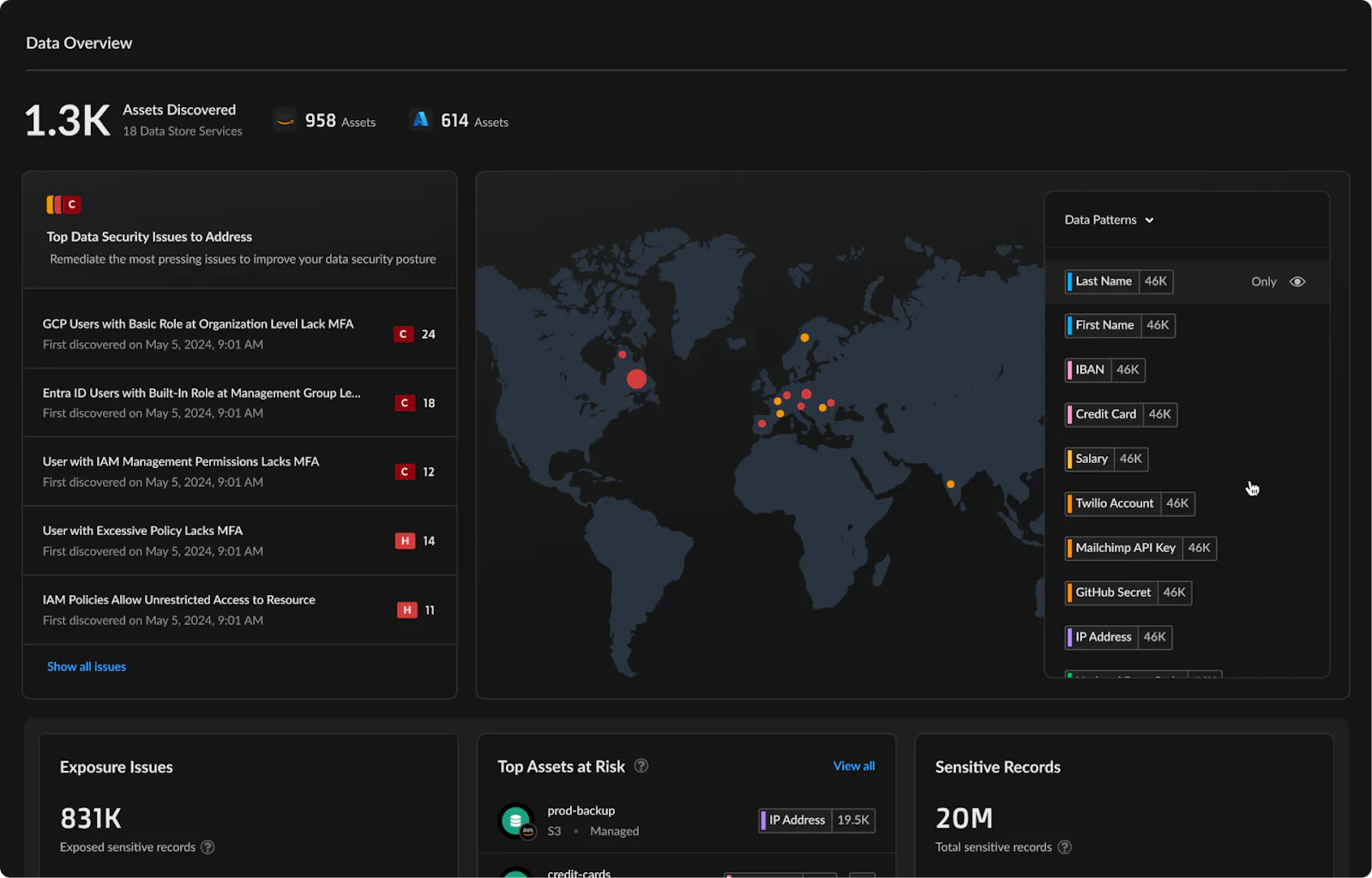
Palo Alto Networks Cortex Cloud serves as a CNAPP with growing data security features for multi-cloud environments. It combines broad coverage across major providers with AI-driven prioritization to highlight the highest-risk data issues.
Key features:
Multi-cloud coverage delivers consistent visibility across major providers so teams can maintain clear oversight, no matter where data resides.
Integrated DevSecOps capabilities seamlessly connect data security to application development workflows for faster, more secure software delivery.
Compliance monitoring automation streamlines audit preparation and ensures ongoing regulatory alignment with minimal manual effort.
Best for: Large enterprises with diverse cloud footprints
Considerations: With Cortext Cloud, implementation complexity and resource requirements can be significant. Because of this, organizations should plan for thoughtful integration with their existing security and development workflows.
5. Securiti
G2 rating: 4.7 out of 5 ⭐ (81 reviews)
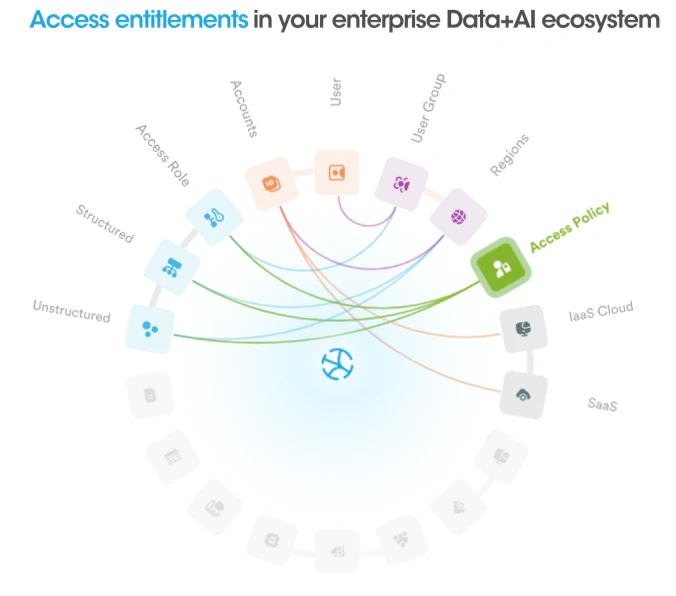
Securiti operates as a unified data and AI command center that excels in integrated DSPM through its innovative knowledge graph technology. It also maps sensitive data flows and correlates security insights across hybrid multi-cloud environments to enable secure AI adoption and strong traditional data protection.
Key features:
Knowledge graph technology correlates security intelligence across hybrid multi-cloud environments and provides deep contextual understanding of data relationships.
Strong capabilities help organizations navigate both traditional data security and emerging AI governance requirements.
Best for: Organizations that are looking to safely harness data for AI initiatives
Considerations: Implementation complexity may require thoughtful integration planning for existing security and data governance frameworks.
6. BigID
G2 rating: 4.3 out of 5 ⭐ (17 reviews)
BigID acts as a comprehensive data intelligence platform that merges privacy, security, governance, and DSPM using generative AI for smarter insights. It also auto-discovers sensitive data across hundreds of structured and unstructured sources in on-premises and cloud environments while delivering accurate AI-powered classification and automated end-to-end risk remediation.
Key features:
Auto-discovery technology supports hundreds of data sources across structured, unstructured, on-premises, and cloud environments to eliminate blind spots.
Its classification engine combines RegEx with advanced AI and machine learning techniques to identify sensitive data with high accuracy.
End-to-end risk management covers discovery through remediation by automating labeling, tagging, retention, and encryption to streamline security workflows.
Best for: Organizations that require unified data governance and privacy compliance in a single solution
Considerations: BigID’s multiple deployment options allow flexibility but also require careful selection based on your specific infrastructure and security needs. It also brings particularly strong capabilities in data governance and privacy compliance.
7. SentinelOne Singularity Cloud
G2 rating: 4.9 out of 5 ⭐ (112 reviews)
SentinelOne Singularity Cloud is an AI-driven security platform with cloud security capabilities that features unified visibility across endpoints and the cloud, along with automated response capabilities. Its BigID integration also brings data lineage tracking into its XDR platform, which enables SOC teams to trace breach impacts through data relationships rather than just infrastructure.
Key features:
The BigID integration brings data lineage tracking to Singularity’s XDR platform so SOC teams can trace breach impacts through data relationships rather than just infrastructure.
Unified visibility spans endpoints and the cloud to deliver comprehensive threat detection and response across environments.
Automated response capabilities accelerate incident containment and speed up remediation processes significantly.
Best for: Organizations that want to prioritize automated threat detection and response
Considerations: Integrating this platform with existing security workflows requires careful planning. Additionally, SentinelOne excels at threat detection and response, though partnership integrations further enhance its DSPM capabilities.
How DSPM solutions fit into your broader cloud security strategy
DSPM doesn’t operate in isolation. The most effective implementations instead connect data security to your broader cloud security program, including cloud security posture management (CSPM), cloud infrastructure entitlement management (CIEM), vulnerability management, and data governance.
Here’s how each type of security team uses DSPMs within its cloud environment:
Cloud security teams use DSPM to understand where sensitive data lives and how misconfigurations or network exposure create risk.
AppSec teams leverage DSPM to trace data flows through applications and identify where sensitive information appears in code or configurations.
SecOps teams correlate DSPM findings with identity access patterns and vulnerability data to prioritize real-world attack paths.
GRC teams rely on DSPM for compliance reporting and audit readiness across GDPR, HIPAA, CCPA, and ISO 27001.
Modern DSPM solutions function both as standalone systems and as integral components of broader cloud security strategies. This loose coupling ensures that data risks aren’t siloed from infrastructure or identity risks and allows teams to orchestrate remediations across layers from a single interface. This is an essential component to effective security since new innovations like AI and GenAI require teams to advance and continually secure systems.
What should you consider when evaluating DSPM solutions?
The below areas will help you evaluate which tools offer real coverage, align with your team’s workflows, and support long-term cloud data governance:
Cloud native coverage and visibility scope
Effective DSPM starts by clarifying exactly what the platform discovers and analyzes. To this end, look for agentless, cloud native scanning that connects through cloud provider APIs to inventory data stores and inspect configurations, including bucket and object metadata, IAM policies, and workload relationships, with optional snapshot-based disk analysis for deeper workload visibility. You should also ensure that the platform can discover and classify sensitive data across object storage, databases, data warehouses, analytics services, and SaaS applications, not just storage buckets.
Finally, the tool you choose should offer a single control plane that provides consistent policies and risk views across AWS, Azure, GCP, and key SaaS platforms. It should also have the ability to correlate the same dataset across environments and highlight differences in access, encryption, and compliance status.
Key questions to ask:
What data stores do you support out of the box?
How do you highlight coverage gaps where permissions, connectors, or regions prevent scanning?
Data classification accuracy and flexibility
Sensitive data discovery is only as valuable as its classification accuracy. That’s why you should evaluate classification as its own pillar instead of as a secondary feature.
The best DSPM solutions go beyond basic RegEx and use AI and machine learning as well to understand the unique data structures in your environment. That means they can distinguish between a phone number and a telemetry ID or flag proprietary formats that are specific to your business.
Key questions to ask:
How do you handle custom data types that are specific to my industry?
What’s your false positive rate, and how can I validate classifications before taking action?
Risk prioritization and contextual analysis
Thousands of sensitive data findings aren’t actionable if you treat them all equally. That’s why effective DSPM platforms combine data sensitivity, identity access patterns, environment exposure, and surrounding misconfigurations or vulnerabilities.
Helpful tools also tie findings into a security graph to show which data is truly at risk based on real attack paths. For example, a good tool would flag a data store that’s public, contains PCI, and is accessible from a compromised workload as a critical issue. Meanwhile, an isolated staging bucket with PII might get lower priority.
This context is essential for focusing remediation where it matters most.
Key questions to ask:
How do you correlate data findings with identity permissions and network exposure?
Can you show me actual attack paths, not just isolated findings?
Governance, compliance, and response
Discovery without governance feels like noise, so your DSPM should enforce data security policies, support compliance audits, and streamline incident response across teams.
Here are some key areas to evaluate:
Built-in remediation workflows (like masking, encryption, and permission revocation)
Customizable policies (like geo-fencing)
Encryption enforcement
Policy-as-code and CI/CD integration for preventative enforcement
Support for compliance reporting across GDPR, HIPAA, CCPA, and ISO 27001
Integration with IR tools like ticketing, Slack alerts, or automated playbooks
Key questions to ask:
How do you help me enforce policies proactively in CI/CD?
What compliance frameworks do you support out of the box?
Persona-based workflows and reporting
Different teams have different needs from DSPM. That’s why your data security platform should support varied personas and permissions. Here are some examples:
Security teams need cross-cloud views, attack path context, and remediation control.
Data teams may only need targeted reports like, “Where is all customer PII across production Snowflake?”
Compliance teams want dashboards and exports for auditors.
Developers need alerting in pull requests, not just static reports.
To this end, you should look for tools that support custom views, flexible exports, and workflow integrations for your internal stakeholders.
Key questions to ask:
Can you show me how different teams in my organization would use your platform?
How do you tailor views and permissions by role?
Remediation and workflow integration
Discovery alone doesn’t reduce risk. Instead, a DSPM solution must connect directly into your remediation loops to drive action at cloud speed. That means integrating with tools like GitHub, Jira, ServiceNow, and Slack to route issues where teams already work.
Additionally, prebuilt automation options—like auto-remediation or submitting issues for human review—help teams accelerate response and reduce manual triage. CI/CD integrations push this even further by catching policy violations before deployment and preventing sensitive data exposure from ever reaching production.
Key questions to ask:
What integrations do you support natively?
Can I build custom workflows using your API?
Integration with broader cloud security platforms
Modern DSPM solutions must function as both standalone systems and integral components of a broader CNAPP strategy. To help with this, integrated DSPM-CNAPP solutions reduce tool sprawl by correlating data risks with workload vulnerabilities and identity threats. This loose coupling ensures that data risks aren’t siloed from infrastructure or identity risks and helps teams orchestrate remediations across layers. For example, you can block public access, revoke permissions, or secure exposed workloads from a single interface.
Key questions to ask:
How do you integrate with CSPM, CIEM, and vulnerability management?
Can you show me a unified view of risk across data, identity, and infrastructure?
AI and GenAI data usage detection
Because AI and GenAI introduce new data security requirements, organizations need visibility into where sensitive data appears in AI pipelines, model training datasets, and third-party AI services.
To this end, effective DSPM solutions detect when AI and GenAI training, inference pipelines, or third-party AI services use sensitive data and enforce appropriate controls. This capability helps you balance AI innovation with data protection requirements.
Key questions to ask:
How do you detect sensitive data in AI training datasets?
Can you show me data flows into AI services and applications?
Best practices for successfully implementing DSPM solutions
Getting real value from a DSPM solution requires implementation that goes beyond data discovery. Here’s how leading teams roll it out effectively:
Start with agentless data discovery
You should prioritize solutions that integrate via cloud APIs for immediate visibility without agents or downtime. For example, connecting to AWS via an IAM role provides instant access to S3 buckets, RDS databases, and other data stores without installing anything. You can use this early map to surface unknown data stores, shadow assets, and overly exposed sensitive data across multi-cloud and SaaS environments.
This agentless approach allows you to achieve comprehensive visibility across AWS, Azure, and GCP in hours rather than weeks.
Correlate with existing risk signals
Next, integrate DSPM into your cloud security platform (like a CNAPP, CSPM, or CIEM) so you can prioritize based on who has access, what the surrounding risks are, and whether an attacker can reach that data, not just by data type.
This is where graph-based solutions shine. For example, instead of just seeing “S3 bucket contains PII,” you’d see “S3 bucket contains PII, is publicly accessible, and can be reached from a workload with a critical vulnerability.” That context transforms how you prioritize remediation.
Establish shared remediation workflows
You should also connect your DSPM to developer tools like GitHub, Jira, and Slack to route alerts and suggested fixes directly into workflows your teams already use. After all, security should guide, while developers should own the fix.
For instance, when a developer commits code that exposes an S3 bucket, they receive an automated pull request comment with the issue, the risk, and a suggested fix. This approach embeds security into development workflows rather than creating friction.
Operationalize policy as code
This next step involves defining and enforcing data security policies (like encryption, masking, and access controls) through infrastructure as code guardrails and CI/CD policy engines. This makes DSPM proactive since it helps teams prevent issues, not just flag them.
You can also implement policies that automatically flag or block deployments that create publicly accessible data stores, fail to enable encryption at rest, or grant overly permissive access. Where relevant, you can include policies for AI and GenAI data flows too, such as tagging datasets to use for model training.
Measure what matters
Finally, track improvements in percentage of sensitive data with full context (like identity, exposure, or workload), reduction in toxic data, identity, and infrastructure combinations, mean time to remediation for critical data risks, and policy coverage across cloud environments (like encryption, access, or region).
These metrics demonstrate progress to stakeholders and help you identify where to focus your ongoing security investments.
How Wiz delivers DSPM as part of a unified CNAPP
Wiz combines DSPM with comprehensive CNAPP capabilities—including CSPM, CIEM, vulnerability management, and Kubernetes security—in a single graph-powered platform. This unified approach correlates sensitive data with identity permissions, misconfigurations, vulnerabilities, and network paths to show you real attack paths, not just isolated findings.
Our agentless architecture also provides immediate visibility across AWS, Azure, GCP, and SaaS environments without deployment overhead. And the Wiz Security Graph dynamically maps your entire cloud environment so you can understand which data risks matter most and focus remediation where it counts.
We support AI and GenAI visibility as well to help you understand where sensitive data appears in model training, inference pipelines, and AI applications. Our developer-ready workflows then route issues directly into pull requests and CI/CD pipelines so teams can fix problems where they work.
Ready to see how Wiz simplifies DSPM as part of unified cloud security? Request a demo today to explore how we can secure sensitive data across your entire cloud stack.
FAQs
Below are some common questions about DSPM solutions: