Digital transformation across the U.S. Public Sector has reached a pragmatic milestone. To accelerate mission delivery, federal, state, and local agencies are actively operating within interconnected hybrid cloud environments.
To deliver citizen-facing services, advance mission-critical workloads, and fulfill legislative mandates, government agencies operate complex ecosystems that span multiple Cloud Service Providers (CSPs). In these borderless operational environments, cloud services seamlessly interoperate with on-premises databases and legacy workloads. .
While this architecture unlocks critical operational agility, it introduces a highly fluid attack surface. On-premises vulnerabilities serve as launchpads into the cloud, while cloud misconfigurations expose core legacy systems. Managing this risk requires more than just scaling up traditional security frameworks; it demands a shift in how public sector organizations understand, prioritize, and mitigate exposure.
The Fragmentation Trap and the OMB A-130 Gap
Securing hybrid environments has historically been undermined by fragmented, siloed point solutions. Organizations routinely deploy separate tools for cloud infrastructure, on-premises servers, and external attack surfaces. Because these tools operate in isolation, use different interfaces, and leverage conflicting terminology, achieving a unified view of enterprise risk can be nearly impossible.
This approach fundamentally fails to address the official federal definition of information security risk. As codified in OMB Circular A-130, risk is not just an isolated vulnerability score; it is a direct function of likelihood versus impact:
‘Risk’ means a measure of the extent to which an entity is threatened by a potential circumstance or event, and typically is a function of: (i) the adverse impact, or magnitude of harm, that would arise if the circumstance or event occurs; and (ii) the likelihood of occurrence.
OMB Circular A-130, Managing Information as a Strategic Resource, July 2016.
Siloed tools fail both sides of this official equation:
They cannot assess likelihood: A traditional scanner flags a critical vulnerability based purely on its static CVSS score. It cannot determine if the asset is completely shielded by cloud network controls or actively exposed to the internet.
They cannot evaluate impact: These tools lack the architectural context to know if a vulnerable system connects to a mission-essential citizen service or an on-premises database holding sensitive data.
This disconnect results in an increase in contextless alerts, wasted engineering hours, and systemic limitations for prioritizing risks that actually threaten the mission.
Normalizing Risk across On-Prem and Cloud Environments
Wiz Exposure Management (Wiz XM) breaks this deadlock by shifting the operational focus from isolated scanning to centralized context–bringing in insights from deployed cloud, on-premises, and AI resources. Wiz XM allows agencies to leverage legacy tooling investments by ingesting data from current security infrastructure including vulnerability scanners, such as Tenable and Qualys, application security scanners, including SonarQube and Snyk, and DAST and Pentesting tools, like Invicti and HackerOne. Wiz XM unifies these third-party findings with code and cloud-native telemetry across AWS, Azure, GCP, OCI, and connected on-premises environments.

At the core of this capability is the Wiz Security Graph. The graph acts as a cross-environment translator, normalizing disparate data formats, naming conventions, and risk metrics into a single language. By mapping every asset, network connection, identity entitlement, and vulnerability across your entire hybrid footprint, it delivers:
Maximized ROI: Wiz XM enhances the value of your existing security data by contextually linking your current tools without requiring an infrastructure migration.
Operational Efficiency: By automatically correlating vulnerabilities with actual network reachability, Wiz filters out environmental noise so cybersecurity personnel and engineers spend time fixing real, exploitable threats.
Context-Driven Prioritization: Wiz automates risk identification and assessment, prioritizing findings to reflect real risk based upon impact and likelihood, allowing teams to focus on the risks that matter most.
Map Risks to their Owner: Wiz uses configuration management database metadata and AI-powered analysis to quickly identify ownership for accelerated remediation.
Cross-Team Collaboration: Break down traditional silos between cloud engineering, on-premises sysadmins, and the SOC by aligning everyone around the same graph-validated, prioritized remediation tasks.
The Mission Engine: Operationalizing Risk with Wiz UVM
For public sector agencies and state and local governments, asset discovery and vulnerability tracking can have significant operational overhead. Compliance mandates like CISA’s Binding Operational Directives (BOD) BOD 23-01 (asset visibility) and BOD 26-04 (Prioritizing Security Updates Based on Risk) demand continuous inventory tracking and swift remediation.
This is why Wiz Unified Vulnerability Management (UVM) is a powerful ally for government environments. It aggregates vulnerability data from both cloud workloads and connected on-premises systems, immediately cross-referencing findings against the real-time context of the Wiz Security Graph to solve the risk equation:
Validating Likelihood: Wiz UVM determines if a vulnerable system is exposed via an active, unpatched network path, or if it is completely shielded by cloud network access controls, validating reachability and exposure from the outside in.
Identifying Impact: It analyzes whether the asset maintains high-privilege identity entitlements or connects directly to a legacy on-premises database holding sensitive citizen data.
By injecting this context automatically, Wiz UVM allows agencies to shift from a reactive compliance-focused checklist to dynamic, mission-aligned risk mitigation. Admins no longer waste time on non-exploitable flaws, ensuring limited resources are focused precisely where they achieve the greatest reduction in enterprise risk.
The Perimeter Validator: Continuous Attack Surface Scanning via Wiz ASM
While Wiz UVM delivers foundational internal visibility, Wiz Attack Surface Management (ASM) provides the critical external attack surface perspective. Wiz ASM continuously discovers and maps an agency’s external digital footprint, identifying internet-facing assets, shadow IT, and exposed APIs across the hybrid perimeter.
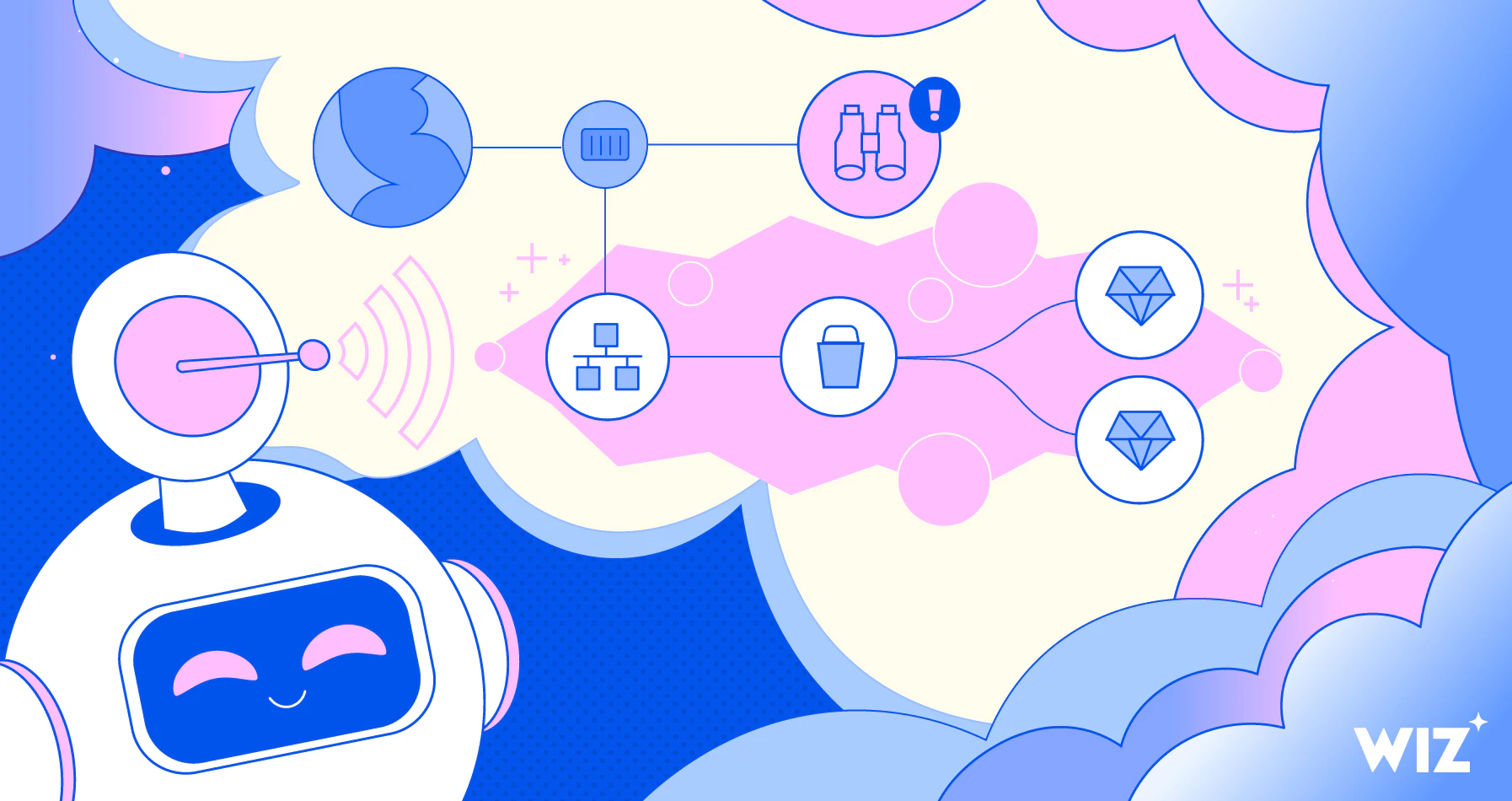
Crucially, Wiz ASM does not operate as an isolated point solution. It feeds directly into the Wiz Security Graph to execute validated attack path analysis. By combining external exposure data with internal vulnerability context, Wiz maps potential attack paths to show precisely how an external internet exposure can be leveraged to pivot laterally into an internal, on-premises core system.

The Horizon: Empowering Defense Teams through AI-Driven Analysis
As public sector organizations securely adopt artificial intelligence under recent federal directives, the next phase of exposure management will be defined by practical, AI-enhanced analysis.
Wiz XM leverages AI not as a novelty, but as a force multiplier that augments high-fidelity, ground-truthed data from the Wiz CNAPP. These AI Agents are already transforming risk response within our commercial Wiz offering, and are on the roadmap for future inclusion in additional Wiz environments. These AI-driven insights break down traditional operational boundaries, accelerating remediation across specialized teams:
Red Teams (Adversarial Emulation): AI automatically chains complex, multi-stage vulnerabilities across different cloud and on-prem environments, helping teams model realistic advanced persistent threat attack vectors. The Wiz Red Agent brings in autonomous adversarial testing layers to scale continuous validation across the hybrid perimeter.
Blue Teams (Defenders & Incident Responders): When zero-day threats emerge, AI-enhanced analysis lets defenders query their entire hybrid footprint using natural language to instantly find exposed systems and generate targeted remediation scripts. The Wiz Blue Agent enhances these defenses by driving autonomous threat investigation and cross-layer triage at machine speed.
Purple Teams (Collaborative Security): AI bridges the gap between offensive testing and defensive operations, translating technical graph data into plain-English risk summaries and mission-impact assessments. The Wiz Green Agent further extends this collaboration by connecting offensive insights directly into automated, closed-loop remediation workflows to continuously reduce exposure.
Operationalizing the Mission
For Federal, State, and Local governments, exposure management is a critical operational requirement. Successfully securing modern hybrid environments means moving past isolated point solutions and embracing a framework that prioritizes remediating true critical risks across cloud and on-premises environments.
By normalizing risk across these hybrid systems, Wiz enables agencies to defend their critical infrastructure with unparalleled accuracy. The result is an operational framework that safeguards critical infrastructure, maximizes the utility of public funds, empowers cross-team collaboration, and securely positions the public sector to withstand the threats of tomorrow at the speed demanded by missions today.
Ready to get started? Schedule a demo.